did pims nicu
| |

How did the PIMS NICU tragedy unfold?


An initial investigation by the Pakistan Institute of Medical Sciences (PIMS) has shed new light on the fire that killed 15 newborn babies at the hospital’s neonatal intensive care unit (NICU).

According to the preliminary report prepared by the PIMS administration, a nebulizer attached to an incubator, used to deliver or monitor oxygen for a newborn, reportedly burst inside the NICU. The incident caused the oxygen to catch fire, triggering a blaze in the unit.

The report says the fire initially remained limited but spread rapidly. Thick smoke entered the babies’ breathing system through the oxygen pipeline, while the fire and heat also affected the infants. The preliminary findings indicate that the newborns died from a combination of oxygen supply failure, smoke inhalation and burn injuries.

Earlier, rescue officials and hospital authorities had attributed the fire to an air-conditioner compressor explosion in the gynecology ward. They also said the presence of oxygen cylinders contributed to the rapid spread of the flames. One newborn reportedly survived the incident.

The tragedy has raised serious questions about safety arrangements and emergency response at the hospital. The bodies of the deceased newborns have been handed over to their families.

Parents and eyewitnesses alleged that hospital staff were not present in the nursery when the fire broke out and claimed that the doors remained closed, making it difficult to evacuate the babies. They also questioned the response time of rescue teams.

PIMS Executive Director, however, rejected claims that staff had abandoned the NICU. He said two doctors, four nurses and other staff members were present in the intensive care unit at the time of the incident. He also maintained that the hospital had an adequate fire safety system.

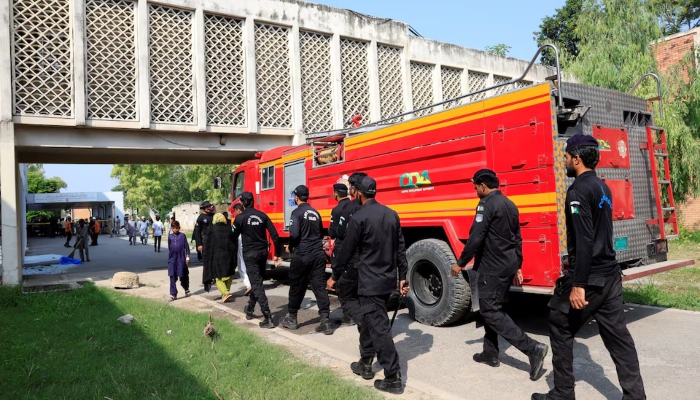
The Capital Development Authority (CDA) said its rescue teams reached the hospital soon after receiving the emergency call. According to the authority, firefighters brought the blaze under control and immediately shifted the affected newborns to the intensive care unit for treatment.

The district administration has formed an eight-member inquiry committee to determine the exact cause of the fire and assess whether safety protocols were properly followed. The committee has been directed to submit its findings within 24 hours.

The conflicting accounts about the source of the fire have increased pressure for a detailed and impartial investigation. The final inquiry is expected to establish how the fire started, why it spread so quickly, whether the oxygen system played a role and whether the hospital staff and emergency services responded according to established safety procedures.

Similar Posts

  • | |

    Lahore High Court sets aside lower courts

      The Lahore High Court has overturned the decisions of two lower courts that had directed the National Database and Registration Authority (NADRA) to issue Computerized National Identity Cards (CNICs) to two individuals despite questions regarding their citizenship. The ruling reinforces that disputes involving suspected citizenship fall within the jurisdiction of NADRA’s verification mechanism rather than civil courts. Justice Mohsin Akhtar Kayani issued a detailed written judgment after allowing NADRA’s appeals against the decisions of the lower courts. In the judgment, the court clarified that civil courts do not have the legal authority to decide cases involving disputed or questionable citizenship. Instead, such matters must be addressed through the procedures established under the relevant laws governing nationality verification. According to the written decision, individuals whose identity cards have been blocked or whose citizenship status has been questioned must approach the NADRA Verification Board within 30 days. The High Court further directed the Verification Board to examine each case and issue a decision in accordance with the law within 60 days of receiving the application. The judgment explains that NADRA had challenged the rulings issued by the Senior Civil Judge in Sialkot and the Sessions Judge, who had ordered the authority to issue national identity cards to two citizens despite concerns regarding the authenticity of their Pakistani citizenship. The High Court concluded that these lower courts exceeded their legal jurisdiction by issuing such directives. Justice Kayani emphasized in the written ruling that obtaining a national identity card is a fundamental right of every eligible Pakistani citizen. However, the court also stressed that this right must be exercised in accordance with the law and only after citizenship has been properly verified through the legally prescribed process.   The respondents maintained before the court that they were Pakistani citizens by birth and therefore entitled to receive national identity cards. They argued that NADRA had incorrectly classified them as foreign nationals and subsequently blocked their CNICs, depriving them of an essential legal document required for everyday civic and economic activities. NADRA, on the other hand, presented documentary evidence supporting its decision to classify the individuals as non-citizens pending verification. According to the High Court’s judgment, the authority’s documentary evidence was found to be reliable and credible. The court observed that the respondents failed to produce sufficient evidence to establish their claim of Pakistani citizenship. The judgment further states that the lower courts overlooked significant documentary evidence and failed to apply the relevant legal principles before directing NADRA to issue the identity cards. As a result, the High Court held that these legal errors warranted judicial intervention. Justice Kayani noted that the High Court has the constitutional authority to correct legal mistakes committed by subordinate courts. Exercising this authority, the court declared both lower court decisions null and void, thereby allowing NADRA’s appeals. The ruling establishes an important legal precedent regarding the resolution of citizenship disputes in Pakistan. It clarifies that while access to a national identity card is a fundamental right, questions relating to citizenship must first be determined through NADRA’s statutory verification process rather than through civil litigation. The decision also seeks to ensure consistency in handling citizenship-related cases by directing affected individuals to the NADRA Verification Board and requiring the board to decide such matters within a specified timeframe. This approach aims to balance the protection of citizens’ rights with the need to maintain the integrity and accuracy of Pakistan’s national identity registration system.

  • | | |

    Unlicensed Hotels in Phuket Targeted as Thai Government Expands Nominee Investigations

    Phuket— Deputy Interior Minister Polpree Suwanchawee has intensified efforts to dismantle nominee business structures in Thailand, leading a high-profile inspection of hotels in Phuket suspected of foreign-controlled ownership. The campaign is part of the government’s stance that “Thailand’s land must belong to Thai people.” During the inspection of hotels across three districts in Phuket, authorities […]

  • | |

    Five Nepali climbers’ bodies reach Islamabad

    The bodies of five Nepali climbers who died in an avalanche on Broad Peak have been brought to Islamabad. According to Deputy Commissioner Hamza Murad, the bodies were transported to Islamabad by air and have been placed in the morgue at the Pakistan Institute of Medical Sciences (PIMS). He said the bodies would be sent to Nepal once the necessary travel documents had been completed. The avalanche struck Broad Peak about a week ago, leaving 10 climbers missing. According to the deputy commissioner, the bodies of eight climbers, including renowned Nepali mountaineer Nirmal Purja, have so far been recovered. The search for two missing climbers is still underway. They include Pakistani mountaineer Sohail Sakhi and a foreign female climber. Authorities are continuing efforts to locate the remaining climbers while arrangements are being made to repatriate the recovered bodies to their respective countries.

  • | | |

    Ishaq Dar offers special prayers for Pakistan in M…

    Medina: Pakistan’s Deputy Prime Minister and Foreign Minister Ishaq Dar visited the Prophet’s Mosque (Masjid an-Nabawi ﷺ) in Madinah, where he offered prayers and prayed for Pakistan’s peace, prosperity and continued progress during his official visit to Saudi Arabia. According to Pakistan’s Foreign Office, the deputy prime minister paid his respects at the Roza-e-Rasool ﷺ and offered Salam. He also performed voluntary (Nafl) prayers at the Prophet’s Mosque, one of Islam’s holiest sites, where millions of Muslims from around the world gather every year to worship and seek spiritual blessings. The Foreign Office said Dar made special prayers for Pakistan’s economic development, national stability and the well-being of its people. He also prayed for unity, peace and prosperity across the Muslim world, expressing hope for harmony and progress among Islamic nations. As part of his visit to Madinah, Dar also travelled to Jabal Uhud, a site of immense historical and religious significance in Islamic history. He visited the resting place of Hazrat Ameer Hamza (RA), the beloved uncle of Prophet Muhammad ﷺ and one of the most revered martyrs of the Battle of Uhud, where he offered prayers and paid his respects. The visit reflects the spiritual aspect of Dar’s Saudi Arabia trip while highlighting Pakistan’s longstanding religious and diplomatic ties with the Kingdom. Senior Pakistani officials traditionally visit Islam’s holy sites during official engagements in Saudi Arabia, where they offer prayers for the country and the wider Muslim Ummah. The Foreign Office noted that Dar’s prayers focused on Pakistan’s future, asking for sustained peace, economic growth and national prosperity. His visit to the Prophet’s Mosque and other sacred sites also underscored the importance of faith and spiritual reflection alongside official diplomatic engagements. The visit comes at a time when Pakistan continues to seek economic stability and stronger cooperation with friendly countries, while reaffirming its commitment to unity and the welfare of the Muslim Ummah.

  • | | |

    Pakistan, Saudi Arabia, Türkiye set for strategic…

    Pakistan’s top civilian and military leadership offered prayers at Islam’s holiest site on Friday as Islamabad prepared for what diplomatic sources describe as a pivotal round of high-level engagements in Saudi Arabia that could reshape strategic cooperation among Pakistan, Saudi Arabia and Türkiye. Prime Minister Shehbaz Sharif, Chief of Defence Forces and Chief of Army Staff Field Marshal Syed Asim Munir, Deputy Prime Minister and Foreign Minister Senator Ishaq Dar, Defence Minister Khawaja Muhammad Asif, Information Minister Attaullah Tarar, Special Assistant Tariq Fatemi and members of the Pakistani delegation performed Umrah during their official visit to the Kingdom. Before performing Umrah, the delegation was granted the rare honour of a special visit inside the Holy Kaaba. Following the pilgrimage, Prime Minister Shehbaz Sharif, Field Marshal Asim Munir and members of the delegation offered special prayers for Pakistan’s peace, economic prosperity, national security, the unity of the Muslim Ummah and lasting regional and global peace. The visit comes at a strategically significant moment for the region. Diplomatic sources say Turkish President Recep Tayyip Erdoğan is also expected to arrive in Saudi Arabia, where a possible trilateral engagement involving the leaders of Pakistan, Saudi Arabia and Türkiye is expected on the sidelines of high-level consultations. According to diplomatic sources, the expected meeting could pave the way for a major expansion in defence cooperation, with discussions likely to focus on military collaboration, defence industrial partnerships, regional security coordination and strategic cooperation among the three countries. The Saudi visit underscores Pakistan’s growing diplomatic profile and its deepening strategic partnerships with Riyadh and Ankara. Officials view the engagements as an opportunity to advance cooperation in defence, investment, regional stability and economic development, while reinforcing Pakistan’s role in promoting peace and security across the Muslim world.

  • Pakistan discovers lithium in underground brine

    Islamabad – Oil and Gas Development Company Limited (OGDCL) has achieved a major scientific milestone by confirming the presence of lithium in underground formation water (brine) in Pakistan for the first time. The concentration is reported to be comparable to that found in some of the world’s well-known lithium-bearing geothermal brines. According to sources, the discovery was made during advanced geochemical analysis of formation water obtained from a successfully tested high-temperature geothermal well under OGDCL’s pilot geothermal program. Senior OGDCL officials told The News that this is the first discovery of its kind in Pakistan. With this achievement, Pakistan has joined the list of countries exploring geothermal brine as a potential source of lithium. Lithium is considered a critical mineral in the global transition to clean energy. It is an essential component in electric vehicle (EV) batteries, large-scale energy storage systems and a wide range of advanced technologies.

Leave a Reply

Your email address will not be published. Required fields are marked *