
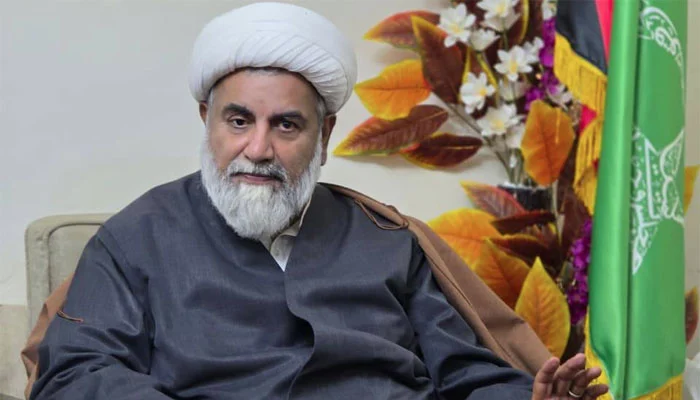
raja nasir abbas
| |

Raja Nasir Abbas condemns PIMS hospital tragedy, q…

ISLAMABAD: Leader of the Opposition in the Senate Allama Raja Nasir Abbas has described the PIMS Hospital incident as an extremely painful and unbearable tragedy, expressing deep concern over the loss of lives and the suffering of affected families.

Speaking to the media after arriving at the Pakistan Institute of Medical Sciences (PIMS), Raja Nasir Abbas criticized the government’s response to the incident and questioned whether removing a health secretary could be considered an adequate action in response to such a serious tragedy.

He said that simply removing a senior health official would not address the underlying issues that led to the incident. According to him, the government must look beyond administrative changes and take practical measures to prevent similar incidents from occurring in the future.

“Do you think that by removing one health secretary, you have done your job?” he questioned while speaking to the media.

The Senate opposition leader also expressed sympathy for the families who lost their children in the incident. He asked people to imagine the pain and suffering of parents whose children were burned to death.

“What must the parents whose children were burned to death have gone through?” he asked, while condemning what he described as the actions and handling of the situation by the authorities.

Raja Nasir Abbas said that such incidents raise serious questions about the quality of public services and the government’s responsibility toward citizens. He stressed that people rely on state institutions for essential services, particularly healthcare and education, and expect these institutions to provide safe and reliable facilities.

The opposition leader also drew a comparison between the public education and healthcare systems and the growing reliance on private institutions.

He said that when government schools fail to meet people’s expectations, families are often forced to turn toward private educational institutions. Similarly, when people do not receive satisfactory treatment or adequate medical facilities at government hospitals, they are compelled to seek treatment from private hospitals.

He argued that this trend places an additional financial burden on ordinary citizens, particularly families who cannot afford expensive private healthcare or education.

Raja Nasir Abbas emphasized that government institutions should be strengthened so that citizens can receive essential services without having to depend on private alternatives. He suggested that authorities need to identify weaknesses within public-sector institutions and take effective steps to improve their performance.

His comments came during his visit to PIMS, where he spoke about the incident and the concerns surrounding the hospital’s safety and management. The tragedy has prompted questions about safety arrangements, institutional accountability and the government’s responsibility for protecting patients and their families.

The opposition leader’s remarks also highlighted the broader issue of public confidence in government institutions. When public hospitals fail to provide adequate care or safe facilities, people who cannot afford private treatment are particularly vulnerable.

He called for greater accountability and better management of public-sector institutions, arguing that administrative decisions alone cannot resolve systemic problems.

The incident has intensified debate over hospital safety and emergency preparedness, with calls for authorities to investigate what happened and determine whether negligence or shortcomings contributed to the tragedy.

Raja Nasir Abbas maintained that the government must take meaningful measures rather than limiting its response to the removal of individual officials. He stressed that improving public hospitals and ensuring the safety of patients should remain a priority.

He further expressed solidarity with the bereaved families and condemned the circumstances surrounding the deaths, saying that the suffering of parents who lost their children could not be ignored.

Similar Posts

  • | |

    Japan PM’s market woes deepen as support slides

    Japanese Prime Minister Sanae Takaichi is facing mounting political and economic pressure as falling public support makes it harder for her government to balance tax cuts, economic stimulus and financial stability. Takaichi’s approval rating fell sharply in July, reaching its lowest level since she became prime minister last year. Rising inflation has increased pressure on households and weakened public confidence in the government. Higher import costs linked to a weaker yen have contributed to price increases. The impact of inflation is now becoming a major political challenge for Takaichi. The prime minister has continued to support higher government spending and large-scale investment. She has also criticised excessive monetary and fiscal tightening. However, investors are increasingly worried that the government’s expansionary policies could worsen Japan’s already difficult fiscal position. Those concerns have pushed Japanese government bond yields higher. Rising yields indicate that investors are demanding greater returns to hold Japanese debt. The market pressure has also complicated government efforts to support the yen. Officials have repeatedly warned currency traders against excessive speculation, but their comments have had limited impact. Government sources said the effectiveness of such verbal intervention was weakening as investors became more concerned about Japan’s fiscal outlook. One source warned that financial markets were gaining greater influence over fiscal management, creating a situation Japan had not experienced on this scale for decades. Takaichi is caught between two competing objectives. She wants to stimulate economic growth and reduce the burden of rising living costs. At the same time, she needs to convince investors that Japan remains committed to fiscal discipline. Her government’s spending plans have already contributed to market concerns. Japanese government bond yields climbed to their highest level in about three decades in July as investors assessed the potential impact of increased spending and borrowing. Takaichi has acknowledged the importance of rebuilding confidence among investors. She recently said that communication with financial markets would become increasingly important. However, she has shown little intention of abandoning her expansionary economic strategy. The prime minister has reiterated her goal of ending what she calls excessive fiscal tightening. She wants to promote growth through increased investment and tax reductions. That position has created a political dilemma. Reducing or delaying her planned measures could weaken her popularity. But continuing with them could further unsettle financial markets. The pressure could intensify in the coming months. Takaichi is expected to proceed with a proposal to reduce an 8% consumption tax on food for two years. Japanese media have reported that the government intends to move ahead despite reservations within the ruling party. The plan could provide relief to households struggling with higher prices. However, analysts say uncertainty over how the tax reduction would be financed could create additional pressure in the bond market. The government is also considering changes to its budget-making process. Under the proposed system, spending requests for key growth sectors would not be subject to strict ceilings. That could lead to higher government expenditure and increased debt issuance in the next fiscal year. Economists have warned that such measures may make it more difficult for the government to reassure investors about its commitment to fiscal responsibility. Japan’s currency is also facing significant pressure.

  • | |

    Maryam hits back at Bilawal with video proof

    Punjab Senior Minister Maryam Aurangzeb has responded to criticism by Pakistan Peoples Party (PPP) Chairman Bilawal Bhutto Zardari by releasing video footage showcasing the condition of roads, streets, and sanitation in several cities across Punjab. The response followed Bilawal’s address at an election rally in Azad Jammu and Kashmir (AJK), where he questioned the state of development and municipal services in different parts of Punjab. During his speech, Bilawal raised concerns about the condition of cities beyond Lahore and asked whether residents of other districts were receiving the same level of attention and development. Soon after the speech, Maryam Aurangzeb shared a series of videos on social media. The footage focused on the same cities mentioned by Bilawal. According to her, the videos were intended to present the actual situation on the ground and respond directly to the questions raised during the rally. The videos highlighted roads, streets, and cleanliness operations in different districts. They showed paved roads, cleaned streets, and sanitation activities carried out by local authorities. Maryam Aurangzeb maintained that the footage reflected the provincial government’s ongoing efforts to improve infrastructure and public services across Punjab. She gave special attention to Vehari and Kasur, two districts specifically mentioned by Bilawal in his speech. To answer his criticism, she shared separate videos from both cities. The footage displayed roads, residential streets, and cleanliness arrangements, which she described as evidence of the government’s development work. Maryam Aurangzeb said the videos served as visual proof of the progress made in Punjab. She maintained that the provincial government was working to improve civic facilities in both major cities and smaller districts, rather than focusing only on Lahore. https://x.com/i/status/2079953668946976948

  • | |

    Illegal cigarette factory busted in Chakwal, goods…

    CHAKWAL: Authorities have busted an illegal cigarette factory near Dhrabi village in Chakwal and seized goods, machinery and raw materials worth more than Rs250 million, according to officials. The raid was conducted jointly by the Intelligence and Investigation team of the Federal Board of Revenue (FBR) and other intelligence officials following a tip-off about an illegal cigarette manufacturing network operating in the area. According to FBR officials, the facility was a complete cigarette manufacturing unit that allegedly operated at night to evade Federal Excise Duty (FED) and General Sales Tax (GST). The factory was reportedly producing cigarettes under different brand names and supplying them to the market. Officials said the manufacturing unit was not registered with the FBR. The cigarette packets also allegedly lacked barcodes, which authorities said was part of the tax-evasion mechanism. The raid uncovered a substantial manufacturing operation. Eleven cigarette-making machines and three industrial generators were sealed during the operation. A large warehouse at the site contained significant quantities of finished cigarettes and raw materials. Authorities seized approximately 72,000 cigarette packets that were ready for sale, along with around 12,000 kilograms of raw tobacco. Other materials recovered from the premises included white paper rolls, silver and golden packaging rolls, aluminium foil rolls, polythene rolls and more than 107,000 empty cigarette packets. Officials also confiscated 30 cartons of filter rods, 14 cartons of filter paper, adhesive material and drums used in the manufacturing process. The initial assessment by FBR officials puts the combined value of the raw materials, finished products and seized machinery at more than Rs250 million. Authorities are also calculating the potential amount of tax allegedly evaded through the operation. The discovery highlights the scale of illegal cigarette manufacturing and the potential loss of government revenue through unregistered production and tax evasion. Authorities are continuing their investigation into the illegal cigarette network to determine the individuals and businesses involved in the manufacturing and distribution of the products. The illegal cigarette factory in Chakwal is among the latest targets of enforcement operations aimed at curbing illicit tobacco production and protecting government tax revenues.

  • |

    Pakistan High Commission London launches direct digital property transfer service for British Pakistanis

    In a major step to improve consular services for overseas Pakistanis, the Pakistan High Commission in London has launched a digital property transfer facility, enabling British Pakistanis to transfer property in Punjab without travelling to Pakistan. Introduced in line with Prime Minister Shehbaz Sharif’s directives to enhance services for the Pakistani diaspora, the initiative allows overseas Pakistanis to complete the property transfer process directly at the High Commission after verifying their identity. Under the new system, applicants are no longer required to issue a Power of Attorney or appoint an agent to handle property transfers on their behalf, reducing the risk of fraud and unnecessary legal expenses. The digital property transfer process is designed to be transparent, secure, efficient and cost-effective, offering overseas Pakistanis a streamlined alternative to the traditional method of property transactions. The service is part of a collaboration between the Punjab Land Records Authority (PLRA) and Pakistan’s Ministry of Foreign Affairs, bringing digital land record services closer to the Pakistani community in the United Kingdom. Officials said the initiative reflects the government’s commitment to modernising public services and facilitating overseas Pakistanis by allowing them to manage property matters from London without the need to travel to Pakistan.

  • | |

    Shuja Asad joins protest for Wafflix founder Mir Raza

    The murder of 25-year-old Karachi entrepreneur Mir Raza has sent shockwaves through the city, and actor Shuja Asad is among those who have chosen not to stay silent about it. Mir Raza was a young Karachi-based entrepreneur who had built a dessert brand called Wafflix from the ground up. At just 25, he was carving out a name for himself in the business world, the kind of story that Pakistan needs more of. Then, in a devastating and senseless turn, he was abducted in his hometown. His body was later found in Gulistan-e-Johar, another young life violently cut short in a city that has seen too many. Shuja Asad, who has been building a strong reputation through back-to-back hit drama projects, stepped away from his professional commitments and joined a protest at Bahadurabad demanding justice for Mir Raza. YouTuber Azlan Shah joined him at the demonstration, and both added their voices to a growing chorus of citizens asking how a young man building something legitimate could simply be taken and killed without accountability following. What made Asad’s presence and his remarks particularly pointed was the comparison he drew, one that landed hard with those who heard it. He noted that law enforcement agencies had been visibly active in responding to Wasim Akram’s missing dog, a situation that had generated its own wave of public attention, while a young man had been abducted and murdered without the same urgency or visible response. The contrast was stark and his willingness to name it publicly was widely appreciated. He also called directly on Karachiites to join the protest and demand that Mir Raza’s case be taken seriously. His message was clear: this was not someone else’s tragedy to grieve from a distance. This was a Karachi story, and the people of Karachi had a responsibility to show up. The response from the public was immediate and warm. “He is right. Young men of Karachi deserve better,” wrote one person. “Great brother Shuja,” said another. A third commenter offered direct appreciation: “You took a great stance.” The reactions reflected a genuine sense of gratitude that a public figure with reach had chosen to use that reach for something that mattered. For many ordinary Karachiites who have felt the helplessness of watching violence go unaddressed, seeing Shuja Asad standing at a protest rather than simply posting a condolence message from behind a screen carried real meaning. Mir Raza’s case is still being investigated. For his family and for everyone who knew him, the demand is simple and urgent. Justice for a 25-year-old who was working hard, building something, and deserved to live.

  • |

    Taiwan condemns planned Chinese navy drills with Indonesia as dangerous provocation

    Taiwan’s government has strongly condemned planned Chinese naval drills with an Indonesian warship off its eastern coast, accusing Beijing of political manipulation to project fake territorial jurisdiction over international waters in the Pacific. China’s Defence Ministry announced on Tuesday that it would conduct a joint “navigation exercise” with the Indonesian navy in mid-August in waters east of Taiwan. Joint exercises between Chinese forces and foreign militaries near Taiwan remain exceptionally rare. Taiwan’s Mainland Affairs Council called the announcement a military provocation, stating Beijing was attempting to create a false impression in the international community that it holds sovereign rights off Taiwan’s eastern coast. Addressing parliament in Taipei on Wednesday, Wu Tien-jen, assistant deputy chief of the general staff for intelligence, clarified that the Indonesian vessel was currently returning from Japan rather than deploying specifically for joint drills with Beijing. “Militarily this does not have a direct impact on Taiwan,” Wu said, adding that the vessel was operating 70 to 80 nautical miles off the coast. “It has a geopolitical significance.” Taiwan’s Foreign Ministry confirmed it has requested formal clarification from Jakarta regarding its involvement. Indonesia, which maintains no formal diplomatic relations with Taiwan, has not issued an official response. The dispute coincides with Taiwan conducting its annual Han Kuang military exercises to simulate defences against a potential Chinese invasion, as well as high-level defence meetings between US and Indonesian officials in Jakarta.

Leave a Reply

Your email address will not be published. Required fields are marked *