many people can

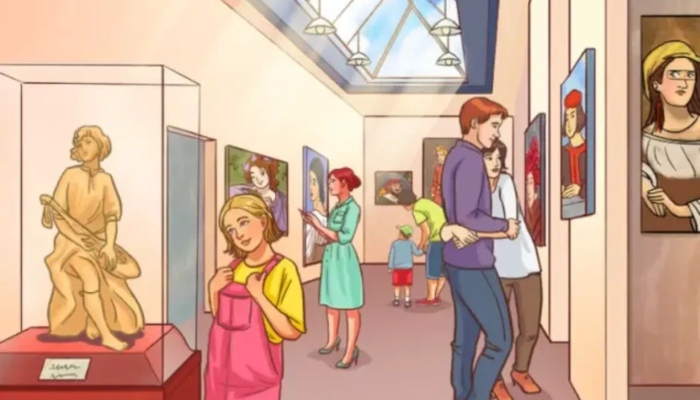
How many people can you spot?

This interesting visual puzzl is a great way to test your observation skills. Look closely at the picture above and try to figure out how many real people are in the scene.

The image shows an art gallery with several paintings hanging on the walls. A number of visitors are looking at the artwork and there is also a statue of a woman inside the gallery.

Can you find the correct number?

At first glance you may think there are 14 people in the picture.  However that answer is incorrect because the people shown in paintings and the statue are not real people so they should not be counted.

If you counted six people that answer is also wrong. There is actually one more person hiding in the picture.

Where is the hidden person?

The correct answer is seven.

To find the hidden person look carefully at the painting in the right corner. Pay close attention to the eyes in the painting. You may notice that a person is cleverly hiding behind it.

Similar Posts

  • |

    Percy Bysshe Shelley’s “Mont Blanc”

    In Romantic-era poetry, Percy Bysshe Shelley’s “Mont Blanc: Lines Written in the Vale of Chamouni” (1816) stands as the ultimate meditation on the romantic sublime. He wrote it during the second generation of English Romanticism alongside Lord Byron and John Keat.  Shelley used the terrifying scale of the Alpine peak to launch questions about perception, human consciousness and the unseen forces governing the cosmos. While early Romantics like William Wordsworth often found moral harmony and divine comfort in nature, Shelley’s philosophical temperament brought a different energy. For Shelley, nature was not a benevolent mother figure, but an indifferent, boundless, and overwhelming energy. Shelley engages directly with the concept of the Sublime. The sublime is an aesthetic experience where vastness or power induces a feeling of terrifying awe. It makes the human observer feel physically insignificant while mentally elevated. Rather than finding traditional religious comfort in the mountain’s height, Shelley explores his philosophical atheism. He views Mont Blanc as a symbol of Necessity or an impersonal power that governs existence. Throughout the five-part poem, Shelley constructs a series of striking visual and philosophical wonders. Shelley opens the poem by comparing human thought to a river flowing through a ravine. The “everlasting universe of things” rolls through human perception. Human consciousness is both passive (receiving impressions from the grand landscape) and active (shaping those impressions into meaning). The everlasting universe of things Flows through the mind, and rolls its rapid waves… Looking up at Mont Blanc, Shelley does not describe a peaceful picture-postcard landscape. Rather, he depicts a wild, chaotic realm of ice, rock, and storm. He envisions the mountain as a primordial arena where “the old Earthquake-daemon taught her young / Ruin”. The glaciers are slow-moving “frozen floods” that flatten forests and rocks with silent force. Shelley reflects on what lessons this silent mountain holds for humanity. The mountain possesses a mysterious tongue that teaches a lesson. To Shelley, Mont Blanc speaks an unspoken truth that can repeal large codes of fraud and woe (i.e., tyrannical dogmas, religious orthodoxies, and political oppression). Nature’s unyielding reality strips away human pretense. The poem reaches its dramatic climax by returning to the relationship between the peak and human thought. Shelley notes that the mountain remains still, snowy, and serene high above human affairs. He closes with a famous philosophical question: And what were thou, and earth, and stars, and sea, If to the human mind’s imaginings Silence and solitude were vacancy?  The mountain’s grandeur is real, but its meaning exists because the human imagination is there to perceive it. Without the human mind to process wonder, the immense universe would merely be an empty void.  

  • Dad’s fake Ultrasound trick goes viral

    A father’s unusual way of helping his young daughter stop eating junk food has gone viral on social media. The video shows a Chinese father who was worried because his daughter loved junk food and would not stop eating it even after he asked her many times. https://www.instagram.com/reel/Dbalh_1AbcP/?igsh=NTV3MGpkcWpkang0 To teach her a lesson the father created a fake ultrasound video. In the video it looked like a worm was growing inside the girl’s stomach because of the junk food she was eating. The animation showed the worm happily eating ice cream and other unhealthy foods becoming bigger each time she ate them. According to the viral story the trick worked and the little girl completely gave up junk food. The video quickly spread across social media and received mixed reactions. Some people praised the father’s creative idea while others said it is better to explain the benefits of healthy eating instead of frightening children.

  • Too much gaming may harm children

    Online and video games are a popular source of entertainment for children.  However experts warn that spending too much time playing games can affect a child’s mental physical and social development. Playing games in moderation can be enjoyable but excessive gaming may lead to several problems. Experts say the growing popularity of video games among children is becoming a concern around the world. Spending long hours in front of a screen can reduce time for schoolwork exercise and other healthy activities. Research also suggests that too much gaming may make some children more irritable angry or aggressive. According to experts excessive gaming may also affect brain function and the nervous system. Children who spend too much time playing games may lose interest in their studies perform poorly at school and become more likely to develop an unhealthy dependence on video games. Too much screen time can also reduce social interaction. Instead of spending time with family and friends children may prefer staying alone with their games which can affect their communication and relationship skills. Pediatric experts advise parents to set clear limits on screen time and encourage children to take part in other activities. Outdoor games painting arts and crafts reading and other creative hobbies can support healthy physical and mental development. These activities are even more beneficial when parents are involved. Experts also say that spending time with siblings and family members helps children build stronger relationships confidence, and social skills.  If video games become a child’s main focus family life and personal development may suffer. Experts do not recommend banning video games completely as learning to use technology is important today. Instead parents should set reasonable gaming limits monitor what their children play and encourage a balanced lifestyle that includes learning physical activity and family time.

  • The Unspoken Pain: A Lexicon of Shame – Infertility in Pashtun Society

    By Dr.Sajjad Ali A suffering pervades the walled villages of Khyber Pakhtunkhwa, and the privacy of the homes in the city, in a language of suffering all distinct. The language of infertility is not the one used in medical textbooks but it is the one that speaks to life and death in Pashtun society. Being a childless woman is being defined by a lexicon of failure here, a failure that runs against the very ethos of Pashtunwali, where a person’s nasl (lineage) and naam (name) is everything. The condition is identical, but the language employed to use it as a weapon against women and men are very different, very vicious. It is a public indictment to her; a silent, emasculating damnation to him. The Woman’s Cross: The Public Indictment The worthiness of a Pashtun woman is arbitrarily squeezed into her reproductive capability. When she drops the one perceived duty, she is not infertile, she is cursed, useless and dangerous. The attack starts with an endless list of names and peghoor (tease). She is a banjh (barren), the most common and heart-breaking epithet. She is a shana (dry, unfruitful tree that bears no fruit). She is khaanch (empty), a hollow vessel with no substance. The elders of the family complain, “Mata plar na laree, khaanch de” (She hasn’t borne him a son, she is empty). Her body is compared to the barren land of Sheera zameena (salty, infertile land) which nothing can grow, or shara (fallow land). The childless woman or the one whose children have died is generally known as a kheeri, which translates as woman of ill omen, bearer of misfortune. She is slightly banned from being present at weddings or cradles (gharay). When a child is sick after the visit, people begin muttering, “Da kheeri da las na ye bimar sho” (After the touch of the kheeri the child fell sick). This spiritual banishment is so devastating! If her husband returns to marriage, or if the family goes bankrupt, she is considered a shamat (a bad omen, a curse to the family) and a manhoos (inauspicious, unlucky). The psychological take-home message is no less horrifying: she is not only failing to give birth; she is an active, evil agent of birthlessness and death and decay. She’s a curse for their existence. The peghoor is available in a dramatic fashion. A mother-in-law would see a hen with chicks and will loudly cry out, “Da charkha ham bachy kawal, khu da adamzad mung na shwe.” (Even this hen hatched chicks, but this human gave us nothing). Neighbours grumble, ‘Khudai da qahar da, cha ta kho pukha na we (She is God’s wrath, she hasn’t ripened for anybody—to mean that she has not become a mother). A cruel comic scene that is often acted out: The guest exclaims the house is a paradise, and the mother-in-law replies, “Kor kho jannat de, khu khaanch de, khoonda raghlay na de” [The house is a paradise, but it is empty, no fragrance has come into it]—singing about the fragrance of a child which reminds her of something she failed to do with her daughter-in-law. This puts her in an economic hostage position. She is a servile slave to make up for her “defect” because of the ever-present unspoken danger of a balka (co-wife). All the money is spent on her own “cure,” which includes dangerous dai (traditional birth attendant) concoctions, expensive visits to taweez-keeping (piir sahib) and futile taweez (amulet) usage. She will wear a tawiz laced with prayers for fertility and she will be made to drink water that has been washed with a dranzay (a special supplication)—her husband’s diagnosis will not even be suspected. This quest devours the family’s resources, everything aimed at the woman who is in a desperate struggle to remain not the family’s shamat. The Man’s Secret: The Silent Emasculation The man feels that the lack of producing babies is not something he has failed to do biologically, but something he has failed to do as a man. He can’t be brought into pity, because if he is, he’s acknowledging that he lost nang (honour). The words he has to say, the words he is not allowed to say, the words he can’t say at all: his torment is a poison that is surrounded by a wall of aggressive denial, but is intended to un-man him. If he is unable to generate a zo-ye (a son), then he is no longer a sar-ye (a man, a leader). His name is a na-mard, the worst of all names, that of a non-man. He is a susra—an utterly impotent, weakling man, a term of maximum contempt. A khassya (castrated bull, eunuch), who has no power and virility. He is a namardanz (an impotent creature). A popular bit of vicious poetry is: “Dwa kalah ye we-weted, khu goly ye na kholay shwe” (“He tried twice, but not a bud was able to blossom for him”, a poetic and mean way of saying that he was unable to start life. His true trial is in the hujra (man’s assembly). The taunt is never a literal arrow, but an arrow of some sort. A story will be told: “Da kala de, cha tofang walwela, khu dasy nese wa, che laande khassia we” (“There’s a man who wields a big rifle, and makes a lot of noise, but inside, he’s a eunuch”). They all laugh, the childless man is forced to laugh loudest, and the white-hot shame is his. The tale is best told in a popular social media comic strip that shows a doctor showing a semen analysis report to a furiously upset husband with a nervous wife looking on: Panel 1: A doctor shows a semen analysis report to a furious-looking husband, with his wife sitting nervously. The Doctor says, “The report reads: azoospermia.The Doctor says, “The report reads azoospermia. Panel 2: A huge, broken speech bubble bursts out of the husband’s mouth: “Tor! Tor! Sta da peghalay!” (“Lies! “It’s your slander!”)

  • Marriage can change couples personalities, study reveals

    Marriage is often described as a situation where “those who marry regret it and those who do not marry regret that too.” Now, scientists have revealed a surprising effect that marriage can have on couples. According to researchers, the first two years of marriage can bring significant changes to the personalities of newly married couples. A joint study by the University of Georgia and the University of California found that personality changes during the first two years of marriage can have important long-term effects on marital relationships. According to the study, newlyweds experience noticeable changes in their personalities and these changes can influence their satisfaction with their relationship with their spouse. The research found that during the first 18 months of marriage, husbands tend to become more dependent on their wives and increasingly focus their attention on their wives rather than the outside world. The study also found that wives experienced reductions in anxiety, depression, feelings of inferiority, restlessness and stress. These positive personality changes were observed among couples of different age groups. However, researchers also noted one negative development: compatibility between husbands and wives tended to decrease. The researchers said that, overall, the findings show that men and women undergo significant personality changes soon after marriage and these changes can be important for developing a healthy long-term relationship. The findings of the study were published in the journal Developmental Psychology. Spousal support and stress Earlier, a study conducted by Binghamton University in the United States in April 2024 found that feeling a lack of support from a spouse can increase physical stress. This feeling can raise levels of cortisol, a hormone associated with stress. Cortisol works with parts of the brain involved in regulating mood, motivation and behaviour. Researchers said that people’s perceptions of their spouse’s support become stronger over time allowing them to predict how their partner is likely to behave in different situations. They further noted that support from a spouse is more important than people may expect.

  • Shark jump captured on camera

    A video of a great white shark jumping out of the water near the California coast has gone viral on social media. According to international media reports, Soren Stevenson was filming a family member surfing near Newport Beach when a great white shark suddenly leaped out of the water. The unexpected moment was captured on video. Stevenson said he did not notice the shark while recording. He only saw it later when he watched the footage and was shocked by what had happened. Christopher Lowe a marine biology professor and director of the Shark Lab at California State University Long Beach believes the shark was likely a young great white that was simply playing near the surface. https://www.instagram.com/reel/DbZIMciAkbr/?igsh=cjlwNTlyZjhvdG8x According to the National Oceanic and Atmospheric Administration great white sharks are found in temperate and subtropical oceans around the world and often migrate as water temperatures change. Wildlife officials also said that warmer ocean waters linked to the 2026 El Nino weather pattern may bring more great white sharks closer to Southern California’s coastline.

Leave a Reply

Your email address will not be published. Required fields are marked *