can you find

Can you find the missing number?

Do you enjoy answering internet riddles especially math puzzles?

If yes then the puzzle shown in the image is a great test for your brain. Many people struggle to find the correct answer.

Look at the image and try to figure out which number should replace the question mark in the third row on the left side.

The first row contains the numbers.

3, 6, 2, 7, 9

The second row contains:

3, 7, 8, 5, 6

The third row contains:

?, 4, 1, 3, 5

ur task is to find the missing number.

To solve it you need to notice the pattern connecting the numbers.

The trick is to add the numbers vertically starting from the right side and moving left.

Here is the method:

9 + 6 = 15 → write 5 in the bottom row and carry 1.

7 + 5 + 1 = 13 → write 3 and carry 1.

2 + 8 + 1 = 11 → write 1 and carry 1.

6 + 7 + 1 = 14 → write 4 and carry 1.

3 + 3 + 1 = 7.

So the missing number is 7.

Answer: 7

Similar Posts

  • Low magnesium? Don’t ignore these warning signs

    Health experts say magnesium is an essential mineral that helps keep the bones muscles nerves and heart healthy. A lack of magnesium can lead to several physical and mental health problems, so it is important to recognize the early warning signs. According to experts low magnesium levels may affect the nervous system causing anxiety nervousness irritability and mood changes. If these symptoms continue for a long time magnesium deficiency could be one possible reason. Magnesium deficiency can also affect emotions making some people more sensitive to stress or more likely to overreact to small problems. Experts recommend eating beans nuts leafy green vegetables fish and whole grains to help maintain healthy magnesium levels. Feeling tired weak or low on energy even after getting enough sleep may also be a sign of low magnesium.  Doctors suggest getting a blood test to check vitamin and mineral levels if these symptoms continue. Health experts also say that frequent nausea and vomiting can sometimes be linked to magnesium deficiency and should not be ignored. Low magnesium may also cause muscle weakness leg pain cramps muscle tightness or spasms as the mineral is important for normal muscle function.  While magnesium rich foods can help experts advise speaking to a doctor before taking any magnesium supplements.

  • Vaping risks for young people

    A major review by the Royal College of Paediatrics and Child Health has raised concerns about the growing use of e-cigarettes among children and teenagers. Researchers reviewed thousands of studies looking at how vaping may affect the health of young people. Vaping has increased sharply According to the report vaping among young people has increased 10 times over the past decade.  Many teenagers are also starting to vape at a very young age, increasing concerns about long term health effects. Vaping may harm lung health The review linked vaping among young people with several breathing problems including: •Coughing •Wheezing •Symptoms of bronchitis Worsening asthma symptoms Experts also warn that young people who vape may be more likely to start smoking traditional cigarettes later. Other possible health effects The report also highlighted several other concerns linked to vaping including. Nicotine addiction •Poor oral and dental health •Anxiety •Depression •Suicidal thoughts •Possible sleep problems •Potential effects on eye health •Allergies Researchers say more studies are still needed to fully understand some of these effects. Experts warn parents and young people Professor Will Carroll a co-author of the report said vaping should not be viewed as a harmless part of growing up. The evidence shows clear links between vaping, breathing problems nicotine dependence and future cigarette use. Vaping may look less harmful than traditional smoking but experts warn that it can still pose serious risks for children and teenagers. Preventing young people from starting vaping could help protect their health both now and in the future.

  • SpaceX’s 4-ton rocket crashes into Moon at 5,400mph

    Elon Musk’s SpaceX rocket has crashed into the Moon’s surface while travelling at a speed of 5,400 miles per hour while a telescope in Chile captured evidence of the impact. The European Southern Observatory’s (ESO) Very Large Telescope observed the impact on August 5 and detected colorful spectral lines of sodium and lithium gas. These were produced by clouds of lunar dust that were thrown up by the impact. The ESO telescope recorded the “chemical fingerprints” of the gas cloud which remained visible for around 5 to 10 minutes. The cloud was estimated to extend across dozens of kilometers. Experts had previously said that the impact could provide valuable data for future space experiments and help scientists analyze the effects of collisions involving human-made space debris. As NASA plans to establish a permanent human base on the Moon in the future understanding what happens when space debris strikes the lunar surface will be important. Impact site The impact occurred at a location on the Moon that is considered to be near the boundary between the sunlit and dark regions. When the impact sent clouds of dust into the air, they briefly became illuminated by sunlight. However, observing them with the naked eye from Earth was almost impossible. Although several satellites are currently orbiting the Moon, none was positioned at the time of the impact to directly observe it. The rocket fragment was approximately as tall as a five-story building and weighed around 4 tons. NASA’s Lunar Reconnaissance Orbiter and South Korea’s Korea Pathfinder Lunar Orbiter are being considered for photographing the impact site. These images could help determine how much damage was caused by the rocket although it may take several days to collect and analyze the information. It is worth noting that the SpaceX Falcon 9 rocket was launched in January 2025 and carried two landers toward the Moon. Its boosters returned to Earth while the upper stage continued carrying the landers toward the Moon.

  • KFC launches fried chicken flavored toothpaste

    KFC has introduced a surprising new product fried chicken flavored toothpaste. The toothpaste is inspired by the brand’s famous 11 Herbs and Spices giving users a taste and smell similar to KFC’s Original Recipe chicken. According to the company the toothpaste is designed to make brushing feel like enjoying a hot juicy piece of KFC chicken while still leaving the mouth feeling fresh. The limited edition product was created in partnership with Hismile a well known Australian oral care company. Hismile’s Marketing Manager, Koban Jones, said the company enjoys creating fun and unexpected products. He added that turning KFC’s famous flavor into an everyday item like toothpaste was a bold and exciting idea. Although the fried chicken flavored toothpaste is currently unavailable customers can still buy the KFC Electric Toothbrush from the company’s website. The toothbrush features three cleaning modes soft bristles and a built in timer for a better brushing experience.

  • | |

    Multimedia pioneer Cao Fei captures the human heart

    Among contemporary Asian creators, Beijing-based multimedia artist Cao Fei stands out as a defining narrative voice. Working across video, virtual reality, installation, and photography, her globally acclaimed career centers on a simple yet profound premise: amidst the whirlwind of rapid industrial advancement, hyper-capitalism, and sweeping technological change, art must always return to the core of the human condition. Born in 1978 in Guangzhou, Cao Fei grew up on the frontlines of staggering societal evolution. Watching the countryside surrender to megacities, factory complexes, and high-tech infrastructure gave her a unique point on the modern world. Rather than viewing this rapid transition with nostalgia or pessimism, her works connect reality and imaginative fantasy. A hallmark of Cao’s career is her fascination with the workplace, particularly automated logistics hubs and manufacturing floors. In iconic pieces like Whose Utopia and Asia One, she embeds her cameras inside functioning industrial facilities from textile plants to highly automated e-commerce distribution centers. Yet, instead of focusing solely on the cold efficiency of machinery or output metrics, she shifts her lens toward the individual laborers maneuvering through these vast, mechanized systems. Her films document the quiet desires, personal dreams, and unspoken emotional bonds of workers who navigate a world increasingly driven by algorithms and quotas. Parallel to her exploration of physical industry, Cao Fei has consistently operated on the cutting edge of digital frontiers. Long before the concept of the metaverse entered mainstream vocabulary, she was constructing RMB City within online platforms like Second Life, exploring how virtual avatars allow people to seek identity, escape, and community in digital environments. Her projects often feature young people engaging in subcultures like cosplay, stepping out of suburban construction sites and into elaborate alter egos. For Cao, these virtual realms are not merely frivolous distractions; they represent vital spaces of self-expression where individuals reclaim agency against the pressure of uniform urban life. Despite her focus on futuristic landscapes, automated networks, and virtual platforms, Cao Fei maintains that rootedness in heritage remains essential. Traditional culture, memory, and personal history act as indispensable anchors in a world constantly shifting beneath our feet. Whether reflecting on regional Cantonese roots, exploring local neighborhood history in Beijing, or depicting surreal futures, her work grounds high-tech environments in real human memory and emotion.   Ultimately, Cao Fei’s artistic vision offers a thoughtful, multi-layered reflection on modern life. By balancing documentation with surreal storytelling, her art reminds us that no matter how complex our machines, algorithms, or cities become, the central narrative of our time remains fundamentally human.

  • |

    Why marginalia is devised for conversation

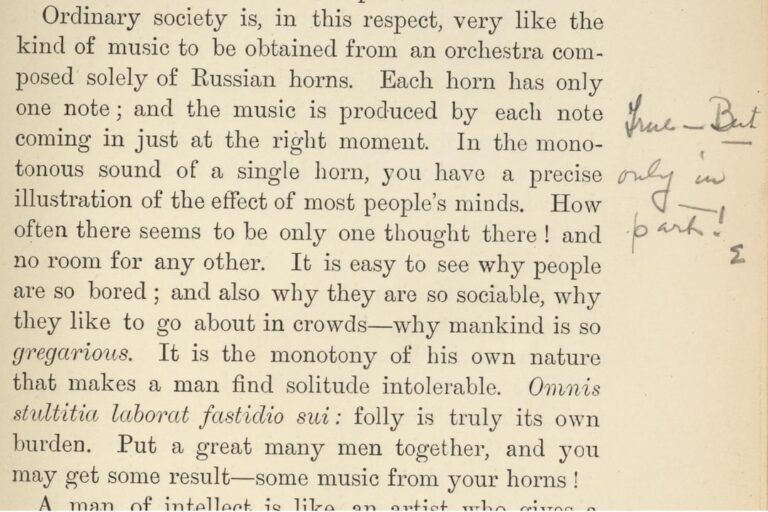
    For centuries, books were treated as sacred, untouchable artifacts. Readers were taught to open a spine with reverence, turn pages by the edges, and never, under any circumstance, mark the paper. But in the modern reading culture, a quiet revolution has taken root: marginalia is no longer viewed as defacement. Today, it is recognized as a vital form of active intellectual engagement. Marking up a book transforms reading from a passive act of consumption into an active. Reading is a two-way dialogue between the reader and the writer. When you read with a pencil, pen, or sticky tab in hand, your relationship with the text fundamentally shifts. You cease to be a distant spectator observing someone else’s thoughts. In other words, you become a collaborator. Underlining a sentence, drawing an exclamation point next to a surprising plot twist, or a counterargument in the margin forces your brain to process language at a deeper level. It requires you to articulate why a passage resonated or failed. Furthermore, annotated books serve as personal time capsules. When you reopen a novel you marked up five or ten years ago, it offers an unfiltered reflection into who you were at that exact moment in your life. You might find yourself cringing at an old marginal note. Then you agree passionately with a circled phrase, or realizing that a passage you completely ignored years ago now carries personal meaning. The book becomes a physical record not just of the author’s story, but of your own cognitive and emotional evolution. Edgar Allan Poe once wrote: ‘In getting my books, I have been always solicitous of an ample margin … for the facility it affords me of pencilling suggested thoughts, agreements and differences of opinion …’ Practically speaking, marginalia also sharpens critical thinking. Students, scholars, and casual readers alike find that tracking themes through custom color-coded tabs or brief summary notes at the end of chapters drastically improves retention and comprehension. It prevents the common phenomenon of eye-scanning where your eyes move across sentences while your mind wanders elsewhere. Annotation demands presence. Ultimately, scribbling in the margins strips away the artificial pedestal we often place books upon. It reminds us that literature is not meant to sit pristine and untouched on a display shelf. Literature is meant to be wrestled with, questioned, celebrated, and lived in. The next time you open a book that challenges or moves you, don’t hold back. Pick up a pen, claim the empty white space on the page, and join a conversation that has been taking place across centuries.  

Leave a Reply

Your email address will not be published. Required fields are marked *