police constable martyred
|

Police constable martyred , two suspected robbers …

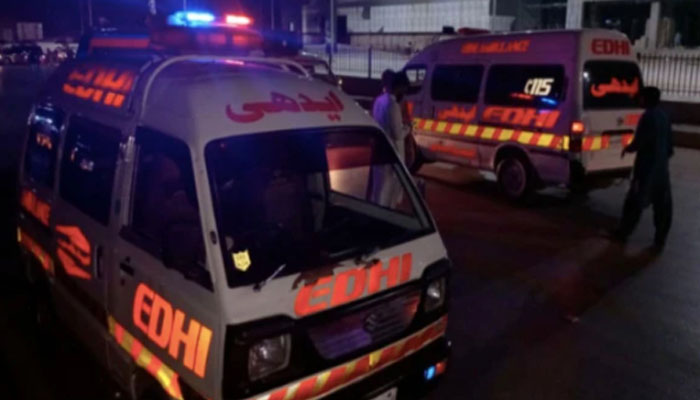
A police constable was martyred and two suspected robbers were shot dead during an exchange of fire in Karachi’s Orangi Town early on Tuesday morning, according to police and rescue services officials.

The senior superintendent of police (SSP) of District West, Tariq Illahi Mastoi, said that four police officials of District West were conducting routine motorcycle patrolling near Liaquat Chowk, within the limits of Pakistan Bazaar Police Station, when they encountered armed robbers. Upon seeing the police party, the suspects opened indiscriminate fire. The police retaliated in self-defence, resulting in an exchange of fire, he said.

The SSP added that both armed suspects were killed during the exchange of fire. Two pistols along with ammunition, spent shell casings, and the motorcycle being used by the suspects were recovered from their possession. According to a police statement, there were “at least 13 criminal cases” registered against one suspect, while one case had been registered against the other.

The incident comes amid a recent surge in violent crime in the port city. Last week, a suspected robber was gunned down and a policeman was wounded in a shoot-out on Mauripur Road. Earlier this month, two suspected robbers were shot dead by citizens in Gulzar-i-Hijri and Cattle Colony. In another incident, a suspected robber was lynched by an angry mob and another was wounded by a bullet allegedly fired by an accomplice during a robbery in Korangi.

Police have reiterated their commitment to combating criminal activity in the city, while the latest encounter underscores the ongoing challenges law enforcement faces in maintaining public safety amid rising street crime.

Similar Posts

  • | |

    FBR introduces three-day sales tax registration fo…

      Islamabad: The Federal Board of Revenue (FBR) has introduced a new mechanism to speed up sales tax registration for low-risk applicants, allowing eligible and complete applications to be processed within three working days. The measure was announced through Sales Tax General Order No. 20 of 2026, issued by the Revenue Division on August 24, 2026. The order is aimed at making the registration process faster, more transparent and business-friendly while retaining safeguards against fraudulent or suspicious registrations. Under the new system, applications submitted through the FBR’s IRIS system will be assessed according to risk-based parameters. Applicants classified as low-risk through the computerized system will receive priority treatment, provided their applications contain all required information and documents. According to the order, the relevant Local Registration Office (LRO) will be required to complete the registration process for eligible low-risk applicants within three working days. Officials have been directed to avoid unnecessary delays in processing such applications. The FBR has also restricted registration offices from seeking additional documents from low-risk applicants unless those documents are specifically required under the Sales Tax Act, 1990, the Sales Tax Rules, 2006, or are demanded by the computerized risk-management system. Another major feature of the new procedure is the introduction of pre-registration certification for manufacturers. Sector-specific trade associations operating under the Federation of Pakistan Chambers of Commerce and Industry (FPCCI) will be able to certify the credentials of their member applicants before registration. The certification will cover key details including the applicant’s manufacturing activity, business premises and membership of the relevant trade association. However, the FBR has clarified that such certification is intended only as a facilitation measure and will not replace any legal or statutory requirement for sales tax registration. The new order also establishes clearer procedures for dealing with incomplete applications. If an application does not meet the required conditions, the applicant must be informed within seven days and provided with specific reasons for the objection. The FBR has prohibited registration officials from raising vague or generalized objections. This requirement is intended to provide applicants with greater clarity about deficiencies in their applications and allow them to address issues without unnecessary delays. For manufacturers, the order requires concerned LROs to conduct pre-physical verification under Rule 5(3) of the Sales Tax Rules, 2006 within three working days. Applications considered high-risk or suspicious, however, will remain subject to enhanced scrutiny and additional verification. The FBR said the initiative forms part of broader efforts to facilitate businesses, reduce administrative delays and encourage genuine manufacturers to enter the formal tax system. By involving recognized trade bodies in the initial verification process, the tax authority hopes to make better use of industry-level information while retaining the final decision-making authority with the relevant tax offices. The General Order has been circulated among all Chief Commissioners Inland Revenue, Commissioners, the Director General of IT and PRAL for immediate implementation. The FBR has also emphasized that classification as a low-risk applicant does not provide permanent immunity from scrutiny. If false information, misrepresentation or fraudulent documentation is discovered at a later stage, the applicant may still face subsequent verification and action under the applicable law. The new framework is therefore designed to combine faster registration for legitimate businesses with continued monitoring of applicants who may pose tax or compliance risks.

  • Two Boys From School Shooting Remain in Critical Condition After Surgery

    BANGKOK – A tragic school shooting at Debsirin Nonthaburi School has left a local community in deep shock. Currently, two young boys remain in the intensive care unit after surviving the horrific attack. Both students have undergone major surgery, but they are still fighting for their lives today. Dr. Sakon Sukphrom is the respected current […]

  • HSA VC dismissal upheld in harassment case

    Islamabad: The President of Pakistan rejected the appeal of Health Services Academy Vice Chancellor Dr Shahzad Ali Khan and maintained his dismissal from service. The latest order held that retaliatory action against Dr Ayesha Khan created a hostile work environment and amounted to gender based harassment, justifying the punishment of dismissal. The decision creates a major legal twist in the high profile HSA case. The President’s legal forum clearly observed that this was not established as a case of sexual harassment in the manner found earlier by the Federal Ombudsperson for Protection Against Harassment of Women at the Workplace. It said the earlier FOSPAH decision contained serious weaknesses, including failure to properly examine the nature of the relationship between the two parties and failure to frame separate questions on several important parts of the dispute. However, those weaknesses did not save Dr Shahzad Ali Khan from dismissal. The final order stated that his later conduct, especially the abrupt termination of Dr Ayesha Khan, could not be ignored. It held that the retaliatory measures created a hostile work environment for her and amounted to gender-based harassment. The President approved the recommendation to dismiss Dr Shahzad Ali Khan’s representation and maintain the penalty of dismissal from service. The final decision also strongly observed that Dr Shahzad Ali Khan had not approached the President with clean hands. It questioned his claim that he had been honey trapped when that claim was examined together with what the decision described as extreme retaliatory measures taken against Dr Ayesha Khan. One important point was the timing of her removal from service. The record showed that Dr Ayesha Khan registered an FIR and her employment was terminated the following day. The presidential decision said this sequence was important when deciding whether retaliation had occurred. At the same time, the President’s legal forum strongly criticised major parts of the original FOSPAH reasoning. It said FOSPAH failed to properly establish the timeline of the different complaints and legal actions between the two parties. It also found contradictions and unanswered questions in the case. The decision said FOSPAH should have separately examined the exact nature of the relationship, whether any employment benefit was linked to a romantic or sexual demand, whether electronic evidence was reliable, what the financial transactions represented and whether Dr Ayesha Khan’s termination was retaliation. Instead, FOSPAH had mainly framed the broad question of whether harassment had occurred and who was responsible. The President’s legal forum described that approach as inadequate for such a complicated case. The order went further and stated that not a single specific incident of sexual harassment had been identified in the complaint. It said the sexual harassment conclusion was reached through indirect reasoning instead of being linked to a particular incident. The forum therefore concluded that the dispute could not properly be treated as sexual harassment on that basis. The decision described the dispute as involving two people who had remained close for several years before serious differences developed. Dr Ayesha Khan’s position was that the relationship involved marriage or a promise of marriage. Dr Shahzad Ali Khan denied that a marriage existed and claimed he had been honey trapped. The presidential forum said neither honey trapping nor marriage had been established on the record before it. It observed that questions over whether a valid marriage existed should be decided by a competent family court rather than through workplace harassment proceedings. The case originally started with complaints and counter complaints between Dr Shahzad Ali Khan and Dr Ayesha Khan. Dr Shahzad Ali Khan accused Dr Ayesha Khan of blackmail, honey trapping, financial fraud, threats and misuse of authority. He alleged that she extracted Rs 27.44 million from him through threats and manipulation for an alleged property investment. He also alleged that she threatened his wife while demanding Rs 30 million. According to his version, money from the sale of two vehicles, worth around Rs 10 million, was also handed to Dr Ayesha Khan for investment and was not returned. Dr Ayesha Khan denied those accusations. She alleged that Dr Shahzad Ali Khan made personal and inappropriate remarks, discussed private marital matters with her, promised marriage and later took retaliatory action against her. She also accused him of workplace harassment and alleged physical harassment in an official vehicle. She maintained that her termination and other actions followed her resistance to him and her pursuit of legal action. The original FOSPAH order took a much stronger view against Dr Shahzad Ali Khan. It found that he had misused his authority while serving as a teacher and later Vice Chancellor, developed an inappropriate relationship with a student who later became his junior colleague and gave her unusual professional benefits. FOSPAH ordered his removal from service after finding quid pro quo harassment. WhatsApp messages also became an important part of the original case. The record included messages from Dr Shahzad Ali Khan’s number in which Dr Ayesha Khan was addressed with personal names including Zalim Princess and other affectionate expressions. FOSPAH considered these messages important evidence against the honey trap allegation and viewed them as showing personal communication initiated from a position of authority. The Ombudsperson also found that allegations of financial misappropriation against Dr Ayesha Khan had not been proved through enough documentary evidence. Dr Shahzad Ali Khan challenged the FOSPAH decision before the President. His lawyers argued that Dr Ayesha Khan had given different versions of important events before different legal forums. They also challenged the use of WhatsApp screenshots, saying the material was incomplete and had not been properly examined through forensic testing. His side denied any marriage, sexual favour or sexual relationship and argued that the finding of quid pro quo sexual harassment was based on assumptions rather than direct evidence. Dr Ayesha Khan’s lawyers opposed the appeal. They argued that the original order had followed a full inquiry, evidence and cross examination. Her side said the WhatsApp messages came from Dr Shahzad Ali Khan’s registered number and argued that his

  • | |

    Ishaq Dar holds telephone conversation with Saudi …

      Pakistan’s Deputy Prime Minister and Foreign Minister Ishaq Dar held a telephone conversation with Saudi Foreign Minister Prince Faisal bin Farhan, during which the two sides discussed matters of mutual interest as well as regional and international developments. According to a statement issued by the Foreign Office spokesperson, the two foreign ministers exchanged views on a range of issues of common interest during the telephone call. The conversation focused on strengthening bilateral relations between Pakistan and Saudi Arabia and maintaining close coordination on important regional and global matters. During the discussion, Ishaq Dar and his Saudi counterpart also reviewed the prevailing regional situation. The two ministers exchanged views on developments affecting peace and stability in the region and discussed the importance of continued diplomatic engagement and cooperation among countries. The foreign ministers also discussed multilateral cooperation and matters related to international forums. They emphasised the importance of maintaining coordination between Pakistan and Saudi Arabia on issues of common concern at both regional and international levels. According to the Foreign Office, Pakistan and Saudi Arabia reaffirmed their commitment to maintaining close contact and cooperation through bilateral and multilateral platforms. The telephone conversation comes as Pakistan and Saudi Arabia continue to maintain close and longstanding relations based on political, economic, diplomatic and people-to-people ties. Both countries regularly consult each other on regional developments and issues of mutual interest. Pakistan considers Saudi Arabia an important partner in the Middle East, while Saudi Arabia has maintained close relations with Pakistan over the years. High-level exchanges between officials from both countries have remained an important feature of their bilateral relationship. The discussion between Ishaq Dar and Prince Faisal bin Farhan also reflects the importance attached by both countries to regular diplomatic consultations. Such contacts provide an opportunity for the two sides to exchange assessments of emerging regional developments and coordinate their positions on matters discussed at international forums. Multilateral cooperation was another important aspect of the conversation. Pakistan and Saudi Arabia have worked together at various international platforms and have frequently supported closer coordination on issues affecting the Muslim world and the broader international community. The two ministers also reiterated the importance of continued engagement between their respective governments. By maintaining regular communication, both sides aim to strengthen their strategic partnership and enhance cooperation on matters of mutual interest. The telephone conversation is expected to contribute to ongoing diplomatic efforts to further deepen Pakistan-Saudi Arabia relations. Both countries have repeatedly expressed their desire to expand cooperation across multiple areas and maintain strong institutional and political contacts. The Foreign Office spokesperson did not provide further details about the specific regional issues discussed during the call. However, the reference to the regional situation and multilateral cooperation indicates that the conversation covered broader developments beyond bilateral relations. The reaffirmation of close coordination on bilateral and multilateral platforms demonstrates the continued importance of the relationship between Islamabad and Riyadh. Regular communication between senior officials remains a key mechanism for both countries to exchange views, coordinate diplomatic positions and respond to developments in the region. The latest telephone conversation between Ishaq Dar and Prince Faisal bin Farhan therefore underscores the two countries’ commitment to maintaining close diplomatic engagement and strengthening cooperation at both bilateral and international levels.

  • | |

    Karachi traffic accidents claim 603 lives this yea…

    Karachi: At least 603 people have lost their lives in different traffic accidents across Karachi this year, according to data released by Rescue authorities. Thousands of others have suffered injuries in road crashes, highlighting the continuing traffic safety challenges faced by the city. According to Rescue officials, 7,467 people were injured in traffic accidents during the year. The victims include people from different age groups and both genders. Of the 603 people who died in road accidents, 463 were men, 73 were women and 67 were children. The figures show that men made up the majority of fatalities, while women and children also suffered significant losses in road crashes. Rescue authorities said heavy vehicles were involved in a considerable number of fatal accidents. A total of 184 people were killed in accidents involving heavy vehicles during the year. According to the available data, 12 people lost their lives after being hit by dumpers. Trailer-related accidents claimed the lives of 84 people, making trailers one of the major contributors to fatalities involving heavy vehicles. Water tankers were also involved in several deadly accidents. Rescue officials reported that 46 people were killed in accidents involving water tankers during the year. Meanwhile, 18 people died in accidents involving mini-trucks, while 24 people were killed in accidents involving buses. The injury figures are also significant. Of the 7,467 people injured in traffic accidents, 5,649 were men, 1,322 were women and 496 were children. The data underscores the scale of road safety concerns in Karachi, where busy roads, increasing traffic and the movement of heavy vehicles have contributed to serious accidents. The high number of fatalities and injuries has renewed concerns about traffic management and road safety measures in the city.

  • |

    Bangladesh hints at joining Pakistan-Saudi-Türkiy…

    DHAKA: Bangladesh has signalled that it could consider joining the emerging economic or defence framework involving Pakistan, Saudi Arabia and Türkiye, opening a potentially significant new chapter in regional diplomacy and security cooperation. Bangladesh Prime Minister’s Foreign Affairs Adviser Humayun Kabir said Dhaka was taking a positive view of the possibility of becoming part of a framework involving the three countries. His comments come only weeks after Pakistan, Saudi Arabia and Türkiye signed the Makkah Joint Defence Agreement. The agreement, signed in Makkah on Aug 7, commits the three countries to strengthening collective security and defence cooperation. It also states that an armed attack against any one of the three signatories would be regarded as an attack against all three. Kabir, speaking to Bangladesh’s state news agency, indicated that Dhaka would examine the idea through the lens of its own national interests and the rapidly changing global economic and trade environment. “The government is following a Bangladesh First policy,” Kabir said, according to reports, stressing that national interests remain at the centre of Dhaka’s foreign policy. The remarks are particularly noteworthy because Bangladesh has recently been working to strengthen practical ties with Pakistan. Kabir said the two countries were seeking greater cooperation in trade and people-to-people contacts, suggesting that economic engagement could form an important part of the relationship. For Pakistan, Bangladesh’s interest could give the Makkah framework a wider South Asian dimension. For Saudi Arabia and Türkiye, Dhaka’s possible participation could also expand the reach of an arrangement that the signatories have described as defensive rather than directed against any particular country. Turkish President Recep Tayyip Erdogan has said the agreement is open to other friendly countries seeking peace, prosperity and stability in the region. Turkish officials have also stressed that the pact does not identify a common enemy and is intended to strengthen defence cooperation and collective deterrence. Bangladesh’s possible move comes as Dhaka is also deepening its relationship with Saudi Arabia. Kabir said Prime Minister Tarique Rahman is expected to visit Saudi Arabia following an invitation from Crown Prince Mohammed bin Salman. The visit could provide an opportunity for discussions on economic cooperation, regional security and Bangladesh’s possible role in broader regional frameworks. For now, Dhaka has not announced any formal decision to join the defence agreement. But its positive signal is already attracting attention, particularly because Bangladesh’s participation could reshape the strategic picture across South Asia and the wider Muslim world. The next step will likely depend on how Dhaka assesses the proposed framework against its national interests, economic priorities and wider foreign-policy objectives.

Leave a Reply

Your email address will not be published. Required fields are marked *