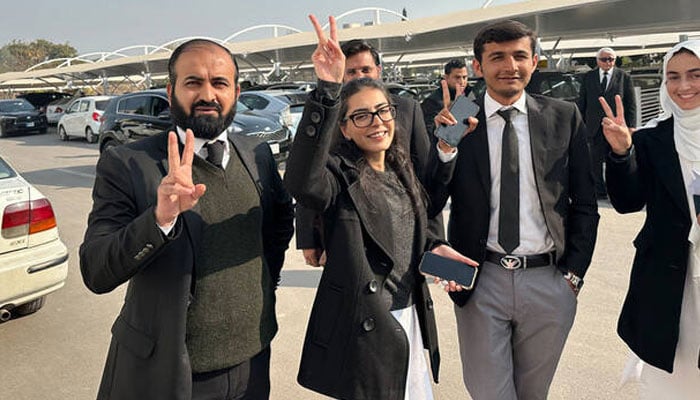
ihc declares mazari
| |

IHC declares Mazari, Chatha sentence suspension pl…

The Islamabad High Court has declared admissible the petitions seeking suspension of sentences of Imaan Mazari and Hadi Chatha, who were convicted by a trial court in the controversial tweets case.

Justice Muhammad Azam Khan of the Islamabad High Court issued a reserved verdict, rejecting a miscellaneous application filed by the prosecution challenging the admissibility of the petitions.

The court had reserved its decision yesterday after hearing arguments from both sides. The prosecution had argued that the petitions for suspension of sentence filed by Imaan Mazari and Hadi Chatha were premature.

It is pertinent to mention that Additional Sessions Judge Muhammad Afzal Majoka had sentenced both Imaan Mazari and Hadi Chatha to a total of 17 years in prison each under the Prevention of Electronic Crimes Act (PECA).

Both convicts have approached the Islamabad High Court seeking suspension of their sentences.

Earlier, The Islamabad High Court on Friday reserved its decision on whether petitions seeking the suspension of prison sentences awarded to lawyers and human rights activists Imaan Zainab Mazari-Hazir and Hadi Ali Chattha can proceed.

The petitions relate to the couple’s convictions in a case involving alleged controversial social media posts under the Prevention of Electronic Crimes Act (PECA).

The hearing was conducted by Justice Muhammad Azam Khan, who considered preliminary arguments from both the prosecution and the defence before reserving his ruling on the maintainability of the petitions.

During the proceedings, lawyers representing the National Cyber Crime Investigation Agency (NCCIA) argued that the requests for suspension of sentence had been filed too early. They maintained that the court should first decide the prosecution’s objection challenging the admissibility of the petitions before considering any request for relief

Similar Posts

  • |

    Increasing fuel prices

    From Meer Baloch Through the columns of your respected newspaper, I would like to draw the attention of the concerned authorities to the continuous increase in fuel prices in Pakistan. The rising cost of petrol and diesel has made life difficult for ordinary people. Higher fuel prices increase transportation costs, which also raise the prices of food, medicines, and other daily necessities. Poor and middle-class families are suffering the most because their incomes remain the same while expenses continue to rise. The government should take effective measures to control fuel prices and provide relief to the public. It should also promote affordable public transport and reduce unnecessary taxes on fuel. I hope my letter will create awareness and encourage the authorities to take prompt action.

  • Thailand Ends 60-day Visa-free Scheme For 93 Countries

    BANGKOK, Thailand — Thailand’s Cabinet has approved the cancellation of the pre-travel 60-day visa exemption scheme for citizens of 93 countries, a policy introduced two years ago to stimulate tourism and economic recovery, according to Tourism and Sports Minister Surasak Phancharoenworakul following the Cabinet meeting. Thailand Prepares To Halve Visa-free Stay For Tourists From 60 […]

  • | |

    FBR introduces three-day sales tax registration fo…

      Islamabad: The Federal Board of Revenue (FBR) has introduced a new mechanism to speed up sales tax registration for low-risk applicants, allowing eligible and complete applications to be processed within three working days. The measure was announced through Sales Tax General Order No. 20 of 2026, issued by the Revenue Division on August 24, 2026. The order is aimed at making the registration process faster, more transparent and business-friendly while retaining safeguards against fraudulent or suspicious registrations. Under the new system, applications submitted through the FBR’s IRIS system will be assessed according to risk-based parameters. Applicants classified as low-risk through the computerized system will receive priority treatment, provided their applications contain all required information and documents. According to the order, the relevant Local Registration Office (LRO) will be required to complete the registration process for eligible low-risk applicants within three working days. Officials have been directed to avoid unnecessary delays in processing such applications. The FBR has also restricted registration offices from seeking additional documents from low-risk applicants unless those documents are specifically required under the Sales Tax Act, 1990, the Sales Tax Rules, 2006, or are demanded by the computerized risk-management system. Another major feature of the new procedure is the introduction of pre-registration certification for manufacturers. Sector-specific trade associations operating under the Federation of Pakistan Chambers of Commerce and Industry (FPCCI) will be able to certify the credentials of their member applicants before registration. The certification will cover key details including the applicant’s manufacturing activity, business premises and membership of the relevant trade association. However, the FBR has clarified that such certification is intended only as a facilitation measure and will not replace any legal or statutory requirement for sales tax registration. The new order also establishes clearer procedures for dealing with incomplete applications. If an application does not meet the required conditions, the applicant must be informed within seven days and provided with specific reasons for the objection. The FBR has prohibited registration officials from raising vague or generalized objections. This requirement is intended to provide applicants with greater clarity about deficiencies in their applications and allow them to address issues without unnecessary delays. For manufacturers, the order requires concerned LROs to conduct pre-physical verification under Rule 5(3) of the Sales Tax Rules, 2006 within three working days. Applications considered high-risk or suspicious, however, will remain subject to enhanced scrutiny and additional verification. The FBR said the initiative forms part of broader efforts to facilitate businesses, reduce administrative delays and encourage genuine manufacturers to enter the formal tax system. By involving recognized trade bodies in the initial verification process, the tax authority hopes to make better use of industry-level information while retaining the final decision-making authority with the relevant tax offices. The General Order has been circulated among all Chief Commissioners Inland Revenue, Commissioners, the Director General of IT and PRAL for immediate implementation. The FBR has also emphasized that classification as a low-risk applicant does not provide permanent immunity from scrutiny. If false information, misrepresentation or fraudulent documentation is discovered at a later stage, the applicant may still face subsequent verification and action under the applicable law. The new framework is therefore designed to combine faster registration for legitimate businesses with continued monitoring of applicants who may pose tax or compliance risks.

  • PAAM opposes DRAP’s proposed alternative medicine rules 2026

    LAHORE: A covert gambit by the Drug Regulatory Authority of Pakistan (DRAP) to impose arbitrary regulations on the alternative medicine sector has been laid bare, sparking widespread outrage across the pharmaceutical industry. ​The regulatory body is accused of using an upcoming ‘Pak Health Expo’, organized by an association at a local hotel in Islamabad on August 12–13, as a smokescreen to push through controversial policies. Reliable sources revealed that the final draft of the highly contentious “Alternative Medicines Rules 2026” has already been finalized behind closed doors, completely bypassing key industry stakeholders. According to these sources, the draft has already been forwarded to the Law and Justice Division for formal vetting. Against this backdrop, the industry has termed DRAP’s sudden announcement of a “consultative session” at the expo issued on a mere 48-hour notice as a farcical exercise in paperwork, designed solely to create a false record of stakeholder consensus. Insiders further alleged that top DRAP officials had been cold-calling homeopathic and Unani pharmaceutical firms over the past several days, pressuring them to purchase expensive stalls worth hundreds of thousands of rupees at the private event. Following a widespread boycott of the expo by established manufacturers, DRAP reportedly engineered the controversial regulatory session within the event to corner the industry into participation. Reacting strongly to the development, Kashif Aslam Malik, Chairman of the Pakistan Association of Alternative Medicine (PAAM), categorically rejected DRAP’s maneuvers, stating that the leadership had anticipated the bureaucratic trap. ​”When the final draft has already been sent to the Law and Justice Division for vetting, this sudden drama of a consultative session at a private venue is nothing but an absolute mockery,” Malik questioned while speaking to journalists. The PAAM chairman emphasized that leaning on private event platforms to legitimize sensitive, sector-defining legislation is clear evidence of regulatory bad faith. He maintained that if DRAP were genuinely sincere about consultation, it would have convened an official, independent roundtable with all veteran associations where the actual draft could be scrutinized transparently. The PAAM leadership has announced that any back-door attempt to benefit a favored private group or to bulldoze industry-hostile clauses under the guise of an expo crowd will be resisted tooth and nail. Kashif Aslam ​Malik reiterated that this persistent bureaucratic high-handedness and regulatory blackmail are precisely why PAAM continues to spearhead the movement for a dedicated, independent federal ministry for alternative medicine. The association demands that policies governing traditional and alternative health sciences be framed by domain experts who understand the discipline, rather than traditional regulators.

  • |

    Samiya Hijab confesses feelings for Yasir Alam

    Tamasha 5 continues to attract significant attention from viewers as the latest season of ARY Digital’s popular reality show brings new friendships, rivalries and emotional moments to the screen. Since its launch in 2022, the Big Brother-style reality series has developed a strong following across Pakistan and the wider Subcontinent. The show is produced by Salman Iqbal and Jarjees Seja and is hosted by Adnan Siddiqui. This season, several contestants have formed close bonds inside the Tamasha house, but the friendship between Samiya Hijab and Yasir Alam has become one of the most discussed relationships among viewers. Their growing connection has sparked interest, particularly after Samiya openly spoke about her feelings for Yasir during a recent episode. While having a conversation with Yasir, Samiya admitted that his success in one of the tasks made her genuinely happy. She recalled watching him thank the audience after winning and asking viewers to continue supporting him so that he could eventually take the Tamasha trophy home. Samiya revealed that she immediately responded by saying “In Sha Allah,” explaining that she normally does not use the phrase when talking about someone else’s success. Her reaction appeared to show just how strongly she has begun to care about Yasir and his journey on the show. She also acknowledged that both of them are competing for the same trophy and that, ideally, neither contestant wants to lose. However, Samiya said she had reached a point where Yasir’s victory would make her happy even if she could not achieve the same result herself. The Tamasha contestant also asked Yasir not to simply respond to her feelings because she tends to overthink such situations. Her comments reflected the emotional confusion she has been experiencing while trying to balance her personal feelings with the competitive nature of the reality show. Yasir, meanwhile, thanked Samiya for the unconditional support she had shown him during his task. In response, Samiya casually said that this was what friends were for, although her earlier comments suggested that their bond may have become more meaningful to her. Samiya later expressed her frustration about the situation and spoke about how difficult it has been for her to deal with her feelings for Yasir while living inside the Tamasha house. With contestants constantly surrounded by cameras, competition and emotional pressure, personal relationships can quickly become complicated. The growing bond between Samiya and Yasir has now become one of the season’s most talked-about dynamics. Whether their relationship remains a close friendship or develops into something more remains to be seen as Tamasha 5 progresses. For now, Samiya’s candid confession has given viewers another emotional storyline to follow, while Yasir’s response and their continued interactions are likely to receive even more attention in upcoming episodes.

  • | |

    Sindh University VCs seek extensions as tenures ne…

    ISLAMABAD: The extension of the tenure of Professor Dr Nusrat Shah, Vice Chancellor of Shaheed Mohtarma Benazir Bhutto Medical University (SMBBMU), Larkana, has reportedly prompted vice chancellors of several public-sector universities across Sindh to seek extensions as their first terms approach completion. According to sources, the first four-year terms of vice chancellors at eight government universities are set to expire over the coming months. Almost all of the serving VCs, except one, are reportedly seeking second terms. Nusrat Shah’s extension case reaches CM House Sources in the Sindh Chief Minister’s House said that a summary seeking an extension for Dr Nusrat Shah has been forwarded to the Chief Minister of Sindh. Dr Nusrat Shah’s current four-year term is scheduled to expire on January 1, 2027. She is the daughter of former Sindh chief minister Syed Qaim Ali Shah. Sources said her extension case has gained considerable attention and may receive approval. The development has reportedly encouraged other vice chancellors whose terms are also nearing completion to pursue extensions. One extension approved so far The Sindh government has so far approved an extension only for Dr Amjad Siraj Memon, Vice Chancellor of Jinnah Sindh Medical University. Sources said extension cases of Dr Khalid Iraqi and Dr Farooq Hassan have been rejected. Other VCs seeking second terms   Several other vice chancellors are also approaching the end of their first terms: Dr Ikramuddin Ujan — Vice Chancellor, Liaquat University of Medical & Health Sciences, Jamshoro. His term expires on January 1, 2027. His extension case is reportedly complicated by allegations concerning the awarding of multiple gold medals to his son at the university. Dr Zahid Hussain Khand — Vice Chancellor, Aror University of Art, Architecture, Design and Heritage, Sukkur. His term expires on January 19, 2027. Arbela Bhutto — Vice Chancellor, Shaheed Allah Buksh Soomro University of Art, Design and Heritages. Her term expires on January 19, 2027. Dr Asif Sheikh — Vice Chancellor, IBA Sukkur. His term expires on January 19, 2027. Dr Taha Hussain — Vice Chancellor, Mehran University of Engineering and Technology. His term is due to expire in mid-March 2027. Tahmina Nangraj — Vice Chancellor, Begum Nusrat Bhutto Women University, Sukkur. Her term expires on January 19, 2027.  Dr Samreen Hussain — Vice Chancellor, Dawood University of Engineering and Technology, Karachi. Her term expires in January 2027. Sources said summaries seeking extensions for several of these vice chancellors are expected to be forwarded to the Chief Minister’s House in the coming weeks. Test for Sindh government The growing number of extension requests is likely to pose a fresh challenge for the Sindh government and the Chief Minister, who exercises an important role in the appointment and continuation of leadership at public universities. The decisions are expected to be closely watched, with the candidates’ performance, administrative record, political affiliations and any controversies surrounding their tenures likely to come under scrutiny. The outcome of these cases could also shape the leadership of Sindh’s public-sector universities for the next several years.

Leave a Reply

Your email address will not be published. Required fields are marked *