ihc judge urges
| | |

IHC judge urges lawyers to improve courtroom condu…

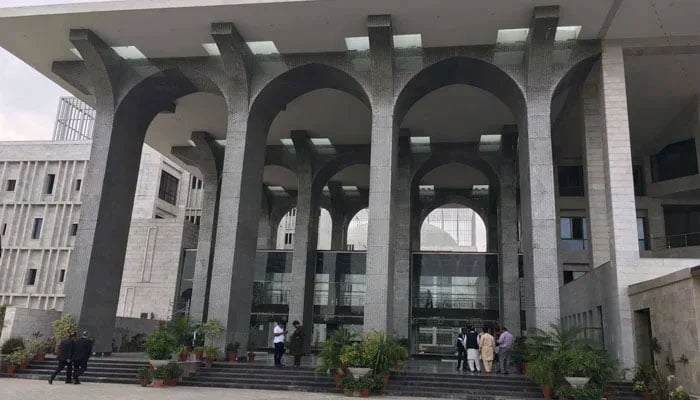
Islamabad High Court (IHC) Justice Khadim Hussain Soomro has expressed serious concern over the conduct of lawyers in the federal capital. He urged the leadership of the legal community to take steps to improve professional behaviour in courts.

The judge made the remarks during the hearing of a case in which Supreme Court Bar Association President Haroon Rashid appeared before the court.

Justice Soomro said he felt deeply disappointed after observing the attitude of some lawyers in Islamabad. He said lawyers were expected to cooperate with the court and maintain a respectful environment during proceedings.

The judge observed that lawyers in Islamabad did not provide the level of assistance that he expected. He said the behaviour he had witnessed was painful and disappointing.

Justice Soomro also referred to his background. He said he belonged to a village where people did not behave in such a manner. He remarked that even in his hometown, people showed greater respect while communicating with one another.

“I came here to learn, but I did not learn anything,” the judge said while expressing his disappointment over the situation.

He further criticised the manner in which some people spoke in the courtroom. He said it was regrettable to see people using inappropriate or disrespectful language during legal proceedings.

Justice Soomro asked the Supreme Court Bar president to take up the matter with lawyers’ representative bodies. He urged him to visit the bar council and bar association and advise lawyers to maintain professional standards.

The judge stressed that Islamabad was the federal capital. He said lawyers practising in the capital should demonstrate responsible and professional conduct.

Addressing Haroon Rashid, Justice Soomro said he was the president of one of the country’s largest and most influential bar associations. He asked him to play an active role in guiding lawyers and improving the atmosphere in courts.

The judge’s remarks highlighted the importance of discipline, mutual respect and cooperation between lawyers and judges. He said a healthy courtroom environment was essential for the smooth administration of justice.

Similar Posts

  • Junk food companies caught suing the laws meant to stop them

    The World Health Organization says something troubling is happening behind the scenes of the global obesity fight. Many of the same companies profiting from junk food sales are also dragging governments to court. Their goal is to block laws designed to curb the crisis. A joint investigation by The Guardian and Lighthouse Reports dug into this pattern. Academics and media groups across four continents took part. Together, they uncovered 235 lawsuits filed against governments over ultra-processed food policies. The cases span 2010 to 2025. Countries hit hardest include Mexico, Colombia, Brazil, the US, and the UK. Labelling rules were the most challenged policies. Junk food taxes came next, followed by marketing restrictions. Food companies did not fare well in court. They lost about 75 percent of decided cases. But WHO chief Tedros Adhanom Ghebreyesus says the scoreboard misses the real damage. It is the time these lawsuits consume that hurts most. Combined, the litigation added up to nearly 600 years. Each case dragged on for two and a half years on average. The costs go beyond legal bills. Governments spend billions on healthcare and courtroom battles alike. Tedros calls the resulting hesitation a “regulatory chill.” Long, expensive lawsuits make officials think twice before trying similar reforms. Researchers managed to trace plaintiffs in many of these cases. Of those identified, 38 percent came from just eight companies. The list includes Coca-Cola, PepsiCo, Mondelēz, Kellogg’s, Danone, Ferrero, Xignux, and Heartland Food Products Group. Some of these firms went a step further. They asked courts to keep their names hidden entirely. That secrecy tactic is not new. Researchers say it echoes moves once made by tobacco and alcohol companies. Both industries faced similar scrutiny in the past and used the same playbook. Tedros gave credit where it is due. He noted some companies have reformulated their products in good faith. Still, he insists that’s not enough while lawsuits keep piling up. There is also a wealth gap at play. Most legal battles are happening in richer nations. Poorer countries face the same obesity burden. But they have far fewer resources to defend new health policies if challenged in court. The scale of the crisis makes all this urgent. Nearly a billion people worldwide are currently living with obesity, per WHO estimates.

  • |

    Trump approves landmark US-Saudi nuclear pact

    US President Donald Trump has approved a landmark civilian nuclear agreement with Saudi Arabia, marking a major step in expanding strategic cooperation between the two countries. The proposed deal is expected to remain in effect for 30 years and is valued at tens of billions of dollars. The agreement is designed to support the development of Saudi Arabia’s civilian nuclear energy program while giving American companies a leading role in building the kingdom’s nuclear infrastructure. It is expected to create significant investment opportunities for US firms and strengthen long-term energy cooperation between Washington and Riyadh. Under the proposed framework, American companies could participate in constructing nuclear facilities across Saudi Arabia. The agreement also allows for the possibility of building a uranium enrichment plant in the kingdom if future joint studies by both governments determine that such a project is necessary. US officials say the deal will enable Washington to remain closely involved in the development of Saudi Arabia’s nuclear program. They believe this cooperation will help ensure that the kingdom’s nuclear activities remain focused on peaceful civilian purposes. The Trump administration is expected to submit the agreement to the US Congress in the coming days. The pact is being introduced under Section 123 of the US Atomic Energy Act of 1954, which provides the legal framework for civilian nuclear cooperation between the United States and foreign countries. Once submitted, Congress will have about 90 days to review the agreement. If lawmakers do not reject it during the review period, the agreement will automatically enter into force. Blocking the deal would require Congress to pass a joint resolution with enough votes to override a possible presidential veto. According to officials familiar with the proposal, the agreement does not include the “Gold Standard,” a condition that permanently bars partner countries from enriching uranium or reprocessing spent nuclear fuel. These activities can potentially be used in the production of nuclear weapons. The proposed agreement also reportedly does not include the International Atomic Energy Agency’s Additional Protocol. This protocol allows international inspectors to conduct broader inspections and monitor undeclared nuclear facilities. Its absence has raised concerns among some non-proliferation experts and lawmakers. US officials, however, insist that the agreement contains strong safeguards required under American law. They stress that the deal does not obligate the United States to transfer sensitive uranium enrichment technology or nuclear fuel cycle capabilities to Saudi Arabia. Instead, it establishes a legal pathway for future civilian cooperation while requiring separate approvals for any advanced technology transfers. The agreement follows earlier discussions between senior US and Saudi officials, who signed a preliminary framework last year to expand cooperation in the peaceful use of nuclear energy. The proposal has generated debate in Washington. Several Democratic lawmakers, along with some Republicans, have argued that stronger safeguards should be included before the agreement is approved. They believe stricter restrictions are necessary to reduce the risk of nuclear weapons proliferation in the Middle East. Saudi Arabia has repeatedly stated that its nuclear program is intended to meet growing energy demands and diversify the country’s energy resources. However, Crown Prince Mohammed bin Salman has previously said that if Iran were to acquire a nuclear weapon, Saudi Arabia would also seek similar capabilities. His remarks have fueled international concerns about a possible regional nuclear arms race.

  • Health Secretary’s Gujrat visit triggers major health shake-up

    GUJRAT: A high-level visit by Punjab Secretary for Health and Population Nadia Saqib to Gujrat triggered a major administrative shake-up, resulting in the transfer of senior health officials and a newly appointed medical superintendent, while the office of a patients welfare association at Civil Hospital Jalalpur Jattan was sealed. The secretary visited Gujrat to review the Community Health Inspectors (CHI) programme and attended a training workshop for field staff. Addressing community health inspectors, she stressed the importance of improving primary healthcare services, community engagement and effective field monitoring. The workshop was attended by Deputy Director Khalid Sharif, Additional Secretary (Technical) Dr Zohaib Hassan, Project Director PFPP Captain Usman and Additional Director PIU Dr Farrukh Amin. During the visit, Nadia Saqib also inspected Civil Hospital Jalalpur Jattan to review administrative affairs and healthcare services. According to well-placed sources, the secretary expressed serious displeasure after learning that the recent appointment of Dr Shehzad Gul as Medical Superintendent (MS) of Civil Hospital Jalalpur Jattan had been made without the matter coming to her notice. Sources claimed she questioned the appointment during the inspection and sought an explanation from local health authorities. Soon after the visit, Chief Executive Officer (Health) Gujrat Dr Atta-ul-Munim was transferred and posted as Senior Medical Officer (SMO) in Bahawalnagar. Officials familiar with the matter said the transfer order was issued immediately following the inspection. In another significant development, Dr Shehzad Gul, who had only recently assumed charge as Medical Superintendent of Civil Hospital Jalalpur Jattan, was transferred and posted as Medical Officer in Attock. The inspection also resulted in action against the office of Anjuman-e-Behbood-e-Mareezan operating within Civil Hospital Jalalpur Jattan. According to sources, the office was sealed during or after the visit following concerns that it was functioning in a manner inconsistent with its intended welfare role. Sources alleged that the office had effectively been operating like a business despite the fact that medicines required for patients are supplied free of cost through the government hospital. They claimed the matter was brought to the secretary’s attention during the inspection, prompting immediate action. The Health Department has not officially stated the reasons behind sealing the office. Meanwhile, sources indicated that further administrative changes could be on the cards, with the transfer of the District Health Officer (DHO) Gujrat also being considered, although no notification had been issued until late Thursday. No official spokesperson for the Punjab Health Department issued a detailed statement linking the transfers or the sealing of the office to disciplinary proceedings. Efforts to obtain comments from the transferred officials were unsuccessful. The developments have generated considerable discussion within Gujrat’s health sector, where employees view the latest decisions as part of a wider push for administrative accountability and stricter oversight of public health institutions. The secretary’s visit is being seen as a clear message that governance, transparency and adherence to departmental procedures will remain central to the provincial government’s healthcare reform agenda.

  • | |

    Deadly heatwave sweeps South Korea, claims 16 live…

    SEOUL: South Korea is grappling with one of the most intense heatwaves in its recorded history, with at least 16 people losing their lives and more than 2,000 others suffering from heat-related illnesses as extreme temperatures continue to grip the country. According to South Korean authorities, the nation recently recorded its highest temperature in 122 years of weather observations, with the southern city of Yangsan reaching a scorching 42.5°C. For the first time, officials have issued an extreme heat warning for the capital, Seoul, highlighting the severity of the ongoing weather conditions. President Lee Jae Myung has instructed government agencies to step up emergency measures to protect vulnerable groups, including the elderly, outdoor workers, and people with underlying health conditions. He also directed officials to closely monitor the country’s electricity supply as soaring demand for cooling systems places added pressure on the power grid. Climate experts say the unprecedented heat is being driven by a combination of persistent high-pressure weather systems and the growing impact of climate change, which has intensified extreme weather events across the region. Authorities continue to urge residents to limit outdoor activities, stay hydrated, and take precautions as the record-breaking heatwave shows little sign of easing.

  • | | | |

    Oil prices fall as Hormuz shipments resume

    Global oil prices fell sharply on Friday, extending weekly losses as crude exports through the Strait of Hormuz gradually resumed, easing fears of prolonged supply disruptions despite a fresh maritime security incident near Oman. Brent crude dropped nearly 2% to $73.76 per barrel, while US West Texas Intermediate (WTI) crude also declined around 2% to $70.43 per barrel during trading. The decline reflected growing market confidence that oil supplies from the Gulf were beginning to recover after months of disruption. Saudi Arabia’s state-owned energy company resumed crude loading operations at the Ras Tanura export terminal after a suspension of almost four months. Shipping data indicated that two very large crude carriers were loading oil at the terminal, with another tanker waiting offshore, signalling a gradual restoration of export activity. Market analysts said traders were reacting positively to the increase in tanker movements through the Strait of Hormuz, one of the world’s most important energy corridors. However, they noted that crude demand from China remains weaker than expected, adding downward pressure on prices. The market had briefly rallied a day earlier after a commercial cargo vessel was struck by an unidentified projectile near Oman, prompting the United Nations’ shipping agency to suspend its voluntary evacuation programme in the area. US officials later alleged that Iranian forces had fired on the vessel as it attempted to transit the strait, while Iranian authorities maintained that security could not be guaranteed for ships operating outside designated navigation routes. Although oil shipments through the Strait of Hormuz have reached their highest level since the outbreak of the US-Israel-Iran conflict in February, overall maritime traffic remains well below normal levels recorded before the crisis. Analysts observed that much of the recent increase in tanker traffic reflects vessels that had been stranded during the conflict finally leaving the Persian Gulf. They cautioned that inbound shipping remains limited, suggesting export flows could slow again once the backlog of delayed vessels has cleared. Adding another layer of uncertainty, earthquakes in Venezuela raised fresh concerns about global oil supplies. Initial assessments indicated that the country’s major oilfields, refineries and export facilities escaped significant damage because they were located away from the hardest-hit regions. Nevertheless, widespread power outages have created uncertainty over whether Venezuela can maintain crude production near its recent level of approximately 1.2 million barrels per day. Despite ongoing geopolitical tensions and supply risks, the resumption of Gulf oil exports outweighed immediate concerns, leaving both Brent and WTI crude on course for weekly losses of around eight percent.

  • |

    Pakistan seal seven-wicket win over County Select XI

    BECKENHAM: Pakistan produced a strong second-half turnaround on Saturday, defeating the Professional County Club Select XI by seven wickets in their three-day practice match at the Kent County Cricket Ground. Chasing 262 runs for victory on the final day, Pakistan made the target look comfortable, reaching 265-3 in just 57.1 overs. The result provided an encouraging boost for the visitors ahead of their three-match Test series against England. The star of Pakistan’s successful chase was Saud Shakeel, who delivered a composed unbeaten century. Coming in at No. 3 after opener Azan Awais was dismissed for just one, Saud took control of the innings and finished with 100 not out from 147 balls, hitting 10 fours and three sixes. He found an ideal partner in Imam-ul-Haq, with the experienced opener producing an attacking 80 from 88 deliveries. Imam struck 13 boundaries and combined with Saud for a crucial 127-run partnership, effectively taking the game away from the hosts. Mohammad Rizwan added a useful 33, while Awais Zafar remained unbeaten on 30 to complete the chase. Earlier, the PCC Select XI resumed their second innings at 128-3, holding a 195-run lead. Pakistan’s bowlers, however, quickly turned the pressure into wickets. The hosts managed only 66 additional runs before being dismissed for 194. Falconer top-scored with 56, while Saif Zaib and Manny Lumsden contributed 24 each. Spinner Ali Usman was Pakistan’s standout bowler, finishing with an impressive five wickets for 42 runs. Ubaid Shah claimed two wickets for just nine runs, while Salman Ali Agha, Sajid Khan and Mohammad Ali took one apiece. The comeback victory comes at an important moment for Pakistan. With their first Test against England scheduled to begin in Leeds on August 19, the performances of Saud, Imam and the bowling attack offer Pakistan plenty of confidence. After struggling earlier in the match, Pakistan finished strongly — exactly the kind of response they will hope to carry into the Test series. Brief Scores Pakistan beat PCC Select XI by seven wickets PCC Select XI: 305 (S. Zaib 65, M. Fisher 62*, C. Falconer 59, T. Haines 51; M. Ali 3-23, M. Abbas 3-37) & 194 (C. Falconer 56, J. Rew 40; A. Usman 5-42, U. Shah 2-9) Pakistan: 238 (A. Shafique 61; S. Bashir 4-76) & 264-3 (S. Shakeel 100*, I. ul-Haq 80 retired not out) Result: Pakistan won by 7 wickets.

Leave a Reply

Your email address will not be published. Required fields are marked *