this economy philippine
| | | | | |

[In This Economy] The Philippine economy is stuck in a rut

On August 7, the Philippine Statistics Authority reported that the economy grew by a measly 2.3% in the second quarter of 2026, down from 2.8% in the first quarter.

Save for the pandemic contraction, that is our weakest quarterly growth in 16 years. A BusinessWorld poll of 21 analysts had expected 2.8%, so the actual print also undershot even the already gloomy consensus.
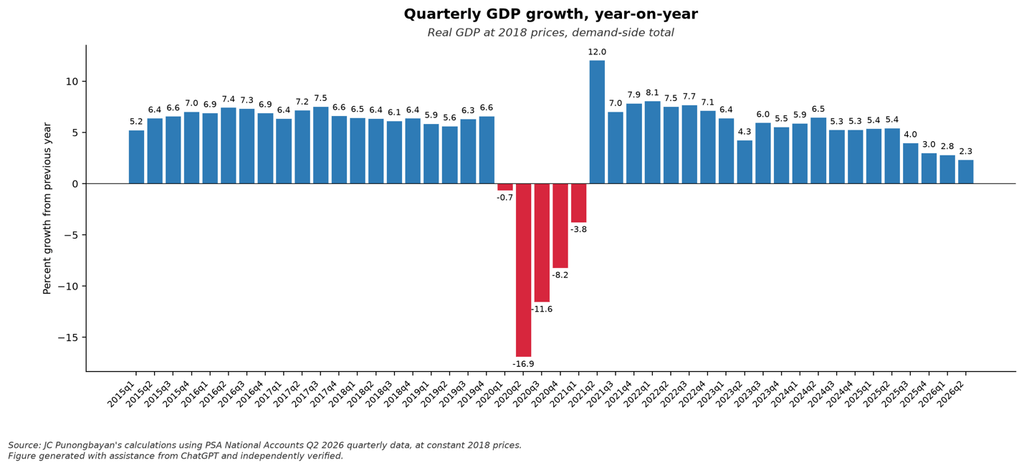
quarterly Philippines GDP growth, year on year 2026

The regional comparison also hurts a lot. In the same quarter, Vietnam grew by a robust 8.4%, while Malaysia grew by 5.8%, Singapore by 5.7%, and Indonesia by 5.3%. Even China, weighed down by a property slump and trade tensions, managed to eke out 4.3%.

That leaves the Philippines last among nearby economies that have reported so far. (Thailand’s second-quarter data are not yet out.)

Not too long ago, government officials routinely described the Philippines as one of Asia’s fastest-growing economies. That claim no longer seems tenable. Growth has substantially slowed for four consecutive quarters: from 5.4% in the second quarter of 2025 to 4%, 3%, 2.8%, and now 2.3%.

The longer trend is even more sobering. By my estimates, real GDP is now about 21% below its pre-pandemic trend, or where output would have been had the economy maintained its average pace in the 2010s. Six years after the lockdowns, the gap is widening rather than closing.

Corruption’s growth tax

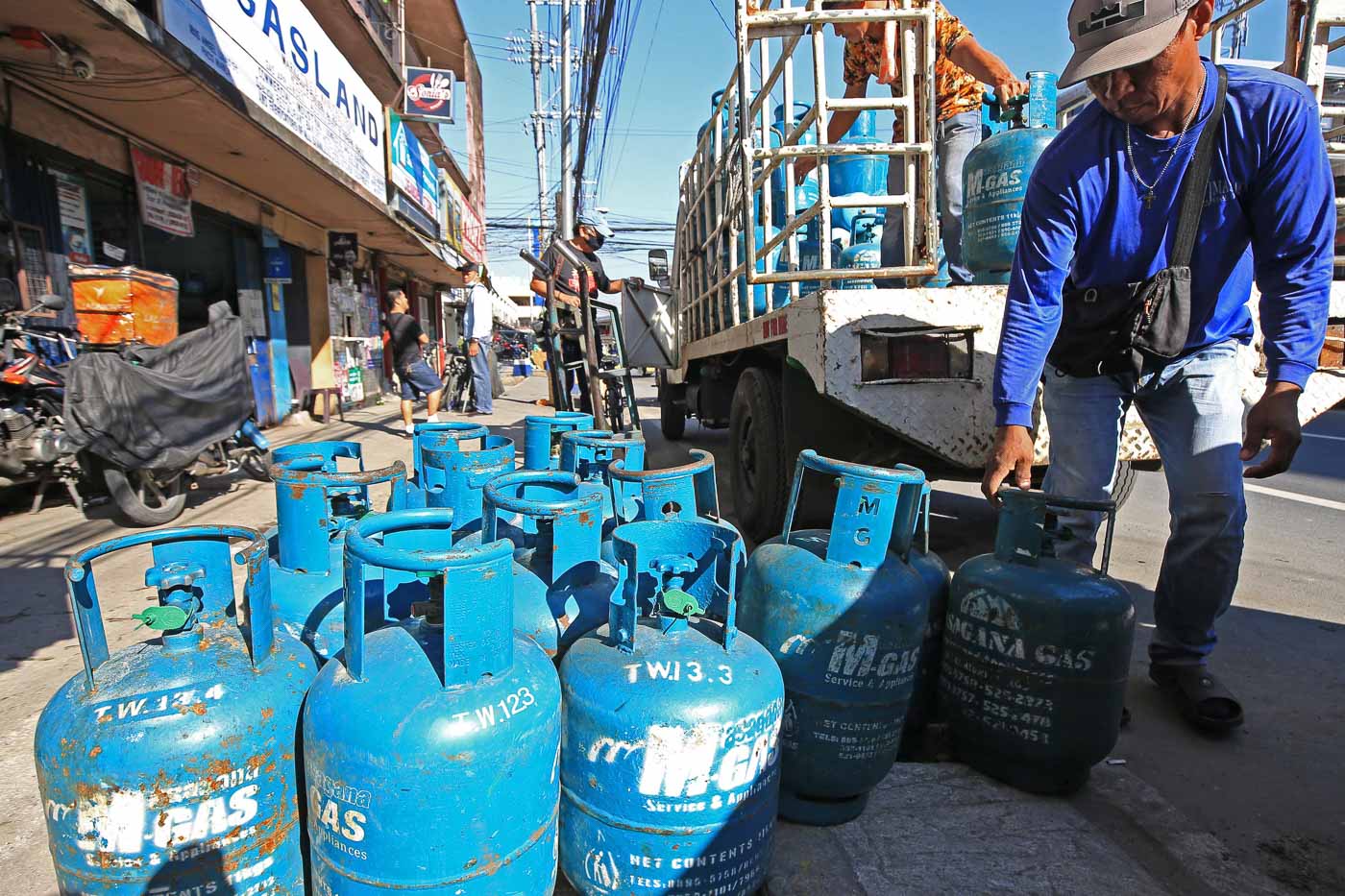
What dragged growth down? The official explanation emphasizes this year’s oil shock. The conflict in the Middle East pushed up world oil prices. And because the Philippines imports nearly all its oil, inflation averaged 4.8% in the first half of 2026 and peaked at 7.2% in April.

Much higher prices invariably ate into family budgets. Household consumption grew by just 2.8%, its weakest pace outside the pandemic since 2010. This is a significant drag in an economy where household spending makes up more than 70% of GDP.

But the national accounts point to a second, homegrown culprit. Gross capital formation (investment in construction, equipment, and inventories) contracted by 9.2% and subtracted 2.4 percentage points from growth, the largest drag among the major expenditure components.

Construction alone fell by 13.9%, while public construction collapsed by 32.4%, largely because of the fallout from the flood control corruption scandal. Projects have been suspended, contractors are under investigation, and agencies (particularly the Department of Budget and Management or DBM) have grown wary of disbursing funds.
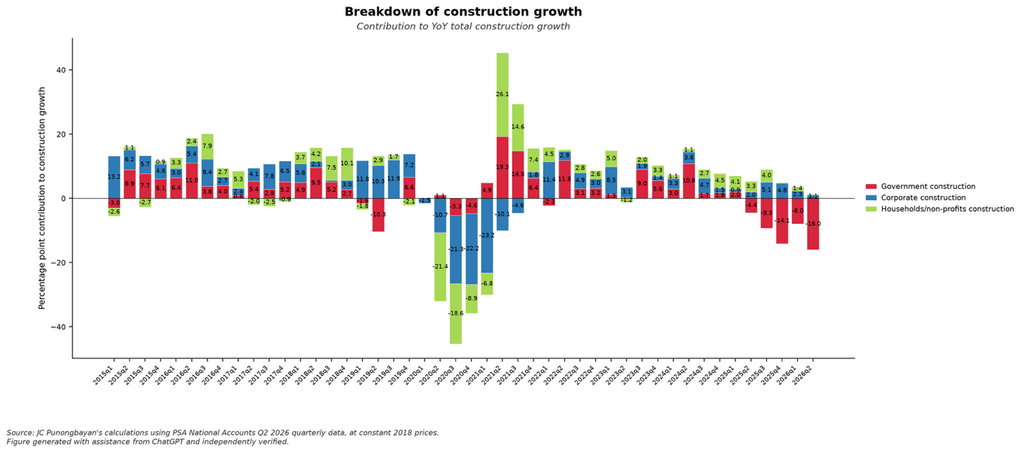
Breakdown of Philippine construction growth, 2026

You might reasonably call this corruption’s tax on growth. Questionable projects already wasted billions of pesos. But the cleanup, however necessary, is also subtracting from growth because the government’s construction machinery has all but stalled.

Industrial data tell more or less the same story. Services still grew by 4.5% and agriculture by 2.7%, but industry contracted by 2.4%, dragged down by construction and mining. In other words, the sectors that build physical assets and expand productive capacity are now shrinking.

Exports were the main bright spot, growing by 12.2% and contributing 3.2 percentage points to GDP growth. Without that export surge, total output would have been close to contracting. Admittedly, this is an unusual quarter where trade, long a weak point of the Philippine economy, does most of the heavy lifting.

Transitory?

During the GDP presser, Socioeconomic Planning Secretary Arsenio Balisacan called the slowdown “transitory” and ruled out stagflation, or the combination of stagnant growth and high inflation. He may be right that the oil shock will fade quickly if world prices ease.

Yet the investment problem looks persistent. Corruption investigations will take time, as they should, while business and consumer confidence tend to recover slowly. Investors are on a wait-and-see mode.

With growth averaging just 2.6% in the first half, to reach even the floor of the government’s already downgraded target of 3.5% to 4.5%, the economy must grow by about 4.4% in the second half—nearly twice its pace in the first semester.

Recall that the Marcos administration originally projected annual growth of 6.5% to 8% until 2028. To reach even the old lower bound this year, second-half growth would need to hit roughly 10.2%. That’s obviously a moonshot.

The immediate fixes are familiar: prosecute those responsible for anomalous projects, reform public procurement, restore integrity to the budget process, and restart legitimate infrastructure projects without reopening opportunities for corruption.

Yet the binding constraint is political. Many politicians and contractors benefited from the system that produced the scandal, and meaningful reform would threaten the same networks that dominate public spending.

In addition, initial reports about the National Expenditure Program (the proposed budget for 2027) tell us that the Marcos administration wants to allocate more than P107 billion in flood control projects. But specifically which projects will be funded? Exactly who will benefit? Will these eventual disbursements be credible? Has public confidence in flood control projects bounced back sufficiently to warrant another wave of flood control projects—in the run-up to the 2028 elections to boot?

By the way, the proposed budget also includes nearly P11 billion in confidential and intelligence funds—just as the impeachment trial of Vice President Sara Duterte is exposing how vulnerable to abuse these funds are.

Economists, for their part, should also estimate more precisely how much corruption is costing the country in forgone growth, jobs, and incomes. There is still little hard Philippine evidence on this, even though the costs are so huge they’re dragging down the economy.

Judging by the latest GDP figures, the costs of corruption are now undeniably showing up in the national accounts, plain for everyone to see. It’s a classic case of bad governance leading to bad economics. – Rappler.com

Jan Carlo “JC” Punongbayan, PhD is an associate professor at the University of the Philippines School of Economics (UPSE). His professional experience includes the Securities and Exchange Commission, the World Bank Office in Manila, the Far Eastern University Public Policy Center, and the National Economic and Development Authority. JC writes a weekly economics column for Rappler.com. He is also co-founder of UsapangEcon.com and co-host of Usapang Econ Podcast.

His first book, False Nostalgia: The Marcos “Golden Age” Myths and How to Debunk Them, was published by Ateneo de Manila University Press in February 2023. His second book, Twin Plagues: How Duterte and Covid-19 Wrecked the Philippine Economy, was published by Penguin Random House SEA in June 2026. Follow him on Instagram (@jcpunongbayan).

Below are In This Economy pieces you may have missed:

Click here for other In This Economy articles.

Similar Posts

  • |

    Electricity tariff may rise by Rs1.34 per unit under quarterly adjustment

    ISLAMABAD: Electricity consumers may face higher power bills for the next three months as the National Electric Power Regulatory Authority (Nepra) considers a proposal seeking to recover an additional financial burden from consumers through the quarterly tariff adjustment mechanism. Nepra has reserved its decision on a request submitted by electricity distribution companies seeking to pass on around Rs34 billion in additional costs to consumers. According to sources, the proposed adjustment could increase the electricity tariff by approximately Rs1.34 per unit each month for three months. If approved, the additional charge would be reflected in consumers’ electricity bills during the applicable period. The quarterly tariff adjustment is used to account for changes in various costs incurred by power distribution companies, including fluctuations in generation and other sector-related expenses. The adjustment is subsequently passed on to consumers after regulatory scrutiny. Sources said Nepra has not yet issued its final decision on the request. The regulator will examine the financial details and relevant data submitted by the distribution companies before determining whether the proposed increase should be approved in full, partially accepted or rejected. The final decision is expected to clarify the exact amount to be recovered from consumers and the period over which the additional charges will apply. Until Nepra announces its decision, the proposed Rs1.34 per-unit increase remains under consideration and should not be treated as a final tariff hike.

  • Thailand Secures Oil Supply to Keeps Gas Prices Stable Amid Middle East Conflict

    BANGKOK – The Department of Energy Business confirms Thailand will avoid a crude oil shortage this August despite the Middle East war. All six domestic refineries have sufficient supply because the nation is actively purchasing crude oil from the United States. This smart shift keeps local gas prices stable and reduces heavy reliance on risky […]

  • Bangkok Property Market Shifts to High-Value Homes Amid Economic Slowdown

    BANGKOK –  The Bangkok residential real estate market is undergoing a significant transformation in 2026. Developers are shifting their focus toward higher-priced homes while reducing the total number of new properties entering the market. According to data released by the Agency for Real Estate Affairs, residential properties remain the core driver of Thai real estate. […]

  • | | |

    Shehbaz, Bangladesh PM set for first Jakarta meeti…

    Prime Minister Shehbaz Sharif is expected to meet Bangladesh Prime Minister Tarique Rahman next week in Jakarta, Indonesia. The meeting will be the first between the two leaders since Tarique Rahman assumed office as Bangladesh’s prime minister around six months ago. The meeting is being viewed as significant in light of recent regional developments. Both leaders will be in Jakarta to attend the 12th summit of the D-8 Organisation for Economic Cooperation. The nine-member grouping is focused on strengthening economic cooperation among its member states. The three-day summit is scheduled to begin on Monday, August 17. The summit was earlier postponed in April due to the conflict that emerged in the Middle East. Leaders from member countries are now expected to gather in Jakarta for discussions on regional and economic issues. Prime Minister Shehbaz Sharif is also expected to hold a meeting with Iranian President Masoud Pezeshkian on the sidelines of the summit. The Pakistani prime minister is likely to meet other participating leaders as well. His expected engagements include a meeting with Turkish President Recep Tayyip Erdogan. The meetings are expected to provide an opportunity to discuss bilateral relations, regional developments and areas of mutual interest. The expected meeting between the Pakistani and Bangladeshi prime ministers also comes amid efforts to strengthen ties between the two countries. Both sides have shown interest in expanding cooperation in different areas. Pakistan has also decided not to seek special permission from India to use its airspace for the prime minister’s journey to Indonesia. Instead, Prime Minister Shehbaz Sharif’s aircraft will take an alternative route to reach Jakarta. The change in travel route will allow the Pakistani delegation to proceed with its scheduled participation in the D-8 summit without seeking special approval from India.

  • |

    Pakistan’s auto tax policy sparks industry divide over EV incentives

    LAHORE: Pakistan’s automobile industry is witnessing growing divisions over the government’s taxation policy for vehicles, with local manufacturers warning that the current framework unfairly benefits expensive imported and premium new energy vehicles (NEVs) while placing a heavier tax burden on affordable cars purchased by middle-income families. The controversy has intensified following the government’s decision to introduce a range of fiscal incentives for new energy vehicles, including battery electric vehicles (BEVs), plug-in hybrid electric vehicles (PHEVs) and range-extended electric vehicles (REEVs). While the policy is designed to accelerate Pakistan’s transition towards cleaner transportation and reduce reliance on fossil fuels, established local assemblers argue that the incentives are skewed in favour of luxury vehicle buyers instead of promoting affordable green mobility. Industry representatives say the taxation gap between conventional locally assembled vehicles and premium electric vehicles has widened considerably, raising concerns over fairness, competitiveness and the long-term sustainability of Pakistan’s domestic automobile manufacturing sector. According to industry estimates, a locally assembled Suzuki Alto—one of the country’s most affordable passenger vehicles priced at around Rs3 million—bears nearly Rs550,000 in taxes, including sales tax, federal excise duty (FED) and the recently introduced New Energy Vehicle (NEV) levy. In contrast, a premium REEV costing close to Rs10 million reportedly attracts sales tax of only around Rs100,000 while remaining exempt from both the federal excise duty and the NEV levy. The tax disparity has triggered criticism from domestic manufacturers, who argue that the current structure effectively penalises middle-income consumers while offering generous incentives to buyers of high-end imported vehicles. Local Assemblers Raise Concerns Pak Suzuki Motor Company spokesperson Ikhlaq Virk said the taxation framework has created an uneven competitive environment that disadvantages affordable vehicles widely used by Pakistani families. He said entry-level models such as the Alto and Cultus serve as essential transportation for the country’s middle class but receive no meaningful tax relief despite their affordability. Virk further noted that premium hybrid and electric vehicles, valued at nearly Rs10 million or more, continue to enjoy substantial concessions under the government’s clean mobility policy. He also pointed to reports suggesting that the sales tax on certain plug-in hybrid and hybrid electric vehicles could be reduced from 25 percent to 18 percent after changes introduced through the Finance Bill, arguing that such relief would primarily benefit affluent consumers rather than encouraging mass-market adoption. IMF Programme Adds Complexity The debate comes at a time when Pakistan remains under an International Monetary Fund (IMF) programme, which has required the government to increase tax revenues, rationalise subsidies and implement fiscal reforms to stabilise the economy. Against this backdrop, industry stakeholders argue that taxation policies should strike a balance between environmental objectives and economic realities, ensuring that clean energy initiatives do not disproportionately favour a small segment of wealthy consumers. The discussion has also reopened a broader policy debate over whether Pakistan’s green mobility strategy should focus solely on reducing emissions or also safeguard domestic manufacturing, employment and industrial investment. Analysts Call for Balanced Incentives Automobile industry experts believe Pakistan’s transition towards cleaner transportation is necessary, but they stress that government incentives should encourage widespread adoption instead of being concentrated in the luxury vehicle segment. Yousuf M. Farooq, Director Research at Chase Securities, said environmental goals should be pursued alongside industrial development and economic sustainability. He noted that while encouraging cleaner transportation is an important national objective, incentive programmes should also consider vehicle affordability, localisation, environmental benefits and the contribution of manufacturers to Pakistan’s economy. Farooq emphasised the need for a consistent taxation framework across all vehicle categories, including conventional internal combustion engine vehicles, hybrids, plug-in hybrids and range-extended electric vehicles, while maintaining adequate protection for local assembly operations and the domestic auto parts industry. He added that environmental incentives should not undermine the competitiveness of local manufacturers or threaten employment generated by Pakistan’s automotive sector. Local Industry Fears Investment Slowdown Pakistan’s automobile industry has invested billions of rupees over the past three decades in assembly plants, localisation programmes and vendor development. The sector supports hundreds of component manufacturers and provides employment to thousands of skilled workers across the country. Industry stakeholders warn that if imported premium electric vehicles continue to enjoy significantly lower taxation than locally assembled conventional vehicles, future investment in domestic manufacturing could slow, weakening Pakistan’s automotive supply chain and localisation efforts. Manufacturers believe a prolonged imbalance may discourage further expansion by existing assemblers while affecting the viability of local parts suppliers that have developed alongside the country’s automobile industry. Government’s Green Mobility Vision Supporters of the government’s policy argue that Pakistan cannot afford to lag behind the global transition towards electric mobility. Many countries are offering tax incentives, subsidies and policy support to encourage electric vehicle adoption, reduce dependence on imported petroleum products and lower carbon emissions. Pakistan, which spends billions of dollars annually on fuel imports, could also benefit from increased electrification of its transport sector by reducing its import bill and improving environmental sustainability over the long term. However, industry observers believe the core issue is not whether electric vehicles deserve policy support but how those incentives should be structured.

Leave a Reply

Your email address will not be published. Required fields are marked *