indias top court
|

India’s top court orders release of minors amid exam protests

NEW DELHI: India’s Supreme Court has ordered authorities to release minors detained during protests over examination paper leaks and directed officials to preserve evidence linked to allegations of excessive police force.

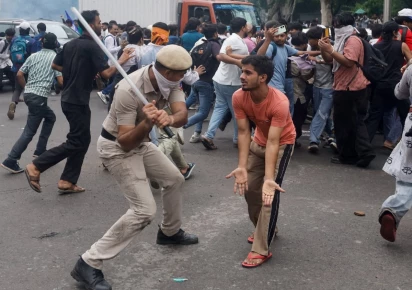
Chief Justice Surya Kant reportedly issued the interim directions while hearing petitions filed by student protesters and activists. The petitions accuse police and paramilitary personnel of using excessive force, including baton charges and other crowd-control measures, against demonstrators.

The court also directed authorities to preserve all available surveillance material from the protests. This includes CCTV recordings, drone footage and body-camera video. Officials were further told to protect the personal and digital information of protesters and ensure that it is not publicly disclosed.

The court reportedly barred authorities from taking coercive action against protesters while the matter remains under consideration.

Justice Kant stressed the importance of an independent investigation into allegations of mistreatment. He said accountability must be established if wrongdoing occurred.

The government has defended the security forces’ response, describing the measures as necessary for crowd control. Solicitor General Tushar Mehta told the court that around 250 police officers were also injured during the unrest. He reportedly said the government had no objection to an investigation into allegations involving protesters.

The protests erupted after question papers for a national medical college entrance examination were leaked. The controversy triggered demonstrations in New Delhi and several other parts of India.

Protesters demanded reforms to the examination system, withdrawal of cases against demonstrators and compensation for families of students who died by suicide following the controversy.

The demonstrations ended after the education minister resigned and the government agreed to several demands raised by the protesters.

Meanwhile, the Indian government has proposed tougher penalties for examination paper leaks. Under the proposed amendments, the maximum prison sentence could be increased to 10 years, while fines could rise to more than $1 million.

The government says the proposed changes are intended to strengthen the examination system, speed up legal proceedings and restore confidence among students and young people.

The issue has also created political tension in parliament. Opposition lawmakers have repeatedly raised concerns about the police response to the protests and demanded accountability.

In several cities, clashes between demonstrators and security personnel led to tear gas and baton charges. Authorities also suspended a police officer in an eastern state after he allegedly fired rounds into the air while attempting to disperse student protesters.

Concerns have additionally emerged over the use of artificial intelligence-powered surveillance during demonstrations. Activists have questioned the deployment of police surveillance equipment capable of providing wide-area monitoring of protest gatherings.

A protest group that helped lead the movement has claimed that hundreds of students were arrested in different states. However, the figure has not been independently verified.
Similar Posts

  • | |

    AJK polls completed transparently, says top poll o…

    Chief Election Commissioner of Azad Jammu and Kashmir Justice (retd) Ghulam Mustafa Mughal has said that the first phase of the electoral process in the region was completed in a free and transparent manner. He said all political parties actively participated in the elections. He added that polling was conducted in a peaceful environment across the region. Justice (retd) Ghulam Mustafa Mughal said voters participated in large numbers. He said people exercised their constitutional right to vote and took part in the electoral process. The chief election commissioner said the overall polling process remained peaceful. He said election authorities and other relevant institutions worked to ensure that voters could cast their ballots. He also acknowledged the role of law enforcement agencies during the elections. According to him, security personnel played an exemplary role in maintaining law and order. The chief election commissioner said security arrangements helped keep the polling environment peaceful. Law enforcement agencies remained deployed to deal with any situation that could affect the electoral process. However, he said an incident was reported in Samahni where attempts were made to disrupt polling. The people involved in creating a disturbance were arrested, he said. Justice (retd) Ghulam Mustafa Mughal said the authorities took action to ensure that polling activities were not affected. He stressed that maintaining peace was essential for a smooth electoral process. He also highlighted the participation of political parties in the elections. He said their involvement reflected the importance of the electoral process in Azad Jammu and Kashmir. The chief election commissioner’s statement came after the completion of the first phase of polling in the region. The election process attracted significant participation from voters. He said the authorities remained focused on ensuring transparency throughout the process. He also stressed the importance of maintaining law and order during polling. The election authorities are now expected to continue the next stages of the electoral process according to the announced schedule. The results and subsequent procedures will determine the political direction of the region. Justice (retd) Ghulam Mustafa Mughal said the peaceful completion of the first phase was an important development. He maintained that the cooperation of political parties, voters, election officials and law enforcement agencies helped the process move forward.

  • |

    Does your native language control how you think?

    With over 7,000 distinct human languages spoken across the globe today, humanity communicates through fascinating sentence structures. A compelling debate has captivated thinkers for decades. Does the language you grow up speaking dictate the limits of what your mind can comprehend? This captivating idea lies at the heart of the Sapir-Whorf hypothesis. A theory that continues to provoke vibrant discussions across linguistics, philosophy, and cognitive science. The Power of Vocabulary and Perception The hypothesis was formulated in the early 20th century by linguists Edward Sapir and Benjamin Lee Whorf. It’s often referred to as linguistic relativity or linguistic determinism. They propose that the structure of a native language fundamentally shapes its speakers’ worldview and cognitive capacity. If a concept or object lacks a dedicated word in a person’s language, that person cannot truly perceive, categorize or conceptualize it. Consider how different cultures classify colors. Some languages possess dozens of specific terms for distinct shades. Whereas,  others operate with only a couple of basic terms distinguishing between light and dark tones. According to strong linguistic determinism, a speaker whose native tongue lacks a dedicated word for green would struggle to perceive a green leaf as distinct from yellow. Similarly, emotional vocabularies vary widely across cultures. German famously uses the word Schadenfreude to describe taking pleasure in someone else’s misfortune. According to Sapir-Whorf theory, an English speaker whose language lacks an exact single-word equivalent would supposedly find it difficult to recognize or isolate that specific emotional state within themselves. Why the Concept Fascinates Us? It is easy to see why the Sapir-Whorf hypothesis captured public imagination. The notion that our mother tongue acts as a unique way through which we view reality is deeply romantic. Philosophically, the theory suggests that the world contains thousands of distinct cognitive universes. If language entirely dictated thought, cross-cultural understanding would face profound barriers. It is so as the speakers of different languages would operate inside fundamentally incompatible mental frameworks. In semantic studies, labeling objects and experiences allows humans to organize chaotic sensory input efficiently. Giving a name to a precise group such as distinguishing toddlers, teenagers and senior citizens helps us categorize society into recognizable stages. The hypothesis demonstrated that naming things provides cognitive shortcuts. Such a naming method makes specific distinctions far easier to reference and discuss in daily life. Why Modern Science Rejects Strong Determinism Despite its initial popularity, modern linguistics and cognitive scientists reject strong linguistic determinism. The fundamental flaw in the hypothesis rests on a misunderstanding of the relationship between mind and speech. Language does not produce thought. Rather, human thought drives the creation and evolution of language. When people encounter new experiences, foods or technologies, they do not remain silent simply because they lack pre-existing terminology. Instead, humans spontaneously create new phrases. They adapt existing terms or borrow words from other cultures to describe what they have experienced. An English speaker can easily understand and feel pleasure at a rival’s failure without ever having heard the German word Schadenfreude. While English uses blue for both dark and light shades. Whereas Italian maintains separate primary words (blu and azzurro). English speakers are fully capable of seeing the difference between a midday sky and the deep ocean. Human cognition precedes language. Speech serves as a flexible tool designed to communicate human experiences, not a rigid cage that imprisons cognitive ability. The Lasting Value of Sapir-Whorf   The Sapir-Whorf hypothesis retains great value even if its most radical claim has been disproven. It paved the way for weak linguistic relativity. The claim further explores how language subtly influences cognition, memory and visual attention without imposing hard limits on intellect. Ultimately, Sapir and Whorf inspired generations of researchers to explore the mysterious connection between human culture, language and the mind.

  • |

    Robert Pattinson to end Batman journey after Matt Reeves trilogy

    Robert Pattinson appears set to hang up the Batman cape after completing the upcoming trilogy directed by Matt Reeves, bringing his journey as Gotham City’s iconic vigilante to an end. Pattinson first stepped into the role of Bruce Wayne in 2022 with The Batman, directed by Reeves. The film offered a darker and more grounded interpretation of the legendary DC character, focusing on a young Batman still finding his place as a crime fighter while confronting corruption across Gotham City. Following the success of the first installment, Pattinson is returning for The Batman Part II. The highly anticipated sequel is scheduled to arrive in 2028 and will continue the story of Bruce Wayne as he faces new challenges following the events of the first movie. A third film in Reeves’ planned trilogy has also been announced, setting the stage for the conclusion of Pattinson’s version of the character. According to recent reports, Pattinson has indicated that he intends to portray Batman one final time after completing Reeves’ trilogy. If the plan remains unchanged, the third installment would mark the actor’s last appearance as the Caped Crusader in this particular series. Pattinson’s debut Batman movie featured a star-studded cast, including Paul Dano as the Riddler and Colin Farrell as Oswald Cobblepot, better known as the Penguin. Jeffrey Wright portrayed Gotham police officer James Gordon, while Andy Serkis appeared as Alfred Pennyworth. The first film followed Batman as he investigated the murder of Gotham City’s mayor. His investigation gradually uncovered a larger conspiracy involving some of the city’s most influential figures. As Bruce dug deeper, he was forced to confront disturbing connections between Gotham’s criminal underworld, political corruption and his own family history. The movie ended with Batman defeating the Riddler’s plans and helping rescue Gotham’s citizens after the city was devastated by flooding. The Riddler was eventually taken to Arkham State Hospital, where he encountered another mysterious inmate. That brief scene fueled widespread speculation that the prisoner was the Joker, played by Barry Keoghan. Although the character’s appearance was limited, the moment opened the door for a possible larger role in future installments. The Joker is widely expected to become an important figure in the upcoming storyline, although many details surrounding his involvement remain under wraps. Pattinson’s Batman will also face the challenge of dealing with the consequences of the first film while continuing to protect Gotham. The Batman Part II is currently scheduled for release on February 18, 2028. Alongside Pattinson, the movie is expected to feature several returning cast members, while Scarlett Johansson and Sebastian Stan have also been linked to the project.

  • | | |

    PM rebukes Islamabad chief commissioner, IG over i…

    ISLAMABAD: Prime Minister of Pakistan has reprimanded Islamabad’s Chief Commissioner and Inspector General of Police (IGP) over their use of a ceremonial buggy during the Independence Day celebrations, describing the display as inconsistent with the principles and values expected from senior public servants. According to official advisories issued by the Prime Minister’s Office on August 17, the incident took place on August 14 during the Independence Day celebrations. Chief Commissioner Islamabad Lt. (Retd.) Sohail Ashraf and IG Islamabad Syed Ali Nasir Rizvi reportedly used a ceremonial carriage belonging to the Prime Minister’s House to attend and observe the parade.The Prime Minister himself was not present at the event. The use of the ceremonial buggy attracted public criticism, with concerns raised over what was perceived as an unnecessary display of protocol and privilege by senior government officials. In its advisory, the Prime Minister’s Office expressed serious displeasure over the incident and said the conduct created an inappropriate impression about the role of public servants. The office maintained that government officials are expected to uphold simplicity, humility and dignity rather than engage in displays of grandeur or personal prominence. The Prime Minister stated that the use of such protocol projected an image of privilege, ostentation and personal aggrandisement that was contrary to the basic ethos of public service. He stressed that government officers serve the public and should therefore avoid conduct that could undermine public confidence in state institutions. The advisory further warned that displays of excessive protocol and personal privilege by senior officials could damage the credibility of public institutions. It emphasized that officers occupying important administrative and law-enforcement positions are expected to demonstrate the highest standards of professionalism and propriety. Following the Prime Minister’s directions, the Establishment Division issued a formal warning to the two officers through Joint Secretary (Discipline) Syeda Shafaq Hashmi. The directive called for an immediate end to practices involving unnecessary protocol, exhibitionism and self-promotion at official events. It instructed the officers to ensure that such conduct does not happen again and emphasized the importance of maintaining simplicity and dignity while performing official duties. The Establishment Division also directed that the advisory be followed strictly, both in letter and spirit. The warning serves as a reminder to senior civil servants that official positions come with significant responsibilities and require them to maintain appropriate standards of conduct in public. The Prime Minister’s Office highlighted the special responsibilities of the Chief Commissioner and IG Islamabad, who serve as the administrative and police heads of the federal capital. Given their positions, the public and government expect them to set an example through responsible governance, discipline and appropriate behavior. The episode has once again brought attention to the government’s emphasis on reducing unnecessary official protocol and promoting a culture of simplicity among public officials. The Prime Minister’s message was clear that public office should be associated with service, responsibility and accountability rather than privilege and ceremonial extravagance. The two officials have now been directed to ensure that similar displays do not recur at future official functions and to uphold the standards expected from senior government officers.

  • | | |

    PM orders expansion of strategic oil reserves

    ISLAMABAD: Prime Minister Shehbaz Sharif has directed authorities to expand Pakistan’s strategic petroleum reserves while approving key amendments to the Pakistan Oil Refining Policy 2023, a move aimed at strengthening the country’s energy security, attracting investment and modernising the refining sector. Chairing a meeting of the Cabinet Committee on Energy (CCoE), the prime minister was briefed on the progress of refinery upgradation projects, ongoing energy sector reforms and the implementation of the revised refining policy. He described the modernisation of Pakistan’s oil refineries as a national priority, saying it would improve energy security, reduce reliance on imported fuels and support the production of cleaner, environmentally friendly petroleum products. The approved amendments focus on upgrading existing refineries to increase production capacity while enabling the manufacture of Euro-V standard petrol and diesel. The changes are also intended to reduce the production of furnace oil and other lower-quality petroleum products, helping Pakistan meet international environmental commitments and curb air pollution. To encourage foreign investment, Prime Minister Shehbaz instructed officials to organise investment roadshows in Qatar, Saudi Arabia and other Gulf countries to promote opportunities in Pakistan’s refining sector. He stressed that the revised policy must be implemented without delay and warned that negligence in executing the reforms would not be tolerated. The premier also directed relevant ministries and institutions to maintain close coordination with stakeholders to accelerate the reform process. In addition, he called for improvements in the performance of the Oil and Gas Regulatory Authority (OGRA) to promote greater transparency, competition and investor confidence in the energy market. Pakistan has been seeking to strengthen its fuel security after recent regional tensions exposed the country’s vulnerability to supply disruptions. The absence of strategic petroleum reserves became a major concern during the conflict that affected oil shipments through the Strait of Hormuz, prompting renewed urgency for energy sector reforms. The refining policy has faced repeated delays since its formulation. Although finalised in 2023 and approved the following year after years of consultations, implementation stalled when incentives were withdrawn in the federal budget, causing refinery upgrade agreements to be put on hold. Discussions resumed after the government addressed financial concerns raised by refinery operators and pledged measures to revive nearly $6 billion in planned investments. Industry stakeholders have continued to seek policy stability and tax-related assurances, arguing that unresolved issues, including sales tax on imported equipment and refinery inputs, have created financial challenges that threaten the viability of modernisation projects. The government has indicated that further measures will be introduced to facilitate investment and ensure the successful implementation of the refinery upgrade programme.

Leave a Reply

Your email address will not be published. Required fields are marked *