iran advances hormuz
|

Iran advances in Hormuz talks with Oman


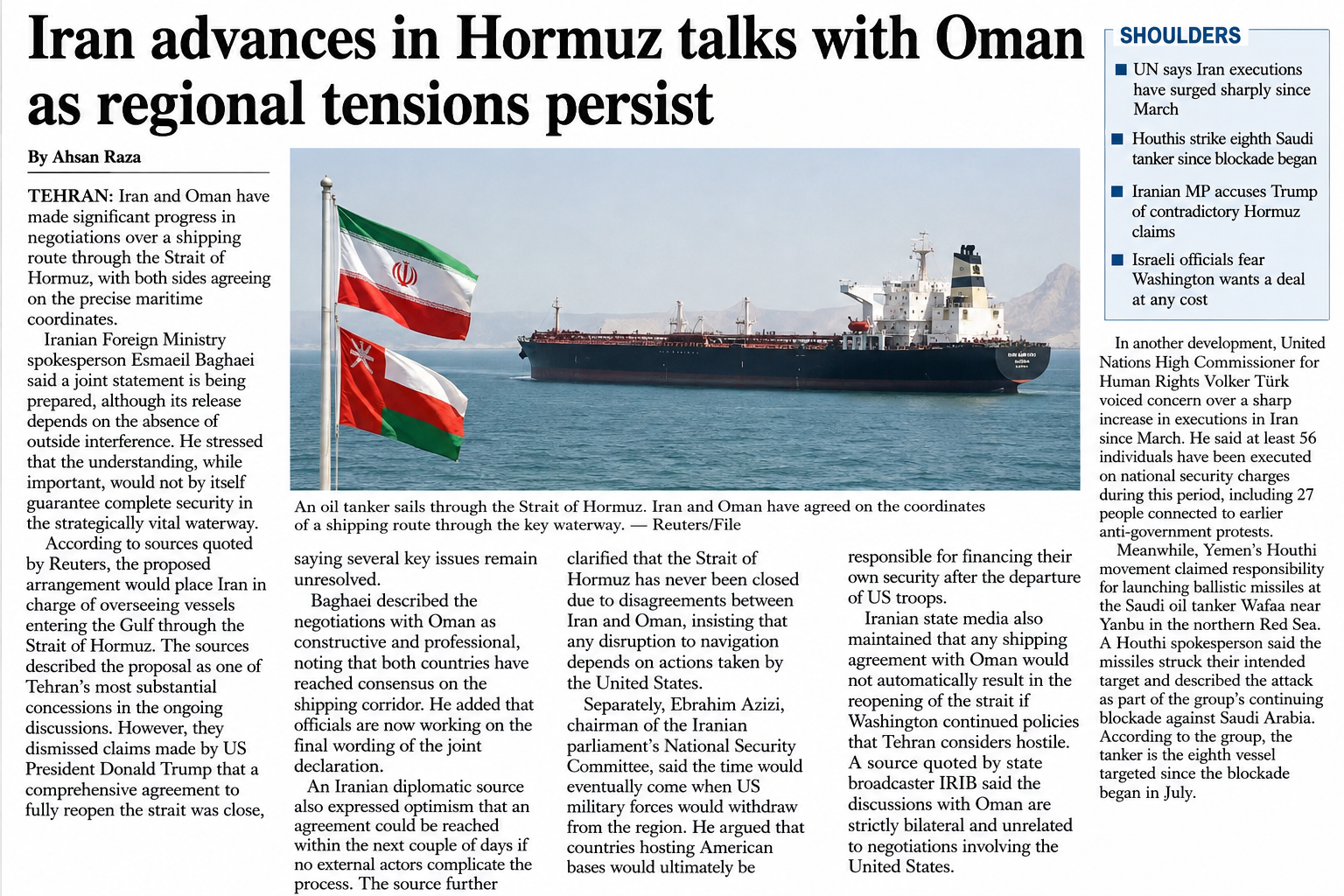
Iran and Oman have made significant progress in negotiations over a shipping route through the Strait of Hormuz, with both sides agreeing on the precise maritime coordinates. Iranian Foreign Ministry spokesperson Esmaeil Baghaei said a joint statement is currently being prepared, although its release depends on the absence of outside interference. He stressed that the understanding, while important, would not by itself guarantee complete security in the strategically vital waterway.

According to sources, the proposed arrangement would place Iran in charge of overseeing vessels entering the Gulf through the Strait of Hormuz. The sources described the proposal as one of Tehran’s most substantial concessions in the ongoing discussions. However, they dismissed claims made by US President Donald Trump that a comprehensive agreement to fully reopen the strait was close, saying several key issues remain unresolved.

Baghaei described the negotiations with Oman as constructive and professional, noting that both countries have reached consensus on the shipping corridor. He added that officials are now working on the final wording of the joint declaration. An Iranian diplomatic source also expressed optimism that an agreement could be reached within the next couple of days if no external actors complicate the process. The source further clarified that the Strait of Hormuz has never been closed due to disagreements between Iran and Oman, insisting that any disruption to navigation depends on actions taken by the United States.

Separately, Ebrahim Azizi, chairman of the Iranian parliament’s National Security Committee, said the time would eventually come when US military forces would withdraw from the region. He argued that countries hosting American bases would ultimately be responsible for financing their own security after the departure of US troops.

Iranian state media also maintained that any shipping agreement with Oman would not automatically result in the reopening of the strait if Washington continued policies that Tehran considers hostile. A source quoted that the discussions with Oman are strictly bilateral and unrelated to negotiations involving the United States.

In another development, United Nations High Commissioner for Human Rights Volker Türk voiced concern over a sharp increase in executions in Iran since March. He said at least 56 individuals have been executed on national security charges during this period, including 27 people connected to earlier anti-government protests.

Meanwhile, Yemen’s Houthi movement claimed responsibility for launching ballistic missiles at the Saudi oil tanker Wafaa near Yanbu in the northern Red Sea. A Houthi spokesperson said the missiles struck their intended target and described the attack as part of the group’s continuing blockade against Saudi Arabia. According to the group, the tanker is the eighth vessel targeted since the blockade began in July.

Iranian parliamentarian Esmail Kowsari criticised President Trump’s public statements on the Strait of Hormuz, accusing him of making inconsistent and misleading claims about the negotiations. He argued that repeated assertions about the strait reopening and Iran’s position have failed to match developments on the ground.

President Trump, however, said the waterway would reopen soon and warned that Iran would face severe consequences if negotiations collapsed. He also claimed that easing tensions in the region could lead to a significant drop in global oil prices.

Qatar said diplomatic mediation efforts are making steady progress, with the country’s Emir discussing the latest developments with President Trump in an effort to narrow differences between Washington and Tehran. At the same time, Israeli officials reportedly expressed concern that the United States appears willing to secure an agreement regardless of the terms, adding that Israel is receiving updates on the Hormuz negotiations only through indirect channels.
Similar Posts

  • |

    Houthis seek to replicate Iran’s Strait of Hormuz strategy in Red Sea, warns Yemeni diplomat

    Yemen’s Houthi movement is attempting to replicate Iran’s strategy in the Strait of Hormuz by disrupting maritime traffic through the Bab el-Mandeb strait, Yemeni Foreign Minister-designate Afrah al-Zouba warned on Monday. Speaking to reporters at the Yemeni Embassy in Riyadh, al-Zouba stated that an insufficient international response has emboldened the group to pursue control over critical Red Sea shipping corridors. The Red Sea has emerged as a major flashpoint following escalations linked to the broader regional conflict involving Iran. The Houthis have intensified operations against Saudi Arabia by launching drone and missile strikes and announcing a blockade on Saudi-bound shipping. In response, Saudi Arabia has conducted airstrikes targeting Houthi military positions and reaffirmed its commitment to protecting commercial maritime routes. The surge in hostilities threatens to unravel the fragile truce established in 2022, raising concerns among diplomats and officials over a potential return to full-scale war in Yemen. Al-Zouba confirmed that while military skirmishes persist along frontline positions stretching from the Red Sea to the Saudi border, neither side has launched a major ground offensive. She emphasised that the internationally recognised government is prepared for further escalation, asserting that the conflict must ultimately be resolved either diplomatically or by force.

  • |

    Xi backs Brazil against foreign interference in call with Lula

    Chinese President Xi Jinping expressed support for Brazil’s efforts to protect its sovereignty and resist foreign interference during a phone conversation with Brazilian President Luiz Inacio Lula da Silva, according to Chinese state media. The discussion took place just months before Brazil’s closely watched presidential election and against the backdrop of growing trade and diplomatic tensions with the United States. According to China’s Xinhua news agency, Xi praised Brazil’s role on the international stage and said Beijing values the country’s influence in global affairs. He stated that China supports Brazil in defending its independence, rejecting outside interference, and contributing to regional and international peace and stability. The phone call comes less than three months before Brazilians head to the polls in an election expected to be highly competitive. President Lula is seeking another term and faces a challenge from right wing candidate Flavio Bolsonaro, the son of former president Jair Bolsonaro. The Brazilian presidency said the two leaders also discussed strengthening economic cooperation. Both sides agreed on the importance of accelerating negotiations for a trade agreement between China and Mercosur, the South American trade bloc that includes Brazil, Argentina, Paraguay, and Uruguay. Such an agreement could expand trade opportunities between the region and the world’s second largest economy. During the conversation, which lasted more than an hour, Lula reaffirmed his commitment to expanding Brazil’s international trade network. He said his government is working to diversify export markets and reduce dependence on a limited number of trading partners, particularly as Brazil faces increased tariff pressure from the United States. Relations between Brasilia and Washington have become more strained in recent months. The United States introduced two additional rounds of tariffs on a range of Brazilian products this month, following a significant tariff increase imposed last year. The measures were linked to political tensions surrounding the legal case that resulted in former president Jair Bolsonaro being sentenced to prison over an alleged coup plot. Lula has strongly criticized the tariffs, arguing that they amount to political pressure during an election year. He has accused Washington of attempting to influence Brazil’s domestic affairs through economic measures, an allegation the United States has rejected. Diplomatic tensions have also surfaced over election related issues. According to diplomatic sources, Brazil recently refused entry visas for two American officials who planned to visit the country’s election authorities ahead of the October vote. The move reflected growing sensitivity within the Brazilian government over foreign involvement in electoral matters. Meanwhile, Flavio Bolsonaro has continued to question the reliability of Brazil’s electronic voting system despite repeated assurances from election officials that it is secure. His claims have echoed similar allegations made by US President Donald Trump regarding American elections, although no credible evidence has supported those accusations. While the Chinese government highlighted Xi’s support for Brazil in resisting external interference, the official statement released by the Brazilian presidency did not specifically mention that part of the discussion. Instead, it focused on economic cooperation and the importance of strengthening trade ties between Brazil, China, and the Mercosur bloc. The conversation underscores the increasingly close relationship between Beijing and Brasilia at a time when Brazil is balancing political challenges at home with shifting economic and diplomatic dynamics on the global stage.

  • | | |

    Japan backs stronger, deeper Pakistan partnership

    Japanese Ambassador to Pakistan Akamatsu Shuichi has reaffirmed Tokyo’s commitment to further strengthening its longstanding relationship with Pakistan. In a message ahead of Pakistan’s 79th Independence Day, the Japanese envoy conveyed greetings to the Pakistani government and people on behalf of Japan. Speaking in Urdu in a video message, Ambassador Shuichi highlighted the longstanding friendship between the two countries and expressed hope for deeper cooperation in the coming years. He noted that Pakistan and Japan will mark the 75th anniversary of their diplomatic relations in 2027. The ambassador said both countries would continue working as trusted partners to promote peace, development and stability. He also pledged to further strengthen friendly relations between Tokyo and Islamabad. Shuichi concluded his message by expressing confidence in the continued bond between the two nations and saying, “Japan-Pakistan Dosti Zindabad.” The ambassador’s message comes shortly after Pakistan and Japan signed a grant agreement worth 350 million Japanese yen, equivalent to around $2.2 million, to strengthen the Human Resources Development Scholarship Programme. The initiative, known as the JDS programme, will expand opportunities for Pakistani civil servants to receive postgraduate education and professional training in Japan. Under the agreement, 17 federal government officials will receive scholarships. Sixteen will pursue master’s degrees, while one official will undertake a PhD programme. Economic Affairs Secretary Muhammad Hameer Karim and Ambassador Akamatsu Shuichi signed the Record of Discussions for the programme. Senior Joint Secretary Miran Mohiuddin Soomro and JICA Chief Representative Yusuke Shinazaki signed the grant agreement. The scholarship programme is expected to contribute to human resource development and strengthen institutional links between Pakistan and Japan.

  • |

    Systemic coronial delays finally end as remains of Bikram Lama are repatriated from Sydney

    Eight months after his tragic death, the remains of thirty-two-year-old former international student Bikram Lama are finally being prepared for repatriation to his family in Makwanpur, Nepal. Bikram, who had been sleeping rough near Sydney’s Hyde Park, passed away unobserved in December, prompting widespread public outrage and intense scrutiny over the systemic failures that leave non-residents trapped in homelessness. Following months of agonising waiting for his grieving seventy-one-year-old mother, Seti Maya Lama, the New South Wales coroner has released his body to a Sydney funeral service, allowing the family the opportunity to perform his final rites. The prolonged delay in returning Bikram’s body was initially prolonged by mandatory DNA verification procedures, but persistent backlogs within the New South Wales coronial system extended the ordeal for months after testing was completed. Legal experts and former judicial officials have highlighted the incident as evidence of flaws within the state’s coronial framework, citing a lack of dedicated police investigative units and poor inter-agency coordination. With financial assistance provided by community organisations, international students, and the Nepalese government, Bikram’s family is preparing to receive his remains, while frontline advocates continue to push for a formal inquest to address the underlying homelessness crisis.

  • |

    India Temple stampede leaves 7 dead, dozens injure…

    NEW DELHI: A crowded morning of worship turned tragic at the Ashok Dham Temple in India’s Bihar state on Monday after a stampede-like incident killed at least seven devotees and injured more than a dozen others. The incident occurred in Lakhisarai district as thousands of worshippers gathered at the temple on the third Monday of the Hindu month of Sawan. Local reports said the crowd surged suddenly, creating panic outside the shrine. Officials said the arrival of two trains between around 6:30am and 6:45am sharply increased the number of people near the temple. The sudden rush reportedly caused a barricade to break, leaving people falling over one another. Initial reports also suggested that an electrical pole or wire may have fallen, triggering panic among worshippers. Authorities have yet to establish the exact sequence of events, and an investigation is underway. Emergency teams and district officials rushed to the scene after the incident. Several injured people were taken to nearby hospitals for treatment, while authorities worked to restore order and manage the remaining crowds. The tragedy has renewed concerns about crowd-control arrangements at major religious gatherings in India, where large numbers of devotees often converge at temples during important festivals. Officials said rescue and relief operations were continuing, while authorities were monitoring the situation around the temple. The incident comes as religious sites across the region experience heavy attendance during the Sawan season, highlighting the importance of effective crowd management, emergency access and safe movement routes.

  • |

    Human rights organizations file federal lawsuit challenging Trump administration sanctions on ICC

    Four prominent non-governmental organizations filed a joint federal lawsuit contesting executive sanctions imposed by the Trump administration on the International Criminal Court, arguing the penalties unlawfully disrupt global war crimes prosecutions. The legal challenge, brought by Human Rights Watch, the Center for Constitutional Rights, the Open Society Institute, and the American Friends Service Committee, targets an executive order enacted in February 2025. The presidential directive established financial sanctions and travel bans against ICC officials, judges, and affiliated advocacy groups involved in investigating alleged war crimes in Palestinian territory, including cases involving senior Israeli officials. Attorneys representing the civil rights organizations contend that the broad scope of the sanctions violates First Amendment protections regarding free speech and association. The suit asserts that the threat of severe civil and criminal penalties has effectively forced US-based legal advocates to suspend representation of victims before the tribunal, while halting formal collaborations with sanctioned international rights groups. The filing marks the latest in a series of legal challenges against the administration’s broader push to limit the jurisdiction of the Hague-based court. Representatives for the US Department of State and Department of Justice did not immediately issue formal statements regarding the lawsuit.

Leave a Reply

Your email address will not be published. Required fields are marked *