iran sets tough
| | |

Iran sets tough conditions for Strait of Hormuz re…

Iran has warned that the strategically vital Strait of Hormuz will remain closed until the United States meets a series of conditions under a June memorandum of understanding, raising fresh concerns about the future of a conflict that has already disrupted global energy markets.

Iranian Parliament Speaker Mohammad Bagher Ghalibaf said on Tuesday that Tehran would not reopen the waterway until what he described as the full terms of the agreement had been implemented.
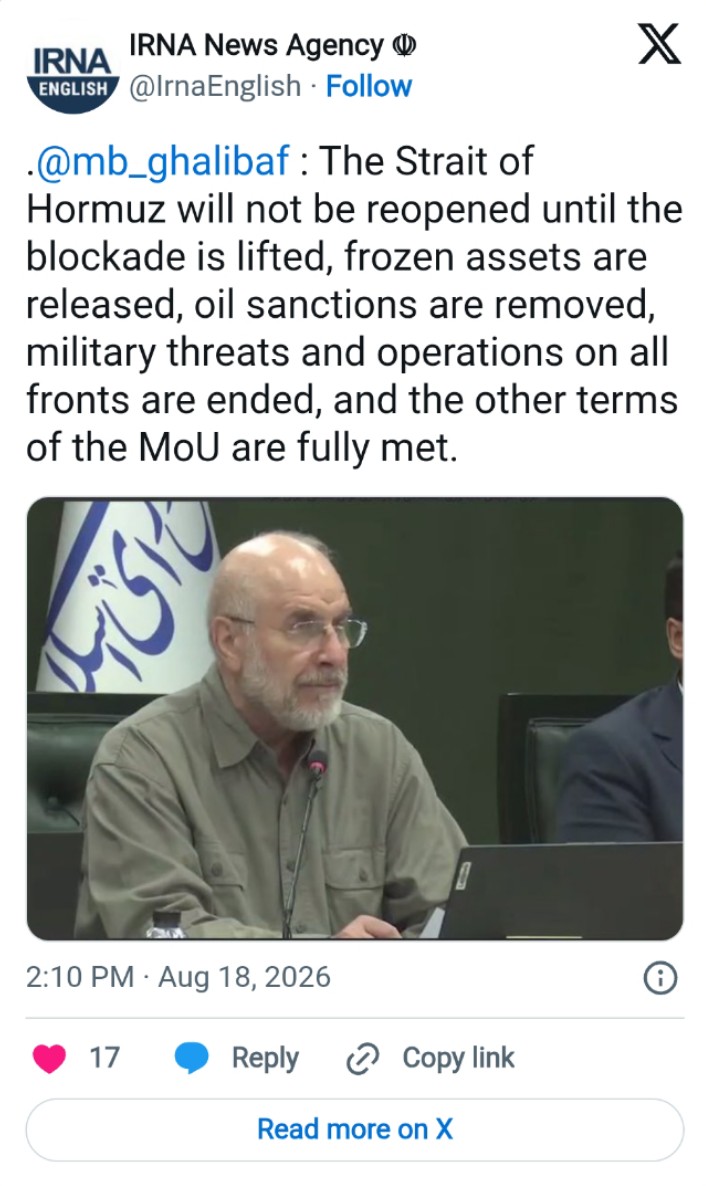
According to Iranian state media, Ghalibaf said the blockade must first be lifted, Iran’s frozen assets released, oil sanctions removed and military threats and operations on all fronts brought to an end. He also insisted that other provisions of the memorandum must be fully implemented.

“Iran is prepared to impose a heavier defeat on the enemy than before,” Ghalibaf said, warning that Tehran’s response would depend on the actions and aggression of its opponents.

The statement came as diplomatic efforts to secure a permanent end to the Iran-US conflict appeared increasingly fragile.

Iran Claims Victory in War and Diplomacy

Iranian Foreign Minister Abbas Araghchi separately declared that Tehran had won both the military confrontation and the diplomatic battle.

Speaking at an event, Araghchi said Iran had resisted sustained military pressure before entering negotiations. He claimed that those who initially demanded Iran’s unconditional surrender later sought talks with Tehran.

“We fought with strength, and we negotiated with strength,” Araghchi said, according to Iranian media.

Araghchi also accused Israel of undermining efforts to implement the June memorandum, saying it had worked to prevent the agreement from being reached and subsequently obstructed its implementation.

His comments followed US President Donald Trump’s call for Iran to surrender and “raise the white flag”, further highlighting the sharp divide between Washington and Tehran.

Hormuz Becomes Central Dispute

The Strait of Hormuz has emerged as one of the most important points of disagreement between the two sides. The narrow waterway links the Persian Gulf with the Gulf of Oman and is a crucial route for global oil and liquefied natural gas shipments.

Shipping activity has already fallen dramatically during the conflict. Reuters reported that only a handful of commodity vessels crossed the strait over the weekend, compared with more than 130 daily ship transits before the war began.

Iran says provisions of the June memorandum give it authority to manage parts of the waterway, while Washington rejects that interpretation.

The disagreement has contributed to renewed tensions after an earlier ceasefire failed to produce a lasting settlement.

Vessel Hit by Unknown Projectile

The latest tensions were accompanied by another maritime incident.

The UK Maritime Trade Operations centre said a vessel travelling outbound through the Strait of Hormuz was struck by an unknown projectile. The impact damaged the ship’s engine room and caused a crew casualty.

The remaining crew members were assisted by the Omani Coast Guard, while authorities began investigating the incident. No environmental impact was reported.

UKMTO urged vessels operating in the area to exercise caution and report suspicious activity.

Back-Channel Diplomacy Continues

Despite the increasingly hostile rhetoric, reports indicate that Washington and Tehran have continued exploring indirect channels.

Media reports said the Trump administration had established a back channel involving figures connected to Iran’s Islamic Revolutionary Guard Corps. The reported effort reflected US concerns over whether Iranian negotiators had sufficient authority to deliver an agreement acceptable to the country’s powerful security establishment.

US special envoy Jared Kushner also indicated that discussions between Washington and different parts of the Iranian government were more extensive than publicly acknowledged.

The developments suggest that diplomacy has not completely collapsed, even as official statements from both sides remain confrontational.

Iran Faces Economic Pressure

Iran’s leaders also face significant economic challenges. The conflict has added pressure to an economy already struggling with inflation, sanctions, currency weakness, energy shortages and structural problems.

Disrupted trade, damaged infrastructure and lost production have increased the financial burden of the war, while prolonged restrictions on shipping through Hormuz threaten Iran’s ability to generate export revenue.

Global markets have also felt the impact. Brent crude rose sharply during the conflict, reaching a peak of $126 a barrel before later easing. The prolonged disruption has raised concerns over fuel prices and inflation in countries dependent on Gulf energy supplies.

Ghalibaf Heads to Iraq

Against this backdrop, Ghalibaf is expected to travel to Iraq for talks on regional developments and bilateral cooperation.

His discussions are expected to cover security, border management, counterterrorism, economic cooperation and implementation of existing agreements between Tehran and Baghdad.

The visit comes after a drone attack targeted the residence and private office of Iraqi Kurdish Regional Government Prime Minister Masrour Barzani. Iran denied involvement and condemned the incident.

Araghchi said nothing justified the attack and warned against attempts to create divisions between Iran, Iraq and the Kurdish region.

With the Strait of Hormuz still at the centre of the dispute, the coming days could prove crucial. Tehran’s insistence on sanctions relief, the release of frozen assets and an end to military threats leaves little room for compromise unless Washington and its allies are prepared to make substantial concessions.

For now, the strategic waterway remains a powerful bargaining tool for Iran — and a major source of uncertainty for the global economy.

Similar Posts

  • |

    Syrian court sentences ousted president Bashar al-Assad to death in absentia

    A court in Damascus has sentenced ousted leader Bashar al-Assad to death in absentia after convicting him of war crimes, crimes against humanity, intentional murder, torture, and arbitrary arrest during the country’s civil war. The ruling marks the first Syrian conviction against Assad following his removal from power by opposition forces in December 2024, ending his family’s 54-year rule. The court handed down identical death sentences in absentia to Assad’s brother, Maher al-Assad, who commanded the Fourth Armoured Division. Former security official Atef Najib, a cousin of the Assads, was tried in person following his capture in early 2025 and also received a death sentence. Crowds gathered in Damascus and Deraa to celebrate the verdict, carrying photos of relatives killed or detained during the conflict. Assad and his brother currently reside in Russia under political asylum. Legal experts note that the capital sentence makes future extradition from foreign jurisdictions highly unlikely.

  • Thai Cabinet Backs Faster Deportation for Foreigners Who Violate Social Norms

    BANGKOK, Thailand – The Thai cabinet has approved a draft regulation in principle aimed at expediting the deportation of foreign nationals whose behavior is deemed incompatible with Thai morals and social norms, addressing long-standing procedural bottlenecks in the country’s immigration system. Thai Cabinet Approves First Draft Of Strict New Deportation Regulations Deputy Prime Minister for […]

  • | |

    Pakistan rejects Imran Khan’s sons’ allegation…

    The Government of Pakistan has categorically rejected allegations by the sons of former Prime Minister Imran Khan that he has been kept under a seven-month communications blackout and denied access to his family, lawyers and doctors, terming the claims “unsubstantiated” and contrary to official prison records. In a detailed response, the government said documented records showed that Imran Khan had continued to receive visitors, legal access and medical care during his imprisonment, rejecting what it described as an attempt to create an international controversy without evidence. According to the government, since the beginning of his conviction, prison records show 198 meetings involving more than 900 visitors, including family members, legal representatives and political associates. It said Khan was also allowed a weekly meeting with his wife, with the latest meeting taking place on 4 August 2026, the same day his sons made allegations of a communications blackout during an appearance on CNN. The government said prison authorities maintain records of approved visits and communications, including WhatsApp and landline calls with family members in Pakistan and abroad. It added that Khan’s last call with his son was recorded on 21 March 2026. The statement said any temporary restrictions were imposed under Pakistan Prison Rules, court orders and security requirements applicable to high-profile prisoners, particularly due to political activities outside the prison. “There is no prohibition on access; it is regulated under the law,” the government said, adding that prison meetings cannot be used as unrestricted political communication channels. Rejecting claims regarding medical treatment, the government said Imran Khan had received regular medical examinations by specialist teams and medical boards from institutions including the Pakistan Institute of Medical Sciences (PIMS), Shifa International Hospital, Shaukat Khanum Memorial Hospital and Al-Shifa Trust Eye Hospital. The government said Khan underwent treatment for a retinal condition, including five intravitreal anti-VEGF injections, specialist examinations and retinal imaging. It added that his latest specialist assessment was carried out in July 2026, with further medication and follow-up care prescribed. According to the official statement, medical records describe Khan as “oriented and stable”, with no reported acute or unmanaged deterioration. The government said disclosure of medical reports remained subject to legal procedures, patient confidentiality and ongoing proceedings before the Supreme Court of Pakistan. Addressing the issue of Khan’s sons’ travel to Pakistan, the government said the matter involved separate processes relating to NICOP and visa requirements. It stated that overseas Pakistanis holding a valid NICOP are eligible for visa-free entry and rejected what it called an attempt to present an administrative matter as political victimisation. The statement also detailed the facilities provided to Imran Khan in prison, saying he was being kept in a separate compound with accommodation and amenities exceeding minimum requirements for prisoners in the same category. The government maintained that Imran Khan was being treated according to constitutional guarantees, prison laws and court directives, while insisting that no individual was entitled to a separate legal framework or exemption from security regulations.

  • | | | |

    JPMC launches free advanced breast cancer radiothe…

    KARACHI: In a significant step towards improving cancer care in Pakistan, the Jinnah Postgraduate Medical Centre (JPMC) has established a state-of-the-art Breast Radiation Bay that promises faster, safer and completely free treatment for breast cancer patients. The new facility is expected to transform care for thousands of women by reducing treatment time while improving precision and patient safety. Named the Bilquis and Abdul Sattar Edhi Breast Radiation Bay, the project has been developed through a joint collaboration between the Sindh government, the Patient Aid Foundation and the Edhi Foundation. Equipped with advanced tomotherapy technology worth more than Rs1 billion, the facility is in its final stages of completion and is expected to begin serving patients soon. According to Prof. Tariq Mahmood, head of the CyberKnife Department at JPMC, the cutting-edge technology will dramatically shorten the duration of treatment. Radiation therapy that previously required 20 to 22 sessions can now be completed in just five sessions, reducing the physical and emotional burden on patients. He explained that the new system delivers radiation with exceptional accuracy, targeting cancerous tissues while protecting healthy organs, particularly the heart. This precision is expected to improve treatment outcomes and reduce the risk of side effects, making cancer care both safer and more effective. The Breast Radiation Bay will have the capacity to treat around 160 breast cancer patients every day, providing life-saving care to thousands annually. In addition to advanced radiotherapy, the centre will offer a complete range of diagnostic services, including mammography, biopsy, high-resolution CT imaging, and 360-degree helical radiation therapy, allowing patients to receive comprehensive care under one roof. Medical experts say breast cancer remains the most commonly diagnosed cancer among women in Pakistan, with Karachi reporting one of the country’s highest incidence rates. They stress that early detection through regular screening greatly increases the chances of successful treatment. Doctors also urge women to seek immediate medical advice if they notice warning signs such as breast lumps, changes in breast size or shape, skin dimpling, nipple discharge or changes in nipple appearance. While these symptoms do not always indicate cancer, timely evaluation is essential. Health specialists believe the new facility marks a major milestone in Pakistan’s fight against breast cancer by expanding access to world-class treatment regardless of a patient’s financial circumstances. With advanced technology, free care and greater diagnostic capacity, JPMC aims to give thousands of women a better chance at early recovery and long-term survival.

  • | |

    Pakistan rise in WTC standings after West Indies w…

    Port of Spain: Pakistan breathed new life into their ICC World Test Championship (WTC) 2025-27 campaign after defeating the West Indies by eight wickets in the second and final Test, a victory that lifted them off the bottom of the standings and restored confidence under new captain Babar Azam. The convincing win helped Pakistan move up to seventh place in the WTC table with a points percentage of 22.22, replacing the West Indies, who dropped to the bottom after another disappointing result. Pakistan have now won two of their six matches in the current championship cycle, while the Caribbean side have managed just two victories in 12 Tests. At the top of the standings, Australia remain the dominant force with seven wins in eight matches and a remarkable winning percentage of 87.50. Defending champions South Africa occupy second place, followed by New Zealand, Bangladesh, India, Sri Lanka, England, Pakistan and West Indies. Pakistan entered the Caribbean series under fresh leadership after Babar Azam replaced Shan Masood as Test captain. However, the new chapter began on a disappointing note as the visitors suffered a 90-run defeat in the opening Test at Tarouba. The Green Shirts responded in style in the second Test at Queen’s Park Oval with an impressive all-round performance. After electing to bat, the West Indies posted 344 thanks to fighting half-centuries from captain Roston Chase and Justin Greaves. Pakistan answered with determination as opener Abdullah Shafique produced a magnificent unbeaten 160, anchoring the innings from start to finish. Captain Babar Azam added a composed half-century as Pakistan reached 387, taking a valuable first-innings lead of 43 runs. The turning point came in the West Indies’ second innings when Pakistan’s spin duo completely dominated the hosts. Sajid Khan and Ali Usman claimed four wickets each to dismiss the West Indies for just 117, leaving Pakistan a modest target of 75. Pakistan completed the chase comfortably with eight wickets to spare. Shafique and Babar remained unbeaten on 24 each, guiding their team to its first away Test victory since July 2023. Teams Matches Wins Losses Draw Points Winning Percentages Australia       8    7      1     0    84        87.50 South Africa       4    3      1     0    36           75 New Zealand       6    4      1     1    52        72.22 Bangladesh       4    2      1     1    28        58.33 India       9    4      4     1    52        48.15 Sri Lanka       4    1      1     2    20        41.67 England      13    4      8     1    38        24.36 Pakistan       6    2      4     0    16        22.22 West Indies      12    2      8     2    30        20.83   The morale-boosting triumph not only squared the two-match series 1-1 but also revived Pakistan’s hopes in the World Test Championship race. With Babar Azam’s captaincy beginning to take shape and key players delivering under pressure, Pakistan will now look to build momentum in the remainder of the WTC cycle.

  • Dozens Dead, Scores Injured in Fire at Swiss Ski Resort Nightclub

    CRANS-MONTANA, Switzerland — A devastating fire ripped through a nightclub at the popular Crans-Montana ski resort in the early hours of Thursday, leaving dozens dead and around a hundred injured, according to Swiss police. Goa Nightclub Owners Flee to Phuket After Deadly Fire Kills 25 The blaze, described as “very violent,” broke out at approximately […]

Leave a Reply

Your email address will not be published. Required fields are marked *