kkr exits first
| |

KKR exits First Gen, sells stake to Gateway-linked firm for P25.8B

MANILA, Philippines – Global private equity investment giant KKR has exited First Gen Corporation, selling its entire 19.9% stake in the Lopez-led power company for about P25.77 billion, just weeks after an attempt to increase its investment and take First Gen private fell through.

In a regulatory filing, KKR-linked Valorous Asia Holdings said it disposed of 715.8 million First Gen shares on September 10 for P25.77 billion, equivalent to P36 per share. Valorous said the transaction included shares held indirectly through Philippines Clean Energy Holding Inc. and left it with no remaining stake in First Gen.

The buyer was Angsana Finance Limited, which separately disclosed that it had acquired the same 715.86 million shares, equivalent to 19.9% of First Gen’s outstanding common shares. Angsana is incorporated in the Cayman Islands and is wholly owned by Gateway Holdings Limited, the parent of emerging markets investment firm Gateway Partners. Gateway, which operates out of Singapore and Dubai, is already an investor in the Philippines as one of the backers of UNO Digital Bank.

Only a month earlier, KKR had sought to increase its stake in First Gen.

Must Read

Making sense of US firm KKR’s offer on Lopez family’s First Gen


Making sense of US firm KKR’s offer on Lopez family’s First Gen

In August, First Philippine Holdings (FPH), First Gen’s parent company, rejected KKR’s non-binding proposal to purchase another 8.43% of the power company from FPH and launch a voluntary tender offer for First Gen’s entire public float at P35 per share. FPH said the proposed price did not represent First Gen’s “true value.”

Had the proposal pushed through, the tender offer would also have supported a potential voluntary delisting of First Gen from the Philippine Stock Exchange.

Now, KKR has instead sold its existing shares at P36 apiece, P1 higher than its proposed tender price.

The exit was also followed by a change in First Gen’s board. Manolo Michael de Guzman resigned as a director and member of the Board Risk Oversight Committee effective September 11. 

De Guzman is a senior adviser at KKR and president of Philippines Clean Energy Holding Inc., one of the vehicles through which KKR held its First Gen stake. His resignation came a day after KKR sold its entire stake, although First Gen did not state a reason for his departure. – Rappler.com

Similar Posts

  • |

    Pakistan, Japan sign $2.2 million grant agreement for civil servants’ scholarships

    ISLAMABAD: The governments of Pakistan and Japan have signed a grant agreement worth JPY 350 million, equivalent to around $2.2 million, to support the Human Resource Development Scholarship Programme (JDS) for 2026. The agreement was signed during a ceremony held at the Ministry of Economic Affairs on Tuesday, August 11, as both countries reaffirmed their commitment to strengthening cooperation in human resource development and institutional capacity building. Secretary of the Ministry of Economic Affairs Muhammad Humair Karim and Japanese Ambassador to Pakistan Akamatsu Shuichi signed the Record of Discussions and Exchange of Notes during the ceremony. The grant agreement was separately signed by Miran Mohiyuddin Soomro, Senior Joint Secretary at the Ministry of Economic Affairs, and Yusuke Shinozaki, Chief Representative of the Japan International Cooperation Agency (JICA) in Pakistan. Senior representatives from the Embassy of Japan, JICA and Pakistan’s Ministry of Economic Affairs also attended the signing ceremony. 17 scholarships to be offered Under the latest phase of the JDS programme, 17 Pakistani government officials will receive scholarships to pursue higher education at leading Japanese universities. The 2026 programme will offer 16 scholarships for master’s degree programmes and one scholarship for a doctoral programme. The initiative is primarily aimed at young officers serving in Pakistan’s Federal Civil Service and Ex-Cadre services. The scholarship programme is designed to enhance the professional expertise of government officials by providing them with opportunities to acquire advanced academic knowledge and specialized skills in Japan. Officials who benefit from the programme are expected to contribute to policymaking, public administration and Pakistan’s broader socio-economic development after completing their studies. Ninth phase since 2018 The latest grant marks the ninth instalment of Japan’s JDS programme in Pakistan since its launch in 2018. Over the past eight batches, approximately 17 to 18 Pakistani officials per batch have benefited from the scholarship initiative. The programme has consequently created a growing network of Pakistani officials with exposure to Japanese academic institutions, public-sector practices and professional training. The JDS initiative is part of Japan’s broader development cooperation with Pakistan, with a particular focus on strengthening human resources and improving the capacity of government institutions. In addition to the long-term JDS scholarships, Japan also facilitates short-term training opportunities for Pakistani government officials in various fields. These programmes provide participants with exposure to international practices and technical expertise that can be applied to their respective departments in Pakistan. Focus on bilateral cooperation Speaking at the ceremony, Japanese Ambassador Akamatsu Shuichi reiterated Japan’s commitment to working with Pakistan on human resource development and other areas of mutual interest. JICA Chief Representative Yusuke Shinozaki also expressed the agency’s willingness to continue cooperating with the Government of Pakistan to strengthen institutional capacity and promote sustainable development. The Japanese side said such initiatives also contribute to closer people-to-people links and reinforce the longstanding friendly relations between Pakistan and Japan. The two countries have maintained development and economic cooperation for decades, with Japan supporting Pakistan through grants, technical assistance, training programmes and other capacity-building initiatives. The continuation of the JDS programme is expected to further deepen bilateral cooperation while equipping Pakistani public-sector officials with knowledge and skills that can support more effective governance and economic development.

  • |

    Pakistan, Iran agree to boost bilateral trade to $10 billion

    ISLAMABAD: Pakistan and Iran have reaffirmed their commitment to significantly strengthen economic cooperation by increasing bilateral trade to $10 billion and accelerating efforts to finalize a long-awaited Free Trade Agreement (FTA). The understanding was reached during the 10th meeting of the Pakistan-Iran Joint Trade Committee, held in Islamabad on Tuesday. The session was jointly chaired by Federal Minister for Commerce Jam Kamal Khan and Iranian Minister for Industry, Mine and Trade Dr. Mohammad Atabak, with senior officials from both countries participating in discussions aimed at expanding trade and investment ties. During the meeting, both sides reviewed the current state of bilateral trade and explored practical measures to unlock its full potential. The two countries agreed that stronger economic integration, improved connectivity, and enhanced cross-border cooperation are essential for achieving the ambitious trade target of $10 billion. Speaking on the occasion, Commerce Minister Jam Kamal said Pakistan and Iran enjoy longstanding historical, cultural, and religious ties, but stressed that these relations should now be translated into a robust economic partnership. He emphasized that expanding trade and investment would bring mutual economic benefits and contribute to regional prosperity. The minister underscored the importance of completing the Pakistan-Iran Free Trade Agreement at the earliest opportunity, describing it as a key step toward facilitating commerce between the neighboring countries. He also called for the removal of bottlenecks affecting border logistics, customs procedures, and cargo movement to ensure smoother and faster trade flows. Jam Kamal noted that bilateral trade could be further enhanced through the development of joint border markets, greater use of electronic data interchange systems, and closer coordination between relevant government agencies. He said modernizing trade infrastructure and simplifying customs procedures would help businesses on both sides benefit from increased commercial activity. The Joint Trade Committee also agreed to formulate a practical roadmap aimed at strengthening economic cooperation across multiple sectors. The roadmap will focus on trade facilitation, infrastructure development, logistics, and investment opportunities while encouraging closer collaboration between the public and private sectors. Iranian Minister Dr. Mohammad Atabak described Pakistan as one of Iran’s key long-term strategic trade partners and expressed confidence that bilateral economic relations could expand considerably in the coming years. He highlighted the importance of increasing regional trade and logistics cooperation, particularly by utilizing Pakistan’s Karachi and Gwadar ports to improve connectivity and facilitate the movement of goods. Dr. Atabak also voiced optimism about the early conclusion of the Pakistan-Iran Free Trade Agreement, saying it would create new opportunities for businesses in both countries. He added that cooperation in electricity trade, transport networks, and regional connectivity projects could open new avenues for economic growth and strengthen commercial links across the region.

  • | |

    Pakistan exports rise 13.1% to $3.94 billion in Ju…

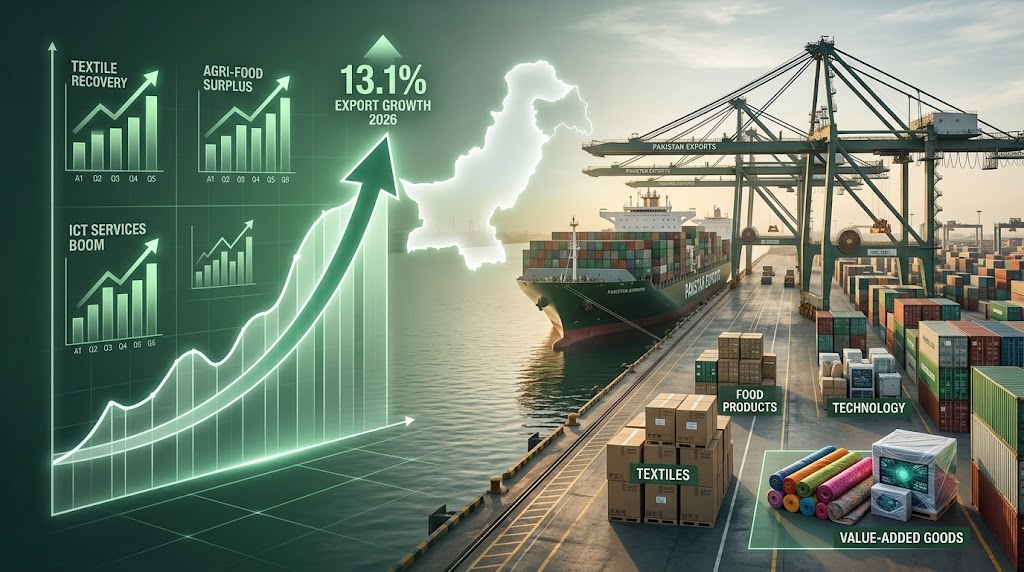
    ISLAMABAD: Pakistan’s exports of goods and services rose by 13.1 percent year-on-year to $3.94 billion in July 2026, providing an encouraging start to the new fiscal year and signalling continued improvement in the country’s external sector. Federal Minister for Planning, Development and Special Initiatives Ahsan Iqbal shared the figures on Saturday while presenting the Monthly Development Update for August 2026. He said exports stood at $3.48 billion in July 2025, meaning the latest increase reflects stronger performance across several major export categories. According to the minister, merchandise exports increased by 9.4 percent to around $3 billion in July 2026 from $2.8 billion a year earlier. When services exports are included, the combined figure reached approximately $3.9 billion, compared with $3.5 billion in July last year. Key export sectors show growth Ahsan Iqbal said the improvement in exports was supported by higher shipments across several important sectors. Surgical goods recorded the strongest growth among the highlighted export groups, increasing by 16.3 percent. Food exports rose by 8 percent, while leather goods registered growth of 7.8 percent. Textile exports, one of Pakistan’s largest sources of foreign exchange, also increased by 3.9 percent during the month. The minister said the figures indicated that Pakistan’s external sector had started the new fiscal year on a positive trajectory, although maintaining this momentum would require continued reforms, improved competitiveness and greater diversification of export products and markets. Manufacturing sector stages strong recovery The positive external-sector performance coincided with a broad-based recovery in domestic industrial activity. According to Ahsan, Large-Scale Manufacturing (LSM) expanded by 5 percent during fiscal year 2025-26, reversing a 0.74 percent contraction recorded in the preceding fiscal year. He said the recovery was spread across the industrial sector, with 16 of the 22 LSM sectors registering positive growth. The automobile sector posted the highest increase at 57.8 percent, followed by transport equipment at 42.4 percent. Electrical equipment production grew by 14.3 percent, tobacco by 12.6 percent and food manufacturing by 7 percent. The figures, he said, reflected an improvement in industrial activity and could provide support to investment, employment and overall economic growth if the recovery remains sustained. FBR collection, remittances improve The government also reported improvement in tax revenues at the beginning of FY2026-27. Federal Board of Revenue tax collection increased by 8.4 percent to Rs820.9 billion in July 2026, according to the minister. He said stronger revenue mobilisation, together with fiscal discipline, was helping improve the country’s overall financial position. Workers’ remittances also remained a major source of support for Pakistan’s external account. Remittance inflows reached $3.63 billion in July 2026, up 13 percent from approximately $3.2 billion in the same month of 2025. Ahsan said the latest increase followed record remittances of $41.6 billion received during the previous fiscal year. He noted that remittances not only strengthened Pakistan’s foreign exchange position but also provided direct financial support to millions of households across the country. Current account deficit remains contained Despite continued pressure on the external account, the current account deficit remained relatively contained. The deficit stood at $328 million in July 2026, compared with $529 million during the same month of the previous year. The minister described the development as another indication of improved external-sector stability. He also highlighted the growing contribution of Pakistan’s technology sector. Information and Communication Technology exports reached $417 million in July 2026, underlining the increasing role of digital services in generating foreign exchange. The government has been seeking to expand technology exports as part of a broader strategy to diversify Pakistan’s sources of external earnings beyond traditional sectors such as textiles and agricultural products. Inflation moderates Ahsan Iqbal also pointed to a moderation in consumer price pressures at the start of the new fiscal year. Consumer Price Index inflation eased to 9.2 percent in July 2026, compared with 11.7 percent in May 2026. The minister said the decline suggested that inflationary pressures were beginning to moderate. He added that changes in the year-on-year inflation rate were also influenced by base effects as well as the impact of international food and energy prices. The government is aiming to maintain price stability while supporting economic activity and protecting the purchasing power of households. Fiscal position strengthens The planning minister said Pakistan’s fiscal position had also improved significantly during FY2025-26. The fiscal deficit narrowed to 2.6 percent of GDP from 5.4 percent in FY2024-25. According to Ahsan, this represented the lowest fiscal deficit recorded in two decades. He said stronger fiscal management would remain essential during FY2026-27 as the government seeks to maintain macroeconomic stability while creating room for development spending and economic expansion. Development spending and job creation Public investment is another major component of the government’s economic strategy. Projects approved during July 2026 are expected to create around 7,851 direct jobs and 14,053 indirect employment opportunities across different sectors. The minister said employment generation would remain an important objective of development planning, particularly as the country seeks to create greater opportunities for its young population. He said Pakistan had undergone a difficult period of economic adjustment and that the stability achieved in recent years had required significant effort. Under the government’s URAAN Pakistan initiative, the next phase would focus on converting macroeconomic stability into long-term economic transformation, with exports positioned as a key driver of growth. According to Ahsan, higher exports could help generate employment, increase household incomes, expand opportunities for young people and improve living standards. Rs211.3 billion authorised for development projects The Ministry of Planning authorised Rs211.327 billion, equivalent to 21.1 percent of the relevant allocation, during July 2026 to facilitate timely financing for priority development projects. The minister said the move was aimed at ensuring that strategically important schemes received funding without unnecessary delays. During July, the Central Development Working Party (CDWP) also reviewed a number of development proposals. It approved nine projects, three position papers and one concept clearance proposal, while nine projects were recommended for consideration by the Executive Committee of the National Economic Council (ECNEC). Three projects were deferred, while

Leave a Reply

Your email address will not be published. Required fields are marked *