philippine economy slows
| |

Philippine economy slows to 2.3% in Q2 2026, weakest since 2009

MANILA, Philippines – The Philippine economy grew by only 2.3% in the second quarter of 2026, slowing further as weak investment and elevated prices weighed on economic activity, the Philippine Statistics Authority reported on Friday, August 7.

The latest figure was lower than the 2.8% growth recorded in the first quarter of 2026 and the revised 5.4% expansion in the second quarter of 2025. It brought economic growth in the first half of 2026 to 2.6%. 

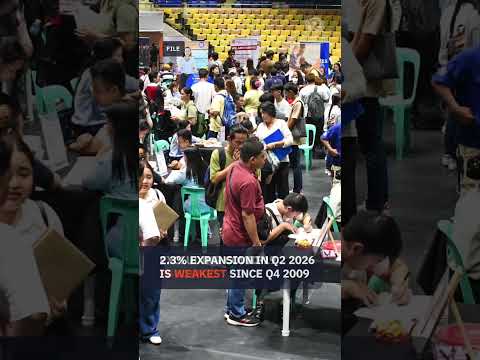
The 2.3% expansion in Q2 2026 was the weakest since Q4 2009, excluding the COVID-19 pandemic, when the economy grew by 1.8%.

Philippine economy slows to 2.3% in Q2 2026, weakest since 2009

Economy, Planning, and Development Secretary Arsenio Balisacan said domestic demand remained subdued as total investment continued to decline, while household consumption slowed down amid higher prices, job losses, and weaker remittance receipts linked to the conflict in the Middle East.

Gross capital formation, a broad measure of investment, contracted by 9.2%. Its largest component, gross fixed capital formation, fell by an even steeper 13.7%, its worst non-pandemic performance since the second quarter of 2011.

The biggest drag was general government construction, which plunged by 32.4% year-on-year. The broader industry sector consequently contracted by 2.4%, even as manufacturing continued to grow.

“Although public construction is a small part of the economy, the amount of that contraction, 32%, brought a significant impact on the economy,” Balisacan said.

He added that the economy could have grown by at least one percentage point more had public construction simply recorded zero growth instead of contracting. He said that reports on the ground showed that officials and employees were more reluctant to approve or take responsibility for projects given the heightened scrunity following the flood control scandals of 2025.

The country’s chief economist also said that there are reasons to believe that hesitancy will ease.

“The Department of Budget and Management began releasing mobilization funds for 2026 infrastructure projects to the Department of Public Works and Highways toward the end of June. The DPWH in turn started awarding contracts in June and July. We therefore expect public construction and infrastructure spending to begin picking up in the third quarter and gain further momentum in the months ahead, ” he added in his opening statement.

The government expects construction spending to pick up in the third quarter and accelerate further toward the end of the year, as agencies implement catch-up plans and spend funds left unused during the first half.

Household spending, traditionally the Philippine economy’s main growth engine, expanded by just 2.8%. Excluding the pandemic, this was its weakest growth since the third quarter of 2010, when consumption rose by 2.6%.

Balisacan attributed the slowdown partly to high inflation and weaker consumer confidence. He said the government must convince households that elevated prices are not permanent and that economic conditions will improve.

The government has already slashed its growth target range to 3.5% to 4.5% for the full year, amid weaker investment, elevated inflation, and domestic and external uncertainties. The World Bank expects the Philippine economy to grow by 3.7% in 2026. 

To reach at least the 3.5% lower end of that target, Balisacan said the economy would have to grow by no less than 4.4% in the second half. He acknowledged that this would be “demanding,” but maintained that it remained possible if infrastructure spending rebounds and inflation continues to ease.

Despite the combination of slower growth, high inflation, and rising unemployment, Balisacan rejected concerns that the Philippines was heading toward stagflation, a prolonged period of weak economic activity accompanied by persistently high prices.

There were also bright spots in exports, agriculture, and manufacturing. Agricultural output grew by 2.7%, while exports of goods surged by 17% and exports of services rose by 6.9%. Net exports contributed 1.2 percentage points to gross domestic product (GDP) growth.

Balisacan said stronger exports, particularly semiconductors and electronics used in artificial intelligence systems, electric vehicles, and other advanced technologies, were helping diversify the economy beyond consumption. Exports of consumer electronics grew by 230.3% year-on-year in the second quarter, while exports of components/devices, or semiconductors, rose by 13.4%.

Balisacan said this was related to the “boom” in AI and related sectors, which require these electronics and semiconductor components.

“We have been exporting electronics and semiconductors for a while. But we now have to expand and move into higher level of manufacturing, semiconductor and electronics manufacturing, especially those that make use of advanced or supporting advanced technologies like AI,” he added.

The World Bank had earlier warned that investment was slowing amid heightened scrutiny of infrastructure spending following alleged corruption in flood control projects, as well as a surge in global energy prices that compounded the country’s already high power costs. (READ: Cheaper PH electricity? Go beyond system loss; fix costly power contracts)

Ahead of the announcement, Bank of the Philippine Islands lead economist Emilio Neri Jr. forecast second-quarter growth at 1.9%. He cited another steep contraction in public infrastructure spending, softer private investment, and slower household consumption as high transport and electricity costs eroded purchasing power. – Rappler.com

Must Watch

The Philippines is now upper-middle income. Really?


The Philippines is now upper-middle income. Really?

Similar Posts

  • |

    Pakistan, Iran agree to boost bilateral trade to $10 billion

    ISLAMABAD: Pakistan and Iran have reaffirmed their commitment to significantly strengthen economic cooperation by increasing bilateral trade to $10 billion and accelerating efforts to finalize a long-awaited Free Trade Agreement (FTA). The understanding was reached during the 10th meeting of the Pakistan-Iran Joint Trade Committee, held in Islamabad on Tuesday. The session was jointly chaired by Federal Minister for Commerce Jam Kamal Khan and Iranian Minister for Industry, Mine and Trade Dr. Mohammad Atabak, with senior officials from both countries participating in discussions aimed at expanding trade and investment ties. During the meeting, both sides reviewed the current state of bilateral trade and explored practical measures to unlock its full potential. The two countries agreed that stronger economic integration, improved connectivity, and enhanced cross-border cooperation are essential for achieving the ambitious trade target of $10 billion. Speaking on the occasion, Commerce Minister Jam Kamal said Pakistan and Iran enjoy longstanding historical, cultural, and religious ties, but stressed that these relations should now be translated into a robust economic partnership. He emphasized that expanding trade and investment would bring mutual economic benefits and contribute to regional prosperity. The minister underscored the importance of completing the Pakistan-Iran Free Trade Agreement at the earliest opportunity, describing it as a key step toward facilitating commerce between the neighboring countries. He also called for the removal of bottlenecks affecting border logistics, customs procedures, and cargo movement to ensure smoother and faster trade flows. Jam Kamal noted that bilateral trade could be further enhanced through the development of joint border markets, greater use of electronic data interchange systems, and closer coordination between relevant government agencies. He said modernizing trade infrastructure and simplifying customs procedures would help businesses on both sides benefit from increased commercial activity. The Joint Trade Committee also agreed to formulate a practical roadmap aimed at strengthening economic cooperation across multiple sectors. The roadmap will focus on trade facilitation, infrastructure development, logistics, and investment opportunities while encouraging closer collaboration between the public and private sectors. Iranian Minister Dr. Mohammad Atabak described Pakistan as one of Iran’s key long-term strategic trade partners and expressed confidence that bilateral economic relations could expand considerably in the coming years. He highlighted the importance of increasing regional trade and logistics cooperation, particularly by utilizing Pakistan’s Karachi and Gwadar ports to improve connectivity and facilitate the movement of goods. Dr. Atabak also voiced optimism about the early conclusion of the Pakistan-Iran Free Trade Agreement, saying it would create new opportunities for businesses in both countries. He added that cooperation in electricity trade, transport networks, and regional connectivity projects could open new avenues for economic growth and strengthen commercial links across the region.

  • | | |

    Filipinos helped build UAE’s nuclear plant. PH talent may soon do the same back home.

    ‘80% of the people who built that nuclear facility are Filipinos,’ NAPOCOR head Koko Nograles says of the Barakah Nuclear Energy Plant. ‘That should remind us of something important – that the Filipino can do nuclear.’

  • | |

    Massive $4 billion Iranian sanctions evasion network uncovered behind illegal gambling and crypto scheme

    A Reuters investigation has exposed a massive Iranian sanctions evasion network operating through a Dubai-based, unlicensed cryptocurrency exchange named Shelbit. The exchange has processed over $4 billion since May 2024, serving as a critical financial hub that links a Farsi-language illegal gambling network of over 2,000 websites, Iran’s central bank, state-backed bitcoin mining operations, and entities tied to the Islamic Revolutionary Guard Corps (IRGC). Despite strict prohibitions against gambling under Iranian law, the vast network utilises Iran’s central bank-regulated online payments system, allowing sanctioned entities and illicit networks direct access to global crypto markets and major international exchanges. Fronted by prominent Iranian influencers Sasha Sobhani and Pooyan Mokhtari, who promote the gambling sites to millions of social media followers while flaunting lavish lifestyles abroad, the operation is considered one of the largest illegal gambling and sanctions evasion schemes ever identified. Regulatory and law enforcement agencies have begun taking action against the network. Dubai’s Virtual Assets Regulatory Authority (VARA) issued a cease-and-desist order against Shelbit for anti-money laundering and counter-terrorism financing violations, while the U.S. Treasury Department’s Office of Foreign Assets Control (OFAC) confirmed it is actively investigating the network’s digital asset transactions.

  • |

    Pakistan, Japan sign $2.2 million grant agreement for civil servants’ scholarships

    ISLAMABAD: The governments of Pakistan and Japan have signed a grant agreement worth JPY 350 million, equivalent to around $2.2 million, to support the Human Resource Development Scholarship Programme (JDS) for 2026. The agreement was signed during a ceremony held at the Ministry of Economic Affairs on Tuesday, August 11, as both countries reaffirmed their commitment to strengthening cooperation in human resource development and institutional capacity building. Secretary of the Ministry of Economic Affairs Muhammad Humair Karim and Japanese Ambassador to Pakistan Akamatsu Shuichi signed the Record of Discussions and Exchange of Notes during the ceremony. The grant agreement was separately signed by Miran Mohiyuddin Soomro, Senior Joint Secretary at the Ministry of Economic Affairs, and Yusuke Shinozaki, Chief Representative of the Japan International Cooperation Agency (JICA) in Pakistan. Senior representatives from the Embassy of Japan, JICA and Pakistan’s Ministry of Economic Affairs also attended the signing ceremony. 17 scholarships to be offered Under the latest phase of the JDS programme, 17 Pakistani government officials will receive scholarships to pursue higher education at leading Japanese universities. The 2026 programme will offer 16 scholarships for master’s degree programmes and one scholarship for a doctoral programme. The initiative is primarily aimed at young officers serving in Pakistan’s Federal Civil Service and Ex-Cadre services. The scholarship programme is designed to enhance the professional expertise of government officials by providing them with opportunities to acquire advanced academic knowledge and specialized skills in Japan. Officials who benefit from the programme are expected to contribute to policymaking, public administration and Pakistan’s broader socio-economic development after completing their studies. Ninth phase since 2018 The latest grant marks the ninth instalment of Japan’s JDS programme in Pakistan since its launch in 2018. Over the past eight batches, approximately 17 to 18 Pakistani officials per batch have benefited from the scholarship initiative. The programme has consequently created a growing network of Pakistani officials with exposure to Japanese academic institutions, public-sector practices and professional training. The JDS initiative is part of Japan’s broader development cooperation with Pakistan, with a particular focus on strengthening human resources and improving the capacity of government institutions. In addition to the long-term JDS scholarships, Japan also facilitates short-term training opportunities for Pakistani government officials in various fields. These programmes provide participants with exposure to international practices and technical expertise that can be applied to their respective departments in Pakistan. Focus on bilateral cooperation Speaking at the ceremony, Japanese Ambassador Akamatsu Shuichi reiterated Japan’s commitment to working with Pakistan on human resource development and other areas of mutual interest. JICA Chief Representative Yusuke Shinozaki also expressed the agency’s willingness to continue cooperating with the Government of Pakistan to strengthen institutional capacity and promote sustainable development. The Japanese side said such initiatives also contribute to closer people-to-people links and reinforce the longstanding friendly relations between Pakistan and Japan. The two countries have maintained development and economic cooperation for decades, with Japan supporting Pakistan through grants, technical assistance, training programmes and other capacity-building initiatives. The continuation of the JDS programme is expected to further deepen bilateral cooperation while equipping Pakistani public-sector officials with knowledge and skills that can support more effective governance and economic development.

  • |

    DC approves Rs4.14 billion District Health Authority budget for FY2026-27

    GUJRAT: Deputy Commissioner and Administrator District Health Authority (DHA) Gujrat Noor-ul-Ain Qureshi has approved a budget of more than Rs4.14 billion for the District Health Authority for the financial year 2026-27, with the largest allocation earmarked for salaries of healthcare workers and a significant share reserved for the uninterrupted supply of medicines in government health facilities. The budget was approved during a meeting chaired by the deputy commissioner at her office on Wednesday. The meeting was attended by Chief Executive Officer Health Dr Syed Atta ul Munim, Deputy Director Budget Health, and other relevant officials, who reviewed the proposed allocations and expenditure plan for the upcoming fiscal year. According to officials, the total approved budget stands at Rs4,141,211,000, covering salaries, medicines, utilities, contractual staff payments, recruitment and repair of health facilities across the district. Officials informed the meeting that Rs3.274 billion has been allocated for salaries and allowances of doctors, nurses, paramedics and other employees serving in the district health system. The allocation constitutes the largest portion of the annual budget and is aimed at ensuring uninterrupted payment of salaries to healthcare staff working in hospitals and primary healthcare facilities. A sum of Rs400 million has been reserved for the procurement and uninterrupted supply of medicines to government healthcare institutions, including the District Headquarters Hospital, Tehsil Headquarters Hospitals, Rural Health Centres (RHCs), Basic Health Units (BHUs) and other public health facilities operating under the District Health Authority. The meeting was further informed that Rs104 million has been allocated for the payment of electricity, gas, water and other utility bills to ensure smooth functioning of health institutions across the district. An additional Rs60 million has been earmarked for payments to doctors serving under the lump-sum pay package, enabling the authority to continue services in facilities where contractual medical professionals are performing duties. Officials also briefed the meeting that the remaining funds would be utilised for Expanded Programme on Immunisation (EPI) recruitments, repair and rehabilitation of healthcare facilities, and other operational requirements aimed at strengthening service delivery throughout the district. Deputy Commissioner Noor-ul-Ain Qureshi directed the health authorities to ensure transparent utilisation of public funds and stressed that every allocation should directly contribute to improving healthcare services for citizens. She emphasised the need for strict financial discipline and instructed officers to closely monitor expenditure throughout the financial year. The meeting also reviewed priority areas requiring financial support and discussed measures to maintain uninterrupted healthcare services in both urban and rural areas of the district. The approval of the annual budget comes as the District Health Authority seeks to improve service delivery, maintain essential medical supplies and address operational needs across Gujrat’s public healthcare network. Officials expressed confidence that timely release and efficient utilisation of funds would help strengthen healthcare services and improve access to treatment for residents across the district during the 2026-27 fiscal year.

Leave a Reply

Your email address will not be published. Required fields are marked *