pakistan iran agree
|

Pakistan, Iran agree to boost bilateral trade to $10 billion

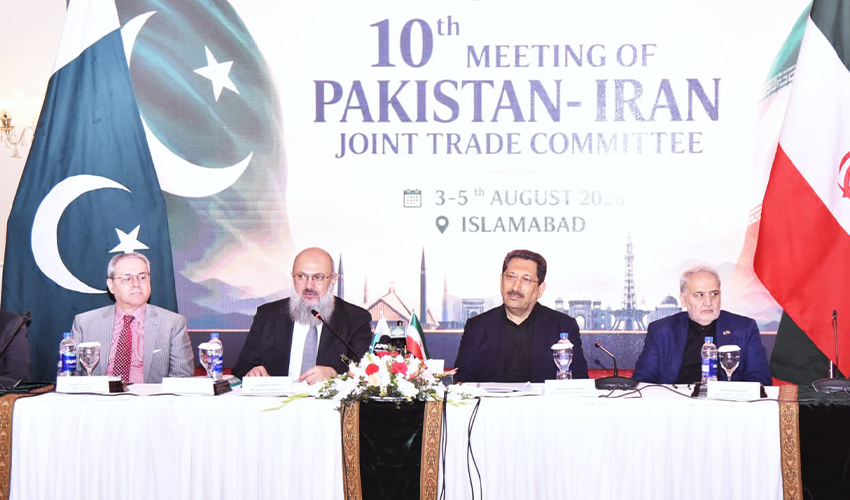
ISLAMABAD: Pakistan and Iran have reaffirmed their commitment to significantly strengthen economic cooperation by increasing bilateral trade to $10 billion and accelerating efforts to finalize a long-awaited Free Trade Agreement (FTA).

The understanding was reached during the 10th meeting of the Pakistan-Iran Joint Trade Committee, held in Islamabad on Tuesday. The session was jointly chaired by Federal Minister for Commerce Jam Kamal Khan and Iranian Minister for Industry, Mine and Trade Dr. Mohammad Atabak, with senior officials from both countries participating in discussions aimed at expanding trade and investment ties.

During the meeting, both sides reviewed the current state of bilateral trade and explored practical measures to unlock its full potential. The two countries agreed that stronger economic integration, improved connectivity, and enhanced cross-border cooperation are essential for achieving the ambitious trade target of $10 billion.

Speaking on the occasion, Commerce Minister Jam Kamal said Pakistan and Iran enjoy longstanding historical, cultural, and religious ties, but stressed that these relations should now be translated into a robust economic partnership. He emphasized that expanding trade and investment would bring mutual economic benefits and contribute to regional prosperity.

The minister underscored the importance of completing the Pakistan-Iran Free Trade Agreement at the earliest opportunity, describing it as a key step toward facilitating commerce between the neighboring countries. He also called for the removal of bottlenecks affecting border logistics, customs procedures, and cargo movement to ensure smoother and faster trade flows.

Jam Kamal noted that bilateral trade could be further enhanced through the development of joint border markets, greater use of electronic data interchange systems, and closer coordination between relevant government agencies. He said modernizing trade infrastructure and simplifying customs procedures would help businesses on both sides benefit from increased commercial activity.

The Joint Trade Committee also agreed to formulate a practical roadmap aimed at strengthening economic cooperation across multiple sectors. The roadmap will focus on trade facilitation, infrastructure development, logistics, and investment opportunities while encouraging closer collaboration between the public and private sectors.

Iranian Minister Dr. Mohammad Atabak described Pakistan as one of Iran’s key long-term strategic trade partners and expressed confidence that bilateral economic relations could expand considerably in the coming years. He highlighted the importance of increasing regional trade and logistics cooperation, particularly by utilizing Pakistan’s Karachi and Gwadar ports to improve connectivity and facilitate the movement of goods.

Dr. Atabak also voiced optimism about the early conclusion of the Pakistan-Iran Free Trade Agreement, saying it would create new opportunities for businesses in both countries. He added that cooperation in electricity trade, transport networks, and regional connectivity projects could open new avenues for economic growth and strengthen commercial links across the region.

Similar Posts

  • | |

    Khwaja Asif says Mohsin Naqvi is government’s mo…

    ISLAMABAD: Defence Minister Khawaja Asif has stirred fresh political debate after claiming that Interior Minister Mohsin Naqvi is the most powerful minister in the federal government and, in several matters, is not even answerable to Prime Minister Shehbaz Sharif. Speaking during a television interview on Monday, Asif delivered unusually candid remarks about Naqvi’s role in the current administration, suggesting that the interior minister operates outside the conventional framework of the federal cabinet. According to Asif, Naqvi has remained largely absent from the government’s routine decision-making process despite holding one of the country’s most influential portfolios. He said he had seen the interior minister attend only “two or three” cabinet meetings since the government took office. The defence minister also questioned Naqvi’s parliamentary presence, claiming the interior minister had appeared in Parliament only seven or eight times. He suggested that if a minister with such influence was publicly expressing dissatisfaction with the existing governance structure, it reflected poorly on the entire government. “If Mohsin Naqvi himself is complaining about the system, then perhaps we should simply go home,” Asif remarked, underscoring what he described as deep institutional weaknesses. His comments came in response to Naqvi’s recent statement warning that Pakistan’s current administrative structure had become too weak to effectively address the country’s long-standing challenges. The interior minister had argued that if the existing governance model continued unchanged, Pakistan could still be facing the same problems a decade from now. He maintained that creating new administrative units or provinces had become essential for improving governance, accelerating development and delivering public services more efficiently. Naqvi said the existing system had outlived its usefulness and was no longer capable of resolving the country’s growing administrative and governance issues. Asif’s remarks have added a new dimension to the ongoing debate over institutional reforms and the balance of power within the federal government. His observations also highlight differing perspectives within the ruling coalition on how Pakistan’s governance challenges should be addressed. The exchange between the two senior ministers is likely to fuel further political discussion, particularly over proposals to create new provinces and reform the country’s administrative framework—an issue that has periodically resurfaced in Pakistan’s political discourse but has remained politically contentious for years.

  • |

    Fauzia Haimani finishes fourth Ironman challenge

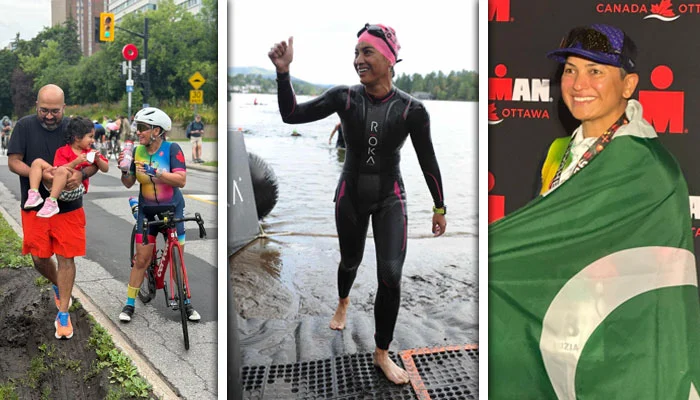
    Fauzia Haimani has done it again. The Pakistani athlete, who is based in Canada, has completed her fourth full Ironman triathlon. This latest finish came at the Ironman event held in Ottawa, where she once again showed off her fitness and endurance. The Ironman is widely considered one of the toughest challenges in endurance sports. It is not a single race. It is three gruelling events combined into one long day. Athletes start with a 3.8-kilometre swim. From there, they move straight into a 180-kilometre cycling stretch. The event then wraps up with a full 42.2-kilometre marathon. All three legs happen back to back, with no rest days in between. Completing all three takes serious physical and mental preparation. Fauzia finished the entire course in 15 hours, 22 minutes, and 35 seconds. Her swim alone took 1 hour and 45 minutes. She then moved on to cycling, completing that portion in 7 hours and 7 minutes. The final stretch, the marathon, took her 6 hours and 11 minutes to finish. This is not new territory for her. Fauzia has completed the full Ironman challenge three times before this latest finish. She first did it in 2021. She returned to complete it again in 2024, and once more in 2025. That makes this her fourth full Ironman overall. Her endurance résumé does not stop there. Alongside the full Ironman races, Fauzia has also completed the half Ironman challenge five separate times. Together, these accomplishments paint the picture of an athlete who has built real consistency in one of the most demanding sports out there. Events like these require months of training. Long swims, long rides, and long runs all need to be built up gradually. Athletes also have to manage nutrition, pacing, and recovery carefully to make it through such a demanding single-day event. Fauzia’s latest finish adds another achievement to her growing list. It also reflects the kind of discipline and determination it takes to keep coming back to one of the hardest physical challenges an athlete can attempt. Her continued participation in international endurance events also highlights the presence of Pakistani athletes on demanding global sporting stages, even outside more commonly covered sports.

  • |

    Sabalenka targets strong comeback at Toronto Open

    TORONTO: World No. 1 Aryna Sabalenka is aiming to rediscover her best form as she begins her campaign at the WTA 1000 Canadian Open in Toronto, with the top ranking and momentum ahead of the US Open at stake. The Belarusian has enjoyed an outstanding hard-court season, winning 23 of her 24 matches on the surface in 2026. Her only defeat came against Elena Rybakina in the Australian Open final. Despite her dominance on hard courts, Sabalenka struggled to produce similar results during the clay and grass-court seasons. She was eliminated in the quarter-finals of the French Open before suffering a fourth-round exit at Wimbledon against Japan’s Naomi Osaka. The Toronto tournament could have a significant impact on the WTA rankings. Sabalenka risks losing the world No. 1 position if she fails to reach the round of 16 and Rybakina goes on to win the title. Although Sabalenka has never progressed beyond the semi-finals at the Canadian event, she believes she is mentally refreshed after taking a short break following Wimbledon. The 27-year-old spent several days on the Greek island of Mykonos before returning to training with renewed motivation. Speaking ahead of the tournament, Sabalenka said the time away from tennis allowed her to recover physically and mentally. She admitted that some adjustments made during the clay and grass seasons did not deliver the desired results but expressed confidence that returning to her usual approach would help her regain consistency. The tournament draw presents another tough challenge for the top seed. Sabalenka leads the upper half, which also features two-time champion Jessica Pegula, Amanda Anisimova and Poland’s Iga Swiatek, who is looking to bounce back after an early Wimbledon exit. Meanwhile, Elena Rybakina heads the bottom half of the draw alongside Coco Gauff, Naomi Osaka and newly crowned Wimbledon champion Linda Noskova. Noskova, who recently captured her maiden Grand Slam title, enters the tournament with growing confidence and could face rising Philippine star Alexandra Eala in the third round. Several notable players will miss the tournament. Wimbledon runner-up Karolina Muchova remains unavailable while recovering from minor surgery, while defending champion Victoria Mboko is also sidelined with the knee injury that forced her to withdraw from Wimbledon.

  • Why Monthly Car Rental in Abu Dhabi Is the Smartest Choice for Long-Term Visitors, Expats, and Business Professionals

    Abu Dhabi, the capital of the United Arab Emirates, is a city of remarkable contrasts — where gleaming modern skyscrapers stand alongside serene cultural landmarks, and bustling business districts sit just minutes from pristine coastline and desert dunes. Whether you are relocating for work, managing an extended business project, planning a long family holiday, or […]

  • | |

    Hajj applications go digital as Pakistan lets pilg…

    ISLAMABAD: Federal Minister for Religious Affairs Sardar Muhammad Yousaf has announced that Pakistan’s Hajj application process has been fully digitized, allowing prospective pilgrims to apply from the comfort of their homes without visiting offices or standing in long queues. Speaking at a press conference in Islamabad, the minister said the digital system had been introduced to make the Hajj registration process easier and more convenient for pilgrims. Around 400,000 registered applicants will be able to submit their applications online. Under the new system, applicants will have several options for paying their Hajj expenses. Payments can be made through credit cards or PSID, while those wishing to pay in cash can print a challan and deposit the required amount. Yousaf said 107,526 pilgrims are eligible to perform Hajj under the government scheme. The collection of the first installment of Hajj expenses will begin on August 17, while the second installment is scheduled to be collected in October. Applications will be processed on a first-come, first-served basis, with registration closing once the government’s allocated quota is reached. The minister also said pilgrims opting for the private Hajj scheme would be able to select a private operator through the Pak Hajj application. However, he cautioned pilgrims against making direct payments to private Hajj operators.

  • |

    Mark Ruffalo rejects Paramount antisemitism accusation

    Mark Ruffalo has strongly rejected allegations of antisemitism made by Paramount after the actor criticised the company’s proposed merger with Warner Bros. Discovery. The actor said his comments were directed at the business and political activities connected to the deal, rather than Jewish people or the Jewish community. He argued that criticising Israeli Prime Minister Benjamin Netanyahu, military technology contracts, or executives involved in such agreements should not be equated with antisemitism. “The accusation that I am antisemitic is appalling and fundamentally dishonest,” Ruffalo said in a statement shared on X. He maintained that his remarks were based on his political beliefs and concerns about the proposed merger. Ruffalo also stressed that he has “deep love and respect” for Jewish people, pointing to the important role Jewish friends, colleagues and loved ones have played in his life. His response came after he criticised the proposed Paramount-Warner Bros. Discovery deal and raised questions about Oracle’s involvement in supplying technology used by the Israeli military. Paramount had previously criticised Ruffalo’s remarks, saying it was concerned that antisemitic tropes were being used in connection with a business dispute. A company spokesperson said Paramount did not tolerate prejudice against anyone but argued that Ruffalo’s comments warranted criticism. The dispute is part of a wider debate surrounding Paramount’s proposed $111 billion merger with Warner Bros. Discovery. Ruffalo has argued that the transaction could have major consequences for the entertainment industry, particularly in areas such as editorial independence, employment and corporate influence. The actor has also questioned Oracle’s business interests in data, surveillance technology and government contracts. He raised concerns about the possible influence of foreign money and powerful technology companies on media organisations and editorial decisions. Ruffalo has called for greater scrutiny of the proposed transaction, arguing that regulators should provide clearer answers about potential national security concerns before the merger is allowed to proceed. “Lawmakers on both sides of the aisle have called for serious national security review,” Ruffalo said, arguing that the deal should not move forward until those concerns are properly addressed. His opposition to the merger is not new. In April, Ruffalo joined attorney Norm Eisen in urging state officials to challenge the takeover through antitrust measures. An open letter opposing the transaction has also attracted more than 5,000 signatures, with support from several entertainment industry and advocacy organisations. The proposed deal gained momentum after Paramount Skydance made a $31-per-share offer for Warner Bros. Discovery following Netflix’s withdrawal from its own proposed agreement with the company. As discussions over the merger continue, Ruffalo’s comments have added another layer to the controversy, bringing questions about corporate ownership, political influence, technology contracts and editorial freedom into the wider debate over the future of the entertainment industry.

Leave a Reply

Your email address will not be published. Required fields are marked *