approves rs414 billion
|

DC approves Rs4.14 billion District Health Authority budget for FY2026-27

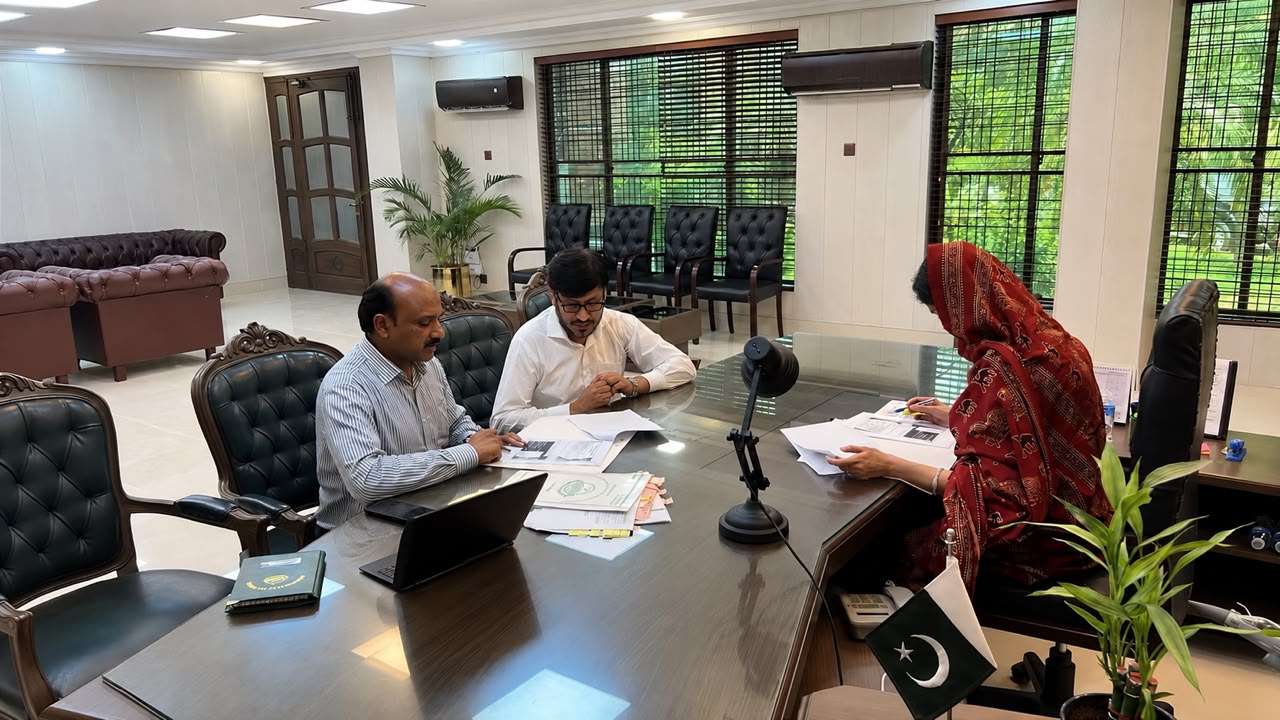
GUJRAT: Deputy Commissioner and Administrator District Health Authority (DHA) Gujrat Noor-ul-Ain Qureshi has approved a budget of more than Rs4.14 billion for the District Health Authority for the financial year 2026-27, with the largest allocation earmarked for salaries of healthcare workers and a significant share reserved for the uninterrupted supply of medicines in government health facilities.

The budget was approved during a meeting chaired by the deputy commissioner at her office on Wednesday. The meeting was attended by Chief Executive Officer Health Dr Syed Atta ul Munim, Deputy Director Budget Health, and other relevant officials, who reviewed the proposed allocations and expenditure plan for the upcoming fiscal year.

According to officials, the total approved budget stands at Rs4,141,211,000, covering salaries, medicines, utilities, contractual staff payments, recruitment and repair of health facilities across the district.

Officials informed the meeting that Rs3.274 billion has been allocated for salaries and allowances of doctors, nurses, paramedics and other employees serving in the district health system. The allocation constitutes the largest portion of the annual budget and is aimed at ensuring uninterrupted payment of salaries to healthcare staff working in hospitals and primary healthcare facilities.

A sum of Rs400 million has been reserved for the procurement and uninterrupted supply of medicines to government healthcare institutions, including the District Headquarters Hospital, Tehsil Headquarters Hospitals, Rural Health Centres (RHCs), Basic Health Units (BHUs) and other public health facilities operating under the District Health Authority.

The meeting was further informed that Rs104 million has been allocated for the payment of electricity, gas, water and other utility bills to ensure smooth functioning of health institutions across the district.

An additional Rs60 million has been earmarked for payments to doctors serving under the lump-sum pay package, enabling the authority to continue services in facilities where contractual medical professionals are performing duties.

Officials also briefed the meeting that the remaining funds would be utilised for Expanded Programme on Immunisation (EPI) recruitments, repair and rehabilitation of healthcare facilities, and other operational requirements aimed at strengthening service delivery throughout the district.

Deputy Commissioner Noor-ul-Ain Qureshi directed the health authorities to ensure transparent utilisation of public funds and stressed that every allocation should directly contribute to improving healthcare services for citizens. She emphasised the need for strict financial discipline and instructed officers to closely monitor expenditure throughout the financial year.

The meeting also reviewed priority areas requiring financial support and discussed measures to maintain uninterrupted healthcare services in both urban and rural areas of the district.

The approval of the annual budget comes as the District Health Authority seeks to improve service delivery, maintain essential medical supplies and address operational needs across Gujrat’s public healthcare network. Officials expressed confidence that timely release and efficient utilisation of funds would help strengthen healthcare services and improve access to treatment for residents across the district during the 2026-27 fiscal year.

Similar Posts

  • | | |

    Sindh empowers Deputy Commissioners to manage Evac…

    The Sindh government has expanded the powers of deputy commissioners by appointing them as administrators of evacuee trust properties in their respective districts. According to a notification issued by the Sindh Minorities Affairs Department all deputy commissioners in the province have been given additional responsibilities to oversee and protect evacuee trust properties. Under the new arrangement deputy commissioners will supervise commercial, agricultural and religious properties located within their districts. They will also be responsible for ensuring the proper management protection and regulation of these properties. The move is aimed at strengthening the administrative oversight of evacuee trust properties and ensuring that such assets are properly managed at the district level. The notification gives deputy commissioners specific powers to regulate and protect these properties. They will also be required to establish district-level committees to assist with the administration and management of evacuee trust properties. The Sindh government’s decision is expected to provide a more centralized administrative mechanism for dealing with properties under the relevant trust arrangements. District administrations will now have a greater role in monitoring these assets and addressing issues related to their management. The new powers cover different categories of properties including commercial agricultural and religious assets. Deputy commissioners will oversee these properties within their respective jurisdictions and take administrative measures under the authority granted by the provincial government. The notification further states that the new orders will take effect immediately. The decision comes as provincial authorities seek to strengthen the protection and regulation of properties that fall under the evacuee trust framework. By assigning these responsibilities to deputy commissioners the government has placed district administrations at the center of the property management process. The formation of district-level committees is also expected to help deputy commissioners carry out their new responsibilities and improve coordination between relevant departments. The Sindh government has not indicated that the new arrangement is temporary. With immediate effect deputy commissioners across the province will exercise their newly assigned administrator powers and oversee evacuee trust properties within their districts. The development represents a significant expansion of the administrative role of deputy commissioners in Sindh and gives district authorities greater responsibility for the protection regulation and management of evacuee trust properties

  • | |

    Nawaz interviews candidates for AJK reserved seats

    Pakistan Muslim League-Nawaz (PML-N) leadership has accelerated consultations over the formation of the next government in Azad Jammu and Kashmir (AJK), with party supremo Nawaz Sharif and Punjab Chief Minister Maryam Nawaz interviewing candidates for reserved seats. The interviews were held in Murree on Sunday for five women’s reserved seats in the AJK Legislative Assembly. PML-N AJK regional president Shah Ghulam Qadir and Prime Minister’s Adviser on Political Affairs Rana Sanaullah also attended the meeting. The party leadership reviewed the profiles of several women seeking PML-N tickets. The interviews reportedly lasted between five and 10 minutes for each candidate. Among those interviewed were Maryam Kashmiri, president of the PML-N AJK Women’s Wing, secretary general Nasira Azeem Khan, former reserved-seat MLA Sehrish Qamar, former Assembly member Nisara Abbasi, Maryam Idrees, Maria Iqbal Tarana and Zareeda Nisar. The widow of late Raja Abid Khan of Dadyal also appeared before the leadership. Her son, Raja Shoaib Abid, had withdrawn from the electoral contest in support of PML-N candidate and MLA-elect Chaudhry Azhar Sadiq. The PML-N leadership praised the participation of women in the recent AJK elections. The party said women had played an active and important role in the electoral process and described their involvement as a positive development for democracy. The PML-N has emerged as the largest party following the recent AJK elections. It secured 25 directly elected seats and has the support of an allied member. Based on its strength in the Assembly, the party is expected to win four of the five reserved seats for women. The party is also expected to secure the remaining three reserved seats allocated to religious scholars or Mashaikh, overseas state subjects, and technocrats and other professionals. The AJK Election Commission has scheduled polling for all eight reserved seats for August 24. The voting will take place at the AJK Legislative Assembly Hall in Muzaffarabad from 10am to 1pm. Candidates will submit nomination papers on August 20. The scrutiny process will be completed the same day, while appeals against decisions regarding nominations can be filed on August 21. The Election Commission will hear the appeals on August 22. Candidates will have until August 23 to withdraw their nominations, after which the final list of contestants will be issued. The AJK Assembly comprises 53 members. Of these, 45 are elected through direct voting, while eight seats are reserved for specific categories. However, elections could not be held in seven constituencies because of the law and order situation in parts of Poonch and Sudhnoti districts. As a result, 38 directly elected members will take part in the process of electing candidates to the reserved seats. Meanwhile, the Election Commission also issued notifications confirming the victories of PPP candidate Sardar Ziaul Qamar and PML-N candidate Sardar Mir Akbar in Bagh district. Qamar was declared successful from LA-15 Central Bagh, while Akbar was declared the returned candidate from LA-16 Eastern Bagh. Their notifications formally completed the electoral process in the two constituencies.

  • | |

    Supreme Court upholds death sentence in woman’s …

    The Supreme Court has issued a landmark ruling concerning women’s rights, declaring that a woman’s right to seek khula (judicial divorce) is a constitutional right and that violence against a woman exercising this right amounts to an attack on the Constitution. A three-member bench of the Supreme Court dismissed the jail petition filed by convict Waseem Abbas and upheld his death sentence. Justice Muhammad Hashim Khan Kakar authored the four-page detailed judgment. According to the judgment, women are fully protected under Articles 9, 14 and 25 of the Constitution, which guarantee their security, dignity and equal rights. The court said that anyone who uses violence against a woman seeking khula would face the full force of the law. It observed that killing a woman for exercising her legal right is an act of brutality and open defiance of the law. The Supreme Court further ruled that a convict involved in a cold-blooded and planned murder does not deserve any concession. The judgment also clarified that the testimony of relatives cannot automatically be rejected in cases involving crimes committed within the privacy of a home. The court said forensic evidence recovered from the crime scene provided conclusive evidence against the accused. The forensic examination established a match between the recovered bullet casings and the pistol linked to the crime. The Supreme Court found no legal or factual flaw in the decisions of the lower courts and upheld the death sentence awarded to Waseem Abbas. According to the case record, Waseem Abbas shot and killed his former wife, Shehnaz Bibi, on October 11, 2020. She had obtained a legal khula decree from a family court before the incident. The convict allegedly entered the woman’s home and killed her around 48 hours after she obtained the decree. A trial court subsequently sentenced Abbas to death and awarded him 10 years in prison. The Lahore High Court later upheld the death sentence.

  • | |

    SC to hear Imran access pleas on August 18

    The Supreme Court has scheduled five petitions concerning access to jailed former prime minister and PTI founder Imran Khan for hearing on August 18. A three-member bench headed by Justice Shahid Waheed will hear the petitions. Justice Naeem Akhtar Afghan and Justice Ishtiaq Ibrahim are also part of the bench. The cases were previously being heard by a bench headed by Justice Muhammad Ali Mazhar. The bench has now been reconstituted after Justice Mazhar became unavailable at the Supreme Court’s principal seat. The petitions seek permission for Imran Khan’s family members, personal doctors and legal team to meet him in prison. The applicants have also requested access to his medical records and proper arrangements for his medical treatment. The petitions gained renewed attention after PTI lawyers and lawmakers gathered outside the Supreme Court earlier this week, protesting over the continued delay in fixing the cases. A delegation led by PTI lawyer Salman Akram Raja subsequently met the apex court registrar. According to Insaf Lawyers Forum chief organiser Intezar Panjutha, the registrar assured the delegation that five petitions relating to restrictions on meetings with Imran would be listed for hearing. The cause list was expected to be issued ahead of the proceedings. One of the petitions was filed by Imran’s sister, Uzma Khan. She has sought his transfer to Shifa International Hospital, arguing that he requires proper treatment and continuous medical monitoring for an eye-related condition and other health complications. The Supreme Court had earlier directed that details of meetings held by Imran and his wife, Bushra Bibi, with family members, lawyers and party leaders in prison be submitted. The newly constituted bench has attracted attention because of the legal positions previously taken by its members in politically sensitive matters. Justice Afghan has been associated with dissenting opinions on several major constitutional and legal issues. He had opposed the constitutionality of trying civilians in military courts and had also dissented in a case involving the transfer of judges between high courts. He has previously granted post-arrest bail to PTI leaders facing cases related to the May 9 violence. Justice Ibrahim was part of a Supreme Court judgment that overturned an earlier order concerning Imran’s right to defend himself in a defamation case filed by Prime Minister Shehbaz Sharif. Meanwhile, the Islamabad High Court is separately hearing petitions concerning the alleged solitary confinement of Imran Khan and Bushra Bibi. The dispute over access to Imran has remained a major issue for the PTI, which maintains that his family, lawyers and doctors should be allowed regular meetings. The government has continued to face pressure over the prison arrangements surrounding the former prime minister.

  • Late GCU physicist’s family endows Rs14m for scholarships

    LAHORE: The family of the late Prof. Faizan-ul-Haq, a distinguished physicist and an unsung hero of Pakistan’s nuclear programme, has donated Rs14 million to establish 14 golden scholarships at Government College University (GCU) Lahore. According to details, the endowment will fund 14 scholarships, worth Rs1 million each, for BS and MPhil students at the university’s Centre for Advanced Studies in Physics (CASP) and Department of Economics. The scholarships were sponsored by Mr. Rizwan-ul-Haque Rana and his family to honour his brother, Prof. Faizan-ul-Haq, who devoted his 60-year career to teaching and research at GCU-CASP. Prof. Faizan-ul-Haq, who passed away on Nov 23, 2023, completed his MSc in Physics from GC Lahore in 1962. He was a direct student of Prof. Dr. Rafi Muhammad Chaudhary, the founder of CASP and widely regarded as the father of nuclear physics in Pakistan. Prof. Faizan played a pivotal role in training 45 Old Ravians who were part of the 150-member expert team that launched Pakistan’s atomic programme on May 28, 1998. He also prepared the PC-1 for the installation of a second Pelletron Accelerator at CASP in 2009. GCU Vice Chancellor Prof. Dr. Muhammad Omer Chaudhry commended the family’s philanthropy, stating: “Prof. Faizan-ul-Haq’s legacy goes beyond his immense scientific contributions; it lives on in the generations of students he mentored. This generous endowment ensures that his mission of empowering young scholars will continue uninterrupted. We are deeply grateful to Mr. Rizwan-ul-Haque Rana and Mrs. Eloisa Rana for this noble cause, which will profoundly support our talented students in CASP.” The scholarships at GCU Lahore have been categorised into the Prof. Faizan Ul Haq Golden Scholarship, the Shah Begum & Ghulam Dastgir Golden Scholarship, and the Mr. Rizwan Ul Haque Rana & Mrs. Eloisa Rana Golden Scholarship. In addition to the endowment at GCU Lahore, the family has also established six golden scholarships, backed by a Rs6 million endowment, for physics students at Government College Women University (GCWU) Sialkot. Prof. Dr. Shazia Bashir, former GCU Vice Chancellor and current Vice Chancellor of GCWU Sialkot, said Prof. Faizan believed in combining theoretical physics with real hands-on experience, training students in techniques ranging from glass blowing and spot welding to fabricating nuclear detectors. “He was an unsung hero who produced skilled, trained, talented, and well-groomed students,” Dr. Bashir stated. “This tremendous contribution to such a noble cause confirms that his good work will continue shaping the futures of thousands of students.”

  • | |

    NA committee summons Lahore metropolitan officer o…

    ISLAMABAD: The National Assembly Standing Committee on Rules of Procedure and Privileges has summoned Metropolitan Corporation Lahore’s Metropolitan Officer (Regulation), Jawad-ul-Hassan, to appear in person before the committee on September 1. The summons were issued on the direction of committee chairman Afzal Khokhar after the officer failed to attend an earlier committee meeting despite being served a notice. According to the National Assembly Secretariat, Jawad-ul-Hassan has been directed to appear at 2pm on September 1 in the Constitution Room of Parliament House, Islamabad. The committee took notice of his absence from its August 12 meeting and decided that his personal appearance should be ensured at the next proceedings. The summons were issued under Rule 227(3) of the Rules of Procedure and Conduct of Business in the National Assembly, 2007. The provision allows the committee to take steps to secure attendance when required in connection with parliamentary proceedings. The official notice also warned that failure to comply could lead to further action under the powers available to the committee. These powers include authority similar to that of a civil court for enforcing attendance and requiring the production of relevant documents. To ensure that the summons are properly served and implemented, the National Assembly Secretariat has sought assistance from the Punjab chief secretary. The inspector general of police Punjab has also been asked to provide necessary assistance, within the law, to facilitate the officer’s attendance before the parliamentary committee. Meanwhile, the chief officer of the Metropolitan Corporation Lahore has been directed to ensure that Jawad-ul-Hassan is informed about the summons and appears before the committee personally. The latest development represents an escalation following the officer’s earlier failure to attend the proceedings. The committee is now seeking his direct appearance rather than allowing the matter to proceed in his absence. The September 1 hearing is expected to provide the committee an opportunity to question the officer directly and examine the circumstances surrounding his previous non-appearance.

Leave a Reply

Your email address will not be published. Required fields are marked *