visits hangu vows
| |

KP CM visits Hangu, vows support for martyrs’ fa…

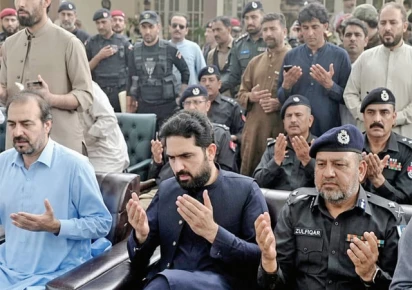
Khyber Pakhtunkhwa Chief Minister Muhammad Sohail Afridi visited Hangu on Thursday to meet the families of police officers who lost their lives in the recent terrorist attack on Khazana Check Post.

The chief minister offered Fateha for the deceased officers and prayed for the elevation of their ranks. He paid tribute to the policemen, calling them national heroes who sacrificed their lives while protecting the country and its people.

Afridi assured the bereaved families that the provincial government would continue to support them through the difficult period. He pledged comprehensive financial and institutional assistance and said the government would use all available resources to ensure the long-term welfare of the martyrs’ families.

After returning to Peshawar, the chief minister chaired a high-level meeting to assess the law and order situation across the province. Provincial Information Minister, Special Assistant to the Chief Minister on Home Affairs, Chief Secretary, Additional Chief Secretary (Home), Inspector General of Police and other senior officials attended the meeting.

Officials briefed the meeting on the security situation, particularly in the southern districts, and discussed recent developments, ongoing operations and emerging security challenges.

Afridi directed the authorities to utilise all available resources to combat terrorism and establish lasting peace in the province. He stressed the need for a coordinated, intelligence-based strategy to strengthen public security and effectively counter militant threats.

Meanwhile, police personnel killed in Wednesday’s terrorist attack in Hangu were laid to rest after funeral prayers at Police Lines Hangu. The ceremony took place with full state honours and was attended by senior civil and police officials, including Police Training College Hangu Commandant Shaukat Abbas, Deputy Commissioner Basir Ali Rahman and local elders.

Similar Posts

  • | |

    Muse singer Matt Bellamy takes legal step to end m…

    Muse frontman Matt Bellamy has officially taken legal steps to end his marriage to model and actress Elle Evans. The 48-year-old musician filed for divorce in Los Angeles on August 12, 2026, citing “irreconcilable differences” as the reason for the split. (People.com⁠) Bellamy and Evans first met in 2015 while Evans appeared in Muse’s “Mercy” music video. Their relationship quickly developed, and the couple became engaged in December 2017. After dating for several years, they exchanged vows in an outdoor ceremony in Malibu on August 10, 2019. (Us Weekly⁠) The couple went on to build a family together. They welcomed their daughter, Lovella Dawn, in June 2020. Their second child, son George Julien-Wade, was born in May 2024. Bellamy also has a teenage son, Bingham, from his previous relationship with actress Kate Hudson. (People.com⁠) News of Bellamy and Evans’ separation first became public earlier this year. In June, Bellamy confirmed that they had separated in summer 2025, describing the circumstances behind the breakup as “really unexpected.” He also explained that the difficult period influenced his creative work and the making of Muse’s album The Wow! Signal. (People.com⁠) At the time, Bellamy focused on keeping life stable for his children. His comments suggested that protecting their family environment remained a priority while he dealt with the major personal change. The latest court filing provides more details about the divorce proceedings. Bellamy is seeking sole legal and physical custody of the couple’s two young children, Lovella and George. He is also asking the court to uphold the terms of their premarital agreement concerning spousal support. (People.com⁠) Evans, meanwhile, has indicated that she plans to contest Bellamy’s custody request, according to reports. The custody issue could therefore become an important part of the proceedings as the former couple works through their separation. (People.com⁠) Despite the end of their marriage, Bellamy and Evans have continued to share a connection through their children. The pair have also been seen maintaining family ties, including reuniting with their children for important occasions. For fans, the divorce marks the end of a relationship that lasted more than a decade from their first meeting and seven years of marriage. Bellamy’s filing now moves their private separation into a formal legal process, while both parents face the challenge of navigating the next chapter of their lives and their children’s future.

  • | |

    Pakistan goods transporters association declares i…

      The Pakistan Goods Transporters Association has raised serious concerns over the volatile and unpredictable daily adjustments in petroleum prices, stating that such frequent fluctuations make it impossible for the transport sector to continue operations smoothly. In a press conference held in Lahore, association officials, led by President Nabeel Mahmood Tariq, articulated a series of demands and grievances that have been mounting over recent months, warning that without immediate government intervention, the entire logistics and supply chain network could face severe disruption. Addressing the media alongside other senior office-bearers of the All Pakistan Goods Transporters Association, Nabeel Mahmood Tariq emphasized that the transportation industry is the backbone of the national economy, responsible for moving essential commodities, industrial raw materials, and consumer goods across the length and breadth of the country. However, he argued that the current pricing mechanism for petroleum products—which has seen almost daily revisions—has created an environment of extreme uncertainty for fleet operators. Unlike larger corporate entities, most truck owners and small transport companies operate on thin profit margins, and without a stable fuel pricing framework, they are unable to quote competitive rates to clients or plan their operational budgets effectively. Tariq pointed out that many transporters have already started grounding their vehicles, as each trip now carries the risk of financial loss if fuel prices rise unexpectedly mid-journey. Beyond fuel prices, the association president laid out a comprehensive list of demands aimed at reducing the financial burden on the sector. First and foremost, he called for an immediate end to unnecessary customs checking at various inter-provincial checkpoints. According to Tariq, these intrusive and repetitive inspections not only cause long delays—sometimes stretching into hours—but also open the door to harassment and bribery, which further inflate the cost of doing business. He urged the federal and provincial governments to streamline customs procedures and adopt a more efficient, technology-driven system that would expedite the movement of goods without compromising security or revenue collection. Another major point of contention raised by Tariq was the recent increase in toll taxes on highways and motorways. He demanded that this hike be rolled back completely, arguing that transporters are already struggling with rising maintenance costs, spare part prices, and tyre rates. The additional toll burden, he said, is simply unsustainable and forces many operators to take longer, less safe alternative routes, which ultimately hurts the overall efficiency of freight movement. Turning his attention to provincial policies, particularly in Punjab, Tariq called for the establishment of new, modern truck terminals across the province. He noted that existing truck stands and loading points are outdated, overcrowded, and lack basic amenities for drivers and helpers. New truck yards, equipped with proper parking, resting areas, workshops, and loading/unloading facilities, would not only improve working conditions but also reduce traffic congestion in urban centers. He also strongly condemned the 300 percent increase in token tax imposed on commercial vehicles in Punjab, labeling it as punitive and counterproductive. He demanded that this excessive tax hike be withdrawn immediately, asserting that it disproportionately affects small owner-operators who form the majority of the association’s membership. In a significant announcement, Nabeel Mahmood Tariq declared that the association fully supports the wheel-jam strike (hunger strike) called for August 8, which has been organized by various transport unions across the country to pressure the government into addressing these long-standing issues. He clarified that this is not a political move but a last-resort measure to draw attention to the existential crisis facing the transport industry. He warned that if the government fails to respond positively before that date, thousands of trucks, trailers, and tankers will park on the roads, effectively paralyzing the movement of food, medicine, fuel, and industrial goods. Such a strike, he cautioned, would have catastrophic consequences for an already fragile economy, leading to shortages, price hikes, and factory closures. Concluding his address, Tariq appealed to Prime Minister Shehbaz Sharif and the chief ministers of all provinces to personally intervene and hold urgent consultations with transport representatives. He reiterated that the industry is not asking for subsidies or charity, but merely for a predictable policy environment, fair taxation, and the elimination of corrupt practices at checkpoints. He expressed hope that the government would act wisely and avert a crisis that benefits no one except speculators and hoarders. The press conference ended with a unanimous resolution passed by the association leaders, vowing to continue their struggle peacefully but firmly until all their legitimate demands are met. The coming days, they warned, will be decisive for the future of Pakistan’s transport sector and, by extension, its entire supply chain.

  • Thai PM Honors Fallen Soldier, Reaffirms Support for Troops and Border Stability

    BANGKOK – Prime Minister Anutin Charnvirakul presided over the royal cremation ceremony for Private Thanaphat Nanthawong at Wat Chuak Nok in Amnat Charoen province on Tuesday, honoring the soldier who was killed while serving along the Thai-Cambodian border. The ceremony was attended by senior government and defense officials, civil servants, and members of the public. […]

  • Death toll in Kabal suicide bombing rises to 17; Chief Minister, IGP visit Swat, JIT announced

    SWAT: The death toll from the suicide bombing at the main gate of Kabal Police Station in Pakistan’s northwestern Swat district has risen to 17 after two more injured victims succumbed to their wounds, officials said on Monday. The deceased include seven police personnel and 10 civilians, while more than 23 injured people remain under treatment at various hospitals. Funeral prayers for the victims were offered before they were laid to rest in their native villages. Markets across Kabal remained completely shut as residents observed a day of mourning. Police have registered a First Information Report (FIR) against unidentified terrorists at the Counter Terrorism Department (CTD) Police Station in Kabal. The case includes charges of murder, attempted murder, and terrorism-related offences under Pakistan’s Anti-Terrorism Act. Preliminary investigations indicate that the suicide bomber used between six and eight kilograms of explosives. Inspector General of Police (IGP) Khyber Pakhtunkhwa Zulfiqar Hameed paid an emergency visit to Swat following the attack. He visited the injured police personnel and civilians receiving treatment at Saidu Sharif Teaching Hospital, inquired about their condition, praised their courage, and wished them a speedy recovery. The IGP also directed doctors and medical staff to ensure the best possible treatment for the injured. Additional Inspector General CTD, Regional Police Officer Malakand, and District Police Officer Swat accompanied him during the visit. Later, the IGP chaired a high-level security meeting at the Regional Police Office Malakand to review the overall law and order situation in the region and assess the progress of the investigation into the attack, including efforts to identify the perpetrators and their facilitators. Officials informed the meeting that the suicide bomber had been identified and that investigators were using modern forensic and technological methods to expedite the probe. The IGP instructed authorities to ensure the swift arrest of everyone involved and bring them to justice. Speaking to reporters, Zulfiqar Hameed announced that a Joint Investigation Team (JIT) would be constituted to investigate the bombing. He said the families of the fallen police personnel would receive the full martyrs compensation package. He added that stringent security arrangements had already been in place due to potential threats and that police officers displayed exceptional bravery by preventing the suicide bomber from reaching the main target, thereby averting even greater casualties. He reaffirmed that terrorists would not be allowed to regroup and said police continue to receive modern weapons, equipment, and operational support. Meanwhile, Khyber Pakhtunkhwa Chief Minister Muhammad Suhail Khan Afridi arrived in Swat along with Special Assistant for Home Tariq Saeed, Chief Secretary Shahab Ali Shah, and the provincial police chief. The chief minister met the families of the victims, offered condolences, and prayed for the departed. He also visited the injured at Saidu Sharif Teaching Hospital and directed hospital authorities to ensure they receive the best available medical care. The chief minister later chaired a high-level meeting on the security situation in Swat, where he was briefed on the bombing, the region’s overall security environment, and the ongoing counterterrorism operations. Addressing the meeting, Afridi said the people and police of Khyber Pakhtunkhwa were paying the price for what he described as the federal government’s flawed security policies. However, he stressed that the sacrifices made by police personnel and innocent civilians in the fight against terrorism would not go in vain. He called for unity among the public, police, and all political and religious stakeholders to defeat terrorism, describing the current campaign as a decisive phase in eliminating the threat. The chief minister said the provincial government was providing all necessary resources to the Khyber Pakhtunkhwa Police and the Counter Terrorism Department (CTD), including a Rs20 billion allocation to strengthen the police force’s operational capacity. Reaffirming his government’s commitment to restoring peace, Afridi expressed confidence that Khyber Pakhtunkhwa would overcome the security challenge and declared that the 2026–27 fiscal year would be a year of peace, development, and prosperity for the province.

  • | |

    MQM-P raises Sindh representation, census demands

    MQM-Pakistan Chairman Khalid Maqbool Siddiqui has accused the Pakistan Peoples Party (PPP) of creating an ethnic divide in Sindh. He said the province had not simply been divided into urban and rural areas. Instead, he claimed that a linguistic and ethnic division had been created. Speaking at a public gathering in Hyderabad, Siddiqui said Muhajirs were settled in 21 cities across Sindh. He said his party had always preferred political and peaceful struggle over confrontation. Siddiqui warned that if the people participating in the political movement were directed towards the Chief Minister’s House, the situation could reach a decisive point. However, he stressed that MQM-P had never called for fighting. He said the party wanted different communities to recognise and respect each other. The MQM-P chief said the cities of Sindh belonged to the descendants of people who had contributed to the creation of Pakistan. He said they had brought their share of Pakistan with them and had continued to remain committed to the country. Siddiqui also spoke about abandoned properties in Sindh. He claimed that the Muhajir community had not received even 10 per cent of what he described as its rightful share. He said the community’s love for Pakistan and desire for peace should not be considered a weakness. He said MQM-P would continue raising the rights of the people regardless of the number of votes it received. Siddiqui claimed that the party was bigger than the assemblies and said its presence represented Pakistan. The MQM-P chairman also urged the federal government to take the party’s demands seriously. He said one of the party’s major demands was the establishment and empowerment of effective local governments. Siddiqui argued that strong local governments were necessary to solve problems at the grassroots level. He said people should have greater control over decisions affecting their cities and communities. The MQM-P leader also demanded a fair and accurate population census in Sindh. He said every person must be properly counted to ensure fair political representation and distribution of resources. Siddiqui warned that those responsible for failing to count people accurately would eventually have to answer for it. He claimed that two sections of society were currently contributing to the state’s economy in Sindh but were not receiving proportionate representation. He argued that a transparent population count could resolve many of the grievances surrounding political representation. According to Siddiqui, if the people of Sindh were properly counted, the demand for a separate province would no longer remain necessary. His remarks come amid an ongoing political debate in Sindh over population figures, ethnic representation, local government powers and the distribution of resources. The MQM-P has repeatedly called for stronger local governments and greater representation for urban areas. The party maintains that accurate population data is essential for determining political representation and ensuring a fair share of development resources.

Leave a Reply

Your email address will not be published. Required fields are marked *