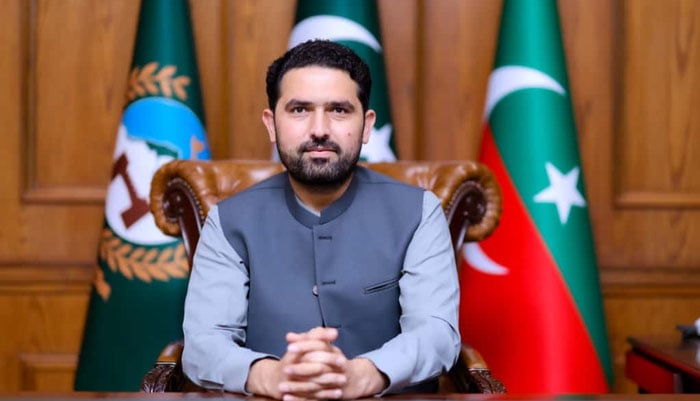
rejects rs64bn proposed
| |

KP rejects Rs6.4bn proposed cut in federal transfe…

PESHAWAR: The Khyber Pakhtunkhwa government has rejected a proposed deduction of Rs6.4 billion from the province’s federal financial transfers.

Chief Minister Sohail Afridi said the federal government had sought an additional amount from Khyber Pakhtunkhwa before the provincial budget. The provincial government had linked the release of the additional funds to a meeting with PTI founder Imran Khan and his approval.

Afridi said the KP government neither approved nor agreed to the proposed deduction of Rs6.4 billion.

He said the additional federal grant had also not been included in the provincial budget for the 2026-27 financial year.

The chief minister said the matter was not merely a political dispute but concerned the province’s constitutional and financial rights. He maintained that Article 164 of the Constitution does not give the federal government the authority to unilaterally deduct money payable to a province.

According to Afridi, any such deduction requires a clear constitutional or legal basis as well as the consent of the provincial government.

He said the Finance Department had clearly conveyed its disagreement with the proposed deduction in a letter issued on August 13. Written instructions were also issued that no deduction should be made without the province’s consent.

Afridi said Finance Adviser Muzammil Aslam immediately met the relevant officials of the Accountant General KP. The Accountant General of Pakistan Revenues was also directed not to record or implement any transaction without the clear consent of the provincial government.

The chief minister said the provincial government had decided to prepare a summary and ordinance under the 7th National Finance Commission (NFC) after the province did not receive its share for six months.

He said the provincial government did not sign the memorandum of understanding concerning the additional amount because a meeting with the PTI founder was not arranged.

Afridi said the KP government had already approached the Federal Constitutional Court to seek its constitutional rights under the National Finance Commission.

He made it clear that the provincial government would not compromise on its NFC rights.

The chief minister further said the federal government had no authority to unilaterally deduct money on the basis of an unapproved memorandum of understanding.

He vowed that the provincial government would use every legal and constitutional avenue to protect its rights and defend every rupee of its financial share.

Afridi also said that if the Federal Board of Revenue (FBR) achieved its Rs15.26 trillion tax collection target, Khyber Pakhtunkhwa’s share would amount to approximately Rs175 billion.

He added that providing the merged districts with their rightful share under the 11th NFC was also one of the provincial government’s conditions.

Similar Posts

  • Thai Prime Minister Anutin Begins Official Visit To France To Strengthen Bilateral Ties

    PARIS, France — Prime Minister Anutin Charnvirakul has commenced an official visit to France at the invitation of French President Emmanuel Macron, marking a significant diplomatic engagement aimed at strengthening bilateral cooperation in trade, energy, transport, and cultural exchange, according to government spokesperson Ratchada Dhnadirek. Thai PM Anutin Says Koh Kood Remains Thai The visit, […]

  • | |

    Diphtheria claims 13 children in Sindh as suspecte…

    Karachi: Health authorities have raised concerns over the increasing number of diphtheria cases in Sindh after 13 children died from the infectious disease at the Sindh Infectious Diseases Hospital in Karachi’s NIPA area this year. The latest figures have intensified public health concerns, coming amid a rise in other infectious diseases across the province. According to hospital data, 30 diphtheria cases have been reported at the Sindh Infectious Diseases Hospital so far in 2026, with 13 children succumbing to the illness. Nationwide surveillance data shows that Pakistan recorded 308 suspected diphtheria cases between January and June this year. Sindh reported 113 suspected cases, the highest among all provinces, followed by Khyber Pakhtunkhwa with 87 cases, Balochistan with 64, Punjab with 35, Islamabad with seven, and Gilgit-Baltistan with two. Health experts describe diphtheria as a highly contagious bacterial infection that spreads from person to person, particularly among children who are not fully vaccinated. The disease primarily affects the throat and airways and can become life-threatening if left untreated. Early symptoms include swollen glands in the neck, the formation of a thick gray membrane in the throat, high fever, severe sore throat, and difficulty breathing. Doctors warn that these symptoms should not be ignored, as delayed treatment can lead to serious complications or death. Medical experts are urging parents to ensure their children receive routine vaccinations and to seek immediate medical attention if symptoms of diphtheria appear. They also stress the importance of early diagnosis and timely treatment to reduce the risk of severe illness and prevent further spread of the infection. Health authorities continue to monitor the situation closely while encouraging the public to remain vigilant and follow recommended immunization schedules.

  • | |

    Murad rejects new province claims, rules out viole…

    Sindh Chief Minister Murad Ali Shah has dismissed claims that Pakistan’s governance system has collapsed, while firmly opposing the creation of new provinces in Sindh and warning that no violence or bloodshed will be allowed over the issue. Speaking to reporters after attending the Mining Technical Conference 2026 in Karachi, the chief minister said the Constitution provides a clear legal mechanism for altering provincial boundaries. He stressed that any such move can only take place if the concerned provincial assembly approves it with a two-thirds majority. Murad Ali Shah said the Sindh Assembly has repeatedly passed unanimous resolutions opposing the creation of any new province in the province. He maintained that there has been no change in the assembly’s position and that the issue should be addressed only through constitutional and democratic procedures. The chief minister said public debate on administrative reforms is acceptable, but warned against creating unnecessary tensions or presenting the issue in a way that could provoke conflict. He said no one would be allowed to exploit the matter to create unrest in Sindh. His remarks came after Interior Minister Mohsin Naqvi recently suggested that Pakistan’s existing governance system was no longer capable of addressing national challenges and called for administrative reforms, including the creation of new administrative units. Responding to questions about public demonstrations, Murad Ali Shah said peaceful protest is a constitutional right but should be held in accordance with the law. He urged organisers to obtain permission from the relevant authorities before staging protests. The chief minister also highlighted the provincial government’s agricultural policy, saying arrangements have been made to procure one million tonnes of wheat to protect local farmers and stabilise the market. Speaking about economic development, he said Sindh continues to expand its mining and energy sectors. He announced that electricity generation from Thar coal is expected to increase from 2,640 megawatts to 3,000 megawatts in the near future. Murad Ali Shah said Thar’s coal fields are producing more than 15 million tonnes of coal annually, helping Pakistan reduce its dependence on imported fuel and saving more than $1.5 billion in foreign exchange each year.

  • | |

    Punjab CTD arrests 18 suspected militants in provi…

    LAHORE: Punjab’s Counter Terrorism Department (CTD) has arrested 18 suspected militants affiliated with various banned organisations during intelligence-based operations across several districts of the province, officials said on Friday. According to the CTD spokesperson, the operations were carried out as part of efforts to prevent possible terrorist activities and maintain law and order across Punjab. A total of 117 intelligence-based operations were conducted, during which 117 individuals were questioned and 18 suspects were taken into custody. The arrested suspects were identified as Hassan Abbas Shah, Muhammad Hanif, Samiullah alias Talib Jan, Muhammad Hasnain, Hafiz Muhammad Abdul Latif, Attaullah, Faizullah, Muhammad Shehzad alias Pama, Muhammad Bilal, Muhammad Anas, Tahir, Waqar Ahmed, Muhammad Ahsan, Muhammad Farman, Muhammad Nauman, Umar Farooq, Abdul Wahab and Shaukat Ali. The suspects were reportedly arrested in Faisalabad, Sialkot, Sargodha, Sahiwal, Hafizabad, Gujranwala, Bhakkar, Lahore and Multan. The CTD said its teams recovered 3.185 kilograms of explosive material, eight detonators, safety fuses, primer cord, four pistols with 21 rounds, along with banned books, prohibited magazines, pamphlets and stickers. Seven mobile phones and Rs42,740 in cash were also seized. Officials said the suspects were allegedly involved in activities aimed at creating fear among the public and disrupting peace and security. Legal proceedings have been initiated against them, while further investigation is underway to determine their alleged links and activities. The spokesperson added that, during the past two weeks, the CTD, local police and other law-enforcement agencies conducted 3,357 combing operations across Punjab. More than 121,000 people were checked during these operations, resulting in 274 arrests, 263 cases being registered and 244 recoveries of various kinds. The CTD said its operations against militants and other elements considered a threat to public security would continue under its objective of ensuring a safer Punjab. Citizens have also been urged to report suspicious activities or information related to terrorism to the CTD Punjab helpline at 0800-11111.

  • | |

    Brad Pitt sees AI as a tool, not a threat to Hollywood

    Brad Pitt has offered a measured view on the growing use of artificial intelligence in Hollywood, saying the technology could help filmmakers produce mid-budget movies more efficiently if it is used responsibly. The Oscar-winning actor acknowledged that AI has become a controversial subject across the entertainment industry. While many filmmakers, actors and other industry professionals remain concerned about its impact, Pitt believes the technology could have practical benefits when treated as a creative tool rather than a replacement for human talent. Speaking about the potential financial impact of AI, Pitt said the technology could make it easier to produce films with budgets ranging from around $40 million to $90 million. According to Pitt, the main value of AI could be in helping filmmakers reduce production costs and bring projects to the screen that might otherwise struggle to secure financing. However, the actor does not appear convinced that AI can simply reproduce an actor’s performance in a way that replaces the individual behind it. Discussing the possibility of artificial intelligence recreating his performances, Pitt pointed to the importance of human decisions in filmmaking. He suggested that even if technology can reproduce aspects of an actor’s appearance or performance, the final result would depend heavily on the person directing and shaping the material. For Pitt, acting is not simply about physical appearance or delivering lines. It also involves personal choices, emotions and discoveries made during the creative process. He questioned whether an AI-generated performance would necessarily reflect the decisions an actor originally made while developing a character. His comments come as Hollywood continues to debate how artificial intelligence should be used in film and television. The technology has raised concerns about the future of acting, writing, visual effects and other creative professions. Industry representatives have been pushing for safeguards to protect performers and creators from having their likenesses, voices or work reproduced without appropriate consent and compensation. Pitt acknowledged that opposition to AI remains widespread within Hollywood. At the same time, his comments suggest that he sees a distinction between using AI to assist filmmakers and allowing it to replace human creativity.

  • | |

    Flood alert as rivers rise, Sukkur, Marala and Bal…

    ISLAMABAD: Pakistan is bracing for another spell of flood-related risks as heavy monsoon rains, rising river levels and high water storage at major dams put several parts of the country on alert. The National Disaster Management Authority (NDMA), through its National Emergencies Operation Centre, has warned of possible low to moderate flooding in vulnerable areas of Khyber Pakhtunkhwa, Punjab, Balochistan and Azad Jammu and Kashmir. According to the latest assessment, the Indus River has already reached low flood levels at Kalabagh, Chashma, Taunsa and Guddu. While the Ravi, Chenab, Jhelum, Kabul and Sutlej are currently within normal ranges, officials expect water flows in several major rivers to increase on August 8 and 9. The NDMA has identified Sukkur on the Indus, Marala on the Chenab and Balloki on the Ravi as areas where low-level flooding could occur. The Jhelum downstream of Mangla Dam and the Kabul River near Adezai are also being closely monitored. Several districts in Khyber Pakhtunkhwa, including Chitral, Upper Dir, Abbottabad, Shangla, Khyber, Orakzai, Kohat, Tank and North and South Waziristan, face the possibility of low to moderate flooding. In AJK, Bagh and Kotli are also considered vulnerable, while Zhob, Musakhel, Kohlu, Barkhan and Dera Bugti in Balochistan remain under watch. Punjab is facing risks from hill torrents, particularly in Dera Ghazi Khan and Rajanpur. The NDMA has also warned of possible urban flooding in Rawalpindi, Gujranwala, Sialkot, Narowal, Faisalabad, Okara and Lahore. Water storage at the country’s major reservoirs remains high. Tarbela Dam’s water level has reached 1,548 feet, with storage at 97.94 per cent, compared with 95.98 per cent during the same period last year. Mangla Dam is at 1,205.2 feet, with storage recorded at 62.99 per cent, slightly above last year’s 62.80 per cent. Authorities have urged residents, tourists and travellers in mountainous and flood-prone areas to remain vigilant, as intense monsoon rainfall can trigger flash floods, landslides and debris flows with little warning. People have been advised to avoid riverbanks, streams and other vulnerable locations and to check weather forecasts and road conditions before travelling as the monsoon system continues to affect the country.

Leave a Reply

Your email address will not be published. Required fields are marked *