
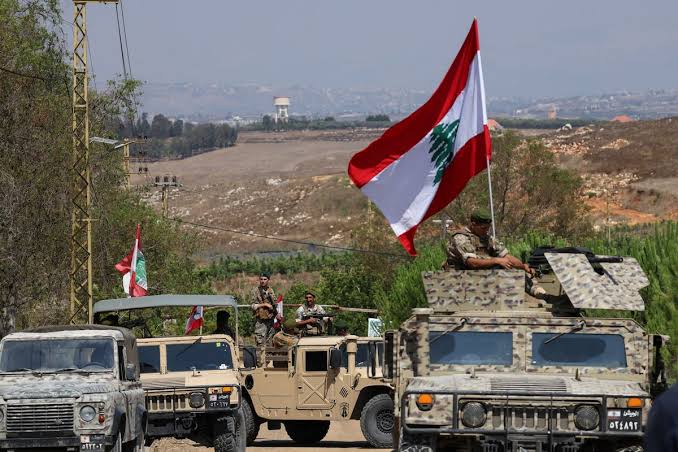
lebanese troops move
| |

Lebanese troops move into first pilot zone as Isra…

Lebanon’s army began deploying troops into a designated pilot zone in the country’s south on Tuesday, following an Israeli withdrawal from part of the area under a framework agreement reached last month with US backing.

The army command said engineering units entered the village of Zawtar al Gharbiyeh in Nabatieh district on Tuesday morning. Later, the command reported that Israeli forces had opened fire near the troops. Israel’s military said its soldiers fired warning shots after Lebanese troops crossed into what Israel considers a security zone.

The pilot zone arrangement envisions Israeli forces withdrawing from a limited portion of territory occupied during the conflict with Hezbollah, alongside the disarmament of the Iran backed Lebanese group. Tuesday’s deployment began ahead of a scheduled meeting in Washington between President Donald Trump and Lebanese President Joseph Aoun.

Aoun was expected to press Trump to push Israel toward withdrawing from the remainder of southern Lebanon and to back the Lebanese army as it works to establish full control over areas currently under Hezbollah’s influence. Speaking to reporters in the Oval Office, Aoun said he told Trump he needed two things from him, political support and backing for the Lebanese Armed Forces. Trump, speaking alongside Aoun, pledged that the United States would help a country he said had been hit hard for decades, adding that Lebanon has been badly treated and deserves proper treatment and respect going forward.

The US State Department announced Monday afternoon that pilot zone operations had begun in Zawtar al Gharbiyeh along with two other villages, Froun and Srifa, consistent with the trilateral framework agreed by Israel, Lebanon and the United States at the end of June. The department described the development as a milestone stemming directly from talks held last week between Israeli and Lebanese representatives in Rome.

Later Monday, an Israeli military official confirmed that Israeli forces would adjust their posture in one of the pilot areas to allow the Lebanese army to carry out its mission, while also protecting Israeli soldiers and preserving the military’s right to self defense and to eliminate threats. The official said the goal of the pilot programme and the broader agreement remains the disarmament of Hezbollah and the removal of its illegal weapons, adding that Israeli forces would stay in the security zone, a strip of occupied Lebanese territory roughly ten kilometers deep along the border, for as long as necessary to protect communities in northern Israel.

On Tuesday, Lebanon’s army command said its units began deploying to Zawtar al Gharbiyeh based on ongoing coordination with the Military Coordination Group for Lebanon, the trilateral body established to support implementation of the framework. The command urged Lebanese citizens to avoid traveling to the village until the security situation stabilizes and to follow instructions from deployed military units for their own safety.

Later Tuesday, the army command said Israeli forces opened fire near these units and warned that the incident hinders progress on deployment across the pilot zones. Israel’s military said its soldiers fired warning shots into the air after Lebanese troops and an engineering vehicle crossed roughly 150 meters into the security zone and breached barriers in the neighboring area of Zawtar al Sharqiyeh. The military said Lebanese troops then withdrew from the area and that no injuries occurred.

The Lebanese army said its troops were already carrying out missions in the nearby villages of Froun and Srifa following Monday’s announcement from Washington. An Israeli source told a regional newspaper that no Israeli troops remained stationed in those villages.

Separately on Tuesday, Lebanon’s state news agency reported that Israeli forces caused two large explosions near the villages of Beit Yahoun and Kounine in Bint Jbeil district, along with blasts from Israeli controlled demolitions in the town of Majdal Zoun in Tyre district. In areas still under Israeli occupation, numerous villages have suffered extensive destruction from strikes and demolitions. Israel’s military says it has been dismantling Hezbollah infrastructure, though human rights organizations have said some of the destruction amounts to deliberate targeting of civilian infrastructure, potentially constituting a war crime.

Hezbollah has rejected the trilateral agreement between Lebanon’s government, Israel and the United States, saying provisions linking Israeli withdrawal to its own disarmament cross what it called all red lines. Israel has said it will not fully withdraw from Lebanon until Hezbollah disarms completely.

Trump said the United States has concrete plans to help Lebanon build the capacity needed to disarm Hezbollah, though he offered no specific details. He also said the Lebanese army is becoming increasingly self sufficient, and added that he would speak directly with Hezbollah representatives if Aoun requested it.

Lebanon became entangled in the broader war between Israel, the United States and Iran on March 2, when Hezbollah launched rockets into Israel in retaliation for a strike that killed Iran’s supreme leader. Israel responded with a bombing campaign across Lebanon and an invasion of a significant portion of the country’s south. More than 4,300 people have died in Lebanon since then, including nearly 800 children, women and medics, according to Lebanon’s health ministry. Israeli authorities say 37 Israeli soldiers and four civilians have been killed on both sides of the border during the conflict.

The pilot zone deployment marks the first tangible step toward implementing the trilateral framework since its signing, though continued friction between Lebanese and Israeli forces on the ground, along with Hezbollah’s outright rejection of the agreement’s terms, points to a difficult path ahead for a plan meant to end one of the region’s longest running conflicts.

Similar Posts

  • | | | |

    Iran rejects talks on ceasefire extension

    Pakistan is making diplomatic efforts to help extend the ceasefire between the United States and Iran, as the current truce is scheduled to expire on Sunday, August 16. Sources said Islamabad is trying to use the understanding reached under the Islamabad Memorandum of Understanding to encourage both sides to maintain the ceasefire and return to negotiations. According to the sources, mediators believe additional time is needed to bridge differences between Washington and Tehran. Diplomatic efforts are therefore continuing to prevent the situation from deteriorating after the current ceasefire period ends. However, an Iranian senior official gave a different assessment of the situation. The official said there have been no discussions between Iran and the United States regarding an extension of the ceasefire. Iran has maintained that Washington must return to the agreement and honour its previous commitments. Tehran has also demanded a clear and credible timeline for the implementation of those commitments before any further understanding can be reached. Meanwhile, US President Donald Trump has made strong statements about the strategic Strait of Hormuz. Trump claimed that the United States now has complete control over the vital waterway and said Iran has limited options to challenge the American naval blockade. The Strait of Hormuz remains a major international shipping route and plays a crucial role in global energy supplies. Any prolonged disruption in the waterway could have serious consequences for oil and gas markets and international trade. Iranian military officials have warned that a renewed US offensive could lead to a wider confrontation. An Iranian military spokesman said energy transmission networks, power plants and infrastructure connected to the global internet could become targets if American military action resumes. The warning has raised concerns that any collapse of the ceasefire could expand the conflict beyond conventional military targets and affect critical infrastructure. Meanwhile, Turkish President Recep Tayyip Erdogan has expressed hope that additional countries will join the Makkah Defence Agreement. He indicated that broader participation could strengthen regional security cooperation. In another development, US Central Command said a Panama-flagged cargo vessel attempting to breach the naval blockade was disabled after a US helicopter fired a missile at the ship. The incident has further highlighted the risks facing commercial shipping in the region amid continuing tensions between Washington and Tehran. Separately, Japanese Prime Minister Sanae Takaichi discussed the situation with Iranian President Masoud Pezeshkian in a telephone conversation. Takaichi called for the Strait of Hormuz to be reopened once negotiations between Iran and the United States reach a successful conclusion.

  • | | |

    Pakistan defeat South Korea to clinch test series …

      ISLAMABAD:Pakistan’s national hockey team continued its impressive run by defeating South Korea in the third match of the four-Test series, securing an unassailable 3-0 lead and sealing the series with one game still to be played. The third Test, played at the Nasir Bunda Hockey Stadium in Islamabad, turned out to be an exciting contest filled with momentum shifts, dramatic goals, and a spirited comeback by the home side. Pakistan displayed resilience and determination, recovering from two separate deficits before claiming a memorable victory in front of the home crowd. South Korea made the stronger start and took the lead in the opening quarter. Their early pressure paid off in the 11th minute, when Lim Deun found the back of the net with a well-taken goal, giving the visitors a 1-0 advantage. Pakistan attempted to respond before the end of the first quarter but was unable to create a clear scoring opportunity. The second quarter saw Pakistan dominate possession and launch several attacks on the Korean goal. The hosts earned promising opportunities and repeatedly tested the opposition’s defence, but they failed to convert their chances into goals. South Korea remained organised at the back and successfully protected its narrow lead. As a result, neither side managed to score during the second quarter, and the visitors went into halftime leading 1-0. Pakistan finally restored parity in the third quarter when Hayat scored an important equaliser, lifting the spirits of both the players and the spectators. However, the celebrations were short-lived as South Korea responded quickly. Kim scored to put the visitors back in front, allowing Korea to end the third quarter with a 2-1 advantage. The fourth and final quarter produced the most thrilling action of the match, with a total of four goals scored. Pakistan came out with renewed energy and determination, pressing aggressively in search of another equaliser. Their persistence paid off as they erased South Korea’s lead and brought the match level once again. The visitors briefly regained the advantage by scoring another goal to make it 3-2 increasing the pressure on the Pakistani side. However, Pakistan refused to give up. During the final ten minutes, the home team produced an outstanding display of attacking hockey, dominating possession and creating multiple scoring opportunities. Pakistan’s relentless pressure eventually overwhelmed the Korean defence. The hosts not only equalised once more but also scored the decisive winning goal, completing a remarkable comeback. The Pakistani defence then held firm in the closing moments to preserve the lead until the final whistle, sealing another impressive victory. With this win, Pakistan secured a commanding 3-0 lead in the four-match Test series, ensuring the series title before the final fixture. The result reflects the team’s growing confidence and consistency, providing a major boost as it continues preparations for upcoming international competitions. Following the match, Pakistan Hockey Federation President Mohiuddin Wani distributed awards to the players in recognition of their performances. The ceremony was also attended by two legendary figures of Pakistan hockey, Olympians Samiullah and Hassan Sardar, who were present as special guests and applauded the team’s fighting spirit and successful series-winning performance.

  • |

    Wildfires force 43,000 to flee in France

    More than 43,000 people have been evacuated from southwestern France as massive wildfires continue to spread across several regions, threatening residential areas, forests and popular tourist destinations. French authorities have launched one of the country’s largest emergency operations of the year as firefighters work around the clock to contain the rapidly advancing flames. The worst-affected area is located near Arcachon Bay and the Cap Ferret peninsula in the Gironde region. The wildfire has already burned through more than 8,700 hectares of land and continues to spread because of strong winds, dry vegetation and extremely high temperatures. Authorities ordered the complete evacuation of the Cap Ferret peninsula, a major holiday destination on France’s Atlantic coast that attracts thousands of visitors every summer. Residents, tourists and campers were instructed to leave immediately as emergency services expanded evacuation operations. To speed up the evacuation, authorities arranged transport by both road and sea. Special boats were deployed from several coastal villages while vehicles used the peninsula’s only highway leading to the mainland. Emergency officials urged everyone in the affected areas to leave without delay for their own safety. French Interior Minister Laurent Nunez described the Gironde wildfire as the largest fire of the current season. He said around 80 homes have been damaged, including nearly 50 houses that were completely destroyed by the flames. More than 1,000 firefighters, supported by helicopters, military engineering units and civil security teams, are working to control the blaze in Gironde. Hundreds of police officers and emergency personnel have also been deployed to help with evacuations, traffic management and public safety. A second major wildfire is burning near Biscarrosse in the neighbouring Landes region. The fire has destroyed more than 2,500 hectares of forest and forced the evacuation of over 23,000 residents, tourists and campers. Local authorities said the blaze remains out of control after continuing to spread overnight. French President Emmanuel Macron has requested international assistance through the European Union Civil Protection Mechanism. Several European countries have agreed to send additional firefighting aircraft and helicopters to help French authorities contain the fires. Croatia is sending Canadair water-bombing aircraft, while Portugal will provide specialised firefighting planes. The Czech Republic and Slovakia are also deploying heavy helicopters to assist emergency crews. Emergency officials said there have been no confirmed fatalities in the Gironde wildfire so far. However, they warned that weather conditions remain highly dangerous and could make firefighting efforts even more difficult in the coming days. Fire experts say the blazes are spreading unusually quickly because of prolonged heatwaves, severe drought and strong winds. These conditions have left forests and vegetation extremely dry, allowing fires to expand rapidly across large areas. Authorities estimate that nearly 50,000 hectares of land have burned across France since the beginning of this year’s wildfire season, making it one of the country’s most destructive fire seasons in recent years.

  • | |

    Punjab bans manual receipts

    The Punjab Revenue Authority (PRA) has banned the issuance of handwritten or manual receipts by businesses operating in the province, according to a notification issued by the authority. Under the new directive, hotels, restaurants, coffee shops and marriage halls must use the Electronic Invoice Management System (EIMS) for issuing customer receipts. The system aims to ensure that businesses properly record their transactions and comply with provincial sales tax regulations. A PRA spokesperson said businesses covered by the directive must generate receipts through EIMS instead of providing handwritten slips or informal receipts to customers. The authority will monitor compliance and take action against businesses that fail to follow the requirement. Businesses that do not issue receipts through the EIMS may face fines ranging from Rs400,000 to Rs1 million, the spokesperson said. The PRA has also warned that repeated violations could lead to stricter action. Authorities may seal the business premises for up to one month if an establishment continues to disregard the rules despite previous enforcement measures. The move forms part of the Punjab government’s efforts to strengthen digital documentation of commercial transactions, improve tax compliance and reduce the possibility of underreporting sales and tax liabilities. The authority has urged businesses in the affected sectors to ensure that their invoicing systems comply with the new requirements to avoid financial penalties and other enforcement action.

  • |

    Romanian forces execute controlled detonation on Danube to safeguard nuclear energy supply

    Romanian naval forces detonated 180 kilogrammes of explosives to clear a massive rock obstruction in the drought-stricken Danube River, attempting to channel essential cooling water towards the country’s sole remaining functional nuclear reactor at Cernavoda. The blast was designed to clear the riverbed and facilitate the construction of a temporary dam to boost water volume heading to the facility. The intervention follows Romania’s declaration of a nationwide state of emergency for August after record-low water levels forced one reactor to shut down entirely. Romanian Defence Minister Radu Miruta defended the costs of the operation, emphasising that maintaining operational capacity at the facility even for a few additional days far outweighs the financial expenditure. Regional energy strains are mounting simultaneously in neighbouring Hungary, where severe water depletion at the Paks nuclear power station has drastically cut output. Prime Minister Peter Magyar warned that a complete plant shutdown could occur next week without weather relief, urging regional coordination and energy restraint to avoid a wider crisis as low rainfall continues across Eastern Europe.

  • | |

    State Department report calls for greater civilian…

    The US State Department said Wednesday that Pakistan needs to strengthen civilian oversight of public finances to improve fiscal transparency, releasing findings that highlighted persistent gaps in how the country discloses key financial information. The department’s assessment described fiscal transparency as a core component of effective public financial management, noting that it allows citizens to understand how government revenues and tax dollars are spent. That visibility into budgets, the report said, gives citizens the tools they need to hold their governments accountable. The findings arrive weeks after Pakistan’s National Assembly passed an 18.8 trillion rupee Finance Bill for 2026 to 2027 in June, which included a defence budget of 3 trillion rupees, with at least 335 billion rupees coming from provincial contributions. In its 2026 Fiscal Transparency Report on Pakistan, the State Department said the country continues to fall short in disclosing important financial data, particularly around debt obligations and the budgets of military and intelligence agencies. The report found that Pakistan’s government did not publish its executive budget proposal within a reasonable timeframe and made only limited information available on debt obligations, including debt held by major state owned enterprises. It further noted that military and intelligence budgets remain outside the scope of adequate parliamentary or civilian oversight. The assessment also pointed to areas of progress. During the review period, the report said, Pakistan’s government made its enacted budget and end of year financial reports widely and easily accessible to the public, including through online platforms. It found that publicly available budget documents offered a substantially complete picture of most planned government expenditures and revenues, including revenue generated from natural resources. The report described the information contained in the budget as generally reliable and subject to audit by the country’s supreme audit institution, which it said meets international standards of independence. Audit reports, the department noted, are published within a reasonable period and contain substantive findings. It also found that the government has specified, and largely followed in practice, clear legal criteria and procedures for awarding natural resource extraction contracts and licenses, while making basic information about such awards publicly available. The report added that Pakistan’s sovereign wealth fund operates under a sound legal framework and that the government publishes accessible information on public procurement contracts. Among its recommendations, the State Department urged Pakistan to make its executive budget proposal available to the public within a reasonable timeframe, disclose more detailed information on government debt, including debt tied to state owned enterprises, and bring military and intelligence agency budgets under parliamentary or civilian oversight. Responding to questions about the report during a weekly press briefing, Foreign Office spokesperson Tahir Andrabi acknowledged that the report had been released the previous day. He said Pakistan adheres to internationally recognized best practices around fiscal transparency, budgeting and financial disclosure, while also operating within its own constitutional, legislative and regulatory frameworks. Andrabi noted that Pakistan remains engaged in an ongoing International Monetary Fund program centered on structural reform and improved fiscal management. He said the country has completed three IMF reviews so far, adding that the reform measures taken under the program have drawn broad recognition, including credit rating upgrades from three international rating agencies as well as positive assessments from the IMF itself.

Leave a Reply

Your email address will not be published. Required fields are marked *