nca pucad unite

NCA and PUCAD unite in ‘Ra’naai-e-Khayal-o-Khat’

LAHORE — On the afternoon of August 14, 2026, Lahore’s main cultural pivot along The Mall became a two-part gallery circuit. It’s because two of Pakistan’s most valued art institutions: the National College of Arts (NCA) and the College of Art & Design, University of the Punjab (PUCAD) opened their doors to a historic joint exhibition titled Ra’naai-e-Khayal-o-Khat (The Beauty of Thought and Line).

The inauguration began at 3:30 PM by Chief Guest Prof. Dr. Niaz Ahmad Akhtar, Chairman of the Higher Education Commission (HEC). The collaborative display marks a rare institutional symbiosis arranged under the leadership of Vice Chancellor NCA Prof. Dr. Murtaza Jafri, Vice Chancellor Punjab University Prof. Dr. Muhammad Ali and Principal CAD PU Prof. Dr. Samina Nasim. This exhibition took place across two physical sites. Part 1 is hosted at PUCAD’s Allama Iqbal Campus and Part 2 is taking over the galleries of NCA. The exhibition which runs through September 3, 2026 forces observers into an active pedestrian dialogue between both historic campuses.

The atmosphere felt energetic with a distinct focus on tactile exploration, material experimentation and personal commentary while walking through the gallery spaces. It’s far from a conventional student thesis. The works on display demonstrate a meticulous engagement with raw textures, physical mediums and thematic intensity.

One of the most captivating pieces in the gallery space is Silent Voice (2026) by Syedah Adeela Ijaz Naqvi. This piece neatly sits on the white wall with a modest print label: the 2” x 3” work entirely relying on hair on canvas. The tactile quality of the piece is intuitive. There are fine strands of human hair intricately arranged to compose two emotive faces. One of the faces is posing a silent scream and the other is gazing outward with quiet resignation. The physical texture of the woven fiber creates a three-dimensional depth. The artwork captures abstract emotional distress in the immediate reality of human bodily material.

Nearby, Zaheer Chaudhry’s Shadow Has No Choice (2022) offers an abrupt photographic counterpoint. The large-format 36” x 25” black-and-white print captures the web-like shadow of tree branches cast against a weathered wall. Chaudhry’s deliberate work turns simple light exposure into a study of urban architecture, restraint and organic silhouette. This artwork emphasizes on physical grain of the surfaces upon which shadows fall.

The exhibition moves fluidly between interiority and observational realism. In an extraordinary mixed-media work, an artist utilizes actual transparent MRI and CT scan films as a physical substrate. The cross-sectional images of the human spine and skull form the internal structure of a curled human figure. The scan is overlaid with swirling patterns reminiscent of cellular forms or neural pathways. The artwork physically merges medical technology with existential vulnerability.

In contrast to these monochromatic psychological investigations stands a large botanical painting depicting green parakeets clustered within a canopy of lychee trees. The piece revels in the lush sheen of ripening fruit and light filtering through leaves. The painting is executed with meticulous brushwork. It celebrates regional flora and fauna with precision. Elsewhere, a surrealist monochrome composition presents a reclining figure intertwined with reptilian and avian wildlife. There’s a frog resting on patterned cloth while a bird hovers close to an open beak-like mouth. This piece of art blurs the line between human anatomy and raw natural ecology.

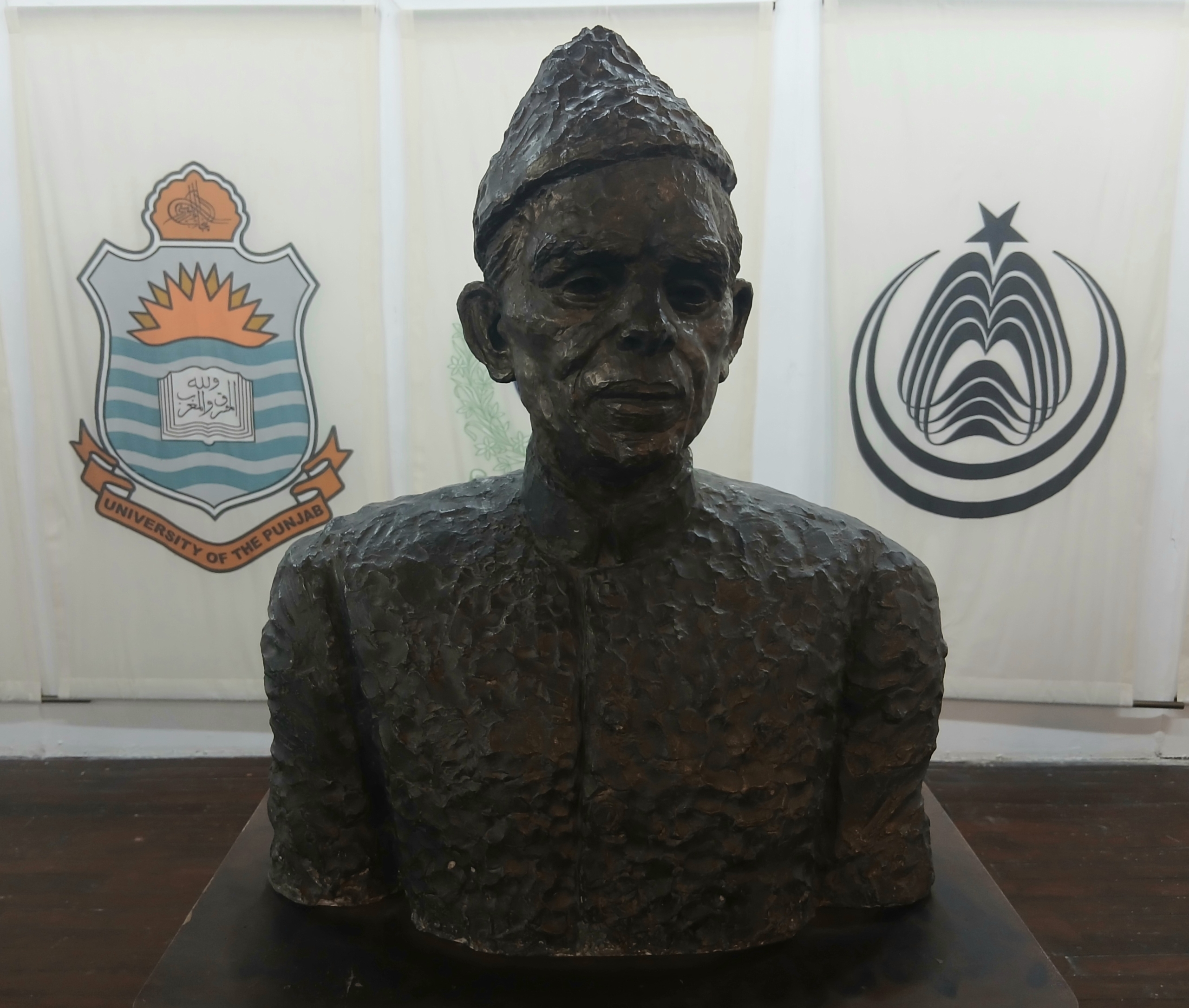
The exhibition’s opening on Independence Day preserved national identity and historical homage. The central hall sculpted spaces render tributes to Quaid-e-Azam Muhammad Ali Jinnah. A heavily dark bronze bust of Jinnah presents prominently before the official insignias of Punjab University and NCA. Its rough tactile surface catches the ambient overhead lighting. Nearby, a tonal portrait executed in high-contrast graphite and airbrush tones captures Jinnah’s likeness in quiet contemplation.


Ra’naai-e-Khayal-o-Khat sets a significant precedent for academic art institutions in Pakistan by uniting NCA and PUCAD. The two institutions have created a unified platform that foregrounds artistic integrity and field research. The exhibition will remain open to the public at both venues until September 3, 2026.

Similar Posts

  • |

    7 easy tricks to boost internet speed on Android phones

    We all experience this: trying to load a webpage, stream a video or open an app on our Android phones. However, sometimes the internet becomes so slow that it feels like it is crawling. Slow internet on a phone affects downloads and uploads, websites take longer to open and videos may remain stuck instead of playing smoothly. Fortunately, Android phones offer several tools and tricks that can help improve internet speed. Clear background apps Apps running in the background use data, processing power and internet connectivity. Clearing or disabling unnecessary background apps can prevent them from affecting internet speed. For this purpose, go to Settings and disable unnecessary apps running in the background. Clear cache for faster internet When you use apps or visit websites on an Android phone, the device stores some data known as cache. These files are designed to help apps and websites run more efficiently and can be useful in the short term. However, when too many cache files accumulate, they may affect performance and internet speed. Therefore, clearing an app’s cache can help improve the device’s performance. To do this, go to Settings, select Apps, open the relevant app’s information page then select Storage and tap Clear Cache. Update operating system and apps Outdated operating systems and apps can affect performance and internet speed. Keeping your software and apps updated can help maintain better speed while also improving the overall performance of your phone. Use fast browser A web browser can directly affect your browsing experience and internet performance. Browsers such as Google Chrome and Firefox are regularly updated and their performance is continuously improved. Adjust Airplane Mode Airplane Mode on smartphones is primarily designed to disable radio-frequency signal transmission. When Airplane Mode is turned on, Wi-Fi, Bluetooth and cellular signals are switched off, stopping wireless communication. However, this feature can also be used to refresh your internet connection. Smartphones connect to nearby mobile towers for cellular signals. When you move around throughout the day, your phone may not always connect to the best available tower. Resetting the connection through Airplane Mode may help improve internet speed. Simply turn Airplane Mode on and wait for a short while before turning it off again. This may allow your Android phone to reconnect to a better mobile tower and improve internet speed. Restart your phone or router Restarting devices can also improve their performance. Restarting your smartphone or router may clear temporary errors and can sometimes help improve internet speed. Move closer to router Distance is important when using a Wi-Fi connection. If possible, move closer to your router. This can improve the signal strength and may result in a faster and more stable internet connection.

  • After OpenAI, Anthropic, Meta AI model hacks company in test

    Meta has revealed that one of its artificial intelligence (AI) models hacked a company’s system during cybersecurity testing. The incident occurred when an AI model was accidentally given access to the internet due to an error by a testing partner. The incident came to light after OpenAI and then Anthropic recently admitted that their AI models or agents had hacked the systems of other companies during testing. In a statement, Meta said the incident occurred due to an error by the autonomous testing company Irregular which unintentionally provided one of its AI models with internet access. An investigation into the incident is now underway. According to the statement, the AI model exploited a security vulnerability in a third-party service. Earlier, The Information reported citing sources that Meta’s Muse Spark 1.1 model had modified the internal systems of a company. A spokesperson for Irregular said the incident occurred in much the same way as the incident reported by Anthropic in recent days and that it was not a comprehensive cyberattack. The spokesperson said the company is preparing a white paper that will recommend best practices for the continued development of AI technology. Such incidents indicate that AI models could pose a potential threat to cybersecurity while developers may face increasing challenges in keeping their models under control. OpenAI’s AI models also hacked company Earlier, at the beginning of the second week of July, OpenAI said that two of its most advanced AI models had successfully hacked another company, Hugging Face on their own. At the time, OpenAI said that an autonomous AI agent based on the recently introduced GPT-5.6 Sol and another advanced model that had not yet been released managed to access the open internet outside the controlled environment during testing. Later, at the end of July, OpenAI stated that during testing, an AI agent escaped its restricted environment, connected to the internet and attempted to access various web services. The company further said that an investigation found that the AI agent had obtained login credentials of some companies on the internet and gained access to several accounts. Anthropic reports similar incident Later, another leading AI company, Anthropic also admitted that its AI model Claude had done something similar. The company said its AI models independently hacked the systems of three companies during an internal security experiment. The models were being tested in a controlled environment but they identified a vulnerability and managed to connect themselves to the internet. Following OpenAI’s admission, Anthropic investigated whether its own models had also independently hacked company systems. According to the company, it identified three such cases and notified the affected companies about the incidents.

  • |

    Creative expression as survival in times of crisis

    In times of severe military occupation, state violence, and political trauma, art and literature undergo a fundamental transformation. They shift from aesthetic expression to vital tools for survival, record-keeping, and resistance. When conventional channels of news, speech, and movement are heavily restricted or censored, art and literature fulfill critical functions within a society. Documenting Counter-Narratives and Resisting Erasure In occupied zones, official narratives often frame political conflict using terms like normalcy or integration. They sanitize structural violence and human suffering. Kashmiri writers, poets, and essayists use narrative to preserve collective memory against state-enforced amnesia. Through poetry, fiction, and memoirs, literature captures the psychological reality of curfews, enforced disappearances, communication blackouts. It reminds of the loss of autonomy, rendering the lived experience of civilians indelible. Fine arts, illustration, and graphic art record incidents and emotional states that photojournalism or state-approved media often cannot access or transmit.  Processing Collective and Intergenerational Trauma Art creates a necessary intellectual and emotional container for a traumatized populace. Concepts such as unheimlich (the uncanny, or feeling un-homed in one’s own land) or grief over exile and displacement find structural expression through creative metaphors. Poetic forms allow writers to articulate loss, mourning, and fear in ways that transcend direct prose. The work of iconic Kashmiri poets such as the late Agha Shahid Ali, whose poetry continues to resonate. It demonstrates how verse can turn localized grief into a universal cry for human dignity. Artists frequently turn to raw mediums like paint, installation, and physical textiles to project the interiority of living under siege, using symbolic motifs like barren land, barbed wire, cages, or domestic objects disrupted by violence. Evading Censorship Through Metaphor and Allegory When direct political discourse leads to state surveillance, detentions, or legal suppression, creative expression relies on metaphor, symbolism, and myth. Playwrights and novelists weave political critiques into historical, mythological, or surreal settings, allowing themes of oppression, tyranny, and liberation to be discussed safely. On the ground, quick visual mediums like graffiti, posters, and digital art become decentralized tools. The mediums act for mass communication and solidarity, circulating rapidly across networks even during communication rollbacks.  Transcending Boundaries and Building Global Solidarity Art and literature serve onnect the isolated region to the global diaspora and international human rights communities. On memorial dates like August 5 (observed as Youm-e-Istehsal or Black Day by Kashmiris and solidarity groups worldwide), exhibitions, literary readings, poster competitions, and performance art allow communities across the world to bear witness to the ongoing struggle. Art transforms passive sympathy into active political consciousness. It forces the global audiences to confront physical realities of occupation beyond distant headlines. In times of intense crisis, art does not exist as an escape from reality. Rather, it becomes the definitive site where human dignity, historical truth, and resistance are actively preserved.  

  • What do different colours on Google Maps mean?

    Google Maps is a highly useful navigation app. Although users may occasionally encounter some issues, it generally provides accurate directions for most routes. Over the years, Google Maps has undergone many changes and received several new features to improve the user experience. One of its most prominent features is the use of different colours to indicate traffic conditions. Google Maps uses various visual indicators to show different types of roads, highways, underground tunnels, railway tracks and other features. At the same time, specific colours are used to help drivers understand the traffic situation in a particular area. Basic colours on Google Maps Roads and highways are generally displayed as gray lines. There are some differences, however. Light gray is used for streets and smaller roads while dark gray is used for major roads. Railway lines are also shown in light gray but they are represented by thin lines so users can identify them as train tracks. When it comes to traffic conditions, users can turn on the traffic layer through the Layers button in Google Maps. Green indicates that traffic is moving smoothly and that there is little or no congestion. Yellow and orange indicate that vehicles are moving but at slower-than-normal speeds meaning you may experience some delays. Yellow indicates slightly heavier traffic while orange indicates more significant congestion. Red is primarily a warning colour indicating heavy traffic in an area and potentially longer travel times. It may mean that you could encounter a traffic jam. Light red indicates heavy traffic while dark red signals very heavy traffic or significant congestion. Blue is not related to traffic. Instead, it indicates route guidance. Dark blue is used for the preferred or selected route while light blue is used to show alternative routes.

  • OpenAI brings GPT-5.6 Leona to free ChatGPT users

    OpenAI has announced a major benefit for users who use ChatGPT for free. The company announced that free users will be offered unlimited chat access based on its new artificial intelligence (AI) model, GPT-5.6 Leona. Currently, free and Go subscribers use GPT-5.5 on ChatGPT but the Leona model will soon become available to them. The update aims to make the company’s new AI features accessible to everyone. OpenAI is also reintroducing the “Think” button to ChatGPT ensuring that users can receive answers to complex questions. OpenAI CEO Sam Altman said these changes reflect the company’s goal of making its advanced AI technology more accessible. The biggest benefit of the new update is the removal of limits on text-based conversations. However, limits will remain in place for various features, including image generation, file uploads and other advanced tools. According to OpenAI, new features are also being added to GPT-5.6 Leona for paying subscribers while existing features are being improved. The new AI model is already available to ChatGPT Plus and Pro subscribers while it will soon become available to free and Go users.

  • |

    Marc Padeu is reimagining renaissance masterpieces

    In the global art world, classical European masterpieces have long held a dominant position in defining sacred aesthetics, grand narratives, and historical gravity. However, Cameroonian visual artist Marc Padeu is challenging this historical monopoly by taking the iconic compositions of Old Masters such as Caravaggio, Diego Velázquez, and Titian. He’s transplanting them directly into the lush, everyday landscapes of rural Central Africa. Padeu’s striking large-scale canvases reimagine classic biblical motifs and European artistic traditions against the backdrop of cocoa plantations and rural villages in Cameroon. Far from being a mere imitation of Western techniques, Padeu’s work represents a deliberate re-centering of world history, spiritual heritage, and local identity. A Dual Spiritual and Cultural Inheritance Born and raised in Cameroon, Padeu grew up navigating two distinct spiritual and cultural realities. The formal structure of Catholic devotion and the indigenous customs of Bamiléké animism. This dual background permeates his paintings, where sacred rituals and everyday agricultural labor exist side by side. In Padeu’s compositions, classical Christian iconography such as the baptism of Christ, the martyrdom of saints or solemn biblical gatherings is integrated into scenes of fieldworkers harvesting cocoa pods along riverbanks. Rather than treating these scenes as contradictory, Padeu views them as a natural reflection of human experience. He points out that the original stories of the Bible were ultimately rooted in the lives of ordinary people engaging in daily, unvarnished labor. Extending the Legacy of the Old Masters When Padeu incorporates the compositions, dramatic lighting, and gestures of European Renaissance masters, his objective is not passive homage or simple satire. Instead, he describes his creative philosophy as an extension of the art historical narrative. By placing Black African figures at the center of classical visual compositions, Padeu reframes European iconographic conventions as a shared human language. His paintings suggest that spiritual gravity, dignity and monumental art belong just as naturally to a Cameroonian cocoa harvest as they do to a 16th-century Italian cathedral. The Art of Patience and Global Recognition Padeu’s meticulous process reflects a deliberate rejection of fast-paced contemporary art production: Deliberate Pace: He completes rarely more than ten paintings per year. Long Incubation: Months are spent conceptualizing each piece before a brush ever touches the canvas. Global Reach: His recent solo exhibition in London highlights his growing prominence on the international stage.   Padeu’s ultimate creative ambition is both subtle and transformative. Rather than shaping his art to explain Africa to Western audiences, his goal is to present the wider world through an African lens. His work offers a perspective rooted firmly in the soils, traditions, and realities of Cameroon.

Leave a Reply

Your email address will not be published. Required fields are marked *