
oil prices surges
| | |

Oil prices surges avove $91 as Iran war fuels Horm…

Oil prices climbed on Tuesday, with Brent crude moving above $91 a barrel as stalled diplomacy over the Iran conflict raised fresh concerns about global energy supplies.

Brent futures gained 27 cents, or 0.3%, to $91.14 a barrel, while US West Texas Intermediate rose 42 cents to $85.04. WTI had earlier reached $85.37, its highest level since July 31.

Markets remained tense after Iran signalled a shift toward a more offensive military posture, while Washington ruled out extending a temporary ceasefire. Progress toward reopening the Strait of Hormuz to normal tanker traffic has also slowed, adding to fears of prolonged supply disruptions.

Only a handful of commodity vessels crossed the strategic waterway over the weekend, sharply below normal traffic levels. Concerns were further heightened by attacks in the Red Sea, reinforcing fears over disruptions at both the Strait of Hormuz and Bab el-Mandeb.

Despite the growing tensions, reports of possible back-channel contacts between the US and Iran offered a limited sign of hope for renewed diplomacy. Meanwhile, markets are also watching US crude inventories, which are expected to have declined last week.

Earlier, Oil prices climbed on Monday as uncertainty over a possible diplomatic breakthrough between the United States and Iran increased, while a sharp slowdown in tanker movements through the Strait of Hormuz heightened concerns about disruptions to global crude supplies.

Brent crude futures gained as much as 1% during early trading to reach $89.40 per barrel. The benchmark was later up 72 cents, or about 0.8%, at $89.20 a barrel by 0229 GMT.

US West Texas Intermediate (WTI) crude also moved higher, rising 44 cents to $82.83 per barrel.

Both international benchmarks posted gains of more than 5% last week after a series of attacks involving energy and shipping assets in and around the strategically important Strait of Hormuz. The incidents have intensified fears that further escalation could affect one of the world’s most important oil transit routes.

Market sentiment was further affected by developments over the weekend, when Iranian Foreign Minister Abbas Araqchi said Tehran had yet to decide whether it would resume negotiations with Washington. US President Donald Trump, meanwhile, told Americans to prepare for somewhat higher gasoline prices as the conflict continues.

Analysts said the renewed uncertainty had brought geopolitical risk back into crude markets after oil prices had previously come under pressure on expectations that diplomatic efforts could ease tensions.

“Oil prices have now rebounded almost completely from the lows seen in early August, as hopes for a more permanent resolution between the US and Iran have faded and geopolitical risk premiums have returned to the market,” said Priyanka Sachdeva, head of market insights at Phillip Nova in Singapore.

Sachdeva cautioned, however, that the rally could lose momentum unless there is evidence of a further deterioration in the situation.

She said the market would need to see renewed aggression in the Strait of Hormuz, particularly significant damage to oil tankers or energy infrastructure, before prices were likely to move substantially higher.

Hormuz shipping activity slows

Concerns over physical supply disruptions increased after ship-tracking data showed a marked decline in vessel traffic through the Strait of Hormuz over the weekend.

According to data from Kpler, only five commodity vessels crossed the strategic waterway on Saturday, while no such transits were recorded on Sunday. This compared with 31 commodity vessel crossings during the previous weekend.

The slowdown is significant because the Strait of Hormuz is a critical route for international energy shipments. Any prolonged disruption could increase transportation risks, raise insurance costs and place additional upward pressure on crude prices.

The United Arab Emirates also accused Iran of attacking another vessel operated by Abu Dhabi National Oil Company (ADNOC) while it was passing through the strait on Friday, according to the Emirati state news agency WAM.

The UAE had earlier blamed Iran for two separate incidents involving ADNOC-operated vessels on Thursday evening.

The latest incidents have added to concerns among traders that the conflict could increasingly affect commercial shipping and energy infrastructure, rather than remaining confined to military and diplomatic confrontation.

The Strait of Hormuz remains particularly important to global oil markets because a substantial volume of crude and petroleum products moves through the waterway. Any sustained interruption could therefore have consequences well beyond the region.

For now, traders are closely monitoring developments involving US-Iran diplomatic contacts, attacks on shipping and the movement of tankers through the strait.

While the latest price gains reflect a higher geopolitical risk premium, analysts remain cautious about predicting a prolonged rally. If shipping activity resumes and diplomatic channels reopen, some of the premium built into crude prices could quickly unwind.

Conversely, additional attacks on tankers, oil facilities or other critical infrastructure could trigger a stronger market reaction and push prices higher as traders reassess the security of regional supplies.

Similar Posts

  • | |

    India’s Gen Z movement raises pressure on Mo…

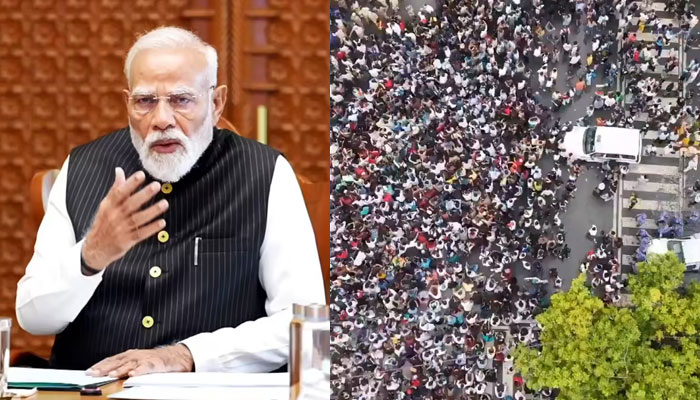
    NEW DELHI: A growing youth-led protest movement is emerging as one of the most significant political challenges to Prime Minister Narendra Modi’s third term, with demonstrations spreading across parts of India over allegations of examination irregularities, unemployment and demands for greater government accountability. What began as an online campaign has evolved into a nationwide movement driven largely by Generation Z, reflecting mounting frustration among young Indians over limited job opportunities and concerns about the country’s education system. The movement, associated with the youth-led platform known as the “Cockroach Janata Party,” initially focused on alleged examination scandals but has since broadened into a wider campaign calling for institutional reforms and political accountability. Protesters are demanding the resignation of the country’s education minister and greater transparency in the recruitment and examination process. The demonstrations have gained further momentum following activist Sonam Wangchuk’s hunger strike and his reported forced relocation, developments that have intensified public debate and drawn fresh attention to the broader protest movement. According to international media reports, the unrest represents one of the strongest waves of public pressure faced by Modi’s government since it began its third consecutive term. Analysts say the protests highlight deeper concerns among young voters, particularly over unemployment, education and confidence in public institutions. Tensions escalated during a protest march toward Parliament, where demonstrators clashed with security forces. Official figures said at least 180 people were injured, including 118 police officers and 60 protesters, as authorities moved to disperse crowds. Mobile internet services were also suspended in several sensitive areas to prevent the spread of unrest. Observers say the movement’s rapid rise demonstrates the increasing influence of social media in mobilising young people. What started as a satirical online campaign quickly transformed into an organised street movement, giving voice to a generation that believes its economic and educational concerns have gone unanswered. Political analysts note that while the protests remain centred on education and employment, they could carry broader political implications if public dissatisfaction continues to grow. The government’s response in the coming weeks is expected to be closely watched, as it seeks to balance law and order with demands for reform. Although it remains uncertain how the movement will develop, the ongoing demonstrations underscore the growing political engagement of India’s younger generation and the challenges facing the Modi administration as it navigates rising public expectations during its third term in office.

  • | |

    Punjab launches ‘Naya Aaghaz’ programme for pr…

    LAHORE: In a major step towards prison reform and prisoner rehabilitation, the Punjab government has launched the “Naya Aaghaz” (New Beginning) Programme, an initiative designed to provide interest-free loans to eligible inmates after their release, enabling them to start small businesses and successfully reintegrate into society. The programme, introduced under Chief Minister Maryam Nawaz’s prison reform agenda, is being implemented through a partnership between the Punjab Home Department and Akhuwat Islamic Microfinance. The agreement aims to support former prisoners by helping them achieve financial independence using vocational skills acquired during their imprisonment. Under the initiative, eligible released prisoners will be able to obtain interest-free loans of up to Rs200,000 to either establish a new business or expand an existing one. The loans will be repaid in equal monthly instalments over 36 months, while recovered funds will be recycled to support future beneficiaries. An initial revolving fund of Rs5 million has been allocated by Akhuwat Islamic Microfinance to launch the programme. All administrative and operational costs will be borne by Akhuwat, ensuring that neither the Punjab Home Department nor the Punjab Prisons Department faces any financial burden. The Punjab Prisons Department will identify inmates expected to be released within the next three months and assess their eligibility based on their conduct in prison and the vocational training they have successfully completed. Final verification of loan applications will be carried out independently by Akhuwat in accordance with its lending policies. Officials said Punjab’s prisons currently offer certified vocational training programmes across all correctional facilities, with inmates receiving technical education in 23 different trades. More than 28,000 prisoners have already earned vocational certificates through TEVTA and PVTC training centres, while approximately 6,500 inmates are presently undergoing skills training. Additionally, 74 psychologists are working in Punjab prisons to encourage rehabilitation through counselling and positive engagement. The agreement was signed by DIG Prisons Ahmed Naveed Gondal and Akhuwat CEO Dr Kamran Shams in the presence of Chairman of the Chief Minister’s Task Force on Prisons Rana Manan Khan, Punjab Home Secretary Dr Ahmed Javed Qazi, Akhuwat Foundation Chairman Dr Amjad Saqib, Inspector General Prisons Mian Salik Jalal, senior Home Department officials and other representatives. Speaking at the ceremony, Rana Manan Khan said the programme would enable released prisoners to become financially self-reliant and lead respectable lives after completing their sentences. He described prison reforms as one of the Punjab government’s highest priorities and said the administration was committed to transforming prisons into genuine rehabilitation centres. Punjab Home Secretary Dr Ahmed Javed Qazi said the initiative reflects the government’s commitment to reducing poverty, promoting social reintegration and ensuring that former prisoners return to society as productive and self-sufficient citizens. He added that education, vocational training and discipline were central to the government’s vision of modern prison reforms. Akhuwat Foundation Chairman Dr Amjad Saqib said the programme is entirely based on the principle of Qarz-e-Hasna (benevolent, interest-free loans) and will provide released inmates with a dignified opportunity to rebuild their lives. He noted that Akhuwat has so far disbursed over Rs500 billion in interest-free loans to around 4.5 million families across Pakistan. Officials also clarified that individuals listed under the National Counter Terrorism Authority (NACTA) or designated under United Nations Security Council sanctions will not qualify for the scheme. They further stated that the Punjab government and the Prisons Department will not be responsible for loan defaults, business losses or repayment issues, as all lending decisions and monitoring will remain the responsibility of Akhuwat Islamic Microfinance.

  • |

    Harry and Meghan’s brand faces a crossroads with UK return

    In late July, Meghan’s lifestyle range, As Ever, launched a new blackberry spread alongside a softly lit video of her picking the fruit. A month later, she and Prince Harry announced plans to return and live in the UK, just as blackberry season winds down. Whether another such video follows remains unclear, especially since experts say the couple’s wider brand is now at a turning point. Since their departure from royal duties in 2020, most of the Sussexes’ California-based ventures, from streaming deals to fragrance lines, have struggled to draw large audiences. Experts say it’s genuinely unclear what direction they’ll take next. Their UK return has surprised many, and although they will not resume royal duties, questions remain about what comes instead. Oxford marketing professor Andrew Stephen says the couple excelled early at capturing attention and monetising it, but have struggled to turn that into a lasting brand identity. He describes their current portfolio as fragmented, spanning social impact, entertainment and lifestyle, making it hard to define exactly what their brand represents. Their $100 million Netflix deal and $25 million Spotify agreement, both signed in 2020, have delivered underwhelming results by most measures. The Netflix arrangement produced just five shows over five years before being replaced with a lower-commitment, first-look agreement last year. Spotify, meanwhile, parted ways with the couple back in 2023. Branding expert Susan Fournier warns that the couple’s repeated pivots, from royal insiders to critics to media producers to lifestyle influencers, carry real risk. She argues that once a brand shifts direction dramatically, reversing course becomes difficult, and a UK return could look like yet another turn rather than a resolution. Stephen suggests the solution lies in building a focused, coherent set of ventures and credible causes, rather than continuing to diversify. One possibility involves Meghan returning to acting, with reports suggesting talks over a role in Netflix’s “The Gentlemen.” Her lifestyle brand, As Ever, is also expected to continue regardless of the move. A potential relocation to the Cotswolds has also sparked interest, with stylist Laura Stoloff suggesting genuine synergy between Meghan’s brand and English country life. Still, Stephen cautions that a new postcode alone won’t reposition a brand, only consistent action will.

  • | |

    Punjab Governor ends 19-year UAF research officers…

    FAISALABAD: In a landmark decision expected to reshape the service structure of the University of Agriculture Faisalabad (UAF), Punjab Governor and UAF Chancellor Sardar Saleem Haider Khan has ordered the upgradation of the post of Research Officer with retrospective effect from April 25, 2007, bringing an end to what many describe as nearly two decades of discrimination against the university’s research cadre. The decision came after the Chancellor accepted a representation filed by Muzaffar Hussain Salik, a Research Officer at the Office of University Books and Magazines (OUBM). Besides approving the upgradation, the Chancellor declared the post of Research Officer a “Teacher of the University,” making its holders eligible for all related service, financial, seniority and pensionary benefits in accordance with the law. The dispute dates back to the implementation of the UAF Amended Service Statutes, 2007, introduced after the federal government’s policy to upgrade university teachers and teaching-equivalent positions with the concurrence of the Higher Education Commission (HEC). While several teaching and equivalent posts received the approved benefits, Research Officers and Senior Research Officers were allegedly left out despite performing comparable academic and research responsibilities. According to the representation, the exclusion created a longstanding disparity, depriving the affected employees of promotions, financial benefits, and equal treatment under the approved statutory framework. It argued that the selective implementation of the service statutes resulted in years of professional and financial disadvantage for members of the research cadre. After reviewing the legal and administrative record, the Chancellor ruled that the benefit of upgradation should be extended to Research Officers from the same effective date as Lecturers — April 25, 2007. The order effectively places the research cadre on par with other teaching-equivalent positions that had already been upgraded under the 2007 amendments. University officials and academic observers believe the decision will benefit around 66 Research Officers, Senior Research Officers and other teaching-equivalent employees, providing them with long-awaited financial relief, revised seniority, pensionary benefits and formal recognition within the university’s teaching community. The ruling has been widely welcomed by researchers, academics and legal experts, who describe it as one of the most significant service-related decisions in UAF’s recent history. They say the order reinforces the principles of equality, transparency and uniform implementation of statutory rights while setting an important precedent for public sector universities across Pakistan. For petitioner Muzaffar Hussain Salik, the decision marks the successful conclusion of a long legal and constitutional struggle. Beneficiaries have hailed the ruling as a collective victory for justice, merit and the rule of law, expressing hope that similar disparities in higher education institutions will now be addressed through fair and consistent implementation of service statutes.

  • | | |

    Punjab introduces new vehicle scrapping law for un…

    The Punjab government has introduced a new law for vehicle scrapping, allowing unusable and damaged vehicles to be legally disposed of through registered scrapping facilities. The move aims to regulate the disposal of old vehicles and remove unfit vehicles from roads across the province. According to reports, Punjab Governor Saleem Haider issued the Motor Vehicles Amendment Ordinance, which provides a legal framework for scrapping vehicles that are no longer fit for use. Under the new ordinance, vehicles without valid fitness certificates may also be sent for scrapping. The law includes vehicles that have been severely damaged in accidents or destroyed by fire and are considered beyond repair. The new regulations allow vehicle owners to voluntarily apply for scrapping if they no longer want to keep their vehicles. However, the process must only be completed through officially registered vehicle scrapping facilities to ensure proper disposal and prevent misuse. Officials believe the new system will help improve road safety by reducing the number of unsafe vehicles operating on roads. Old and poorly maintained vehicles can contribute to accidents, environmental pollution, and increased risks for drivers and passengers. The ordinance also introduces a more organized approach to vehicle disposal, ensuring that scrapped vehicles are handled through approved channels rather than informal methods. Registered scrapping facilities will be responsible for carrying out the process according to legal requirements. Transport experts have welcomed measures aimed at removing dangerous vehicles from circulation, saying that proper vehicle inspection and disposal systems are essential for safer roads and better environmental management. The implementation of the new law is expected to impact owners of old, damaged, and unfit vehicles across Punjab. Vehicle owners will now have a legal option to dispose of vehicles that are no longer economically repairable or safe to operate. The government is expected to issue further guidelines regarding the registration of scrapping facilities and the detailed procedure for vehicle owners in the coming days. The new vehicle scrapping ordinance represents a significant change in Punjab’s transport regulations, with authorities focusing on road safety, environmental protection, and better management of end-of-life vehicles.

Leave a Reply

Your email address will not be published. Required fields are marked *