
pakistan highlights mediatory
| | |

Pakistan highlights mediatory role in US-Iran conf…

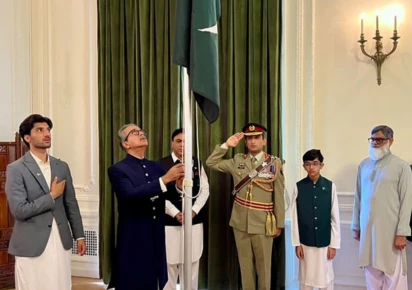
Pakistan’s Permanent Representative to the United Nations, Ambassador Asim Iftikhar Ahmad, has highlighted Pakistan’s mediatory efforts in the US-Iran conflict, saying the country remains committed to promoting peace and stability amid growing global tensions.

Speaking at an Independence Day ceremony at Pakistan House in New York, Ahmad said Pakistan continued to seek peaceful solutions to conflicts and reaffirmed its commitment to sovereignty, security and socio-economic development.

He paid tribute to Quaid-e-Azam Muhammad Ali Jinnah, describing him as a visionary leader who played a historic role in creating Pakistan. Reflecting on the country’s journey since 1947, he praised the resilience and achievements of Pakistanis despite major challenges.

Ahmad also praised the armed forces for defending the country and protecting its people, particularly during the May 2025 conflict with India.

He highlighted the contributions of Pakistanis around the world, including innovators, athletes and artists, and recognised the work of Saima Saleem and Aleena Majeed at Pakistan’s UN mission.

The ambassador said Pakistan had overcome major economic and structural challenges over the decades and continued to show resilience in the face of adversity.


Similar Posts

  • | | | |

    Three powers, one shield? What the pact means

    Pakistan, Saudi Arabia and Türkiye have formalised their long-standing strategic and defence ties through the newly signed Makkah Joint Defence Agreement, establishing a framework for closer military coordination and collective security. The agreement was signed during a trilateral summit in Makkah attended by Prime Minister Shehbaz Sharif, Saudi Crown Prince Mohammed bin Salman and Turkish President Recep Tayyip Erdogan. The pact has attracted comparisons with established military alliances. However, analysts say its stated purpose is not to create a new military bloc or target any particular country. Instead, it provides an institutional structure for defence cooperation that has developed between the three nations over several decades. A formal structure for longstanding ties Pakistan and Türkiye have maintained close political and military relations for decades, while Islamabad and Riyadh have developed extensive defence, diplomatic and economic cooperation. The new agreement is viewed as an attempt to bring these existing relationships under a formal trilateral framework. It is designed to provide a more structured mechanism for consultations, military coordination and strategic cooperation. Why the agreement was signed now The agreement comes amid growing security challenges across the Middle East and wider region. Analysts say conflicts, changing military technologies and emerging security threats have encouraged countries with shared strategic interests to strengthen their defence coordination. The trilateral arrangement is intended to improve collective preparedness and provide a coordinated response to potential threats while supporting regional stability. What the defence pact provides A central element of the agreement is the principle of collective security. Under the framework, aggression against one member is to be treated as a threat to all three countries. The arrangement is expected to encourage greater military coordination, intelligence cooperation, strategic consultations and defence planning. Closer institutional links could also allow the three countries to coordinate their military capabilities and improve their ability to respond to security challenges. Different strengths, shared security interests Each country brings different capabilities to the partnership. Pakistan contributes a large and experienced military, operational expertise and extensive experience in counterterrorism and conventional defence. Saudi Arabia brings significant economic resources, regional influence and political weight. Türkiye adds its growing defence industry, military technology and manufacturing capabilities. Analysts believe these complementary strengths could make the partnership more effective while allowing the three countries to develop greater strategic self-reliance. Pakistan’s diplomatic role The agreement also comes as Pakistan seeks to strengthen its role as a regional diplomatic actor. Islamabad maintains relations with Saudi Arabia, Türkiye, Iran, China and the United States, giving it channels of communication with several major regional and global powers. Analysts argue that Pakistan’s diplomatic engagement, alongside its military capabilities, could help it contribute to regional crisis management and dialogue. What the pact does not mean Despite comparisons with NATO and other military alliances, analysts stress that the agreement is not described as an offensive alliance. It is also not presented as a pact directed against a particular country, a so-called “Muslim NATO”, a nuclear deterrence arrangement or a religious military bloc. Instead, the three countries have presented it as a defensive framework focused on collective security, deterrence, military cooperation and regional stability. The long-term effectiveness of the agreement will depend on sustained political coordination and the willingness of all three governments to implement its commitments.

  • | |

    Oman oil spill spreads dramatically, nearing scale…

    An oil spill off the coast of Oman is rapidly expanding into one of the worst maritime environmental disasters in years after weeks of largely unchecked spread, according to international agencies, satellite imagery and environmental organizations. The slick, which originated from a grounded tanker carrying Russian crude, had reached Oman’s mainland by Wednesday, the United Nations shipping agency confirmed. John Amos, an oil spill specialist who reviewed satellite imagery, said the affected area now covers more than 2,000 square kilometers. The vessel involved, the Caroline Bezengi, was carrying an estimated 800,000 barrels of Russian oil and operates under international sanctions. It ran aground on June 30 near an Omani island that forms part of a protected marine nature reserve. The tanker first reported trouble off the coast of Yemen on June 8, and maritime sources said an explosion appeared to have occurred on board. No party has claimed responsibility for any attack, though the ship was navigating waters tied to two separate conflicts during its voyage from Russia to India. The tanker departed the Black Sea port of Novorossiysk in April, a region central to the ongoing war between Russia and Ukraine. Ukrainian forces have targeted vessels belonging to the so called shadow fleet used to transport Russian oil, a network that includes the Caroline Bezengi. Ship tracking data shows the tanker then passed through the Suez Canal in late May before sailing near Yemen, where Iran aligned Houthi forces have become entangled in the broader regional conflict involving the United States, Israel and Iran. A tangled set of war related and sanctions related shipping regulations is already complicating the emergency response and could further delay efforts to contain the disaster, according to insurers and analysts. The IOPC Funds, the intergovernmental body responsible for compensating tanker spill damages, told a foreign news agency it will not cover cleanup costs since the incident is being classified as an act of war rather than an ordinary accident. The 25 year old tanker also lacks coverage from any recognized Western insurer. Amos, who serves as chief executive of the environmental nonprofit SkyTruth, said the worst case outcome would involve no adequate response capable of preventing further damage. He said the spill’s scale could ultimately rival the 1989 Exxon Valdez disaster and noted that the tanker is comparable in size to the Sanchi, an Iranian vessel that collided with a freighter off China in 2018 in what became the world’s worst tanker disaster in decades. Slick accelerates toward mainland The spill was first identified by analysts in early July and has since begun reaching Oman’s mainland, according to the International Maritime Organization. A spokesperson for the agency said oil is drifting offshore northeast of Al Qibliyyah Island, with some already washing ashore, and confirmed that contingency planning for the spill is underway. The IMO said seasonal monsoon weather has restricted access to the tanker and delayed salvage efforts. Satellite images show the vessel grounded at Al Qibliyyah Island, part of a nature reserve that includes the Hallaniyat Islands and provides habitat for endangered sea turtles, humpback whales and coral reef ecosystems, all of which now face heightened risk from the spreading oil. Omani officials said Monday the slick covers nearly 400 square kilometers, though they have not responded to requests for additional detail on containment efforts beyond confirming the use of booms to limit the spread. Environmental groups and independent specialists estimate the true size at several times that figure, and say the rate of spread has accelerated sharply since early August. Greenpeace reported Tuesday that the affected area grew from around 45 square kilometers at the end of July to 150 square kilometers by early August, then quadrupled to roughly 600 square kilometers within just two days, according to Hanen Keskes, the group’s political campaigns lead for the Middle East. Amos’s estimate of 2,000 square kilometers suggests the spill has grown more than 40 times larger since the start of August alone. Amos said containing the disaster will require more than floating booms, including stabilizing the grounded vessel and transferring any remaining crude to another tanker. He warned that delays in salvage operations will only worsen the tanker’s condition and make the eventual recovery effort more complicated and dangerous.

  • Thailand’s Songkran Festival Named World’s Liveliest Festival

    BANGKOK — Thailand’s Songkran festival has been officially named the world’s liveliest festival, a recognition that government officials say reflects the global appeal of the traditional Thai New Year celebrations and their unique blend of cultural heritage and contemporary joy. US Secretary of State Marco Rubio Sends Songkran Greetings to Thailand Government spokeswoman Rachada Dhnadirek […]

  • Body of Last Thai Hostage Held by Hamas Returned to Israel

    BNGKOK – The remains of the last Thai national held hostage by Hamas in the Gaza Strip were handed over to Israeli authorities yesterday through the mediation of the International Committee of the Red Cross (ICRC). The Thai Foreign Ministry confirmed the return, marking a somber conclusion to the hostage crisis for Thailand following the […]

  • | |

    Balochistan rail operations fully restored

    Train services between Balochistan and other parts of Pakistan have resumed after a one-day suspension caused by railway track repair work. Railway officials confirmed that operations were restored after maintenance teams completed the necessary repairs. The temporary suspension was imposed to ensure passenger safety and to allow engineers to carry out essential work on the affected section of the track. Following the restoration of services, the Jaffar Express departed from Quetta for Peshawar as scheduled. The resumption of the train marked the return of regular rail connectivity between Balochistan and the country’s other provinces. Officials also said that the Jaffar Express travelling from Peshawar is expected to arrive in Quetta on Wednesday according to its scheduled timetable. They added that train operations are now running normally after the completion of repair work. The railway administration said the suspension was purely a precautionary measure aimed at ensuring safe travel. Maintenance crews worked continuously to restore the track within a day, allowing train operations to resume without further delay. The restoration of rail services is expected to provide relief to passengers who were affected by the temporary suspension. Travellers can now continue their journeys through the regular train schedule, while railway authorities have assured passengers that they will continue monitoring the track to ensure safe and uninterrupted operations. Pakistan Railways periodically carries out maintenance work on its network to improve safety and operational efficiency. Officials urged passengers to stay updated on train schedules through official railway channels, particularly when maintenance work or weather conditions affect rail operations.

  • |

    New anti-Taliban group emerges in Afghanistan

      Armed resistance against the Taliban appears to be expanding in Afghanistan, with a new anti-Taliban group reportedly emerging in the northern province of Faryab. Sources say growing opposition to the Taliban’s style of governance, alleged ethnic discrimination and corruption has fueled resistance among sections of the Afghan population. Opposition has also increased over restrictions on education, employment and basic human rights, while the ongoing situation has contributed to a rise in Afghan migration toward Europe. According to sources, fighters affiliated with the newly formed Liberation Front carried out an attack against Taliban forces in Faryab province on Monday. The group is expected to formally announce its organisational structure, leadership and future activities within the next few days. The emergence of the new group comes as other anti-Taliban factions also signal plans to intensify their activities. General Sami Sadat, head of the Afghanistan United Front, and General Yasin Zia of the Afghanistan Freedom Front have both announced their intention to step up resistance against the Taliban. The developments indicate growing challenges for the Taliban as it continues to face opposition from armed groups as well as criticism over its policies on governance, human rights, education and employment.

Leave a Reply

Your email address will not be published. Required fields are marked *