punjab launches electric

Punjab launches 77 electric buses in seven more districts

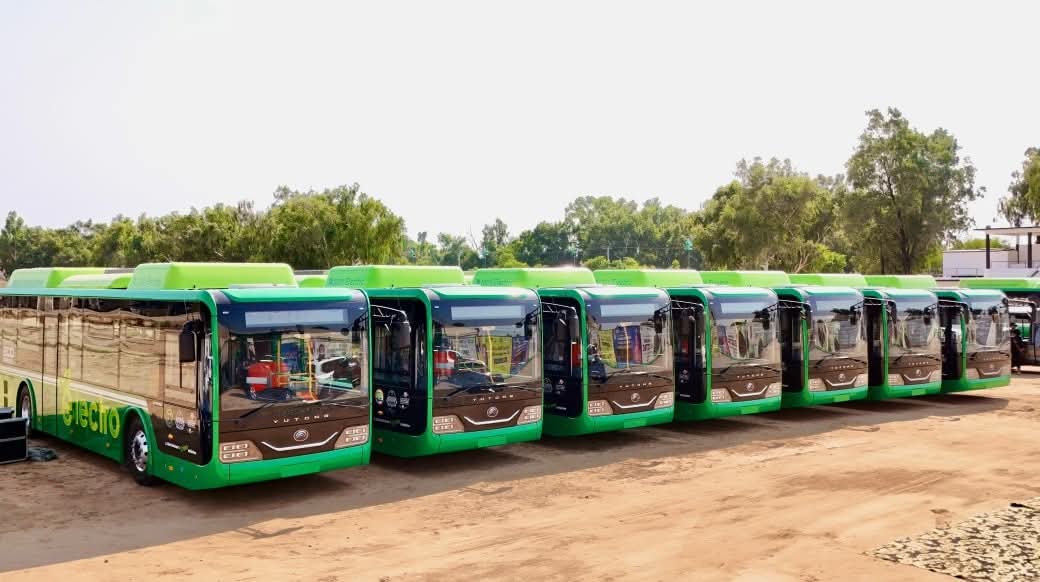
LAHORE – Chief Minister Punjab Maryam Nawaz on Thursday inaugurated 77 electric buses on 17 routes in seven more districts — Vehari, Lodhran, Kasur, Gujrat, Narowal, Sheikhupura and Nankana Sahib — expanding the province’s green public transport network.

According to an official handout, women, students, senior citizens and persons with disabilities will travel free of charge, while the fare for all other passengers has been fixed at Rs20. The buses are equipped with wheelchair ramps, air conditioning, Wi-Fi, CCTV monitoring and charging ports.

The handout said that 511 electric buses were already operational in 29 districts and one tehsil. With the latest addition, the number of operational electric buses has increased to 588 across 36 districts. Another 101 electric buses have already reached nine districts, while the remaining 488 buses are expected to arrive by the end of August 2026.

It added that 1,500 more electric buses would be introduced across every tehsil of Punjab after the completion of the ongoing district-level project. Funds worth billions of rupees have been allocated for the initiative under the Annual Development Programme.

Addressing the inauguration ceremony, the chief minister said the seven districts had received government-operated public transport for the first time. She described the Green Bus Service as a popular initiative that had made daily commuting easier for people travelling to educational institutions, hospitals and workplaces.

CM Punjab said that during her visit to Azad Jammu and Kashmir, she realised the importance of the Green Bus Service, adding that demand for the facility there was higher than anywhere else she had seen. She expressed confidence that the number of electric buses in Punjab would reach 1,100 by the end of August.

The handout further stated that 11 electric buses had been allocated to each of the seven districts. In Gujrat, the buses will operate on routes from the General Bus Stand to Mangowal and Daulat Nagar. In Narowal, services will run from the General Bus Stand to Manga Pull, Shakargarh, Pasrur Chowk, Zafarwal and on the circular route.

In Kasur, buses will ply between the General Bus Stand and Kacha Paka, and between the General Bus Stand and Gajju Matta Stop. In Sheikhupura, services will operate from the e-bus depot to Shahdara Metro Station and Khanqah Dogran.

In Nankana Sahib, the buses will run from the General Bus Stand to Mor Khunda and Warburton. In Lodhran, the routes will connect Shaheed Islam Hospital with Kehror Pacca and Dunyapur. In Vehari, the buses will operate from Government Graduate College to Fawara, and from Pir Mahal to Tibba Sultanpur.
Similar Posts

  • | |

    Fuel price hikes spark transgender protest in Kara…

    KARACHI: Frustration over soaring inflation and repeated fuel price hikes spilled onto the streets of Karachi on Wednesday as members of the transgender community staged a protest outside the Karachi Press Club, urging the government to provide immediate relief from the rising cost of living. Holding placards and chanting slogans, protesters called for a reduction in petroleum prices and stricter measures to curb inflation, saying the financial burden had become unbearable for vulnerable communities already struggling with limited economic opportunities. The demonstrators said increasing prices of fuel and essential household items had significantly affected their ability to meet daily expenses. They argued that every increase in petroleum prices triggered higher transportation costs and pushed the prices of food, medicines and other necessities even further beyond the reach of low-income families. Addressing the gathering, Gender Interactive Alliance spokesperson Zehrish Somroo said the transgender community was facing severe financial hardship as inflation continued to erode incomes and reduce public support. “We have come out to protest because the rising cost of living is affecting everyone, including the transgender community,” she said. “Many of us depend on charity and public donations for survival. If inflation continues unchecked, even those sources of support are shrinking.” Somroo urged the government to take practical steps to reduce inflation, adding that the community had long struggled with limited access to education, employment and equal opportunities. Transgender rights activist Bindiya Rana said the demonstration was not intended to create conflict but to draw attention to the growing economic difficulties affecting ordinary citizens across Pakistan. Protesters said many families were being forced to make painful sacrifices to survive, including selling motorcycles, household belongings and even children’s jewellery to cover basic expenses. They warned that the rising cost of food, electricity, transport and healthcare had left countless households uncertain about how they would meet their daily needs. Participants appealed to policymakers to introduce urgent relief measures, including lowering fuel prices and stabilising the prices of essential commodities. They stressed that immediate action was needed to protect low-income and marginalised communities from further economic hardship. The protesters also issued a warning that if their demands were ignored, members of the transgender community from across Sindh would travel to Karachi to stage a larger province-wide demonstration, intensifying pressure on the government to address the worsening cost-of-living crisis.

  • | |

    Federal Cabinet Interference in CCI matters violat…

      Islamabad: The federal cabinet has no constitutional authority to decide matters reserved for the Council of Common Interests, a Senate sub committee has declared, warning that continued cabinet interference in electricity, petroleum, gas, railways, ports and regulatory bodies is damaging provincial rights and weakening constitutional protection for smaller provinces. The Senate Sub Committee on Devolution, chaired by Senator Barrister Zamir Hussain Ghumro, directed that matters falling under the CCI must not be taken to the federal cabinet. The committee said the Prime Minister should place such issues before the CCI and call its meetings frequently. According to the committee, Article 154 of the Constitution gives the CCI responsibility over subjects listed in Part II of the Federal Legislative List. The committee argued that these powers belong to the CCI rather than the federal cabinet. It said this constitutional arrangement was created to protect provinces from decisions dominated by the federal government. The committee particularly highlighted the position of smaller provinces. It noted that Punjab has 141 seats in the National Assembly while the other three provinces together have 122 seats. According to the committee, putting important provincial matters under the CCI provides protection against decisions based only on the strength of the majority in the National Assembly. The committee said the CCI should be reconstituted in a way that ensures equality among provinces. It also called for more frequent CCI meetings so important disputes between the federation and provinces are not left unresolved. The committee said the prices of electricity, petroleum, gas and medicines should be supervised and controlled through the CCI rather than the federal cabinet. It argued that federal executive authority must operate within the Constitution and that Article 154 gives the CCI authority over relevant subjects. The committee also said major national organisations and sectors connected with Part II of the Federal Legislative List should come under the CCI. These include Railways, Petroleum, Electricity, Ports and several regulatory bodies. The committee specifically named OGRA, NEPRA, PEMRA and PTA among institutions whose matters, in its view, should fall under the CCI framework. It said Planning and Development authorities and other bodies working in fields covered by Part II should also operate under CCI authority instead of federal cabinet control. The committee strongly objected to federal cabinet involvement in these areas. It said interference by the federal cabinet in CCI subjects was contrary to Article 97 read with Article 154 of the Constitution. One of the most serious issues discussed was the planned privatization of electricity distribution companies. The committee stated that the privatization of companies including IESCO, FESCO, LESCO, GESCO, SEPCO and HESCO cannot proceed without CCI approval from the Power Division or Privatization Commission. It argued that taking such decisions without the CCI would violate Articles 154 and 157 of the Constitution. The committee directed that the privatization of electricity distribution companies must be placed before the CCI. It also referred to the Supreme Court judgement in the Mian Nawaz Sharif case and said the CCI should be involved before such major decisions are taken. The committee rejected the federal government’s reliance on the Gadoon Amazai ruling regarding CCI meetings. It said Parliament had already addressed the issue of meeting frequency by requiring the CCI to meet at least once every three months or earlier when urgent matters arise. The committee therefore called on the Prime Minister to convene CCI meetings regularly. According to members, failure to use the CCI weakens the constitutional voice of provinces and allows issues affecting the entire federation to be decided through the federal cabinet. The panel also questioned several ministries, divisions and state owned bodies dealing with subjects it believes belong either to the provinces or the CCI. It said federal structures created around provincial or CCI subjects should be devolved or closed where required, without harming employees. Among the institutions and sectors the committee mentioned included Water Resources, Railways, Industries, Statistics, Petroleum, Inter-Provincial Coordination, Planning and Development and WAPDA. The committee also referred to regulatory bodies and other organisations whose functions, it said, should be examined according to the constitutional division of powers. Members said the purpose of the CCI was not simply to hold occasional meetings. They described it as a constitutional mechanism designed to allow the federation and provinces to jointly decide major national matters. The committee warned that bypassing the CCI could create mistrust between the provinces and the federal government. It said smaller provinces need the CCI to ensure they have a meaningful voice in decisions involving national resources, energy, infrastructure and regulation. The committee directed the federal government to amend its Rules of Business within 15 days so that matters falling under the CCI are handled according to the Constitution. It asked the government to submit a report explaining the changes made. The message from the committee was clear. Major decisions involving electricity, petroleum, gas, railways, ports, regulators and other CCI subjects should not be decided by the federal cabinet alone. The committee wants these matters taken back to the Council of Common Interests, with the Prime Minister required to use the constitutional forum regularly to protect provincial rights and build agreement between the federation and all four provinces.

  • | | | | |

    New US opportunities emerge for Pakistani nurses

    Pakistani nurses and other healthcare professionals could soon have better access to professional opportunities in the United States. A new initiative is being developed to strengthen medical education and workforce development in Pakistan. It also aims to help meet the growing demand for trained healthcare professionals in the US. The American Pakistan Education Foundation and the Pakistan Education Foundation are set to sign a memorandum of understanding in New York. The agreement will establish a framework for cooperation between the two organizations. It will focus on education, professional preparation, training, certification and qualification requirements. The initiative will also explore suitable pathways for qualified Pakistani healthcare professionals to access professional opportunities in the United States. The organizations plan to build stronger links with hospitals, healthcare systems, educational institutions and professional organizations in the US. The American Pakistan Education Foundation is a US-based nonprofit organization. It works on education, healthcare workforce development, professional training and community-focused initiatives in both countries. The project to create professional opportunities for Pakistani nurses was launched with support from New York State Assembly Deputy Speaker Phil Ramos. Members of the foundation’s board have already visited Pakistan twice. During the visits, they met relevant stakeholders and discussed ways to strengthen nursing education and the wider healthcare workforce. The discussions also focused on professional training and the development of medical skills. The delegation examined opportunities to expand institutional cooperation between Pakistan and the United States. Meanwhile, the Pakistan Education Foundation has launched an NCLEX nurse placement programme. The initiative is aimed at helping Pakistani registered nurses prepare for international licensing. A nationwide registration campaign was conducted under the programme. A total of 2,759 candidates registered. After a detailed screening and selection process, 300 eligible nurses were selected for training. More than 80 nurses have so far obtained NCLEX-related licensing credentials. They are now prepared to pursue international professional opportunities. More than 220 additional nurses are currently progressing through the examination process. The programme has also helped candidates who face financial difficulties. They have been able to prepare for the costly licensing examination without travelling abroad. The new memorandum is expected to provide a stronger basis for connecting qualified Pakistani healthcare professionals with potential employers in the US. The American Pakistan Education Foundation plans to establish links with hospitals, healthcare networks, nursing facilities, universities and professional organizations. These institutions could provide employment, training and partnership opportunities for qualified professionals. The two organizations also intend to strengthen nursing and medical education. They will explore professional development programmes for teachers and healthcare workers. Professional exchange programmes could also be developed. Scholarships and educational assistance may be considered as part of future cooperation. The Pakistan Education Foundation will identify nurses and other healthcare professionals with suitable educational and professional backgrounds. It will also assist candidates interested in further education, professional development and potential employment opportunities in the United States. Support could include exam preparation, professional training and assistance with certification and documentation. The proposed cooperation may also involve universities, nursing schools, hospitals, training institutions and professional organizations. Joint educational programmes could be developed for nurses and other healthcare professionals. Existing programmes could also receive additional support. A joint working group may be established to oversee implementation of the memorandum and develop further cooperation between the two organizations. Officials involved in the initiative have welcomed the development. They said the project could create stronger institutional links between Pakistan and the United States. The initiative is also being viewed as a step towards expanding international career opportunities for Pakistani healthcare workers.

  • | | |

    PM Shehbaz orders urgent flood relief nationwide

    Prime Minister Shehbaz Sharif has directed the National Disaster Management Authority (NDMA) to intensify relief efforts and ensure maximum assistance for people affected by ongoing monsoon rains and floods. The prime minister issued the instructions during a meeting with NDMA Chairman Lieutenant General Inam Haider Malik in Islamabad on Saturday. He ordered authorities to utilise all available resources to support flood-hit communities and provide immediate relief to those facing difficult conditions. Shehbaz also stressed close coordination between the NDMA, provincial governments and Provincial Disaster Management Authorities (PDMAs) to ensure relief operations remain effective and reach affected populations without delay. During the meeting, the NDMA chairman briefed the prime minister on the latest weather conditions and the flood situation resulting from heavy monsoon rainfall. He also provided an update on relief operations and ongoing measures to rehabilitate people displaced or affected by the flooding. According to the briefing, federal authorities are supporting relief activities in Khyber Pakhtunkhwa, Gilgit-Baltistan and Azad Jammu and Kashmir. Rescue and assistance operations in these areas will continue with the cooperation of the federal government. The prime minister also praised the NDMA’s use of artificial intelligence and modern technology at the National Emergencies Operation Centre, saying advanced systems could strengthen disaster monitoring and response. The latest figures show the growing impact of monsoon-related incidents across the country. The NDMA reported that at least 155 people have died and 460 others have been injured in rain-related incidents between June 26 and August 14. Pakistan’s monsoon season generally lasts from June to September and plays an important role in replenishing water resources. However, intense rainfall can also cause flash floods, river flooding, landslides and displacement, particularly in vulnerable communities. The situation could remain challenging in the coming days. The Flood Forecasting Division of the Pakistan Meteorological Department has warned of possible high-level flooding in storm-water channels connected to the Chenab and Ravi rivers between August 15 and 21 as water levels continue to rise.

  • | |

    Hajj applications go digital as Pakistan lets pilg…

    ISLAMABAD: Federal Minister for Religious Affairs Sardar Muhammad Yousaf has announced that Pakistan’s Hajj application process has been fully digitized, allowing prospective pilgrims to apply from the comfort of their homes without visiting offices or standing in long queues. Speaking at a press conference in Islamabad, the minister said the digital system had been introduced to make the Hajj registration process easier and more convenient for pilgrims. Around 400,000 registered applicants will be able to submit their applications online. Under the new system, applicants will have several options for paying their Hajj expenses. Payments can be made through credit cards or PSID, while those wishing to pay in cash can print a challan and deposit the required amount. Yousaf said 107,526 pilgrims are eligible to perform Hajj under the government scheme. The collection of the first installment of Hajj expenses will begin on August 17, while the second installment is scheduled to be collected in October. Applications will be processed on a first-come, first-served basis, with registration closing once the government’s allocated quota is reached. The minister also said pilgrims opting for the private Hajj scheme would be able to select a private operator through the Pak Hajj application. However, he cautioned pilgrims against making direct payments to private Hajj operators.

  • | |

    Father, two relatives held over newlywed’s deat…

    KHANEWAL: The sudden death of a 25-year-old newlywed woman in Khanewal has taken a disturbing turn after police arrested her father and two relatives over allegations that she was strangled days after marrying a man of her choice. The woman, identified as Iqra, died in Mehr Shah, an area falling within the jurisdiction of Sadar Khanewal Police Station. Police said her family initially attempted to present the death as an electrocution incident. According to the police and the FIR, Iqra had married Sohail three days before her death despite opposition from her family. Her husband alleged that her father, angered by the marriage, brought her back from her in-laws’ home on the pretext of formally sending her off from her parental house. Investigators allege that after bringing her home, Iqra was strangled with the assistance of her uncle and brother. Police are also examining claims that the family later staged the scene to make the death appear accidental. The case has now triggered a formal murder investigation, with authorities focusing on the circumstances surrounding the young woman’s death. Police arrested Iqra’s father, Falak Sher, and registered a case. Her body was shifted to the District Headquarters Hospital in Khanewal for a post-mortem examination, which is expected to help establish the exact cause of death. Sadar police SHO Ramzan Gul said Falak Sher was in custody and that investigators were waiting for the post-mortem report before drawing final conclusions. The officer said preliminary findings suggested that Iqra’s father could be the main suspect, while investigators were questioning other family members and examining the alleged strangulation and reported attempt to disguise the circumstances of her death. Police said the investigation would proceed further once the medical findings are received. Until then, the allegations remain under investigation, while authorities continue to determine what happened to Iqra after she returned to her family home.

Leave a Reply

Your email address will not be published. Required fields are marked *