rain triggers flooding
| |

Rain triggers flooding, power outages in twin citi…

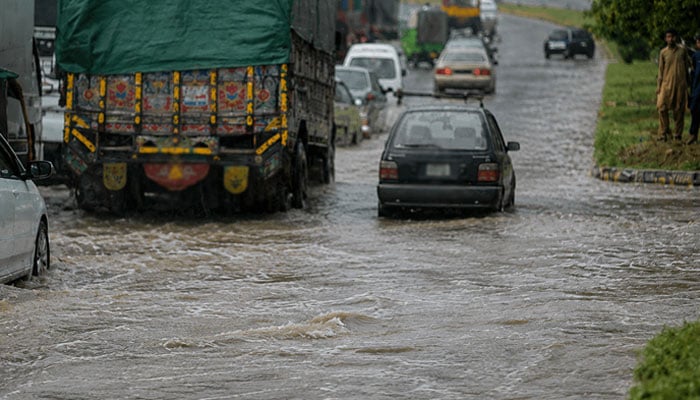
Heavy rain, strong winds and thunderstorms lashed Rawalpindi and Islamabad on Saturday. The downpour disrupted routine life in several parts of the two cities.

Several areas of Islamabad faced waterlogging after the heavy rainfall. Underpasses in the G-6 sector were filled with rainwater. The accumulation of water caused difficulties for motorists and pedestrians.

The situation was also reported to be severe in Chatta Bakhtawar. Roads and streets were submerged under rainwater. Several streets gave the appearance of ponds. Rainwater also entered residential houses in the area, creating problems for residents.

The heavy rain also affected electricity supply in different parts of Rawalpindi and Islamabad. Several areas experienced power disruptions as the weather conditions deteriorated.

Rawalpindi authorities declared a rain emergency following the heavy downpour. The Water and Sanitation Agency (WASA) activated its teams to deal with the situation. Staff members were deployed to affected areas.

Heavy machinery was also moved to different locations. The equipment was being used to remove accumulated rainwater and keep major roads and routes clear.

The Pakistan Meteorological Department has forecast more rain in several parts of the country. Islamabad, Punjab, Khyber Pakhtunkhwa, northeastern Balochistan, Gilgit-Baltistan and Kashmir are expected to receive rain.

The Met Office has warned that some areas may receive heavy rainfall. The intense rain could increase the risk of flooding in streams and rain-fed waterways.

Authorities have also been advised to remain alert in vulnerable areas. Urban flooding may cause further disruption if heavy rain continues.

Meanwhile, the water situation in the Indus River has also become a concern. Medium-level flooding has been reported at Kalabagh.

Water inflow at Kalabagh was recorded at around 397,000 cusecs. The rising water level has increased pressure on river management authorities.

Low-level flooding has also been reported at several major water reservoirs and barrages. These include Tarbela Dam, Chashma Barrage, Taunsa, Guddu and Sukkur Barrage.

Despite the flooding at these locations, the overall situation in the country’s other rivers remains normal. The Flood Forecasting Division in Lahore said there was no major flood situation in the remaining rivers.

Similar Posts

  • PAAM rejects DRAP Rules 2026, warns alternative medicine sector

    ​LAHORE: Kashif Aslam Malik, Chairman of the Pakistan Association of Alternative Medicine (PAAM), has completely rejected the proposed DRAP Rules 2026, labeling them an unscientific plot against the local alternative pharmaceutical industry, Homeopathy, and Unani medicine. He stated that the allopathic pharmaceutical bureaucracy within the Drug Regulatory Authority of Pakistan (DRAP) is attempting to forcefully impose itself on the alternative medicine sector. In reality, the 5-year Pharm.D curriculum completely lacks education and technical training on homeopathic potentization, Unani herbal formulation, or nutraceutical manufacturing. He questioned the legal and scientific authority of allopathic pharmacists who have never studied these disciplines to act as self proclaimed experts and draft policies for this sector. ​Kashif Aslam Malik emphasized that under the universal principle of “right expertise for the right job,” the regulatory framework, registration, and licensing for alternative medicines must strictly be developed under the direct supervision of qualified specialists in Homeopathy, Unani, and Nutraceutical sciences. Imposing these unilateral rules and rigid allopathic SOPs will bankrupt over 80% of small and medium-sized enterprises (SMEs), resulting in widespread unemployment for thousands of homeopathic doctors, Unani practitioners, and industrial workers, while depriving the public of affordable, natural healthcare options. PAAM demands an immediate halt to these rules, the formation of a committee comprising specialized alternative medicine experts, and the establishment of an independent authority modeled after India’s Ministry of AYUSH. He warned that if DRAP attempts to force these rules through, PAAM will unite all industry stakeholders to fight a nationwide battle across the media, judiciary, and public spheres.

  • | |

    Imran Khan asks Akbar S Babar to reunite former PT…

    PTI founder Imran Khan has sent an important message to former party colleague and founding member Akbar S Babar from jail. According to Babar, Khan has asked him to play a role in bringing together the party’s early members. He has also been asked to reach out to disgruntled leaders and workers. Babar confirmed that he received the message through another longtime associate of the PTI founder who is currently in jail. The message reportedly focuses on reconnecting with people who were associated with the Pakistan Tehreek-e-Insaf during its early years. It also includes party members and workers who later became unhappy with the party leadership or distanced themselves from it. Babar said the message reflects Khan’s desire to bring former colleagues closer together. The aim is to create greater unity among PTI’s old associates and workers. The former PTI leader also shared another significant part of the message. He said Imran Khan told him that after being released from jail, he would first visit Babar’s home. The message is being viewed in the context of PTI’s efforts to maintain political unity. The party has faced internal disagreements and differences among several of its former and current leaders. Akbar S Babar was among the founding members of PTI. He later developed serious differences with the party leadership. His disagreements with the party eventually led to a long-running legal and political dispute. Babar has remained critical of several aspects of PTI’s internal affairs. However, the latest message indicates a possible attempt to reconnect with the party’s early associates. The reported communication also highlights the importance of PTI’s original members and workers. Many of them played a role in establishing the party during its early political years. According to Babar, the message from jail was clear. He has been asked to help bridge differences and bring people together. The development could become significant if former leaders and workers respond positively to the outreach. It may also open the possibility of renewed communication between PTI’s current leadership and some of its former associates. For now, Babar has publicly confirmed receiving the message. Further details about the proposed efforts to reunite former PTI members have not been disclosed.

  • | |

    Climate authority summoned again as questions grow…

    Islamabad: The Pakistan Climate Change Authority has been called back before a Senate committee only days after Chairperson Sherry Rehman strongly questioned why a new authority was operating alongside the Climate Change Ministry, asked what new work it was actually doing and raised concerns over staff costs, duplication and the use of public money. The fresh meeting will again focus almost entirely on the authority, its work, projects, programmes and progress. The quick return of the issue to the committee has increased pressure on the authority to clearly explain why it exists and what results it has produced that the Ministry of Climate Change and Environmental Coordination could not already deliver. At the previous meeting, Sherry Rehman repeatedly asked officials what work the authority was doing that the ministry was not already responsible for. She questioned whether the government had effectively created a parallel structure carrying out the same work on climate mitigation, adaptation, coordination and policy implementation. Rehman said the presentation before the committee did not show a clear new role for the authority. She also questioned why another institution was being created at a time when the ministry itself was facing shrinking development budgets. One of the strongest moments came when the committee discussed the authority’s staffing and expenditure. Rehman referred to a sanctioned strength of 24 positions and said employee related expenditure had already reached around Rs 80 million according to the presentation placed before the committee. She questioned why these costs were being incurred when she could not see a clear difference between the work of the authority and the ministry. She warned officials not to treat the meeting as a routine presentation exercise and demanded direct answers about public spending and actual results. Rehman also questioned whether creating the authority had brought new climate experts into government. Members asked whether the purpose was to recruit technocrats who could not otherwise be brought into the ministry. However, Rehman said the presentation appeared to show many of the same officials who had already worked inside government departments. She described the situation as a reshuffling of bureaucracy rather than the creation of a new technical institution. She said fragmentation was already a major government problem, with different organisations working separately on connected climate and disaster issues. According to her argument, creating another body without a clearly different mandate could increase costs while making responsibility more confusing. Rehman also questioned why the authority had been activated years after the law creating it first appeared. She said the law allowed the authority to exist but argued that this did not necessarily mean the government was forced to operationalise it. She said earlier governments had discussed removing such overlapping structures instead. During the exchange, she said she had opposed operationalising the authority while serving as minister because she feared it would create duplication. She told the committee that the result now appeared close to what she had warned about: officials were moving between the ministry and the authority instead of creating a completely new technical team. The authority defended its role. Dr Muhammad Rafiq told the committee that the authority was originally designed to provide technical support to the ministry. He acknowledged that more explanation was needed regarding what the authority was delivering against its original responsibilities. He suggested that the ministry and authority should be given an opportunity to return with a clearer presentation explaining what results they expected to achieve and what the authority could do that the ministry could not. The committee was told that the authority was still incomplete. Officials said a permanent chairperson was still being appointed and that only three members were working at the authority with a limited number of staff against the total positions planned. The authority also presented one of its strongest arguments in defence of its performance. An authority member told the committee that it had become Pakistan’s first public sector organisation to qualify as a delivery partner with the Green Climate Fund through the relevant mechanism. The official said this had been achieved by only three members and without technical assistance. He argued that this status could help the authority develop technical proposals and bring more climate finance into Pakistan. Rehman was not convinced that this achievement alone justified a separate authority. She argued that Green Climate Fund financing had already been coming to Pakistan through government structures and questioned why a completely new authority was needed when a climate finance office could operate within the ministry. She again asked why project development and technical hiring could not be handled directly by the ministry. Her central question remained the same throughout the discussion: what exactly could the new authority do that the ministry could not already do? The ministry told the committee that it had a supervisory and controlling role over the authority and that the authority’s budget passed through the ministry. However, Rehman continued to question how effective that control was if the authority could hire staff and exercise statutory powers separately. She asked officials to explain how rotating officials into a separate authority would make climate work more efficient when the ministry itself was losing development resources. Professor Dr Zahoor Ahmed Bazai, who identified himself as an unpaid member nominated to the authority and as a climate change academic, defended the institution. He told the committee that the authority was included in the climate law and that members had been nominated through the formal process. He argued that the authority was intended to provide expertise and serve an advisory role. Rehman said her criticism was not directed personally at individual members. She said the bigger problem was duplication between institutions and the growing number of attached bodies dealing with similar climate matters. The committee chairperson was also critical of the presentation the authority gave. Rehman said the presentation was not strong enough to be used by Pakistan at an international climate forum and described it as outdated in style. She said that if the authority wanted to demonstrate its value and

  • |

    KP cabinet approves tax exemptions for merged districts, Malakand

    PESHAWAR: The Khyber Pakhtunkhwa government has approved a package of measures aimed at providing tax relief to businesses and industries operating in the province’s merged tribal districts and Malakand Division, while also expanding welfare and education initiatives. According to Khyber Pakhtunkhwa Information Minister Shafiullah Jan, the provincial cabinet has endorsed exemptions from certain provincial taxes for service providers and industries operating in areas previously covered by the Federally Administered Tribal Areas (FATA), Provincially Administered Tribal Areas (PATA) and Malakand Division. Under the decision, service providers operating in the former FATA, PATA and Malakand areas will be exempted from provincial sales tax on services. Industries established in these regions will also receive relief from withholding sales tax. The government said the tax measures were intended to encourage investment, facilitate businesses and support economic activity in areas that have historically faced developmental and infrastructure challenges. Ehsaas Nawaz funding increased The cabinet also approved a significant increase in the financial allocation for the Ehsaas Nawaz programme. According to the information minister, the programme’s funding has been raised from Rs3 billion to Rs5 billion. The increase is expected to provide additional financial support under the government’s welfare initiatives and expand the programme’s reach among deserving segments of the population. Ashra Rahmat Lil-Aalameen programme approved The provincial cabinet also approved arrangements for observing Ashra Rahmat Lil-Aalameen (PBUH) across Khyber Pakhtunkhwa. The celebrations will formally begin from the first day of Rabi-ul-Awwal, with the cabinet approving a schedule for programmes to be organised across the province. The initiative is expected to include a range of activities aimed at highlighting the teachings, life and message of the Holy Prophet Muhammad (PBUH). Education sector measures Several decisions concerning education were also approved during the cabinet meeting. The provincial government sanctioned funds for schools and colleges in various districts to address educational requirements and improve facilities. The cabinet also approved a system for providing textbooks according to the semester system up to Grade 5. In another major education-related decision, the cabinet approved the provision of 100 percent free textbooks for students from Grade 9 to Grade 12. The measures are aimed at reducing the financial burden on students and their families while improving access to educational resources, particularly for students enrolled in government institutions. Public-private partnership legislation The cabinet further approved the Khyber Pakhtunkhwa Public Private Partnership Authority Bill 2026 for enactment. The proposed legislation is intended to establish a formal framework for public-private partnerships in the province and facilitate greater participation of the private sector in development projects. The government believes stronger public-private cooperation can help mobilise investment, improve service delivery and accelerate infrastructure development across Khyber Pakhtunkhwa.

  • | | |

    Rohit Sharma set for television debut after cricket

    Former India captain and star batter Rohit Sharma is preparing for a new career chapter after cricket. Rohit is set to enter the entertainment industry with his own television programme. The former India captain has already retired from Test cricket and the T20 format. He is now preparing to appear on television in a completely different role. An Indian television network is developing the programme as part of its Hindi entertainment lineup. The show is expected to present a different side of Rohit’s personality. Most details about the programme have not yet been disclosed. However, a teaser released by Sony Pictures Networks has given fans a glimpse of what to expect. The teaser runs for more than one minute and 40 seconds. It features Rohit among a group of excited fans. The supporters are thrilled to see the former captain. They repeatedly ask him to say one of his most recognisable cricket-related lines, “No one will roam around in the garden.” The repeated requests gradually appear to test Rohit’s patience. In the teaser, fans continue asking him to repeat the line. Rohit eventually appears frustrated by the constant requests. He then walks away from the gathering. The teaser has generated curiosity about Rohit’s new role outside cricket. Throughout his cricket career, Rohit became known not only for his batting but also for his relaxed personality and memorable interactions. His transition to television is therefore being viewed as an opportunity to showcase his personality in a new setting. The programme is expected to move beyond his traditional image as a professional cricketer. However, several important details remain under wraps. The title of the show has not been officially revealed. Its exact format and premiere date are also yet to be announced. It is also unclear whether Rohit will host the programme himself or appear in another major role. The teaser has nevertheless created considerable interest among his fans. Rohit’s move into entertainment comes after an illustrious international career. He served as India’s captain across formats and established himself as one of the country’s most prominent white-ball batters. His decision to explore television marks a fresh phase in his public career. Fans will now be waiting for an official announcement about the show’s title, format and launch date.

  • | |

    Azma Bukhari slams PPP over Kashmir election defea…

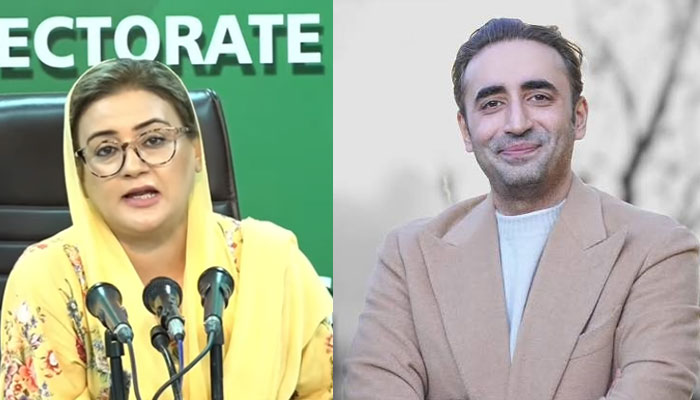
    Punjab Information Minister Azma Bukhari has criticised Pakistan Peoples Party (PPP) Chairman Bilawal Bhutto-Zardari, saying voters in Azad Jammu and Kashmir (AJK) had backed development and modernisation and that political parties should respect the public mandate. Speaking at a press conference in Lahore, Bukhari said the people of the Mirpur Division had made their choice through the ballot and supported the Pakistan Muslim League-Nawaz (PML-N). She urged rival parties to accept the election results with an open heart, saying respect for the people’s decision was an essential part of democratic politics. Bukhari claimed that the election outcome had increased frustration within an unnamed political party. Referring to Bilawal’s recent remarks, she accused him of trying to mock the PML-N leadership while avoiding a discussion of his party’s performance in Sindh. She challenged the PPP chairman to present the achievements of his party’s 18-year rule in Sindh, particularly in Karachi. She questioned why the city still lacked an effective public transport system and why municipal authorities struggled to manage waste collection. Comparing the performance of the Punjab and Sindh governments, Bukhari highlighted several initiatives launched under Punjab Chief Minister Maryam Nawaz, including public transport projects, the provision of laptops and scholarships to students, air ambulance services, improved drainage equipment and development schemes across the province. She also pointed to projects in southern Punjab, including public transport initiatives and the Recep Tayyip Erdogan Hospital, arguing that the region had received greater attention under the PML-N government. Bukhari further criticised the PPP’s record on education, saying students in Sindh continued to raise concerns over access to educational opportunities, while the Punjab government had expanded scholarship and laptop programmes for young people. She also defended the Punjab government’s response to heavy rainfall, saying authorities had equipped the Water and Sanitation Agency (WASA) with modern machinery to deal with urban flooding and drainage challenges. Bukhari invited Bilawal to visit Punjab and see its development projects firsthand, saying he should compare the performance of the two provinces before criticising Punjab’s infrastructure. Turning to the AJK election results, she said the people had clearly expressed their preference through their votes and urged all political parties to accept the outcome rather than question the public’s choice.

Leave a Reply

Your email address will not be published. Required fields are marked *