saudi must recognise
|

Saudi must recognise Israel, says Trump

US President Donald Trump has reaffirmed that Saudi Arabia must establish diplomatic relations with Israel before Washington moves ahead with a civilian nuclear cooperation agreement with the kingdom.

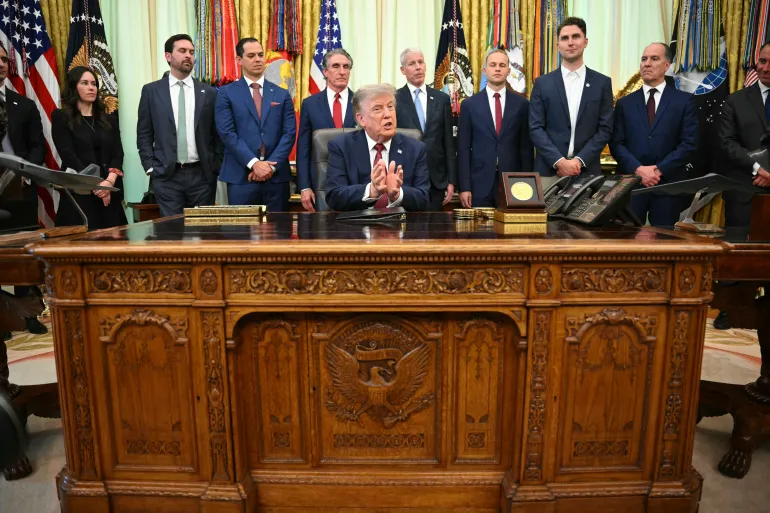
Speaking at the White House on Friday, Trump said the proposed nuclear partnership remains linked to Saudi Arabia joining the Abraham Accords, the US-backed agreements that normalized relations between Israel and several Arab states.

Trump dismissed suggestions that the US Department of Energy had announced the nuclear deal without the Israel-related condition. He said there had been no misunderstanding within his administration and insisted the requirement had always been part of the discussions.

I have always said that Saudi Arabia must become part of the Abraham Accords for the deal to move forward,” Trump told reporters, adding that the accords had been successful and that the time had come for Riyadh to join them.

The latest remarks came just days after the United States and Saudi Arabia signed a framework for cooperation on a civilian nuclear programme. While the initial announcement focused on energy cooperation and economic benefits, Trump later clarified that the agreement would only proceed if Saudi Arabia formally normalized ties with Israel.

Saudi Arabia has not officially responded to Trump’s latest comments. However, the kingdom has consistently maintained that it will not establish diplomatic relations with Israel until meaningful progress is made toward the creation of an independent Palestinian state. Israeli leaders have repeatedly rejected international calls for a Palestinian state under current conditions.

The proposed agreement is expected to create a long-term partnership between the two countries in the peaceful use of nuclear energy. It would involve the transfer of American technology, technical expertise and investment aimed at supporting Saudi Arabia’s civilian nuclear programme.

Trump also rejected reports suggesting the agreement would allow Saudi Arabia to enrich uranium domestically. He stressed that no uranium enrichment would be permitted under the arrangement.

US officials have argued that the partnership is designed to strengthen bilateral relations while ensuring strict oversight of nuclear activities. They say American companies will play a central role in developing the programme, allowing Washington to maintain close monitoring and prevent nuclear proliferation.


Similar Posts

  • | |

    Met Gala 2027 to honour British fashion designer

    The Metropolitan Museum of Art has announced that celebrated British fashion designer John Galliano will be the focus of its Spring 2027 Costume Institute exhibition, titled John Galliano: Horizons. The exhibition will also serve as the inspiration for the Met Gala 2027, making Galliano only the third living designer to receive a solo exhibition at the museum. The announcement marks a significant milestone in Galliano’s career. Before him, only Yves Saint Laurent in 1983 and Rei Kawakubo of Comme des Garçons in 2017 had been honoured with individual exhibitions while still alive. The Costume Institute exhibition will officially open on May 9, 2027, with the Met Gala serving as its traditional fundraising event before remaining on display until January 9, 2028. According to the museum, John Galliano: Horizons will explore the designer’s extraordinary career, tracing his creative evolution from his acclaimed 1984 graduation collection at Central Saint Martins to his work at Givenchy, Christian Dior, his own label, and Maison Margiela. The exhibition will feature garments, sketches, research books and archival material drawn from the Costume Institute’s extensive collection. Vogue editor-in-chief Anna Wintour, who has long admired Galliano’s work, praised the designer while announcing the exhibition. “There is no one more deserving of an exhibition of this scale than John Galliano,” Wintour said in a statement. She continued, “His body of work, at Dior, Givenchy, Margiela, his namesake label and more, combines erudition and creativity, darkness and light, the past, the present, the future all smashing together in a brilliant way.” The exhibition has been curated by Andrew Bolton, who explained the philosophy behind the project and why Galliano’s career remains an important subject in contemporary fashion. Bolton described the exhibition as treating “fashion as a form of cartography, mapping not territories but affinities, tensions, and transformations.” He further explained that the exhibition would examine “how Galliano has remapped the world through fashion and how his conduct, its consequences, and changing cultural values have reshaped our understanding of his work.” Organisers have also confirmed that the exhibition will not avoid one of the most controversial chapters of Galliano’s life. In 2011, the designer was dismissed from both Christian Dior and his own fashion label after making racist and antisemitic remarks. He was later convicted by a Paris court for public insults based on race, religion and ethnicity. According to The New York Times, the museum’s decision to move forward with the exhibition followed a private meeting held in May between Galliano, Andrew Bolton, Anna Wintour and several Jewish community leaders in New York. Rather than overlooking the controversy, the exhibition aims to place it within the broader context of Galliano’s life and career, examining both his artistic achievements and the consequences of his actions. With John Galliano: Horizons, the Metropolitan Museum of Art hopes to present a comprehensive look at one of fashion’s most influential and debated designers, while the Met Gala 2027 is expected to celebrate his lasting impact on the global fashion industry.

  • | |

    Karachi traffic accidents claim 603 lives this yea…

    Karachi: At least 603 people have lost their lives in different traffic accidents across Karachi this year, according to data released by Rescue authorities. Thousands of others have suffered injuries in road crashes, highlighting the continuing traffic safety challenges faced by the city. According to Rescue officials, 7,467 people were injured in traffic accidents during the year. The victims include people from different age groups and both genders. Of the 603 people who died in road accidents, 463 were men, 73 were women and 67 were children. The figures show that men made up the majority of fatalities, while women and children also suffered significant losses in road crashes. Rescue authorities said heavy vehicles were involved in a considerable number of fatal accidents. A total of 184 people were killed in accidents involving heavy vehicles during the year. According to the available data, 12 people lost their lives after being hit by dumpers. Trailer-related accidents claimed the lives of 84 people, making trailers one of the major contributors to fatalities involving heavy vehicles. Water tankers were also involved in several deadly accidents. Rescue officials reported that 46 people were killed in accidents involving water tankers during the year. Meanwhile, 18 people died in accidents involving mini-trucks, while 24 people were killed in accidents involving buses. The injury figures are also significant. Of the 7,467 people injured in traffic accidents, 5,649 were men, 1,322 were women and 496 were children. The data underscores the scale of road safety concerns in Karachi, where busy roads, increasing traffic and the movement of heavy vehicles have contributed to serious accidents. The high number of fatalities and injuries has renewed concerns about traffic management and road safety measures in the city.

  • | | |

    US forces thwart Iranian missile barrage as region…

    WASHINGTON: A fragile pause in hostilities between the United States and Iran came to an abrupt end on Tuesday after Iranian forces launched multiple ballistic missiles toward US military positions in the Middle East, according to the US military. The US Central Command (CENTCOM) said the missiles were fired by Iran’s Islamic Revolutionary Guard Corps (IRGC) in what it described as a surprise attack. In a statement posted on X, CENTCOM reported that all incoming missiles were successfully intercepted, preventing any reported damage or casualties. However, it did not disclose the exact locations that were targeted. The latest exchange marks a renewed escalation after several days of relative calm. Both countries had refrained from military action over the weekend following nearly two weeks of intense conflict, during which the United States carried out nightly strikes on Iranian positions while Tehran responded with repeated missile and drone attacks against US allies across the Gulf region. The recent confrontation traces back to mid-July, when Iran targeted several commercial vessels in the Strait of Hormuz, triggering a sharp rise in regional tensions and prompting a sustained military response from Washington. The temporary ceasefire had raised hopes for diplomacy, with US President Donald Trump stating there was a strong possibility of progress in negotiations aimed at ending the conflict. The lull in fighting also contributed to a decline in global oil prices, reflecting growing market optimism that the crisis could be contained. Tuesday’s missile launch, however, signals that tensions remain high, casting fresh uncertainty over diplomatic efforts and raising concerns about the potential for another round of military escalation in the Middle East.

  • |

    Qatar and Pakistan advance mediation efforts as US and Iran pause direct military strikes

    Regional mediators led by Qatar and Pakistan have achieved significant progress in restoring negotiations between the United States and Iran following a three-day pause in direct military strikes, according to regional officials. The temporary lull comes after nearly two weeks of heavy bombardment triggered by Iranian actions in the Strait of Hormuz. While US President Donald Trump and Tehran have temporarily halted direct strikes against one another, scattered attacks by regional armed groups persist, including drone attacks targetting Saudi petroleum facilities by Iran-backed militias and Houthis, alongside drone interceptions over Jordan and Iraq. Talks facilitated alongside Oman are focusing on establishing a maritime management mechanism for the Strait of Hormuz to restore an interim ceasefire deal, although Iranian Foreign Ministry spokesperson Esmail Baghaei stated that no direct negotiations with Washington are taking place and that the waterway currently remains closed. Concurrently, US naval blockades against Iran persist, and global shipping through both the Strait of Hormuz and the Bab el-Mandeb strait remains constrained. Amid ongoing mediation, Israeli Prime Minister Benjamin Netanyahu is scheduled to meet US President Donald Trump in Washington to discuss the wider conflict, while Iranian officials have condemned a recent Ukrainian strike on an Iranian vessel in the Caspian Sea.

  • |

    7 in 10 Afghan women report poor mental health

    Restrictions imposed on women and girls in Afghanistan have sharply reduced their participation in public life, with more than half of surveyed women saying they now leave their homes only once or twice a month, according to a new UN Women assessment. The findings were released as Afghanistan approaches the fifth anniversary of the Taliban’s return to power in August 2021. UN Women said Afghanistan remains the only country where girls are barred from secondary education and women are prohibited from attending universities. The agency said the restrictions have increasingly affected women’s freedom of movement, education, employment and access to public life. More than half of the women surveyed reported leaving home no more than twice a month. Nearly three-quarters said they did not feel safe going outside without a male guardian, commonly referred to as a mahram. UN Women said the restrictions have also contributed to growing concerns about women’s mental health. Around seven out of 10 women surveyed described their mental health as either “bad” or “very bad”. Respondents cited social isolation, reduced opportunities and limited access to support networks among the factors affecting their wellbeing. The UN agency said Taliban authorities have introduced more than 100 decrees affecting women and girls since returning to power. It described the measures as creating a system of discrimination and said Afghanistan had become an extreme global example of restrictions on women’s rights. The Taliban maintain that their policies respect women’s rights under their interpretation of Islamic law and Afghan culture. Education remains heavily restricted The restrictions on education have affected millions of Afghan girls. UNESCO estimated that about 2.4 million girls have been prevented from attending secondary school since the Taliban returned to power. Women and girls have also been excluded from university education, limiting their opportunities to pursue professional careers and higher education. UN Women said recent measures had further weakened legal protections available to women. According to the agency, rules introduced this year reduced legal equality between men and women, strengthened the authority of men within marriage and created additional difficulties for women seeking divorce. Women largely excluded from workforce Economic participation remains another major challenge. UN Women reported that only about 7% of Afghan women are employed, compared with approximately 84% of men. The agency said the restrictions on education and employment were limiting women’s ability to earn income, develop careers and contribute to the country’s economy. The findings were based on a door-to-door survey involving 2,190 people conducted between February and March 2025. The agency also conducted telephone interviews with 2,811 people between April and May 2025. UN Women warned that continued restrictions could further isolate women and deepen the social and economic consequences of excluding half of Afghanistan’s population from public life. The Taliban government has not immediately responded to requests for comment on the latest findings.

  • |

    China rejects Pakistan’s waiver request

    Chinese lenders and Independent Power Producers (IPPs) have turned down Pakistan’s request to write off nearly Rs 170 billion in late-payment surcharges. The refusal highlights the growing friction between the two long-standing allies as Pakistan struggles to navigate a staggering power-sector circular debt that continues to drag down its broader economy. The unpaid dues owed to 18 Chinese-backed power generation projects established under the CPEC have now increased to approximately Rs 423 billion. The financial bottleneck stems from a combination of structural inefficiencies within Pakistan’s domestic energy distribution network and systemic delays in clearing operational invoices. Under the original 2015 CPEC Energy Framework Agreement, Pakistan was legally obligated to ensure full and timely payments to power producers, backed by a designated revolving fund to cushion investors against domestic liquidity shortfalls. As payment deadlines were repeatedly missed over recent years due to severe foreign exchange constraints, contractual interest penalties accumulated to the tune of Rs 170 billion. While local power suppliers previously accepted debt-restructuring deals and fee write-offs to ease the burden on state coffers, Chinese energy firms have maintained a strict stance, citing global precedent and financial commitments to their own institutional lenders. This refusal creates an immediate impasse for Pakistan’s Ministry of Energy and financial regulators. The federal government had structured a massive Rs 1.225 trillion banking facility intended to retire the country’s broader circular debt stock. However, disbursement terms mandated that power producers accept renegotiated terms or offer discounts on late-payment fees before receiving principal clearances. Because the Chinese IPPs declined to waive the surcharges or offer similar concessions, billions in funds remain locked, leaving power plant operators facing severe liquidity squeezes that threaten regular fuel procurement and plant operation. Total Outstanding Dues: Rs 423 Billion. Requested Surcharge Waiver (Rejected): Rs 170 Billion. Principal Energy Cost Owed: Rs 253+ Billion. Pakistani negotiators are exploring alternative financial maneuvers to manage the expensive debt burden. Seeking low-interest bilateral funding including potential long-term loan packages in the range of $6 billion to $10 billion from partner nations like Saudi Arabia to retire high-cost Chinese energy loans. Requesting cabinet approval for extensions on expiring domestic banking facilities to prevent immediate default claims. Balancing the debt burden through structured tariff pass-throughs, though consumer capacity to absorb higher electricity prices remains extremely strained. The dispute underscores a delicate transition in the CPEC bilateral relationship. While both nations remain deeply committed to long-term strategic partnership and Phase-Two infrastructure development, commercial reality is setting a firmer baseline. Moving forward, resolving the sovereign debt backlog will require transparent structural reforms within Pakistan’s power distribution setup rather than relying on debt waivers from foreign investors.  

Leave a Reply

Your email address will not be published. Required fields are marked *