scientists use sharks

Scientists use sharks to improve hurricane forecasts

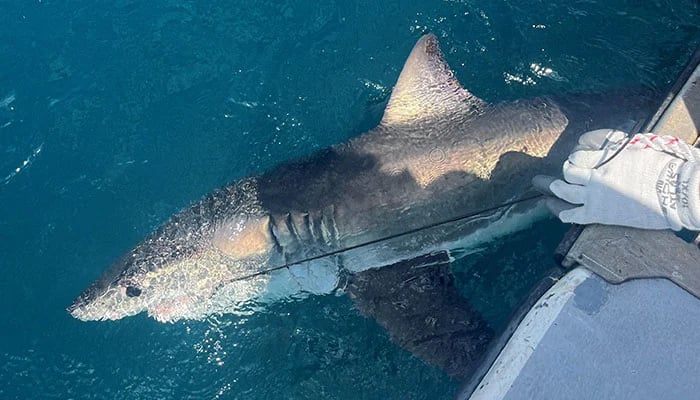
Scientists at the University of Delaware in the United States are investigating whether sharks can be used to improve predictions of hurricane intensity and serve as ocean-observing systems for collecting marine data.

Researchers at the University of Delaware are attaching sensors to sharks that measure ocean temperature, electrical conductivity and depth. Electrical conductivity is related to the amount of salt in the water.

According to Aaron Carlisle, a professor at the university’s School of Marine Science and Policy and the lead researcher of the study, animal-mounted sensors have been successfully used in marine research for several years particularly in areas where scientific observations are limited.

Researchers say sharks are suitable for this research because they are abundant, inhabit vast areas of the ocean and are relatively easier to access than many protected marine mammals.

So far, shark tagging has mainly been used to study their movements and habitats. However, in this new research, scientists are selecting sharks that can collect useful data for hurricane forecasting and swim close enough to the ocean surface for their tags to transmit information via satellites.

Preliminary analyses in the North Atlantic have identified shortfin mako sharks, blue sharks, smooth hammerhead sharks and juvenile great white sharks as suitable species for the research.

According to Aaron Carlisle, scientists are paying particular attention to the heat in the upper layer of the ocean known as the “mixed layer.” This layer of water plays an important role in the intensity of hurricanes because a warmer mixed layer can contribute to the formation of stronger hurricanes.

Caroline Wiernicki, a doctoral student at the University of Delaware said the shark-tagging process begins in early May, when several migratory shark species come closer to the coast after spending the winter in remote areas of the Atlantic Ocean.

Researchers travel 50 to 65 kilometres offshore in a research vessel where they deploy baited lines and typically wait two to three hours for sharks to approach. A tag is attached to the shark’s dorsal fin. When the shark swims near the surface, the tag connects with a network of satellite receivers and transmits data.

Carlisle said the tagging process is completed rapidly similar to a “pit crew” during a motor race and usually takes less than five minutes. Shark tagging is carried out under institutional animal-care oversight to minimize its impact on the animals.

The tags are attached using materials that gradually dissolve and eventually detach on their own. Before each shark is released back into the ocean, its health is examined because stress or injury could affect its natural behaviour and consequently, the reliability of the data collected.

Caroline Wiernicki said sharks are portrayed as extremely frightening animals in movies whereas in reality they are relatively calm creatures.

According to the researchers, if the project proves successful, data collected from sharks could help improve forecasts of the intensity of hurricanes approaching the US East Coast. This information could provide more reliable forecasts to coastal communities from North Carolina to Massachusetts helping them prepare for storms and improve coastal protection.

Aaron Carlisle said sharks are remarkable animals that are exceptionally well adapted to life in the ocean and there is much that humans can learn from them. If it is proven that sharks can also benefit humans, it would be a win-win situation for both.

Similar Posts

  • MIT robot can fly and swim

    Researchers at the Massachusetts Institute of Technology (MIT) have created a unique robot that can both fly through the air and swim underwater just like diving birds. The lightweight robot costs around $300 and was designed by MIT’s AeroAquatic Robotics team.  Scientists believe it could one day help monitor oceans study marine life and support environmental protection. The robot was inspired by diving birds which use the same wings to fly in the air and move through water.  While scientists have studied these birds for years building a robot that can perform both tasks efficiently has been a major challenge. To solve this the MIT team carefully studied how diving birds move and used those findings to design the new machine. The robot called the Flapping Aerial Aquatic Vehicle weighs only 250 grams.  It runs on a battery powered motor and has nylon wings and a tail coated with water resistant nanoparticles to protect them from moisture. According to the researchers the robot is programmed to flap its wings at a specific frequency allowing it to move smoothly in both air and water without changing its basic movement. It can fly at speeds of up to 13.4 miles per hour and swim at about 2.2 miles per hour. On a single battery charge it is designed to fly as far as 6 kilometers or swim up to 2 kilometers. The robot was tested for about one year first in a water tank in Massachusetts and later in Lake Geneva Switzerland where researchers evaluated its performance in real world conditions.

  • Too much gaming may harm children

    Online and video games are a popular source of entertainment for children.  However experts warn that spending too much time playing games can affect a child’s mental physical and social development. Playing games in moderation can be enjoyable but excessive gaming may lead to several problems. Experts say the growing popularity of video games among children is becoming a concern around the world. Spending long hours in front of a screen can reduce time for schoolwork exercise and other healthy activities. Research also suggests that too much gaming may make some children more irritable angry or aggressive. According to experts excessive gaming may also affect brain function and the nervous system. Children who spend too much time playing games may lose interest in their studies perform poorly at school and become more likely to develop an unhealthy dependence on video games. Too much screen time can also reduce social interaction. Instead of spending time with family and friends children may prefer staying alone with their games which can affect their communication and relationship skills. Pediatric experts advise parents to set clear limits on screen time and encourage children to take part in other activities. Outdoor games painting arts and crafts reading and other creative hobbies can support healthy physical and mental development. These activities are even more beneficial when parents are involved. Experts also say that spending time with siblings and family members helps children build stronger relationships confidence, and social skills.  If video games become a child’s main focus family life and personal development may suffer. Experts do not recommend banning video games completely as learning to use technology is important today. Instead parents should set reasonable gaming limits monitor what their children play and encourage a balanced lifestyle that includes learning physical activity and family time.

  • Tommy cherry sets new cube World record

    American speed cuber Tommy Cherry has reclaimed the Guinness World Record for solving a Rubik’s Cube while blindfolded. The 21year old set the new record on June 28, 2026 during the Mid-Atlantic Quiet Championship 2026 in Branchburg, New Jersey. He solved a 3×3×3 Rubik’s Cube in just 11.56 seconds, setting a new world record. Tommy first earned this record in 2021 with a time of 15.27 seconds. Since then he has continued to improve breaking his own records several times over the years. He also shares the world record for the fastest average blindfolded solve of a 3×3×3 Rubik’s Cube with Charlie Eggins. Both speedcubers recorded an average time of 14.05 seconds. https://www.facebook.com/share/r/1EMYY7bxdd/ After his latest achievement Tommy said he was very happy because it was his first world record since 2024. He added that he hopes to keep improving and hold the record for a long time.

  • Survey finds divide over AI

    A new report from the Pew Research Center shows that artificial intelligence (AI) experts and the general public have very different opinions about the future of AI. While experts are mostly positive about its impact many people are worried that AI could replace jobs and create new challenges. According to the survey, 56% of AI experts believe the technology will have a positive effect on the United States over the next 20 years. In comparison, only 17% of the public share that view. Experts are more confident that AI will improve the way people work and help grow the economy. However many people are concerned that AI could reduce job opportunities especially in roles that depend on human workers. The report also highlights the jobs experts believe are most likely to be affected by AI. About 73% think cashier jobs could be replaced followed by truck drivers (62%) journalists (60%) factory workers (60%) and software engineers (50%). The public generally agrees with these predictions although only 33% believe truck drivers are at high risk. Both experts and the public agree that healthcare is one of the areas where AI can bring the greatest benefits. They believe AI could improve medical care and support better treatment. At the same time both groups are concerned that AI may not improve the accuracy of news or election coverage. The survey also found strong support for greater control over AI. Many respondents believe governments may struggle to regulate the technology effectively as it continues to develop. Another finding is the difference between male and female AI experts. Around 63% of male experts expect AI to have a positive impact on the United States compared with 36% of female experts. Women were generally more cautious saying the technology could have both benefits and risks. The report also notes that women remain underrepresented in the AI industry. Researchers suggest that increasing women’s participation in AI development could lead to more balanced technologies. They also point out that many jobs with a large number of female workers such as administrative and customer service roles are becoming more automated increasing the risk of job losses. Overall the report shows that understanding both expert opinions and public concerns is important. As AI continues to grow balancing its benefits with responsible rules and safeguards will be essential.

  • YouTube adds custom thumbnails for shorts

    YouTube has launched a long awaited feature that allows creators to upload custom thumbnails for their YouTube Shorts. According to reports the new feature is currently available for creators who are part of the YouTube Partner Program (YPP). They can now choose and upload their own thumbnail images instead of relying on a frame from the video. This update gives creators more control over how their Shorts appear. They can design eye catching thumbnails that match their brand and make their videos more attractive to viewers. YouTube said custom thumbnails have been one of the platform’s most requested features. The company is rolling it out first to Partner Program members and plans to expand access to more creators in the future. Previously Shorts creators could only select a still frame from the video as the thumbnail making it harder to create a consistent look or build a strong brand identity. The new feature aims to solve that problem and improve the overall presentation of Shorts.

  • | |

    DI Khan church still guards colonial memories

    There are some places we pass every day without realising how much history they hold. They remain untapped until some visitors put their eyes on them. During summer vacations, I travelled to Dera Ismail Khan, a district situated in southern Khyber Pakhtunkhwa. It takes six hours from Lahore to arrive in this historic city. During my stay there, I came across one such place that immediately captured my attention, and I thought to write about it. It was St Thomas Church, sacred place of worship for Christian community. A large cross standing at the entrance, old rusty walls, and an ambience of spiritualism. But the Church showcased more than that. Its walls contain historical accounts of colonial past, the military campaigns led by British soldiers in this area and a grave of one Lieutenant Governor of Punjab.   St Thomas Church was built in 1856 during British rule in the Indian subcontinent. It is one of the oldest churches in present-day Pakistan. It has survived political changes, the Partition of 1947, and the passing of time. Even today it stands as a symbol of the rich and diverse heritage of Dera Ismail Khan. The church is not only a place of worship but also a reminder that different faiths and communities have long been part of the history of this region. As we walked inside, we met the old priest and caretaker of the church named Chand. He welcomed us warmly and narrated the remarkable history of this place. There are memorials of British soldiers who lost their lives in this region during military campaigns. The priest stood in front of each tablet inscribed on the church wall and briefed about it. One memorial narrates the names, ranks and units of one hundred and 69 British military officers and other ranks who were killed or died due to injuries or disease in Waziristan military campaigns launched between 1919 to 1921.     Another memorial lists details of sixty-eight officers and other ranks who met a similar fate during the 1936-1938 Waziristan military campaigns. Similarly, one tablet erected by friends and fellow officers mourns the death of Herbert Walter Gee, ICS, deputy commissioner of Dera Ismail Khan, who died in 1901. There are other memorials as well, erected by colleagues in memory of the fallen officers. I thought that these names contain historical accounts year by year about what happened in this part of the world at that time. Every sentence of the Priest carried a new story, such as how the church has witnessed a lot of happenings through generations and that it still serves the small Christian community living in Dera Ismail Khan. As we stepped outside, believing our visit had come to an end, the priest said, “Wait. I have to show you one more thing.” He took me to the back of the building, where I saw a large white grave standing quietly among the dusty bushes. Here rests Lieutenant General Sir Henry Marion Durand (1812-1871). Durdand – a quite familiar name for the people of Pakistan and Afghanistan. Sir Durand was a career British military officer, diplomat, and administrator. He served in the East India Company Army, took part in several military campaigns, and later became the Lieutenant Governor of Punjab from 1870 to 1871. His son Sir Mortimer Durand is the one who drew the contours of the border between British India and Afghanistan in 1893. A man who once held such an important position now lies in silence behind an old church, while many people living nearby are unaware that his grave even exists. Henry Marion Durand died in 1871 at the age of 58 from a tragic accident. He was visiting Nawab of Tank Shahnawaz Khan along with his daughter when he fell from an elephant. The elephant was passing through the gateway by the town of Tank with the Nawab on the same elephant and an official (Chaprassy). The gate was too low to cross an elephant with howdah. The howdah struck the walls of crossing and the elephant got frightened resulting in the fall of Durand. He remained unconscious for a few days and never recovered. He was buried beside St. Thomas’ Church in Dera Ismail Khan. The British suspected some conspiracy into this incident. One of descendent of Nawab Shahnawaz Khan says that The British launched an enquiry into it. But the daughter of Durand gave testimony in favour of the Nawab that it was just an accident and there was no fault on his part. However, as a punishment, the British authorities stripped the powers of Nawab Shahnawaz Khan in 1875 and sent him to Lahore under strict watch. He passed away in 1881 while under surveillance. Standing beside the grave of Sir Henry Durand, I felt as if I had stepped into a forgotten chapter of history. The name engraved on the stone reminded me that many important events and personalities of the past remain connected to places that we often overlook. How easily history can fade from people’s memories, even when it is standing right in front of us. As I left St Thomas Church, I felt that I had walked through a chapter of history that few people ever get to read. Sir Henry Durand ruled Punjab from this soil, and his son later sat across a table in Kabul and drew the line that still separates Afghanistan and Pakistan today. That line appears in newspapers and political debates all the time. Yet the grave of the man whose name it carries lies quietly behind a church in Dera Ismail Khan.

Leave a Reply

Your email address will not be published. Required fields are marked *