syed mohammad ahmed
| |

Syed Mohammad Ahmed on Kya Drama Hai judges

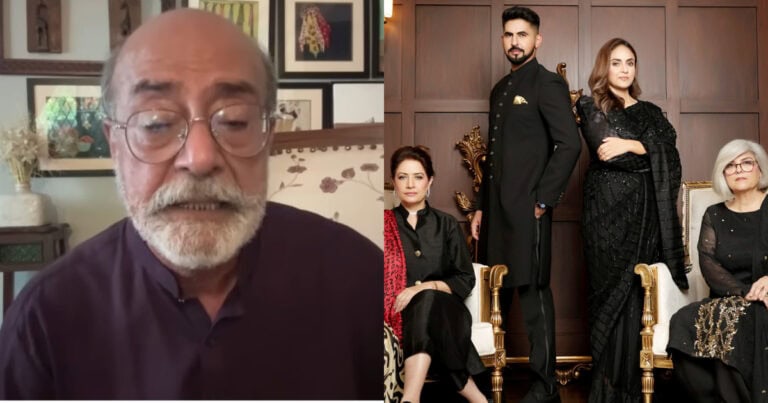
Syed Mohammad Ahmed has been a pillar of Pakistani television for decades. As an actor and writer, he has built a reputation not only for his craft but for the kind of honest, unhurried perspective on the industry that comes from having seen it evolve over a very long time. In a recent podcast appearance, he offered exactly that kind of perspective, speaking candidly about Kya Drama Hai and the three respected actresses who serve as its judges.
The context for his remarks was a controversy that had recently surfaced around Nadia Khan, the show’s host, who had mimicked Sajal Aly in a segment that drew significant criticism from audiences who felt the impression was mocking rather than affectionate. Ahmed addressed this directly and did not tread lightly around it.
He said that in earlier times, mimicry was an art form conducted with permission and done tastefully, with genuine respect for the person being imitated. What he saw in Nadia Khan’s impression of Sajal Aly fell outside those boundaries. His discomfort was rooted in what he perceived as a mismatch in calibre. He said he did not understand how someone who was not even in Sajal’s league could presume to mock her in that manner. It was a pointed observation, delivered without hostility but with unmistakable clarity.
He then turned his attention to the judges themselves, Marina Khan and Atiqa Odho, and what he had to say about them was warm but carried its own kind of candour.
Of Marina Khan, he spoke with genuine admiration. He described her as someone who simply does not backbite, a quality he clearly values greatly, and said she is a truly great person. His comment about why she would participate in a show like Kya Drama Hai was not unkind but it was honest. He said he understood that running a household requires income, and that Marina simply has to work, framing it as a practical reality rather than a criticism of the show itself.
He was equally warm toward Atiqa Odho, describing her as well-learned and well-read. But again he expressed genuine puzzlement about why someone of her intellect and standing would join such a programme.
The thread connecting both observations was his broader view of why channels produce the kind of content they do. He was clear that it comes down to ratings. Channels run this content because it works commercially, and individuals participate because participation keeps them working. He was not condemning anyone, but he was naming a dynamic that many in the industry understand but rarely state plainly.
For an actor of Syed Mohammad Ahmed’s stature, the willingness to speak this honestly about a format that involves three of his respected contemporaries is itself notable. He managed to criticise a system without diminishing the people within it, which is a harder balance to strike than it looks.

Similar Posts

  • | |

    Abdullah Saleem scores 1,191, tops DG Khan Board

    The Board of Intermediate and Secondary Education (BISE) Dera Ghazi Khan has announced the position holders for the 2026 Matric Annual Examinations ahead of the official declaration of results. Chairman Professor Dr Abdul Rauf unveiled the names of the top-performing students and congratulated the position holders and their parents on their outstanding achievement. Board Secretary Abdul Rehman Chaudhry, Controller of Examinations Professor Muzaffar Hussain, and other senior officials were present during the announcement ceremony. The board said the complete Matric Annual Examination results will be officially announced on August 6. Abdullah Saleem from Layyah secured first position across the DG Khan Board by scoring 1,191 marks. Mir Mujtaba from Taunsa Sharif claimed second position with 1,190 marks. The third position was shared by Farwah Ahmed from Muzaffargarh, Meerab Zahra from Layyah, and Syed Muhammad Jon Abbas from Layyah, with each student scoring 1,189 marks. Students from Layyah, Taunsa Sharif, and Muzaffargarh dominated the list of top achievers this year, reflecting the strong academic performance of the region. The announcement sparked celebrations among parents, teachers, and educational circles, who praised the students for their remarkable success. The position holders credited their achievement to hard work, the guidance of their teachers, and the prayers and support of their parents.

  • |

    Pakistan targets 90% clean electricity by 2035, says Awais Leghari

    Federal Minister for Power Awais Leghari outlined Pakistan’s long-term strategy to transform its electricity sector, setting an ambitious target of raising the share of clean energy in the national power mix to 90 percent by 2035. The announcement came during the Solar, Storage and Flexibility 2026 Conference, where the minister also highlighted key policy hurdles, including restrictions under Pakistan’s International Monetary Fund (IMF) programme that are delaying the introduction of a market-based electricity pricing mechanism. Speaking at the conference on Tuesday, Leghari said the government was pursuing a major shift in energy policy by moving away from a traditional generation-focused model towards a system centred on grid flexibility, energy security, battery storage and domestic manufacturing. He said the new approach is designed to reduce Pakistan’s dependence on imported fuels, shield consumers from volatile global energy prices and maximise the benefits of the country’s rapidly expanding solar sector. The minister said Pakistan has witnessed remarkable growth in rooftop solar installations, with nearly 38 gigawatts of distributed solar capacity now installed through private consumer investment. He described the rapid adoption of rooftop solar as one of the country’s biggest energy success stories but cautioned that it has also created new challenges for the national power system. According to Leghari, Pakistan generates significant amounts of electricity from solar energy during daylight hours, yet the absence of sufficient battery storage infrastructure prevents that surplus electricity from being utilised during evening peak demand. He stressed that without modern storage systems, the country would continue to struggle with balancing electricity supply and demand despite having abundant renewable energy resources. Referring to disruptions in Re-gasified Liquefied Natural Gas (RLNG) supplies earlier this year, the minister said the episode exposed Pakistan’s continued dependence on imported fuels. He noted that the interruption in fuel supplies led to electricity shortages and load shedding even though ample solar power was available during the daytime, highlighting the urgent need for large-scale energy storage. “Battery storage is no longer an optional technology—it has become a strategic national asset that is essential for ensuring Pakistan’s energy sovereignty,” Leghari said. He noted that clean energy sources, including hydropower, nuclear, wind and solar, currently contribute approximately 55 percent of Pakistan’s total electricity generation. However, he warned that achieving the government’s renewable energy targets would require significant investment in battery storage systems, transmission infrastructure and power market reforms. The minister emphasised that expanding renewable generation alone would not be sufficient unless supported by a modern electricity network capable of storing and transmitting clean energy efficiently. To support the country’s long-term energy transition, Leghari announced a three-point strategy. The plan includes expanding battery energy storage systems across the national grid, encouraging local battery manufacturing and assembly to reduce reliance on imports while creating employment opportunities, and introducing regulatory reforms aimed at providing long-term certainty and confidence for domestic and foreign investors. During a question-and-answer session following his address, the minister also disclosed that Pakistan’s commitments under the IMF programme currently limit the government’s ability to introduce a fully flexible, market-based electricity tariff system. He explained that the government has been in discussions with the IMF for several months regarding the introduction of a time-of-use tariff, under which electricity prices would vary according to the actual cost of power generation at different hours of the day. Such a system, he said, would encourage consumers to shift electricity consumption to off-peak periods, reduce pressure on the national grid and help integrate renewable energy more efficiently.

  • | |

    Rawalakot election possible on August 20 or 21 if …

    Azad Jammu and Kashmir (AJK) Chief Election Commissioner Ghulam Mustafa Mughal has said that elections in Rawalakot could be held on August 20 or 21 if the ongoing protest is resolved within the next three to four days. Speaking to the media in Muzaffarabad, Mughal said polling in Bagh and Haveli was scheduled to take place first due to security concerns. He said security personnel had already arrived in the two districts, while polling material was being transported under the supervision of the military. He added that eight security personnel would be deployed at each highly sensitive polling station to ensure the safety of voters and election staff. The chief election commissioner said efforts were also under way to restore internet services in Bagh and Haveli on August 9 and 10. Mughal said the Election Commission expected to be in a position to announce the polling date for Rawalakot within the next seven days. However, the final schedule would depend on the resolution of the ongoing protest. “If the protest is resolved within three or four days, elections in Rawalakot can be held on August 20 or 21,” he said. Responding to allegations made by political leaders, Mughal said the Election Commission could not engage in a war of words with politicians. He said the commission would provide the facts once the electoral process had been completed and would determine whether any irregularities had occurred and who was responsible.

  • | | |

    Tax ombudsman flags flaw in FBR refund system

    Pakistan’s Federal Tax Ombudsman has identified a major flaw in the Federal Board of Revenue’s (FBR) FASTER sales tax refund system and directed the tax authority to take immediate corrective measures. The ombudsman said the issue is affecting exporters and undermining the effectiveness of the automated sales tax refund mechanism, which was introduced to ensure quicker processing of refund claims. The observations were made in a ruling issued by Federal Tax Ombudsman Zafar Hijazi while deciding complaints filed by a company regarding delays and issues in the refund process. According to the decision, the FASTER system is unable to distinguish between commercial export goods declarations and non-commercial sample exports. As a result, exporters may face unnecessary delays or complications in obtaining legitimate sales tax refunds. The ombudsman directed the FBR to address the technical shortcomings in the system without delay to ensure that genuine exporters receive timely refunds and the automated mechanism functions efficiently. The ruling emphasized that improving the FASTER system is essential for protecting exporters’ interests and maintaining confidence in Pakistan’s tax refund process

  • |

    Rajab Butt reveals why he always shows off his wealth

    Rajab Butt has become one of Pakistan’s most talked-about YouTubers and social media influencers, often attracting attention not only for his content but also for the controversies surrounding his personal and professional life. From public disputes and legal issues to discussions about his marriage, the social media personality frequently finds himself in the spotlight. While he has a large following, his outspoken personality and extravagant lifestyle have also made him a polarizing figure, with some fans strongly supporting him while others criticize his approach. In a recent interview with 24 Digital, Rajab Butt opened up about his latest controversies, public disagreements and the reasons behind his highly visible lifestyle. During the conversation, the YouTuber addressed a topic that has repeatedly sparked discussion online: his habit of openly displaying his wealth. Rajab Butt has often shared glimpses of his expensive purchases, luxurious lifestyle and business activities with his audience. He has also previously claimed that he has achieved billionaire status through his YouTube career and various business ventures. His claims and lifestyle have generated considerable discussion among social media users, with many questioning why he chooses to make so much of his financial success public. Explaining his perspective, Rajab Butt said that showing his wealth is closely connected to the nature of his work as a content creator. According to him, if he purchases something expensive, it naturally becomes part of the content he creates for his audience. He gave the example of buying a car worth Rs 5 crore, saying that if he spends such a huge amount on a vehicle, he would make a vlog about it rather than keeping the purchase completely private. For him, such moments are not simply personal experiences but also opportunities to create content and keep his viewers interested. Rajab further pointed out that content creators have increasingly turned everyday occasions into material for their videos. He noted that YouTubers can create content even from events such as birthday celebrations, suggesting that almost every aspect of a creator’s lifestyle can become part of their online presence. He explained that he follows the same approach. Since his career depends on producing engaging videos, he believes he has to make his content interesting enough to hold the audience’s attention. Sharing expensive purchases, cars and other aspects of his lifestyle is therefore part of the entertainment value he offers to his viewers. His comments provide an insight into how Rajab Butt views the relationship between his personal life and his career. Rather than treating his wealth as something that should always remain private, he considers it a source of content that can help attract viewers and generate interest. For Rajab Butt, displaying his wealth is ultimately connected to the demands of being a modern YouTuber. As social media continues to blur the line between private life and entertainment, he appears comfortable turning major personal milestones, purchases and lifestyle choices into content for his audience.

  • | | |

    Saeed Ghani rejects MQM’s demand for new provinc…

    Sindh Provincial Minister Saeed Ghani has rejected the demand for dividing Sindh and creating a new province, saying that no matter how much pressure is exerted, a new province will not be established in the province. Ghani accused the MQM of creating hatred by repeatedly raising the issue of a separate province. He said several other political parties were also opposed to dividing Sindh, while MQM leader Mustafa Kamal had himself acknowledged that people in Sukkur had rejected the idea of a new province. The provincial minister questioned the political standing of a few MQM leaders and said that even within the party, its members were not willing to sit together. Speaking about local government arrangements, Ghani said protests had previously been held against the dual local government system in Sindh. He maintained that Karachi had been given a separate system under an agreement reached with the MQM. Commenting on Jamaat-e-Islami’s protests, Ghani said the party claims to be protesting over public issues, but shutting down Karachi at multiple locations would not resolve people’s problems. He advised JI leader Hafiz Naeemur Rehman to hold protests at locations where people would respond sympathetically. Ghani also criticized demands for abolishing the levy, questioning whether making life difficult for Karachi’s residents would force Prime Minister Shehbaz Sharif to accept the protesters’ demands. He said all provinces contribute their share of revenue to the federation, adding that Sindh had also fulfilled its financial responsibilities. According to Ghani, the political and administrative circumstances in Punjab and Khyber Pakhtunkhwa are different, and the demand for a new province in Sindh remains unacceptable.

Leave a Reply

Your email address will not be published. Required fields are marked *