
want install solar
| | | | |

Want to install solar panels? How DOE’s simplified rules apply to you

MANILA, Philippines – Filipinos who want to install solar panels to ease their electricity bills may now have less paperwork to deal with, but exactly how simple the process becomes depends on what kind of system they install.

The Department of Energy’s (DOE) new rules cover solar systems meant primarily for the consumer’s own electricity use rather than for selling power back to the grid under a net-metering program. But within that broad category are three different setups, each with its own requirements: connected zero-export systems, isolated zero-export systems, and small micro-solar systems (MSS).

The biggest change is that distribution utilities such as Meralco and electric cooperatives can no longer require pre-installation clearances, technical permits, or inspection fees as a condition for installing systems covered by the policy. Utilities may still study how installations affect their networks, but must shoulder the cost themselves and cannot use the study to delay or block installation.

Which rules apply to you?

The easiest category is an MSS, which are small, consumer-grade or plug-and-play setup.

To qualify, the solar panels must have a total capacity of no more than 1 kilowatt (kW), paired with a micro-inverter with a maximum output of 0.8 kW. The system must also meet electrical and safety requirements. (READ: What will it take for solar power to take off in the Philippines?)

For consumers installing an MSS, they simply need to notify their distribution utility — such as Meralco — using the DOE’s prescribed form. No building permit or Certificate of Compliance (COC) from the Energy Regulatory Commission is required under the circular.

Consumers with analog meters also don’t have to wait for a meter replacement before installation. The utility has up to 12 months after notification to replace the meter with one suitable for MSS installations, while the existing meter may continue to be used temporarily.

Those with larger solar installations fall under what the DOE calls Self-Generating Facility Zero-Export Solar Systems (SGF ZESS). Unlike an MSS, there is no capacity ceiling, but the system must be configured so that electricity is not exported to the distribution grid.

There are two kinds: connected SGF ZESS and isolated SGF ZESS.
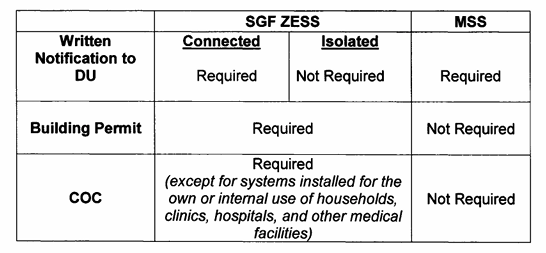
SIMPLIFIED. Table of requirements for each type of solar system. DOE Department Circular 2026-08-0017.

A connected SGF ZESS remains connected to the distribution system but uses equipment that prevents excess solar electricity from flowing into the grid. Consumers installing one must notify their distribution utility and secure a building permit.

A completely isolated SGF ZESS, meanwhile, operates independently from the distribution grid. No notification to the utility is required, but a building permit still is.

While both connected and isolated SGF ZESS require a building permit, consumers may not have to get a new one if their local government verifies that an existing building permit is sufficient for the solar installation.

The COC requirement depends on who will use the system. Households, clinics, hospitals, and other medical facilities are exempt from securing a COC for SGF ZESS installations. Other users, such as businesses, generally still need one.

And if you’re hoping to earn from the excess electricity your solar panels generate, these streamlined rules are not for you. Any electricity sent back to the grid under these arrangements will not earn bill credits or payments.

To receive credits for excess solar power, consumers still have to enroll in the net-metering program and enter into a net-metering agreement with their distribution utility, which are goverened by a different set of paperwork requirements.

Energy Secretary Sharon Garin said the policy is intended to remove costs and requirements that can discourage consumers from adopting solar in the first place.

“By simplifying the process and removing unnecessary costs and requirements, we are opening the door for more households, clinics, and small businesses to generate clean electricity for their own use,” Garin said.

According to the Department of Energy, the measure is meant to directly support the energy directive of President Ferdinand Marcos Jr. in his 2026 State of the Nation Address. Marcos had called for faster renewable energy adoption and for rooftop solar and battery storage installation to become simpler and more affordable.

The Philippines currently gets 25% of its energy from renewables and hopes to reach a renewable energy target of 35% of the power generation mix by 2030 and 50% by 2040. – Rappler.com

Must Read

[READOUT] The race to deliver cheaper power


[READOUT] The race to deliver cheaper power

Similar Posts

  • |

    Government adjusted petrol and diesel rates

    The federal government has announced the rate of petrol by Re0.94 per litre while raising high-speed diesel (HSD) by Re0.54 per litre. Under the newly adjusted tariffs, petrol will now sell at Rs324.98 per litre, whereas HSD will cost consumers Rs382.79 per litre. Despite these minor shifts, significant fiscal levies remain embedded in local pump prices, with taxes and duties standing at Rs114 per litre for petrol and Rs100 per litre for diesel. According to official directives issued by the Petroleum Division, the revised rates take effect immediately for August 13. This latest decision highlights a broader downward trend from the historic spikes observed earlier this year. Fuel prices experienced an unprecedented surge following the breakout of the US-Iran conflict in late February. HSD, which traded around Rs281 per litre before the geopolitical crisis, climbed sharply to reach an all-time peak of Rs520.35 on April 3 before gradually retreating. Similarly, petrol prices escalated from Rs266 in early March to a maximum height of Rs458.41 on the same April date before cooling down to present levels. In a structural shift to handle ongoing market volatility, Petroleum Minister Ali Pervaiz Malik revealed that fuel pricing will transition to a daily adjustment mechanism. While the government had temporarily relied on weekly pricing revisions and targeted subsidy schemes since March to buffer against Middle Eastern supply disruptions, authority over price setting has now been formally handed over to the Oil and Gas Regulatory Authority (OGRA). Under the approval of the Prime Minister and the federal cabinet, OGRA will directly track daily international market fluctuations to determine local retail costs. However, this policy pivot has met swift pushback from commercial stakeholders. The All Pakistan Dealers Association strongly rejected the transition to daily rate changes, warning that the organization is formulating a formal protest strategy to oppose the decision.   The economic stakes of these pricing shifts remain high across every level of society. Petrol costs directly influence everyday commuters, small vehicle operators, rickshaw drivers, and motorcycle owners, placing immediate financial pressure on middle- and lower-income households when rates rise. On the other hand, diesel price movements carry a broader inflationary impact, as HSD powers heavy transport fleets, agricultural machinery, power generation plants, and industrial backup generators. Together, petrol and diesel form the bedrock of the national energy supply and state revenue, generating massive combined monthly sales of 700,000 to 800,000 tonnes, compared to a meager 10,000 tonnes of monthly demand for kerosene. Daily adjustments will now determine how these vital economic drivers impact consumers nationwide.

  • | | |

    Daily petrol prices trigger Senate debate over tra…

    Islamabad: Pakistan’s new daily petroleum pricing system came under serious discussion in the Senate as lawmakers questioned whether the mechanism is providing relief to consumers or creating new challenges for the public and fuel dealers. The Senate Standing Committee on Petroleum reviewed the daily petrol price determination system and demanded clarity over why the government replaced the previous fortnightly price revision system with daily changes. The committee questioned the reasons behind the new policy and asked whether frequent price adjustments were helping ordinary citizens or increasing uncertainty in the fuel market. Federal Minister for Petroleum informed the committee that the government had removed political influence from the petroleum pricing process by giving the responsibility of setting prices to the Oil and Gas Regulatory Authority (OGRA), an independent regulator. He said the new system was introduced to make petroleum price decisions more transparent and based on market conditions. OGRA Chairman informed the committee that petrol prices are calculated through a seven day average of international Platts benchmark prices. He explained that instead of directly passing sudden changes in international oil markets to consumers, the seven day average spreads the impact over time. According to OGRA, the system helps reduce sudden price shocks, especially during international tensions and market uncertainty. Officials said the daily pricing mechanism also aims to discourage people from creating artificial shortages or making unfair profits through speculation. However, senators raised concerns about the effect of frequent price changes on citizens and businesses. The committee expressed concern over the high tax burden on petroleum products and questioned how increasing fuel costs affect the daily lives of ordinary people. Representatives of the Petroleum Dealers Association informed the committee that frequent price revisions were creating operational difficulties for fuel dealers. They said continuous price changes make business planning more difficult and require better coordination between authorities and dealers. The committee directed OGRA to consult all stakeholders, including petroleum dealers, and prepare practical recommendations to address their concerns. Members also stressed the need for greater use of technology in the petroleum supply chain to prevent fuel smuggling, adulteration and illegal storage. The committee said a stronger digital monitoring system could improve transparency and ensure consumers receive better quality fuel. Senator Umer Farooq chaired the meeting of the Senate Standing Committee on Petroleum, where members reviewed the new pricing system and related petroleum sector issues. The committee emphasized that petroleum pricing directly affects every citizen because fuel costs influence transportation, business expenses and prices of daily goods. Members said the government and regulators must ensure that any pricing system protects consumers while maintaining stability in the petroleum market. The committee directed OGRA to continue reviewing the mechanism and ensure that the interests of consumers remain the top priority.

Leave a Reply

Your email address will not be published. Required fields are marked *