day trumps asia
|

Day 2 of Trump’s Asia tour: Putin’s handshake, fried chicken and high-stakes diplomacy

SHENZHEN, China – US President Donald Trump arrived in China on Wednesday, November 18, ahead of the highest-stakes leg of his Asia trip: an unprecedented summit with Chinese President Xi Jinping and Russian President Vladimir Putin.

The gathering in Shenzhen brings together the leaders of the world’s three biggest nuclear powers at a moment of tension over Ukraine, Iran, trade and a global arms buildup.

Here are some takeaways from Trump’s second full day in the region.

A weighty handshake

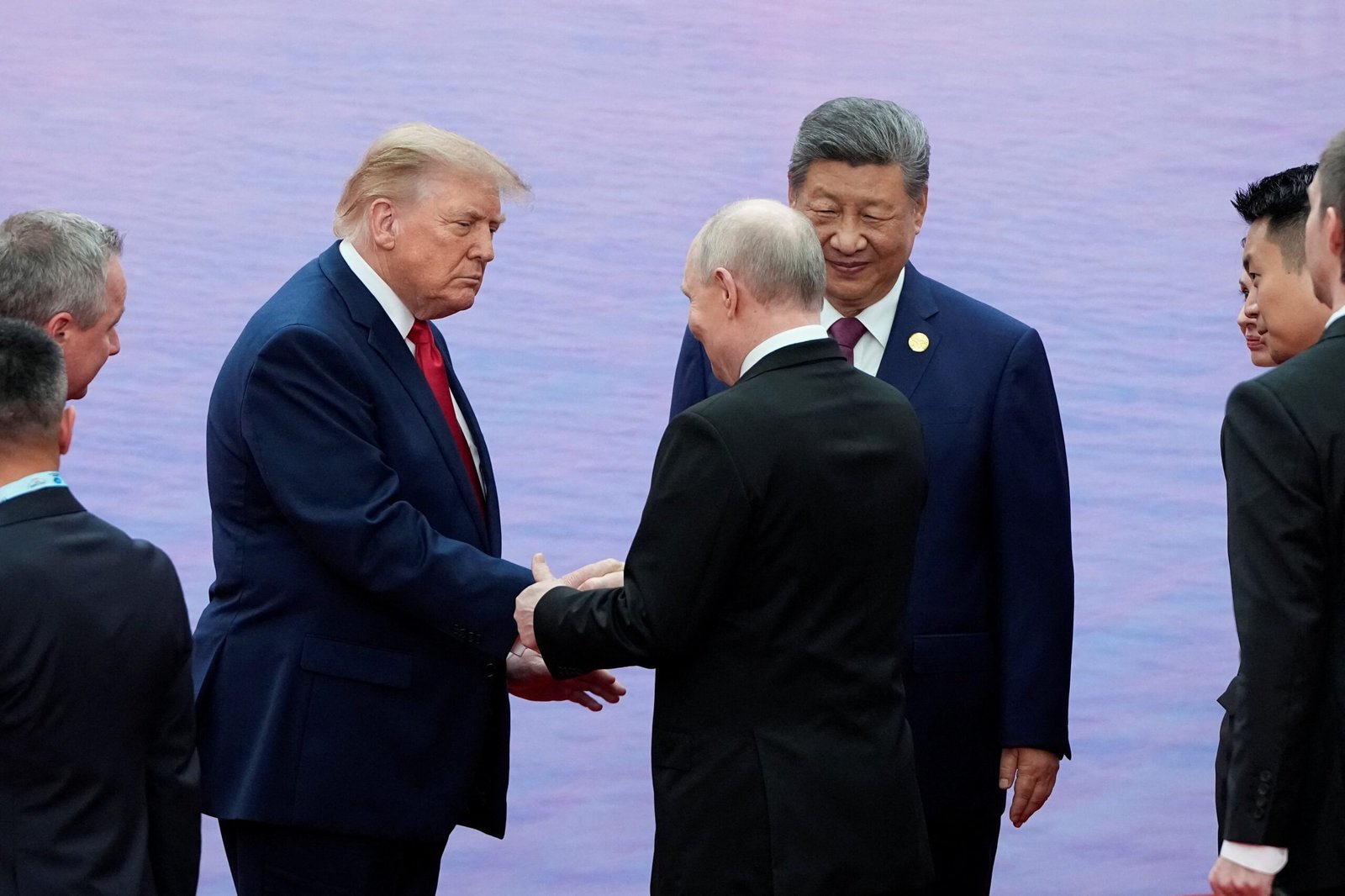
A gathering of world leaders inevitably involves plenty of handshakes, but one in particular stood out on Wednesday.

Putin approached Trump and initiated a handshake in front of cameras, offering a public display of cordiality between the two leaders at a time when Russia remains isolated from much of the West over its war in Ukraine.

The moment gave Putin an opportunity to show that he retains direct access to the American president and remains a player on the world stage. For Trump, it reflected his emphasis on personal relationships with other world leaders.

The brief exchange did not guarantee any policy breakthroughs but set a friendly tone ahead of Thursday, when Trump, Putin and Xi are scheduled to hold the first trilateral meeting among the three leaders. Trump is also expected to meet Putin separately.

The leaders’ agendas for the meeting do not entirely align. Trump wants to talk about limiting nuclear weapons, a subject that Xi would prefer to avoid because his country is engaged in a massive nuclear buildup to catch up with US and Russian dominance. Trump has also said Ukraine and Iran will come up.

In opening remarks at the Asia-Pacific Economic Cooperation forum, Putin criticized Western sanctions imposed over Russia’s war in Ukraine, while Xi took aim at US tariffs, calling for “free and open trade.”

A president who loves the stage

Trump has a way of making even a routine arrival look different from those of other world leaders.

As leaders entered the APEC summit banquet, most walked past an eight-piece classical music ensemble and a throng of journalists with little more than a nod or passing glance.

Trump took a different approach. As the band played “America the Beautiful,” he paused for roughly 10 seconds, appearing to take in the music before turning directly toward the press corps and facing the cameras. He held the pose, giving photographers a straight-on portrait shot that stood out from the procession of more understated arrivals.

It was a small but unmistakably Trump moment. He has long embraced the pageantry of the presidency, relishing military jet flyovers, crisp salutes and elaborate welcome dances — all with him at center stage.

Fried chicken diplomacy

Trump’s love of fast food is well documented. One of the most memorable photos from his winning 2024 presidential campaign captured him wearing an apron and cooking french fries at a McDonald’s.

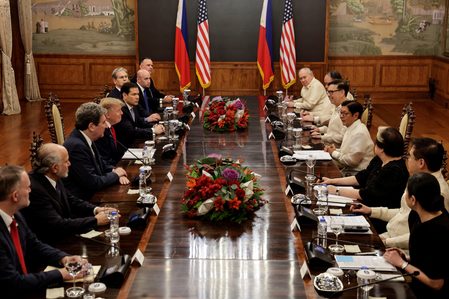
On Wednesday, Philippine President Ferdinand Marcos Jr. announced to a gathering of Asian leaders in Manila that he had ordered fried chicken from the famed Filipino chain Jollibee for Trump and his delegation as a late-night snack.
Must Read

‘Taste of Manila’: Marcos sends Trump, team late-night Jollibee snack


‘Taste of Manila’: Marcos sends Trump, team late-night Jollibee snack

Marcos boasted that Jollibee is so popular that “we are very proud to say that we have surpassed KFC in the United States in terms of popularity.”

“Oh wow, fantastic,” said Trump, who has been known to dip into buckets of the US chain’s fried poultry.

It was unclear whether he ate any of the Jollibee delivery.

A quick hello with a longtime friend

Trump’s Manila visit included a reunion with Imelda Marcos, the 97-year-old former first lady whose husband, Ferdinand Marcos, governed the Philippines for 21 years before being driven from power in 1986. Her vast collection of jewels and more than 1,000 pairs of shoes became a symbol of the family’s excess during his autocratic rule.

Now the Marcos family is back in power with her son, known widely as Bongbong, serving as president.

Sitting in a wheelchair, Imelda Marcos blew Trump a kiss during their brief encounter, shared in a video posted on social media by a White House aide. “Have a good time, okay?” Trump told her.

The two go back decades. Trump met the former first lady at a New York party when he was a rising real estate developer and recalled his long history with the family earlier in the trip.

“I just don’t want to date myself, but I knew your parents very well, and they were great,” Trump told Marcos Jr. in a speech on Tuesday night. “I believe in genetics, and they did a good job. You have very good genetics. I can tell you that.”

Deals now, details later

Trump has repeatedly used his Asia trip to declare economic victories, an important message for a president whose tariff policies have faced criticism at home over their effect on prices and whose Republican Party suffered major losses in the November midterm elections.

Eager to show he is making progress, Trump twice on the trip has announced what he portrayed as significant trade breakthroughs, with Thailand and the Philippines.

“This is an incredible victory,” Trump said of the Thai agreement.

The details, however, are not completely sorted.

A White House statement on the Thai deal said the two governments had reached a “substantial conclusion” and that final work toward an agreement would now be made. Trump said under the pending deal, Thailand will eliminate all tariffs on US exports and remove substantial non-tariff barriers.

Trump called the Philippines agreement a landmark deal that would benefit US farmers and the energy sector, though he provided no specific terms, figures or timeline. Manila said the two countries had reached only an understanding on economic cooperation.

Trump X factor

For all the anticipation leading up to Thursday’s three-way summit, expectations for a major breakthrough are low.

Trump, Xi and Putin are coming to the table with different priorities. The Chinese leader wants to focus generally on world peace, Putin is looking for an off-ramp out of the war in Ukraine on favorable terms and Trump would like to limit nuclear weapons.

The meeting is expected to be highly choreographed, with access tightly controlled. But at such a high-profile gathering, there is a certain degree of unpredictability about what Trump might do when the cameras are rolling.

Ukrainian and European leaders are nervous that Trump might try to strike a deal with Putin on Ukraine. Taiwan is worried about any move by the leaders that could encourage China to put more pressure on the self-ruled island.

The summit may be scripted. Trump often isn’t.

Stay tuned. – Rappler.com

Similar Posts

  • | |

    US and UK plan high level meeting in London on Str…

    The United States and the United Kingdom are reportedly planning a high-level meeting in London next week to discuss the future of the Strait of Hormuz, according to a report by Axios cited by Al Jazeera. The meeting is expected to include talks on the possible establishment of a coalition naval force to protect ships in the strategic waterway, diplomatic sources told the website. High-level European, American, and Arab officials, including defence ministers and military commanders, may participate in the meeting, which comes amid a spate of attacks in the Strait of Hormuz and the renewed conflict between the US and Iran. The strait, through which approximately 20% of global oil supplies pass, has been a flashpoint in the escalating tensions, with Iran launching attacks on commercial shipping and the US conducting strikes to keep the waterway open. The proposed coalition naval force would aim to ensure the safety of maritime traffic in the region, which has been disrupted by attacks on tankers and other vessels. The US has already enforced a naval blockade in the strait, while Iran has targeted ships that violated its rules on navigating the waterway. The situation has raised concerns about global energy supplies and the potential for a wider conflict. The meeting in London reflects the growing international concern over the instability in the region and the need for a coordinated response. The UK, a key US ally, has been actively involved in efforts to de-escalate tensions and protect shipping lanes. The potential involvement of Arab officials highlights the regional dimensions of the crisis, with Gulf states directly affected by the disruptions. The establishment of a coalition naval force would be a significant step in ensuring the safety of maritime traffic in the Strait of Hormuz and the broader Gulf region. However, the success of such an initiative would depend on the cooperation of all parties involved, including Iran, which has insisted on maintaining control over the strait. The meeting in London is expected to explore options for addressing the crisis, including diplomatic and military measures. As the situation continues to evolve, the international community remains focused on finding a resolution to the conflict. The meeting in London represents a crucial opportunity for key stakeholders to coordinate their efforts and develop a strategy to ensure the security of the Strait of Hormuz. The outcome of the discussions could have significant implications for global energy markets and regional stability. The world will be watching closely as the high-level meeting approaches, hoping for a diplomatic breakthrough that can de-escalate tensions and restore stability to the region. The coming days will be critical in determining whether the international community can unite to address the challenges posed by the conflict and protect the vital shipping lanes that are essential to global trade and energy security.

  • | | |

    Iran warns tankers over Strait of Hormuz passage

    Iran’s Islamic Revolutionary Guard Corps (IRGC) has claimed that one of three oil tankers caught fire after an explosion while attempting to navigate a route reportedly surrounded by naval mines south of the Strait of Hormuz. According to the IRGC, the other two tankers turned back and abandoned their attempt to continue through the area. The Iranian force said the incident occurred amid heightened tensions in the strategically important waterway, which serves as a major route for global energy shipments. The IRGC maintains that Iran controls the Strait of Hormuz and has closed the passage completely in response to what it describes as increased US military activity in the region. The IRGC also issued a warning to commercial vessels, saying that no tanker would receive permission to enter or pass through the strait without Iran’s approval. The statement signals a further escalation in tensions surrounding one of the world’s most important oil transit routes. The Strait of Hormuz connects the Persian Gulf with the Gulf of Oman and remains a crucial corridor for international energy supplies. Any disruption to shipping through the waterway could affect global oil markets and raise concerns over the security of maritime trade. The reported tanker incident and Iran’s warning come as regional tensions remain high, increasing uncertainty for shipping companies and energy markets operating in and around the Gulf.

  • | | | |

    Iraq demands proof over Saudi attack claims

    BAGHDAD: Iraq has rejected allegations that its territory was used to launch attacks against Saudi Arabia and has called for evidence to support the claims. A spokesperson for the Commander-in-Chief of the Iraqi Armed Forces said no country or organisation had presented proof that attacks on Saudi Arabia originated from Iraqi soil. The spokesperson said Iraq remained committed to protecting its sovereignty and preventing its territory from being used to threaten neighbouring countries. He added that the government was implementing measures to strengthen national security and maintain full control over the country’s borders and military activities. The statement came after reports linked Iraq to attacks on Saudi Arabia, increasing tensions in an already volatile region. Following recent US and Saudi military strikes inside Iraq, the Iraqi National Security Council convened an emergency meeting to assess the security situation. During the meeting, the council condemned the attacks and described them as a violation of Iraq’s sovereignty. Officials stressed that all hostile actions carried out on Iraqi territory were unacceptable. The council said the Iraqi government alone has the authority to decide how to respond to any attacks launched from within the country. It warned against any unilateral military action that could further destabilise the region. The office of Iraqi Prime Minister also issued a statement reaffirming Baghdad’s policy of keeping Iraq out of regional conflicts. The statement said the government would continue to pursue diplomatic and legal measures to protect the country’s sovereignty, security and political stability. The latest developments follow joint US and Saudi air strikes targeting locations believed to be used by Iran-backed militias in Iraq. The strikes were reportedly carried out in response to drone attacks on Saudi oil facilities. According to the Popular Mobilisation Forces (PMF), the attacks targeted its headquarters and facilities across seven Iraqi provinces. The group said at least 20 of its personnel were killed, while another 32 were injured in the air strikes. It added that the heaviest attack took place in Nineveh province, where 10 fighters lost their lives. The military action has further raised concerns about growing instability in the region and the possibility of wider confrontation involving regional and international powers.

Leave a Reply

Your email address will not be published. Required fields are marked *