trump put thousands
|

Trump put thousands of soldiers on Washington’s streets. They seldom stop crime  

WASHINGTON, USA – Well past midnight one day this spring, three police officers pulled up to a nightclub where a man was stomping on a young woman lying on the sidewalk.

The officers stopped the attack and arrested him, according to a police report. It was the kind of assault police might encounter on almost any night in almost any city.

But one detail stood out to police officer Xavier Jimenez, who wrote the report: “There was approximately 15 national guard members in the area on routine patrol who did not take any action.”

President  Donald Trump deployed thousands of National Guard troops to Washington last summer as the centerpiece of what he describes as a no-holds-barred effort to combat crime, especially in cities run by Democrats. Every day, small clots of soldiers in camouflage and body armor patrol tourist-heavy areas of the US capital, including national monuments, subway stations and the area around its professional baseball park.

What the soldiers seldom do, Reuters found, is fight crime.

Since their arrival last August, the National Guard soldiers Trump ordered to Washington have been mentioned in only a tiny fraction — about 1.3% — of the criminal cases filed in the Superior Court of the District of Columbia, which handles nearly all the city’s criminal prosecutions. In dozens of cases, the soldiers appear not as people making the arrests but as victims of crime.

The roughly 4,500 soldiers currently deployed to Washington outnumber its 3,200 police officers. And they cost more: The Trump administration last year told Congress that sending guardsmen to the capital cost about $1.65 million a day — before officials doubled the number of troops this summer. The city’s most recent police budget was about $1.5 million daily.

The administration told Congress it plans to keep sending soldiers to Washington — though it has not said how many — until the end of Trump’s presidency in 2029 at a cost of $1.4 billion.

To gauge the impact of that deployment, Reuters reviewed every publicly available charging document filed in Superior Court and interviewed lawyers, residents, service members and others who are familiar with their work.

The soldiers mostly responded to minor incidents in neighborhoods that are wealthier, whiter and less dangerous than the rest of the capital, Reuters found after comparing court records to the city’s demographics and crime information. Reuters could find no reference in court records to soldiers doing any kind of law enforcement in the neighborhoods where about 82% of the city’s 859 murders occurred over the past five years.

The White House did not respond to questions about soldiers’ work. Spokeswoman Lauren Bis said Trump’s efforts in the city have “driven down crime, beautified the city, and improved quality of life for countless individuals.”

DC Mayor Muriel Bowser, who has called the deployment “problematic,” declined to comment, as did the city’s police department.

The National Guard taskforce managing the Washington deployment did not respond to questions about its work or its cost. A spokeswoman, Leona Hendrickson, said soldiers were too busy to be interviewed.

Although soldiers have sometimes broken up fights or assaults, many of the crimes for which they detained people have been minor. In October, soldiers chased down a man who had taken two slices of pizza and offered $2 as partial payment, according to police records. A week later, they stopped a man who threw a rock at a bus. In April, they detained a man who allegedly stole two beef jerky sticks worth about $7 from a pharmacy, according to the report. Last month, six soldiers held a woman who drank a bottle of root beer without paying.

The Rev. William Young, who lives in the Navy Yard neighborhood where soldiers patrol frequently, laughed when asked whether the troops made him feel safer. “It’s a way of keeping fear in all of us,” he said. “This is not how a capital of democracy should be protected, by having soldiers marching to protect the streets.”

‘They could have done more’

Reuters found 217 criminal cases in Washington in which police mentioned the involvement of the National Guard. In about a quarter of them, 62 cases, soldiers single-handedly stopped people suspected of a crime, often for things like shoplifting or jumping turnstiles to avoid paying subway fare. In another 43 cases, soldiers helped police officers arrest someone.

Videos obtained by community groups also show troops in groups of 20 or more stationed outside subway stations at night, blocking teens from descending the escalators to enforce a city curfew.

“It’s like they brought people here from all across the country, just to be here. And they harass people a lot more than they are actually doing police work,” said the Rev. Norman Nixon, the pastor of the Union Temple Baptist Church.

Although the guardsmen have been deputized as US Marshals, according to government records, they have limited law-enforcement power. The Defense Department has described their work as “presence patrols,” a show of force meant to deter crime rather than respond to it. They can detain suspects, but then must call police officers to make a formal arrest.

Court records describe 35 instances in which the troops were witnesses to crimes, sometimes simply watching until police officers arrived. They have told officers about a drug deal, a man urinating in public, another who exposed himself to a subway policeman and two men writing with chalk on a monument outside the city’s train station, one of them wearing a banana costume.

Evelyn Jones said she wonders whether soldiers could have saved her nephew, Keon Jones, who was stabbed to death in April near a trendy strip of hotels and restaurants on the city’s waterfront.

The soldiers called emergency services after finding Jones unresponsive after a fight. They later told police they thought Jones was merely intoxicated. They did not realize, until after officers reached the scene, that he had been stabbed so severely his intestines were spilling out. He died in hospital about two hours later.

“They could have done more to help him,” his aunt said.

The service members themselves have often been victims, a fact underscored last year when two soldiers from West Virginia were shot not far from the White House, killing one of them.

Reuters found 62 cases in which people were charged with pushing, punching or threatening soldiers. Nine were accused of spitting on the soldiers. One man allegedly tried to grab a soldier’s pistol as the soldier tried to arrest him for stealing baseball caps in a subway station. Another man was charged after he told a group of soldiers that he wanted to “shoot you, in between your balls, with a bazooka,” according to a police report.

And twice, police in Washington arrested off-duty soldiers for violating the city’s firearms laws, though the US Attorney’s Office dropped the charges against both of them.

This summer, they took on a new mission: guarding the Lincoln Memorial Reflecting Pool, which the Trump administration spent millions of dollars to renovate only to see it turn green with algae as its liner peeled away. Trump claimed the pool was sabotaged by vandals. But U.S. Attorney for the District of Columbia Jeanine Pirro eventually conceded that a government contractor “botched” the job.

Patroling safer neighborhoods

The US has long used National Guard soldiers to respond to disasters, help secure major events like the Super Bowl and occasionally quell riots, but they haven’t been used for everyday crime-fighting. Trump also authorized smaller deployments in Memphis and New Orleans and has mused about sending soldiers to other cities.

“You do not want armed soldiers on the streets of America,” said Gen. Randy Manner, who retired in 2012 as the second-in-command of the National Guard Bureau. He said soldiers are ill-prepared for police work and more expensive than hiring more police officers.

Determining the soldiers’ impact on crime in Washington is not straightforward. In addition to the soldiers, the Trump administration sent hundreds of extra federal agents into the city, who largely functioned as local police officers.

The number of murders in Washington fell for the third consecutive year. But homicide numbers also dropped in cities where the government has not sent soldiers or additional federal agents. And the total number of violent crimes — serious assaults, robberies and sex offenses in addition to homicides — reported by city police between January and mid-August is marginally higher than last year, about 4%.

A study in May by the nonpartisan Niskanen Center found that sending soldiers into Washington led to fewer stolen cars but had no impact on violent crimes.

Charles Stimson, a senior fellow at the pro-Trump Heritage Foundation, said the soldiers’ visibility served as a deterrent. “When you’re speeding and you see a cop, you slow down,” he said. “If those National Guard went poof and left town tomorrow, crime would go up.”

The Reuters review of court records found little evidence of soldiers’ presence in high-crime neighborhoods where they might have responded to more serious crimes.

Instead, the court records show soldiers were more likely to be mentioned in arrest records in city neighborhoods that have higher incomes, in which more people have college degrees, and where more people are white. Most of the arrests in which soldiers participated were either near the city’s core or its subway stops.

Reuters used the location of incidents in court records to identify the areas in which soldiers were either assisting the police or seeking help from them, then compared those neighborhoods to the rest of the city. That does not account for places soldiers might have been sent if they did not interact with law enforcement there. But it suggests that their presence was not aimed at quelling the violent crime that had ravaged parts of the city in the past.

Salim Adofo, an outreach coordinator with the Anacostia Coordinating Council, a nonprofit operating in a low-income part of the city, said that matched his experience.

“I haven’t seen them all year,” he said. – Rappler.com
Similar Posts

  • | |

    Hurricane Lala triggers flash flooding across Hawa…

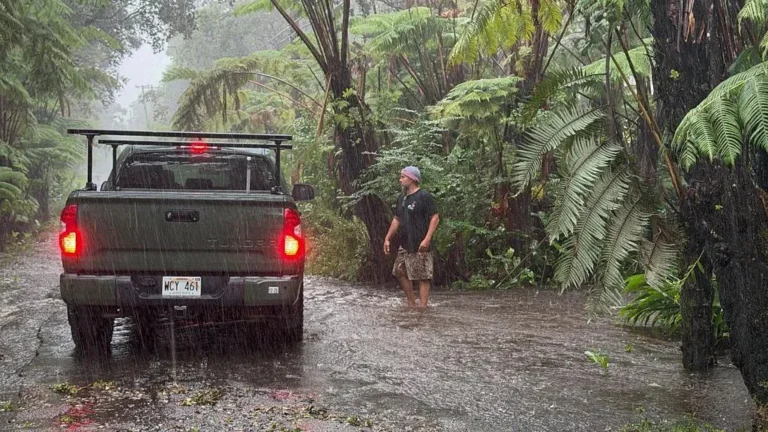
    Hawaii is grappling with widespread flash flooding after Hurricane Lala skirted the Big Island as a category one storm, bringing powerful winds and heavy rain that officials say may have swept some homes off their foundations. Tens of thousands of properties across the islands have lost power, and officials have urged residents to brace for life threatening conditions, including mudslides, as the storm continues tracking westward south of Hawaii. Lala strengthened into a hurricane on Saturday, with wind speeds reaching a peak of 91 miles per hour, or 147 kilometers per hour, and forecasters say the storm could dump as much as 35 inches, or 89 centimeters, of rain in some areas. Hawaii Governor Josh Green said Saturday that one person died in a weather related car accident on Big Island, where numerous roads have been affected by the storm. Hawaii County officials said that as of 1:00 a.m. local time Sunday, two areas on Big Island had experienced flash flooding, warning that several occupied homes may have been swept off their foundations. Big Island Mayor Kimo Alameda said the county’s civil defense agency launched a search and rescue operation to locate residents whose homes may have been carried away by floodwaters. He described the rescue effort as especially difficult given the combination of rushing water, debris, boulders blocking roads and darkness. Footage released by Hawaii’s Department of Transportation shows roads submerged under fast moving water and blocked by fallen trees. Green urged residents to prepare for what he called an incredible amount of water and pleaded with people to stay off the roads during the storm, delivering the warning in a video posted to social media. The governor said 190 flights have been postponed as a result of the storm. At Ellison Onizuka Kona International Airport, Big Island’s largest airport, 40 percent of flights were grounded Saturday according to flight tracking service FlightAware, while roughly 80 percent of flights were canceled at Hilo International, the island’s other major airport. The National Weather Service issued its most severe warnings for areas in Big Island’s southeast, the region that came closest to the hurricane’s center, saying major rainfall flooding could prompt widespread evacuations and rescues as rivers and tributaries rapidly overflow their banks in multiple locations. Nearly 115,000 customers had lost power across Hawaii as of Sunday morning local time, according to the tracking service PowerOutage. Green said three hospitals also lost electricity but continued operating on backup generators. In Maui, some residents have been without water service since Saturday afternoon. A county statement said crews who responded to assess the situation were forced to turn back due to worsening weather and multiple downed trees, adding that repair work would resume once conditions allow safe access. Meteorologist Jennifer Myers, who lives in Hilo on Big Island’s eastern coast, said landslides have already cut off some roads while falling trees have torn down power lines in the area. Describing the view from her apartment overlooking the Wailuku River where it meets Hilo Bay, she said the water level had risen dramatically and that the bay, normally blue, had turned a deep red from sediment and runoff pouring into it. The hurricane ultimately did not make landfall on Big Island as some forecasts had suggested was possible, instead passing within 30 miles, or 48 kilometers, of the island’s South Point. Tropical storm warnings remain in effect across all eight of Hawaii’s major islands, including Big Island, Maui, Molokai, Kahoolawe, Oahu, Lanai, Kauai and Niihau. Big Island had previously been under a full hurricane warning. The National Hurricane Center said damaging winds and heavy rain will continue across Big Island overnight before spreading westward to the smaller islands on Sunday. Officials had repeatedly urged residents to prepare ahead of the storm’s arrival. Social media posts from local community groups showed residents filling sandbags to protect their homes and asking about store hours in the early hours of Saturday. Hawaii County’s Civil Defense Agency said public shelters remain open across every district on Big Island.

  • |

    Israel’s influence in Washington weakens under Trump says former envoy

    Former Israeli ambassador to the United States Mike Herzog has said Israel’s ability to influence decisions in Washington has declined significantly during President Donald Trump’s current administration. He also warned that support for Israel among the American public has been steadily weakening, creating long term challenges for the country’s relationship with its closest ally. Speaking in an interview with Israeli radio station 103FM, Herzog said the close personal bond that once existed between Israeli Prime Minister Benjamin Netanyahu and Trump no longer appears as strong as before. While Netanyahu recently described his latest meeting with Trump at the White House as one of their best meetings, Herzog argued that the event should be viewed more carefully. In his opinion, the meeting lacked the warmth and personal interaction that previously defined the relationship between the two leaders. Herzog said one positive outcome for Netanyahu was that Trump avoided publicly criticising Israel or placing any visible demands on the Israeli government during the meeting. He suggested that this helped Netanyahu present the visit as a diplomatic success, particularly as Israel moves closer to national elections. According to Herzog, the prime minister had a political interest in showing that his ties with Trump remain strong despite growing speculation that relations between the two leaders have cooled. The former ambassador also pointed to several details surrounding the visit that, in his view, reflected a more distant relationship. Netanyahu entered the White House through a side entrance instead of receiving a more prominent arrival. There was no private one on one meeting between the leaders and media attention surrounding the visit remained limited. Herzog said these diplomatic signals suggested the White House wanted to avoid creating the impression that Trump was closely aligned with Netanyahu. He linked this cautious approach to political concerns in the United States following the conflict with Iran. Herzog said many Americans believe Israel played a major role in drawing the United States into the confrontation. Since the conflict has been unpopular with parts of the American public, he believes Trump is careful not to appear as though he acted under pressure from the Israeli leadership. Even so, Herzog said there are currently no major disagreements between Washington and Tel Aviv over Iran, although the relationship is no longer as close as it once was. Beyond the immediate political situation, Herzog warned that Israel’s overall standing in the United States has suffered lasting damage. He said changes in American society, political shifts, economic developments, international campaigns against Israel and policy decisions made by successive Israeli governments have all contributed to a steady decline in public support. He also acknowledged that the actions of Israel’s current government and the ongoing military campaign in Gaza have negatively affected how many Americans view the country. Netanyahu himself recently admitted that support for Israel has weakened in the United States, arguing that social media has played a major role in shaping public opinion. His comments came as recent polling showed a noticeable increase in negative attitudes toward both the Israeli government and the Israeli people. A survey conducted by the Pew Research Center found that public opinion has shifted over the past several years. The percentage of Americans holding unfavourable views of the Israeli people rose from 28 percent in 2019 to 42 percent in 2026. During the same period, favourable views of the Israeli government fell from 41 percent to 32 percent. International criticism of Israel has also intensified since the war in Gaza began in October 2023. In November 2024, the International Criminal Court issued arrest warrants for Prime Minister Netanyahu and former Defence Minister Yoav Gallant on allegations of war crimes and crimes against humanity linked to Israel’s military operations in Gaza. According to reported figures, more than 73,000 people have been killed during the conflict, which has continued despite a truce agreement reached in October 2025.

  • |

    High Commissioner Tipu Usman unveils people-centred consular reforms for British Pakistanis

    LONDON:Pakistan’s High Commissioner to the United Kingdom, Tipu Usman, has announced a series of people-centred reforms aimed at improving consular services for the British Pakistani community. As part of the new measures, consular services at the Pakistan High Commission in London will now begin at 8:00 am, Monday to Friday, increasing the number of appointments available each day and helping reduce waiting times. The High Commission has also introduced a daily walk-in facility from 3:00 pm to 4:00 pm, Monday to Friday, on a first-come, first-served basis. The service will cover passport issuance and renewal, NADRA-related services, document attestation, including Powers of Attorney, and Police Character Certificates. The reforms are among the first major public service initiatives introduced by High Commissioner Tipu Usman since assuming office. They are aimed at making consular services more accessible, efficient and responsive to the needs of overseas Pakistanis living in London and surrounding areas. Members of the British Pakistani community have welcomed the initiative, describing it as a practical step that will ease access to essential consular services and improve the overall public service experience at the Pakistan High Commission in London.

  • |

    Ancient Roman shipwreck found off Sicily carrying hundreds of 2,000-year-old amphorae

    Italian authorities have uncovered an ancient Roman merchant ship off the coast of Sicily, dating back to the 2nd or 1st Century BC. The vessel was discovered lying 46 metres underwater roughly three nautical miles off Mazara del Vallo. Measuring 21 metres long and 6 metres wide, the vessel’s cargo holds remain piled with hundreds of well-preserved amphorae, primarily Dressel 1A ceramic jars used during the late Roman Republic to transport commodities such as wine, olive oil, and grain. Italian Culture Minister Alessandro Giuli described the site as “one of the most important underwater archaeological discoveries of recent years”. Local fisherman and free-diver Giacomo De Mola first flagged the site after detecting an anomaly on his sonar scanner that resembled a massive reef or rock. Upon diving down to investigate, he encountered the intact cargo mound surrounded by marine life. Following De Mola’s report, specialist divers from the Carabinieri Command for the Protection of Cultural Heritage (Carabinieri Art Squad), working alongside the Sicilian Region’s Superintendency of the Sea, were dispatched to survey and document the seabed. Archaeologists also identified two lead anchor stocks alongside the vessel’s structure. Italian maritime authorities have implemented security measures to safeguard the wreckage from illicit looting while further documentation and cargo analysis take place.

  • | | |

    Trump crypto firm backs venture offering AI from restricted Chinese companies

    A review finds 43 of the 90 models available through WorldClaw’s website were developed by Alibaba, Baidu, Z.ai, and other Chinese tech companies the Trump administration says pose risks to national security and intellectual property

  • |

    Guatemalan emergency services initiate community evacuations following eruption of Fuego volcano

    Guatemalan disaster management authorities ordered the preventive evacuation of settlements surrounding the Fuego volcano after the geological structure entered a paroxysmal eruptive phase, sending plumes of volcanic ash and pyroclastic density currents down its flanks. The National Coordinator for Disaster Reduction (CONRED) issued a nationwide institutional orange alert, while escalating departmental warnings to red across Sacatepéquez, Chimaltenango, and Escuintla. Emergency personnel coordinated the relocation of over 1,700 residents from high-risk communities, including El Porvenir and Las Lajitas in the San Juan Alotenango municipality. Monitoring reports from the National Institute of Seismology, Volcanology, Meteorology and Hydrology (INSIVUMEH) confirmed that high-temperature pyroclastic flows, composed of volcanic gases, ash, and incandescent rock, descended across five major ravines. Officials warned that dispersed ash clouds could affect municipalities up to 130 kilometres west and northwest of the crater. In response, regional transport authorities temporarily closed National Route 14 to civilian traffic, while the Ministry of Education suspended in-person schooling across nearby districts.

Leave a Reply

Your email address will not be published. Required fields are marked *