trump tells rally
| |

Trump tells rally protester: ‘Your mom won’t b…

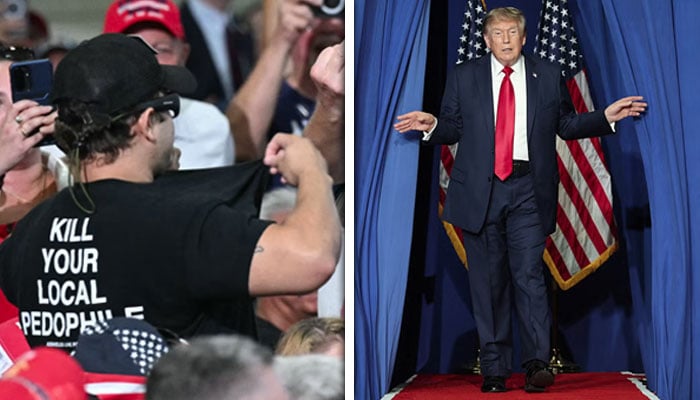
US President Donald Trump made a pointed remark about a protester who interrupted his campaign rally in South Carolina, telling the man that his mother would not be pleased with his actions.

Trump was speaking at the Myrtle Beach Convention Center while campaigning for Darlene Graham, a candidate seeking a seat in the South Carolina Senate. Although Trump’s name was not on the ballot, he urged his supporters to turn out and vote in the election.

According to US media reports, the disruption occurred at around 7:28 p.m. on Friday when a man stood up and interrupted the president’s remarks. Police officers and convention center staff subsequently moved the protester out of the venue.

As the man was being escorted away, Trump briefly paused his speech and commented on the incident. He suggested that the protester would face criticism from his mother, adding that she supported Trump politically.

The president then resumed his address as the protester was taken outside the convention center.

US media reported that the demonstrator was wearing a black shirt carrying a provocative slogan condemning sexual abuse of children.

Similar Posts

  • | |

    Supreme Court upholds death sentence in woman’s …

    The Supreme Court has issued a landmark ruling concerning women’s rights, declaring that a woman’s right to seek khula (judicial divorce) is a constitutional right and that violence against a woman exercising this right amounts to an attack on the Constitution. A three-member bench of the Supreme Court dismissed the jail petition filed by convict Waseem Abbas and upheld his death sentence. Justice Muhammad Hashim Khan Kakar authored the four-page detailed judgment. According to the judgment, women are fully protected under Articles 9, 14 and 25 of the Constitution, which guarantee their security, dignity and equal rights. The court said that anyone who uses violence against a woman seeking khula would face the full force of the law. It observed that killing a woman for exercising her legal right is an act of brutality and open defiance of the law. The Supreme Court further ruled that a convict involved in a cold-blooded and planned murder does not deserve any concession. The judgment also clarified that the testimony of relatives cannot automatically be rejected in cases involving crimes committed within the privacy of a home. The court said forensic evidence recovered from the crime scene provided conclusive evidence against the accused. The forensic examination established a match between the recovered bullet casings and the pistol linked to the crime. The Supreme Court found no legal or factual flaw in the decisions of the lower courts and upheld the death sentence awarded to Waseem Abbas. According to the case record, Waseem Abbas shot and killed his former wife, Shehnaz Bibi, on October 11, 2020. She had obtained a legal khula decree from a family court before the incident. The convict allegedly entered the woman’s home and killed her around 48 hours after she obtained the decree. A trial court subsequently sentenced Abbas to death and awarded him 10 years in prison. The Lahore High Court later upheld the death sentence.

  • |

    Booker calls for diplomacy, says Pakistan can help promote Middle East peace

    Democratic US Senator Cory Booker has called for diplomacy and dialogue instead of military action, saying the United States needs diplomacy, not bombs, to address conflicts in the Middle East. Speaking at a Pakistan Independence Day event in New York, Booker said Pakistan was in a strong position to play a constructive role in promoting peace across the Middle East. He stressed that dialogue should take precedence over war and urged greater diplomatic efforts to resolve ongoing conflicts. Booker also highlighted the humanitarian consequences of conflicts in the region, saying every human being deserves dignity and respect. He said children in Palestine and Iran deserve the same consideration and protection as American children. “When a humanitarian tragedy is unfolding, none of us should remain silent,” Booker said, emphasizing the need to continue raising voices for a just and lasting peace in Palestine and Iran. The senator also praised the role of Pakistani Americans in strengthening ties between the United States and Pakistan. Referring to the efforts of the American Pakistani Public Affairs Committee (APPAC), he said the organization had worked to bridge communities and ensure that Pakistani Americans receive their rightful place and representation at the local level. Discussing bilateral relations, Booker said the friendship between the United States and Pakistan began soon after Pakistan’s independence and has continued to develop over the decades. He noted that Pakistani Americans have made significant contributions in a wide range of fields, including medicine, engineering, public service and business. He said the success of Pakistani Americans also contributes to the strength and prosperity of the United States, stressing the importance of ensuring that the community has a strong and influential voice in American society. Booker further spoke out against discrimination and Islamophobia, saying that when a Muslim faces prejudice in the United States, it is not only a problem for the individual or the Muslim community but a problem for the entire country. He recalled his efforts to combat anti-Muslim hatred and said he had introduced legislation aimed at addressing Islamophobia and protecting Muslims from discrimination. The senator’s remarks came as Pakistani Americans gathered in New York to mark Pakistan’s Independence Day and celebrate the community’s contributions to American society. The event, organized by APPAC, brought together senior officials, community leaders and prominent Pakistani Americans. APPAC Chairman Dr. Ijaz Ahmad and other speakers also addressed the gathering, highlighting the role of the Pakistani-American community in strengthening people-to-people ties and promoting closer relations between Pakistan and the United States. The event also underscored the growing role of Pakistani Americans in civic and public affairs, with speakers calling for greater representation and continued engagement between the two countries.

  • | | |

    Military rejects talks with terrorists, vows conti…

    Pakistan’s military has categorically ruled out any future negotiations with terrorist groups, declaring that security forces will continue operations until militancy is eliminated. The announcement was made by Director General of Inter-Services Public Relations (ISPR), Lieutenant General Ahmed Sharif Chaudhry, during a detailed media briefing on the country’s security situation and ongoing counterterrorism campaign. The military spokesperson said there was no possibility of holding talks with terrorists. He stressed that the state would not negotiate with those involved in violence against Pakistan. According to him, terrorists have only two choices: surrender before the law or face decisive action by the country’s security forces. Lt Gen Chaudhry said the armed forces would continue to engage directly with the people of Balochistan instead of individuals or groups involved in violence. He emphasized that the people of the province are the true stakeholders and that the military remains committed to protecting their lives and supporting their development. He also criticized certain influential elites and tribal leaders, claiming they had failed to promote the welfare of ordinary people. According to him, some powerful groups do not want children from poor families to progress through education and development. The military spokesperson further alleged that the Taliban administration in Afghanistan was providing support to terrorist groups carrying out attacks inside Pakistan. He said cross-border militancy remains one of the country’s major security challenges and continues to complicate efforts to maintain peace. Rejecting claims that the security situation in Balochistan is rapidly deteriorating, Lt Gen Chaudhry said a coordinated propaganda campaign was being carried out to create a false impression about conditions in the province. He maintained that while security challenges exist, the state is actively responding through intelligence-based operations and law enforcement measures. Speaking about Balochistan, he said the province’s unique geography presents operational challenges. Its vast territory, scattered population, and long distances between security posts require extensive coordination and resources. He added that security forces are dealing not only with terrorism but also with organized criminal activities, including drug trafficking, fuel smuggling, robbery, and other illegal networks that threaten stability. Addressing the issue of missing persons, the military spokesperson said the relevant commission had received hundreds of complaints. However, he noted that investigations had revealed that some individuals listed as missing were later found to have been killed during security operations, while others had joined militant organizations and were living in terrorist camps. Lt Gen Chaudhry presented detailed statistics on the country’s counterterrorism campaign. He said security forces have carried out 40,348 intelligence-based operations across Pakistan during the current year. These operations resulted in the killing of 2,084 confirmed terrorists, averaging approximately 10 militants eliminated every day. He added that security forces conduct nearly 194 operations daily as part of ongoing efforts to dismantle militant networks. Khyber Pakhtunkhwa remained the main focus of these operations, with 1,971 intelligence-based missions conducted in the province alone. The military also shared figures regarding casualties suffered during the ongoing campaign. According to Lt Gen Chaudhry, 819 people embraced martyrdom during the year. These included 303 personnel of the Pakistan Army, 194 members of law enforcement agencies, and 322 civilians who lost their lives in terrorist attacks and security-related incidents. The ISPR chief further revealed that 28 suicide attacks had been recorded across Pakistan during the current year. He claimed Afghan nationals were involved in the recent suicide attacks in Tank and Karachi, describing the incidents as evidence of continued cross-border terrorist involvement. Highlighting the importance of national unity, Lt Gen Chaudhry said Pakistan’s Constitution and legal system apply equally to every citizen. He stressed that loyalty to the state is a fundamental responsibility and said national peace, political stability, and economic development depend on a strong and secure Pakistan.

  • | |

    JI announces nationwide shutter-down strike after …

    Jamaat-e-Islami (JI) Emir Hafiz Naeemur Rehman has announced a nationwide shutter-down strike after 12th Rabi-ul-Awwal, as the party continues its protests against rising petroleum prices and the government’s petroleum levy. Speaking at a press conference in Lahore on Sunday, Hafiz Naeem said the JI’s sit-ins in provincial capitals had entered their eighth day and would continue until the government practically implemented the party’s demands. He rejected the idea of ending the protests solely on the basis of government assurances, saying the party wanted concrete action rather than promises. Hafiz Naeem called for a reduction in petroleum product prices and criticised what he described as excessive government expenditure. He also raised concerns over rising prices of essential commodities, saying flour and sugar mafias were making life difficult for ordinary citizens while farmers were struggling with expensive fertiliser. The JI chief said the nationwide shutter-down strike would be launched after Eid Milad-un-Nabi, which falls on August 26 this year. He warned that the party’s protest movement would not be called off until its demands were implemented. According to Hafiz Naeem, negotiations would no longer be based on requests for protesters to end their sit-ins in exchange for verbal commitments. JI workers have been holding demonstrations since August 16. Sit-ins are being staged outside the Punjab chief minister’s residence in Lahore and at governor houses in Karachi, Quetta and Peshawar. The protests come as consumers face growing pressure from fuel costs, inflation and high electricity bills. The government has also faced criticism following repeated increases in petroleum prices. The situation has become more challenging amid fluctuations in international oil prices linked to renewed tensions in the Middle East. Authorities have also moved from a 15-day fuel price review to a daily mechanism. The fuel price issue has triggered separate concerns among transporters and petroleum dealers. Earlier this week, the All Pakistan Goods Transport Alliance suspended a nationwide strike for 40 days after receiving assurances from the federal and Sindh governments regarding several demands, including petroleum pricing. The Pakistan Petroleum Dealers Association has also pressed the government to resolve outstanding issues and honour previous commitments.

  • |

    Electricity tariff may rise by Rs2.50 per unit as July FCA pushes recovery above Rs34bn

    ISLAMABAD: Electricity consumers across Pakistan could face an additional burden of around Rs2.50 per unit as the government moves to recover more than Rs34 billion through the July 2026 monthly Fuel Charges Adjustment (FCA), according to sources. The proposed increase is expected to affect consumers of distribution companies (Discos) as well as K-Electric, with the final adjustment to be determined by the National Electric Power Regulatory Authority (Nepra) after reviewing the relevant power purchase and generation costs. Sources said the expected positive FCA for July has largely been driven by higher electricity consumption during the peak summer season and greater reliance on expensive generation sources. Among the key factors behind the anticipated increase are the use of liquefied natural gas (LNG) procured from the spot market and furnace oil to meet additional electricity requirements, particularly during periods of high demand. June FCA already approved The expected July adjustment comes after Nepra approved a positive FCA of Re0.7503 per unit for electricity consumed in June 2026. The adjustment was lower than the Rs1.20 per unit sought by the Central Power Purchasing Agency-Guaranteed (CPPA-G). Under the FCA mechanism, variations in fuel costs and other electricity generation and purchase-related expenses are passed on to consumers through periodic adjustments. For July, CPPA-G will submit its relevant claims to Nepra, which will examine the costs and determine the admissible adjustment before issuing separate decisions for the respective distribution companies. Multiple costs to be examined The regulator is expected to assess several components included in the FCA claim before determining the final amount recoverable from consumers. Separate adjustments will subsequently be calculated for each Disco after taking into account electricity purchased through CPPA-G, bilateral arrangements with small power producers and captive power producers, as well as electricity supplied under net-metering arrangements. The final impact on consumers could therefore vary depending on the individual power procurement mix and applicable tariff structure of each distribution company. Expensive generation raises concerns The expected tariff increase has emerged at a challenging time for Pakistan’s industrial sector, where electricity prices remain a major concern for manufacturers and exporters. Industrial consumers are already facing pressure from elevated production costs, while exporters are also dealing with uncertainty caused by deteriorating security and economic conditions in the Middle East. The latest FCA discussion has also brought the issue of partial-loading charges under scrutiny. During a recent hearing, Nepra raised questions over approximately Rs4.9 billion in partial-loading costs and asked CPPA-G to explain the reasons behind the additional expenditure and measures being considered to control it. Solar power changes demand pattern CPPA-G told the regulator that the partial-loading charges were not primarily the result of inefficient operation by power plants. Instead, the agency attributed the costs largely to changes in electricity consumption patterns caused by the rapid expansion of rooftop solar generation. According to CPPA-G, daytime demand from the national grid has declined as more consumers generate electricity through rooftop solar systems. Conventional power plants are consequently required to operate below their optimum capacity during solar-generation hours. However, demand rises again in the evening when solar generation falls, forcing grid-connected power plants to increase generation quickly. This change in the daily demand curve has created additional operational costs for the power system. The authority noted that partial-loading charges recorded in June 2026 were around Rs1 billion higher than the corresponding amount in June 2025, highlighting the growing financial impact of the changing electricity demand pattern. Plant shutdowns could increase costs The Independent System and Market Operator (ISMO) also informed the regulator that shutting down power plants during periods of lower demand would not necessarily provide a cheaper solution. According to ISMO, taking plants completely offline to avoid partial-loading charges could result in substantial start-up expenses when the units are required again to meet evening demand. The issue has therefore become increasingly important as the rapid growth of distributed solar generation continues to alter the traditional pattern of electricity consumption. Exporters seek cheaper fuel options Amir Sheikh, a prominent textile exporter, called for the removal of the levy imposed on high-speed diesel and furnace oil-related generation costs, arguing that furnace-oil-based power plants could offer an alternative to expensive RLNG-fired generation under certain circumstances. He maintained that allowing more flexible use of available generation sources could help reduce the overall cost of electricity, particularly during periods when LNG prices remain elevated. Sheikh also proposed a change in the way FCA-related surcharges are calculated. He suggested that the additional charges should be recovered on the basis of projected electricity consumption rather than only through the conventional mechanism, similar to the approach followed under quarterly tariff adjustments (QTA). Falling demand creates another challenge Another concern raised during the discussion was the continuing decline in electricity demand and its possible implications for future tariff adjustments. Rehan Javed highlighted the potential impact of lower electricity consumption on the power sector’s financial structure, particularly as fixed system costs are spread over a smaller volume of electricity sales. The Ministry of Energy’s Power Division, however, said the decline in demand was largely linked to the increasing number of consumers using net-metering facilities. The ministry maintained that although distributed solar generation was changing electricity consumption patterns, its impact on future quarterly tariff adjustments would not necessarily be as severe as feared by industrial consumers. Government seeks to avoid costly LNG purchases The Power Division further explained that electricity demand was being managed in a manner designed to reduce dependence on expensive RLNG spot-market cargoes. Officials said excessive reliance on spot LNG during the summer could significantly increase power generation costs and ultimately translate into higher electricity tariffs for consumers. The government is therefore attempting to balance electricity availability, fuel costs and demand management while dealing with the changing structure of Pakistan’s power market. If Nepra ultimately approves an FCA close to the expected Rs2.50 per unit, consumers could face another substantial increase in their electricity bills. The final adjustment, however, will depend on Nepra’s assessment of CPPA-G’s July claim and the costs deemed

  • | |

    US appeals Court again blocks Trump’s $100,0…

    The Trump administration has suffered another legal setback after a US federal appeals court refused to reinstate a controversial $100,000 fee for H-1B visas, dealing a fresh blow to the administration’s immigration policy. A three-judge panel of the First US Circuit Court of Appeals in Boston ruled that the administration had failed to demonstrate a strong likelihood of success in its appeal or prove that it had acted within its legal authority when imposing the massive fee increase. The decision comes in a lawsuit filed by attorneys general from 20 Democratic-led states, who challenged the legality of the policy soon after it was introduced. The appeals court’s ruling leaves in place an earlier decision issued on June 8, when a lower court declared the $100,000 H-1B visa fee unlawful. That court concluded that Congress had never granted the executive branch the authority to impose a charge of that magnitude, describing it as a tax that exceeded the administration’s legal powers. President Donald Trump introduced the fee increase through an executive order issued last year, arguing that the H-1B visa program had been widely used by companies to replace American workers with lower-paid foreign professionals. The administration maintained that the significantly higher fee would discourage misuse of the program and encourage employers to prioritize hiring US workers. Critics, however, argued that the measure would severely disrupt industries that rely on highly skilled international talent, particularly the technology, healthcare and engineering sectors. Under current immigration rules, the United States issues 65,000 H-1B visas annually, along with an additional 20,000 visas for applicants holding advanced academic degrees from US institutions. The visas are generally granted for periods ranging from three to six years. Before Trump’s proposed increase, employers typically paid between $2,000 and $5,000 in government filing fees for an H-1B visa, depending on the size of the company and other applicable charges. The proposed $100,000 fee would not have applied to foreign nationals already in the United States on student visas who later transitioned to H-1B status. The latest court ruling represents another significant legal obstacle for the Trump administration’s immigration agenda and ensures that the dramatic fee increase will remain suspended while the broader legal battle continues.

Leave a Reply

Your email address will not be published. Required fields are marked *