chief calls curbs
| |

UN chief calls for AI curbs and end to wars in his last assembly address

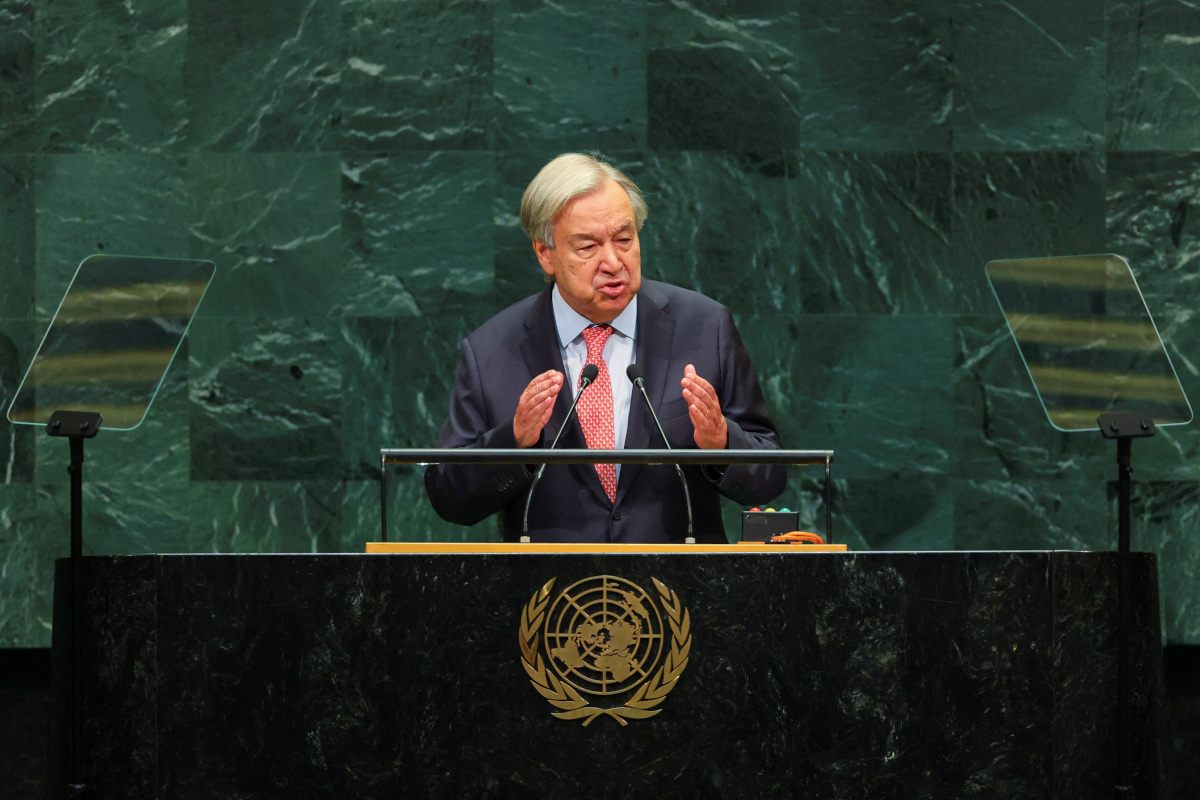
UNITED NATIONS – United Nations Secretary-General Antonio Guterres used his final address to the General Assembly on Tuesday, September 22, to urge world leaders to regulate artificial intelligence, end wars, focus on climate change, and overhaul UN institutions he warned are struggling to confront mounting global challenges.

The former Portuguese prime minister, whose second five-year term ends on December 31, reiterated his calls for global oversight of AI risks, just as the UN’s 15-member Security Council prepares to host AI leaders for a briefing on the powerful technology.

Guterres also reflected on the gridlock within the organization, as nearly 130 world leaders gathered in New York, and Chinese President Xi Jinping and others — including leaders from South Africa, India and Germany — skipped the diplomatic meeting.

Delegates responded with sustained applause when Guterres defended a two-state solution for Israelis and Palestinians, demanded that “polluters must pay” for climate change, and pressed for reforms to international institutions, causes he has championed throughout his decade leading the United Nations.

The address capped a decade-long tenure in which Guterres sought to position the UN as a mediator in conflicts and a forum for governing emerging technologies, even as major powers increasingly bypassed the organization and Washington slashed its funding.

“Those countries leading this technological revolution must share information on emerging safety risks, cooperate on testing and evaluation – and work towards common safeguards that protect us all,” Guterres told the assembly.

He called on the leaders gathered in New York to “advance the conditions for the responsible pacing of AI and the additional safeguards needed to address risks” and to “work towards a multilateral AI risk management framework, supported by credible and independent oversight.”

US Treasury Secretary Scott Bessent said on Sunday that Washington had proposed a new AI safety notification mechanism for US President Donald Trump and Chinese President Xi to consider at their summit this week. The proposal emerged from talks on establishing a US-China AI dialogue and would cover AI-related incidents with national security implications.

A champion for global governance of AI

Guterres has long pushed for global governance of AI. In 2023, the UN created a ‌39-member ⁠advisory body on AI, with members including tech company executives, government officials and academics from countries such as the US, Russia and Japan.

The Security Council, which is charged with maintaining international peace and security, met for the first time on the risks of artificial intelligence the same year, when China said the ​technology should not become a “runaway horse” and Washington warned against its use ​to censor or ⁠repress people.

On the Middle East, where the conflict has widened as Houthi gains along the Red Sea coast threaten shipping routes and tensions persist in the Strait of Hormuz, Guterres called for “de-escalation and dialogue.”

“Together, let’s send a clear message from this hall: The fighting must stop. Humanitarian aid must flow. And navigational rights and freedoms must be fully restored in accordance with international law,” Guterres said.

On the UN system, criticized by Trump and others as bloated and ineffective after Washington withdrew from several UN agencies and slashed funding, Guterres said, “our mechanisms for collective action are under growing strain” and global institutions “continue to reflect the power realities and interests of a largely bygone age.”

Guterres used the address to bid farewell to most of the global leaders he has worked with over the last 10 years.

“So, on January 1st, when I am no longer Secretary-General, be sure of this. Wherever I will be, whatever I will be doing – I will keep championing the conviction that peace is possible,” he said. “I will continue to stand up for the values of the United Nations Charter and I will never, ever give up. Thank you.” – Rappler.com
Similar Posts

  • |

    Trump’s Board of Peace plan draws global attention and criticism

    United States President Donald Trump has announced that his Board of Peace has secured an agreement aimed at the complete disarmament of Hamas and other armed groups in Gaza, along with the gradual withdrawal of Israeli forces from the territory. Trump described the agreement as a historic breakthrough and said it would be carried out in stages, with Israeli troops leaving Gaza as disarmament progresses. The Board of Peace was first proposed by Trump in September last year as part of his plan to end the war in Gaza. He later expanded the initiative, saying it would also work to address conflicts in other parts of the world. The board is intended to coordinate peace efforts and oversee reconstruction projects, a role that has traditionally been led by the United Nations. According to its charter, countries joining the board normally serve three year terms. However, nations that contribute one billion dollars toward its activities are eligible for permanent membership. Trump serves as chairman of the initiative and has broad executive authority, including the power to veto decisions and remove members under certain conditions. The White House named Secretary of State Marco Rubio, special envoy Steve Witkoff, former British Prime Minister Tony Blair and presidential adviser Jared Kushner as members of the board’s founding executive team. More than two dozen countries have joined the initiative. Alongside the United States, members include Israel, Saudi Arabia, Egypt and Qatar, all of which have played important roles in recent Middle East diplomacy. Other participating countries include Bahrain, Jordan, Kuwait, Morocco, Turkey and the United Arab Emirates. Outside the region, Albania, Argentina, Armenia, Azerbaijan, Belarus, Bulgaria, Cambodia, El Salvador, Hungary, Indonesia, Kazakhstan, Kosovo, Mongolia, Pakistan, Paraguay, Uzbekistan and Vietnam have also joined. Several major countries and international partners have declined to participate. Britain, France, Germany, Norway, Sweden and the European Union have all decided not to join the initiative. Brazil, Mexico, India and South Africa have also remained outside the board, while China and Russia have chosen not to participate. The Vatican has argued that responsibility for handling international conflicts should remain with the United Nations. Canada also lost its invitation after a diplomatic disagreement between Trump and Prime Minister Mark Carney earlier this year. The Board of Peace received international recognition after the United Nations Security Council approved a United States drafted resolution acknowledging its temporary role in Gaza. Under the resolution, the board will coordinate funding for reconstruction and oversee a temporary international stabilisation force in Gaza through 2027. It must also report its progress to the Security Council every six months. China and Russia abstained from the vote, saying the resolution did not clearly define the United Nations’ role in Gaza’s future administration. Despite official backing, the initiative has attracted widespread criticism from human rights organisations and political observers. Critics argue that the board resembles a colonial style governing structure because it is designed to supervise Gaza without including Palestinian representatives. They have also questioned the inclusion of Tony Blair because of his role in the Iraq war and criticised the participation of countries with poor human rights records. The decision to include Israel on a body responsible for overseeing Gaza has generated additional controversy. Opponents argue that Israel’s ongoing military campaign has left much of Gaza destroyed and displaced its population. Israel maintains that its military actions were carried out in self defence following the Hamas attack in 2023 that killed around 1,200 people and resulted in more than 250 hostages being taken. Since its launch, the Board of Peace has focused mainly on plans for rebuilding Gaza. Trump said member countries have already pledged around seven billion dollars toward reconstruction, although experts estimate that restoring the territory after more than two years of conflict could cost as much as 70 billion dollars. The board has also reportedly held discussions with international companies on future infrastructure and supply chain projects as planning for Gaza’s recovery continues.

  • | |

    Egypt confirms drone strike behind blaze at two ga…

    A drone strike caused the fire that engulfed two gas vessels at Egypt’s Mediterranean port of Damietta, the Egyptian cabinet confirmed Thursday, ending speculation over whether the blaze that broke out a day earlier was an accident or an attack. No group has claimed responsibility for the strike, which occurred close to the Suez Canal, now serving as the last safe route for Saudi oil shipments reaching global markets. Egyptian authorities said they are continuing their investigation and taking steps to safeguard national security. British maritime security firm Ambrey said Wednesday that a drone had struck a US owned gas storage tanker at the port, an early assessment that raised fears the wider regional conflict could spread further. Three trading sources familiar with the incident said the drone hit the floating storage vessel Energos Winter, sparking a fire that then spread to a second ship, Gaslog Salem. According to maritime risk group Vanguard, the Energos Winter was struck on its starboard side, and the resulting fire was later extinguished. Egypt’s petroleum ministry said firefighting and security teams responded immediately and that the incident caused no injuries or fatalities. Petroleum Minister Karim Badawi traveled to the port to personally oversee the emergency response, according to the ministry. The strike came shortly after Iran launched a missile attack targeting US forces in Jordan, prompting Washington and Saudi Arabia to carry out strikes against Iran backed paramilitary groups in Iraq. President Donald Trump warned of retaliation against Iran, while Yemen’s Houthi movement declared a naval blockade against Saudi Arabia, marking what appears to be the widest expansion of the conflict since the United States and Israel began bombing Iran in February. The Energos Winter is a floating storage and regasification unit owned by the US based firm Energos Infrastructure. Its technical, safety and commercial operations are managed by Wilhelmsen Ship Management, a Singapore based subsidiary of the Norwegian company Wilhelmsen Group. In a first for the five month war, Saudi Arabia publicly joined US forces in striking Iran aligned groups in eastern Iraq on Wednesday, responding to drone attacks on Saudi oil facilities that were launched from Iraqi territory. Following the joint operation, Saudi Arabia’s defense minister met with US Vice President JD Vance in Washington to urge the Trump administration against further escalation, according to two people familiar with the meeting. The conflict began in February when the United States and Israel launched a bombing campaign against Iran that Trump initially said would last only a few weeks. A temporary ceasefire reached in June collapsed amid renewed fighting centered on the Strait of Hormuz, a critical waterway that Iran now claims to control. The latest strikes in Iraq and Egypt threaten to pull additional countries into the conflict, coming after Yemen’s Houthi forces declared a naval blockade on Saudi Arabia last week, putting the alternative Red Sea shipping route for Saudi oil bound for Asia at risk. Attacks on vessels by Houthi fighters have already prompted London’s marine insurance market to expand its high risk zone in the Red Sea to cover a larger stretch of coastline near Saudi ports. Trump said the United States would respond forcefully to Iran’s missile attack on American forces, while maintaining that Washington remains open to a negotiated peace deal to end a war that has unsettled global energy and financial markets. Oil prices jumped more than eight percent on Wednesday before easing slightly on Thursday amid volatile trading, with benchmark Brent crude hovering just under 90 dollars a barrel. Iran said Wednesday that it had struck three tankers attempting to pass through the Strait of Hormuz along what it called an unauthorized route. Even so, a QatarEnergy controlled liquefied natural gas tanker exited the strait overnight, the first such vessel tracked leaving the waterway since July 11. Iran’s semi official Fars news agency reported that Tehran had specifically authorized the tanker’s passage. Oman has presented Iran with a Gulf backed proposal to manage traffic through the Strait of Hormuz, including a system of voluntary usage fees, according to sources familiar with the talks. Iran rejected that proposal on Wednesday, though foreign ministry spokesperson Esmaeil Baghaei said discussions with Oman over the strait’s management are continuing, according to the semi official ILNA news agency. Separately, sources familiar with the matter said Iran is expected to receive its first shipment within weeks of up to 400 Chinese made shoulder fired air defense missile launchers, part of an effort to shore up gaps in its ability to protect military sites and strategic infrastructure exposed during the war. Iran’s foreign ministry did not immediately respond to a request for comment, while China’s foreign ministry denied the report. The expanding pattern of strikes across Iraq, Egypt and the Red Sea underscores how a conflict initially centered on Iran has increasingly drawn in neighboring states and global shipping lanes, complicating efforts by mediators to contain the fighting before it further disrupts international energy markets.

  • |

    Protests erupt in Bologna after man’s death during police restraint

    Thousands of people marched through the Italian city of Bologna after the death of a Moroccan born man who died while being restrained by police, prompting a criminal investigation and violent clashes that left dozens of officers injured. The protests were held in memory of Abderrahim Fakir, whose death on Sunday has sparked widespread public anger and renewed debate over police conduct in Italy. Demonstrators gathered to demand justice before a smaller group broke away from the main rally and clashed with riot police late into the night. Authorities said 64 police officers were injured during the unrest as protesters threw objects, confronted security forces and set two vehicles on fire. Police eventually brought the situation under control. The incident that led to the demonstrations began after officers responded to reports of a man behaving erratically in Bologna’s Pilastro neighbourhood. According to police, Fakir was seen kicking garage doors before officers attempted to calm him. They later used pepper spray during the confrontation. A video widely shared by Italian media shows two police officers holding Fakir face down on the ground while another man restrains his legs. Emergency medical workers are also visible nearby. In the footage, Fakir can be heard asking the officers to stop before he gradually stops moving. After he became unresponsive, officers handcuffed him and attempted to wake him before medical staff intervened. Prosecutors have opened a manslaughter investigation involving the police officers and emergency workers who were present at the scene. The inquiry will examine whether the restraint methods or medical response contributed to Fakir’s death. Several witnesses told local media that although Fakir appeared distressed, he was unarmed and did not pose a threat to anyone nearby. His sister, Khadija Fakir, called for a full investigation and said the family wanted answers about how he died while in police custody. Bologna Mayor Matteo Lepore also expressed shock after watching the video and organised Monday’s public demonstration in support of Fakir’s family. During the rally, Fakir’s niece addressed the crowd, describing her uncle as a caring and respected member of the community. She said he deserved compassion, dignity and help rather than the outcome that followed. Although the main demonstration remained peaceful, officials said a small number of protesters later turned violent. Mayor Lepore condemned the unrest while drawing a distinction between peaceful demonstrators and those who resorted to violence. The police union defended the officers’ actions and argued that the available video showed they had acted appropriately under difficult circumstances. Union representatives said the officers immediately handed over body camera footage to investigators and insisted the use of force was justified because officers faced resistance during the incident. Prime Minister Giorgia Meloni called for a thorough investigation into Fakir’s death while strongly condemning the violence that followed. She said determining the truth about the incident was essential but stressed that attacks on law enforcement could not be justified. Fakir’s death has drawn comparisons with previous high profile cases involving deaths in police custody in Italy. Opposition politicians have criticised the government’s strong support for police, while human rights advocates say the investigation must establish whether officers followed proper procedures during the arrest. The case has intensified public discussion over policing practices and accountability across the country.

Leave a Reply

Your email address will not be published. Required fields are marked *