protests erupt bologna
|

Protests erupt in Bologna after man’s death during police restraint

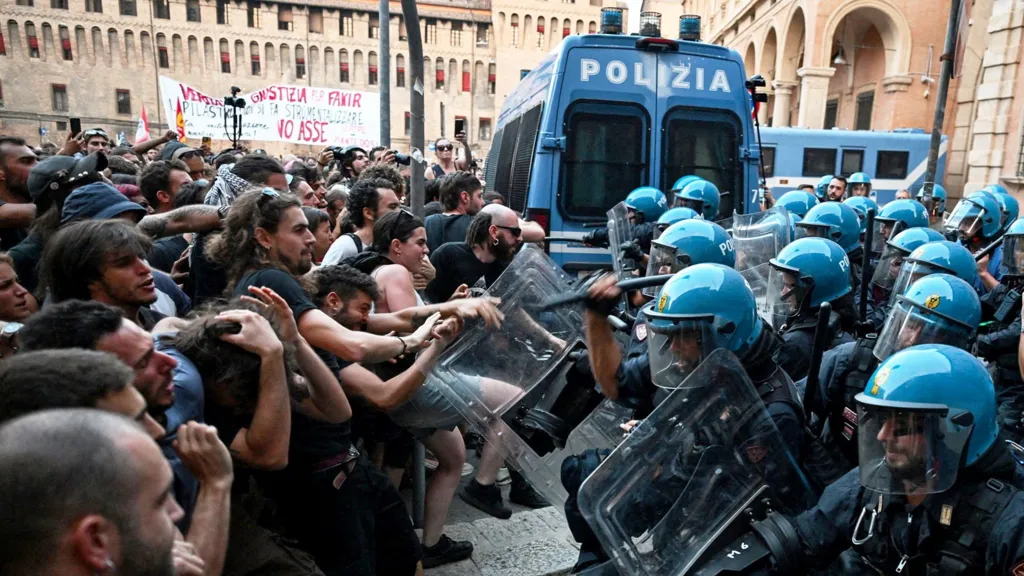
Thousands of people marched through the Italian city of Bologna after the death of a Moroccan born man who died while being restrained by police, prompting a criminal investigation and violent clashes that left dozens of officers injured.

The protests were held in memory of Abderrahim Fakir, whose death on Sunday has sparked widespread public anger and renewed debate over police conduct in Italy. Demonstrators gathered to demand justice before a smaller group broke away from the main rally and clashed with riot police late into the night.

Authorities said 64 police officers were injured during the unrest as protesters threw objects, confronted security forces and set two vehicles on fire. Police eventually brought the situation under control.

The incident that led to the demonstrations began after officers responded to reports of a man behaving erratically in Bologna’s Pilastro neighbourhood. According to police, Fakir was seen kicking garage doors before officers attempted to calm him. They later used pepper spray during the confrontation.

A video widely shared by Italian media shows two police officers holding Fakir face down on the ground while another man restrains his legs. Emergency medical workers are also visible nearby. In the footage, Fakir can be heard asking the officers to stop before he gradually stops moving. After he became unresponsive, officers handcuffed him and attempted to wake him before medical staff intervened.

Prosecutors have opened a manslaughter investigation involving the police officers and emergency workers who were present at the scene. The inquiry will examine whether the restraint methods or medical response contributed to Fakir’s death.

Several witnesses told local media that although Fakir appeared distressed, he was unarmed and did not pose a threat to anyone nearby.

His sister, Khadija Fakir, called for a full investigation and said the family wanted answers about how he died while in police custody. Bologna Mayor Matteo Lepore also expressed shock after watching the video and organised Monday’s public demonstration in support of Fakir’s family.

During the rally, Fakir’s niece addressed the crowd, describing her uncle as a caring and respected member of the community. She said he deserved compassion, dignity and help rather than the outcome that followed.

Although the main demonstration remained peaceful, officials said a small number of protesters later turned violent. Mayor Lepore condemned the unrest while drawing a distinction between peaceful demonstrators and those who resorted to violence.

The police union defended the officers’ actions and argued that the available video showed they had acted appropriately under difficult circumstances. Union representatives said the officers immediately handed over body camera footage to investigators and insisted the use of force was justified because officers faced resistance during the incident.

Prime Minister Giorgia Meloni called for a thorough investigation into Fakir’s death while strongly condemning the violence that followed. She said determining the truth about the incident was essential but stressed that attacks on law enforcement could not be justified.

Fakir’s death has drawn comparisons with previous high profile cases involving deaths in police custody in Italy. Opposition politicians have criticised the government’s strong support for police, while human rights advocates say the investigation must establish whether officers followed proper procedures during the arrest. The case has intensified public discussion over policing practices and accountability across the country.

Similar Posts

  • | |

    Hafiz Naeem targets IPP deals, fuel prices

    Jamaat-e-Islami Emir Hafiz Naeemur Rehman has strongly criticised the government over rising fuel prices, heavy taxation and electricity costs. Addressing participants at the party’s sit-in in Lahore, Hafiz Naeemur Rehman said the government was putting an increasing financial burden on ordinary citizens. He demanded the immediate withdrawal of the recent increase in petrol and diesel prices. He said the petroleum levy had no direct connection with the actual price of petrol. He questioned the justification for repeatedly increasing fuel prices and said the government was making life more difficult for the public. “The government drops a petrol bomb on us every day,” he said. Hafiz Naeemur Rehman also criticised the government’s policies regarding independent power producers (IPPs). He alleged that successive governments had entered into unfair agreements with IPPs in the name of ending load-shedding. According to him, the government was now passing the cost of its own shortcomings on to the people through higher taxes. He said citizens were already struggling with expensive electricity and gas bills. The Jamaat-e-Islami leader said heavy taxes were being imposed on electricity and gas bills. He argued that such charges were increasing household expenses and adding to the difficulties faced by ordinary consumers. Hafiz Naeemur Rehman further said the government had shut down five of the 27 IPPs. He referred to the government’s own claim that the move would provide a benefit of Rs3,360 billion to the national exchequer. He questioned why similar measures could not be taken to provide lasting relief to consumers. He said the government should focus on reducing electricity costs instead of continuously increasing taxes and other charges. The Jamaat-e-Islami emir also criticised the Federal Board of Revenue (FBR). He alleged that corruption within the tax collection system remained widespread. He called for greater transparency and accountability in government institutions. He said economic policies should be designed to provide relief to the public rather than increase their financial difficulties.

  • | | |

    Shehbaz, Bangladesh PM set for first Jakarta meeti…

    Prime Minister Shehbaz Sharif is expected to meet Bangladesh Prime Minister Tarique Rahman next week in Jakarta, Indonesia. The meeting will be the first between the two leaders since Tarique Rahman assumed office as Bangladesh’s prime minister around six months ago. The meeting is being viewed as significant in light of recent regional developments. Both leaders will be in Jakarta to attend the 12th summit of the D-8 Organisation for Economic Cooperation. The nine-member grouping is focused on strengthening economic cooperation among its member states. The three-day summit is scheduled to begin on Monday, August 17. The summit was earlier postponed in April due to the conflict that emerged in the Middle East. Leaders from member countries are now expected to gather in Jakarta for discussions on regional and economic issues. Prime Minister Shehbaz Sharif is also expected to hold a meeting with Iranian President Masoud Pezeshkian on the sidelines of the summit. The Pakistani prime minister is likely to meet other participating leaders as well. His expected engagements include a meeting with Turkish President Recep Tayyip Erdogan. The meetings are expected to provide an opportunity to discuss bilateral relations, regional developments and areas of mutual interest. The expected meeting between the Pakistani and Bangladeshi prime ministers also comes amid efforts to strengthen ties between the two countries. Both sides have shown interest in expanding cooperation in different areas. Pakistan has also decided not to seek special permission from India to use its airspace for the prime minister’s journey to Indonesia. Instead, Prime Minister Shehbaz Sharif’s aircraft will take an alternative route to reach Jakarta. The change in travel route will allow the Pakistani delegation to proceed with its scheduled participation in the D-8 summit without seeking special approval from India.

  • |

    Lahore Mass Transit Authority phases out tokens and legacy transit cards for digital payments

    The Lahore Mass Transit Authority (LMTA) has officially discontinued tokens and legacy transit cards across its public transport network, including the Orange Line Train, Speedo buses, and Metro Bus services. Under the new system, commuters must switch to digital payment methods, which include the official T-Cash Card, the LMTA mobile application, or standard bank ATM cards. LMTA In-charge Uzair Shah confirmed that existing balances on old cards will not be refunded, though passengers can return their physical cards to designated transit stations to claim their security deposit. The sudden shift has drawn criticism from local commuters, who reported being instructed to recharge the legacy cards shortly before the change and cited a lack of advance public notice.

  • |

    France’s top court blocks social media ban for under-15s

        France’s Constitutional Council, the country’s highest constitutional authority, has rejected a proposed law that would have banned children under the age of 15 from accessing social media. The decision represents a setback for President Emmanuel Macron, who had strongly supported measures aimed at protecting young people from the potential harms of social media. The proposed legislation would have prevented children below 15 from creating social media accounts from September 1. It also required social media companies to close accounts belonging to existing under-15 users within four months. Platforms would have been required to introduce an age-verification system approved by France’s privacy regulator to determine whether users met the minimum age requirement. However, the Constitutional Council ruled that important parts of the legislation did not provide sufficient legal safeguards. In particular, the council objected to the requirement that users prove their age without clearly defining the conditions and limits surrounding the collection and use of such information. According to the council, the legislation placed disproportionate restrictions on freedom of expression and communication. It also failed to adequately protect individuals’ right to privacy. The ruling effectively prevents the law from coming into force in its original form. French lawmakers had approved the legislation in July, making France one of the first European countries to pursue such a comprehensive restriction on social media use by young teenagers. The move followed Australia’s decision to introduce a world-first social media ban for children under 16 in December. The Australian restrictions cover major platforms such as Facebook, Snapchat, TikTok and YouTube. Australian lawmakers are now considering stronger penalties for companies that fail to comply, although early data has indicated that the ban has had mixed results. Several other countries have also taken steps to restrict young people’s access to social media. China, the United Arab Emirates and Türkiye have introduced measures or discussed plans aimed at limiting children’s access to online platforms. At the European Union level, authorities have also indicated that stronger protections may be needed to shield children from harmful features and content on social media platforms. Major technology companies have generallyFrance’s Constitutional Council, the country’s highest constitutional authority, has rejected a proposed law that would have banned children opposed blanket restrictions, arguing that they already provide tools and age-based safeguards to protect younger users. At the same time, companies have indicated that they would follow government regulations where required. Google, Meta, Snap and TikTok had not immediately issued comments on the French court’s decision. Following the ruling, Macron instructed Prime Minister Sebastien Lecornu to revise the proposed legislation and address the Constitutional Council’s concerns. The Elysee Palace said the French president remains committed to introducing the reform. The government wants a revised version of the legislation to take effect before spring 2027, when France is scheduled to hold its next presidential election. Macron is constitutionally barred from seeking a third consecutive term, making the issue a significant part of his government’s remaining agenda.

  • | |

    SC transfers NAB cases to Constitutional Court

    The Supreme Court of Pakistan has ruled that all appeals and bail petitions filed under the National Accountability Bureau (NAB) law will now be heard by the Federal Constitutional Court. The judgment clarifies that the Supreme Court no longer has jurisdiction over these matters following amendments made to the accountability law earlier this year. In its detailed written verdict, the court stated that the legal amendments introduced to the NAB law have transferred the authority to hear appeals and bail applications from the Supreme Court to the Federal Constitutional Court. The judges observed that Sections 32 and 32A of the amended NAB law do not empower the Supreme Court to hear such cases. The ruling further states that all pending NAB appeals and bail petitions currently before the Supreme Court will automatically be treated as transferred to the Federal Constitutional Court under the relevant constitutional provisions. This means future proceedings in accountability cases will be conducted by the newly established constitutional forum. The decision also has significant implications for the founder of Pakistan Tehreek-e-Insaf (PTI), who had challenged a High Court decision regarding his bail before the Supreme Court. His petition had earlier been returned by the Supreme Court Registrar after procedural objections were raised. Following the latest judgment, his bail application will now be heard by the Federal Constitutional Court. The question of jurisdiction emerged during proceedings in another pending NAB case before the Supreme Court. During the hearing, the bench examined whether the court could continue hearing accountability matters after the recent amendments to the NAB law. The amendments, enacted on March 5, 2026, reassigned the authority to hear NAB appeals and bail petitions to the Federal Constitutional Court through Section 32A of the amended law. The changes were introduced as part of broader judicial and constitutional reforms. The case was heard by a three-member bench headed by Justice Muhammad Ali Mazhar, with Justice Musarrat Hilali and Justice Shahid Bilal Hassan as members of the bench. During the proceedings, the petitioner’s counsel argued that the Supreme Court should retain the power to hear bail applications in NAB cases. He referred to an earlier post-amendment decision in which the Supreme Court had granted bail in an accountability matter. Attorney General Mansoor Usman Awan, representing the federal government, argued that all NAB appeals and bail petitions should now be heard exclusively by the Federal Constitutional Court. He maintained that different stages of the same case could not be heard simultaneously by two separate courts, as this would create legal complications and procedural inconsistencies.

  • |

    Cockroach Janta Party Instagram account suspended, restored hours later

    The official Instagram account of India’s Cockroach Janta Party (CJP) was temporarily suspended on Sunday. The account was restored several hours later. CJP founder Abhijit Dipke claimed that Instagram had suspended the party’s official account. He shared a screenshot on X showing that the account was unavailable. Dipke criticised Instagram over the suspension. He questioned the platform’s decision and drew attention to the account becoming inaccessible. The account was later restored. The party regained access to its official Instagram profile after several hours. CJP also confirmed the development in a statement posted on X. The party said its Instagram account had been suspended in the morning. It added that the account was successfully restored later in the day. The temporary suspension triggered reactions on social media. Several users discussed the incident and questioned why the account had been taken down. Some social media users linked the incident to youth-led protest movements in India. They also accused the government of attempting to silence political opponents. These claims were made by users on social media and were not independently established. Other users criticised India’s ruling Bharatiya Janata Party (BJP). Some called for an explanation from Instagram over the suspension. The party did not provide details about the reason given by Instagram for the action. It also did not say whether any specific post or activity had led to the suspension. The restoration means the party can once again access and use its official Instagram account

Leave a Reply

Your email address will not be published. Required fields are marked *