forces disable two
| | | |

US forces disable two ships amid rising tensions i…

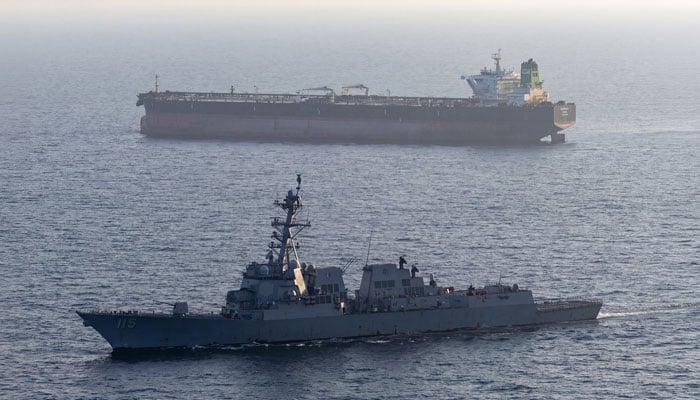
WASHINGTON: Tensions around the Strait of Hormuz have intensified after the United States said its forces had disabled two commercial vessels that failed to comply with orders linked to its naval blockade of Iranian ports.

The US Central Command (CENTCOM) said American forces had redirected 12 commercial vessels attempting to breach the blockade as of July 25. Two ships that allegedly refused to comply were disabled, while two others were boarded to verify compliance.

The latest development adds another layer of uncertainty to maritime traffic through one of the world’s most strategically important waterways, where any disruption can have consequences for global energy and shipping markets.

CENTCOM said the Mozambique-flagged M/T Lavine was disabled in the Gulf of Oman on July 24 after its crew allegedly attempted several times to violate the blockade and ignored repeated warnings. According to the US military, the vessel had been heading towards Iran but is no longer travelling to an Iranian port.

The US military also reported a separate operation involving the Comoros-flagged M/T Charminar in the Arabian Sea. American forces boarded the tanker on July 25 for verification. After the inspection, the vessel was allowed to continue its journey, according to CENTCOM.

CENTCOM has described the naval blockade as remaining fully in effect, saying its forces are continuing to monitor commercial shipping and enforce restrictions on vessels travelling to or from Iranian ports.

The confrontation comes amid heightened US-Iran tensions and growing concerns over the security of maritime routes around the Gulf of Oman and Strait of Hormuz. The waterway is a crucial passage for international trade and energy shipments, making military activity in the area particularly sensitive.

The US claims its measures are aimed at preventing vessels from violating the blockade, while Iran has continued to challenge restrictions on shipping in the region.

The latest incidents could further complicate efforts to maintain safe commercial navigation. With American forces increasing enforcement and vessels facing greater scrutiny, shipping companies operating near the region are likely to remain on high alert.

For now, the Strait of Hormuz remains a major flashpoint, with every confrontation at sea carrying the risk of a broader escalation.

Similar Posts

  • | |

    Nadia Khan addresses divorce rumours with social media post

    Pakistani television host and actress Nadia Khan has seemingly dismissed recent rumours about trouble in her marriage by sharing a photograph with her husband, Faisal Rao, on social media. The post came after several YouTubers claimed that the couple had separated, sparking widespread speculation online. Nadia Khan is one of Pakistan’s most recognisable television personalities. She has appeared in dramas including Des Pardes, Bandhan, Manzilen, Kaisi Aurat Hoon Main, Dolly Darling, Kumzarf and Aesi Hai Tanhai. She is also known for her candid opinions on the entertainment industry through programmes such as Kya Drama Hai and Rise & Shine. Beyond television, Nadia enjoys a strong digital presence through her YouTube channel, OutStyle with Nadia, and has more than 2.6 million followers on Instagram. The actress married retired Pakistan Air Force officer Faisal Rao in January 2021. Since then, the couple has been living in Karachi and has largely kept their personal life away from the public eye. Although Nadia remains active on social media, she rarely shares family-related content and has stepped away from family vlogging because of her busy schedule with Kya Drama Hai and Rise & Shine. In recent days, Nadia’s limited posts about her personal life led to speculation from several YouTube channels, which claimed that she and Faisal Rao had divorced. Among those making the claim was YouTuber Mehreen Sibtain, while other content creators also repeated similar allegations. The rumours quickly spread across social media, prompting discussion among fans. Despite the growing speculation, Nadia chose not to issue a direct statement or publicly address the claims. Instead, after the rumours gained traction online, she shared a photograph with her husband on her Instagram Story. The image, posted around six hours before Reviewit published its report, appeared to reassure followers that the couple remains together. While Nadia did not write a lengthy caption or explicitly mention the divorce rumours, many social media users interpreted the post as her response to the ongoing speculation. Fans described the picture as a subtle but effective way of putting an end to the claims without engaging in unnecessary controversy. The actress has previously maintained that she prefers to keep her personal life private despite her public career. Over the years, she has focused her online presence primarily on her professional work, television appearances and lifestyle content rather than regularly sharing details about her family life. Following the Instagram Story, many of Nadia’s followers criticised the spread of unverified rumours and urged social media users to avoid believing claims that are not confirmed by the individuals involved. The shared photograph has since been widely viewed as Nadia Khan’s way of dismissing the divorce speculation, with no evidence supporting the claims that she and Faisal Rao have ended their marriage. 

  • | |

    LHC grants bail to Libya boat tragedy suspect

    The Lahore High Court (LHC) has granted post-arrest bail to Muhammad Tahir, a suspect in the Libya boat tragedy case, ruling that investigations into international human trafficking cases must be supported by credible and legally admissible evidence rather than mere suspicion. Justice Amjad Rafiq issued a detailed 10-page written verdict explaining the reasons for granting bail. The court observed that allegations of human trafficking, being an international crime, require thorough and professional investigations based on concrete evidence. The court noted that the Federal Investigation Agency (FIA) should have obtained evidence from abroad and sought legal assistance from relevant international authorities during the investigation. It said cooperation with foreign agencies is essential in cases involving cross-border human trafficking. According to the written order, investigators should have collected digital and documentary evidence, including WhatsApp chats, call records, bank records, travel documents and other electronic data. The court stressed that such evidence is necessary to establish the active role of an accused in an alleged trafficking network. The judgment further stated that the standard of investigation must be strong enough to legally prove an accused person’s involvement rather than relying on assumptions or incomplete evidence. The court also highlighted the need for reforms to effectively combat human trafficking. It said stronger legislation, improved investigative methods and better law enforcement mechanisms are essential to tackle organised trafficking networks. The LHC ruled that the transfer of money into a person’s bank account alone cannot be treated as proof of involvement in human trafficking. It added that suspicion, speculation or banking transactions by themselves are insufficient to establish criminal liability in such cases. The court ordered the release of Muhammad Tahir on post-arrest bail against surety bonds of Rs500,000, subject to the conditions set by the court. The case will continue in accordance with the law while further investigation proceeds.

  • | |

    Pakistan’s monsoon crisis deepens as heavy r…

    Heavy monsoon rains continue to cause widespread devastation across Pakistan, with Punjab and Khyber-Pakhtunkhwa (K-P) suffering significant casualties and damage. According to disaster management authorities, at least 43 people have lost their lives and 177 others have been injured due to rain-related incidents, while officials have warned that more heavy rainfall and possible flooding are expected in the coming days. In Punjab, the Provincial Disaster Management Authority (PDMA) reported 21 deaths and 154 injuries linked to the ongoing monsoon season. Lahore has been among the worst-hit cities, receiving approximately 343 millimeters of rainfall over the past 48 hours. The intense downpour flooded roads, underpasses, and low-lying neighborhoods, causing severe traffic disruptions and exposing weaknesses in the city’s drainage infrastructure. Emergency drainage operations were launched across the provincial capital to remove accumulated rainwater. Most fatalities in Punjab resulted from roof and building collapses, which claimed 15 lives. Additional deaths were caused by lightning strikes, electrocution, and drowning. Authorities also reported damage to dozens of homes, highlighting the vulnerability of aging structures during extreme weather conditions. A tragic incident occurred in Lahore when a 19-year-old motorcyclist was critically injured after being electrocuted while riding through flooded streets in the Chungi Amar Sidhu area. The victim was immediately shifted to Lahore General Hospital for emergency treatment. Heavy rainfall also forced the closure of several underpasses and roads in DHA and other parts of the city due to waterlogging, while traffic was diverted through alternative routes. In addition, rain damaged an 11kV electricity line, causing temporary power outages in affected areas. The city also witnessed the formation of multiple sinkholes after continuous rainfall weakened road surfaces. Traffic authorities sealed off the affected locations, redirected vehicles, and coordinated with municipal departments to begin urgent repair work. Earlier, two teenage brothers lost their lives when their motorcycle skidded on a rain-soaked road near Lahore while traveling toward Kasur. Officials attributed the accident to slippery road conditions and urged motorists, particularly motorcyclists, to reduce speed, wear helmets, and avoid unnecessary travel during heavy rainfall. Meanwhile, Khyber-Pakhtunkhwa recorded 22 deaths and 23 injuries in rain-related incidents. The victims included men, women, and several children. The province also suffered damage to 37 houses, with eight completely destroyed and the remaining partially damaged. The affected districts include Peshawar, Mardan, Nowshera, Abbottabad, Mansehra, Bajaur, Swabi, and several others. The K-P PDMA stated that rescue teams, district administrations, and emergency services are working together to provide relief and assistance to affected families. Although river water levels currently remain within normal limits, authorities have placed all districts on high alert due to forecasts of continued heavy rainfall. The Pakistan Meteorological Department has warned that another spell of widespread rain is expected across Punjab, Khyber-Pakhtunkhwa, Islamabad, Rawalpindi, and Kashmir over the next 24 hours. Officials fear urban flooding, flash floods in local streams, and landslides in hilly regions such as Murree and Galiyat. Residents have been advised to avoid unnecessary travel, stay away from damaged buildings and flood-prone areas, and follow official safety advisories to minimize further loss of life and property.

  • |

    Sunny Deol’s ‘Batwara 1947’ earns praise for raw, emotional performance

    The story of Partition has returned to the big screen with “Batwara 1947” and early viewers are already sharing largely positive reactions online. Many praised the film’s emotional storytelling, characters and performances. Directed by Rajkumar Santoshi, the film released in cinemas on August 14. It stars Sunny Deol as Sikandar, Shabana Azmi as Mai, and Preity Zinta as Hamida. Several viewers described the film as an emotional watch suited for the whole family. One social media user called it a complete family film and recommended watching it alongside parents, while also praising Azmi’s performance specifically. Other reactions focused on how the film portrayed the struggles people faced during Partition. Viewers pointed to its handling of fear, displacement and uncertainty as key emotional throughlines. One viewer noted that the film avoided painting Sikandar and Hamida as purely right or wrong. According to that reaction, their choices only made sense once the full weight of their circumstances became clear. Sunny Deol’s performance quickly became one of the most talked-about elements of the film. Numerous users praised his portrayal of Sikandar, particularly his expressive work in emotionally heavy scenes. One user wrote on X that Deol completely owns his character throughout the film. Another said his performance revealed emotional range well beyond his well-known action image, highlighting the quieter moments where his expressions carried entire scenes. The film’s character arc also drew significant attention from early viewers. Several noted that Sikandar’s journey across the story stood out as one of its strongest elements. One viewer pointed out that Sikandar was not written as a flawless hero from the start, instead confronting his own anger and beliefs as the narrative unfolds. Another praised a specific scene where his visible helplessness reportedly shifted the entire mood inside the theatre. Set in Lahore during the 1947 Partition, “Batwara 1947” explores the era’s impact through the lives of ordinary people. The film reportedly draws inspiration from Asghar Wajahat’s play “Jis Lahore Nai Vekhya, O Jamya E Nai.” These early reactions reflect only initial social media responses, with more detailed reviews expected as the film reaches wider audiences in the coming days.

  • | |

    Sangeeta’s intimate direction to Moammar Rana criticized online

    Veteran Pakistani filmmaker Sangeeta has found herself at the center of online discussion after behind-the-scenes footage showing her directing actor Moammar Rana on set began circulating on social media platforms. ​The viral video, captured during the production of her upcoming film Mukho, shows the experienced director physically demonstrating how to execute a close romantic sequence between the lead actors. In the footage, Sangeeta steps in to personally guide Moammar Rana on body posture, facial expressions, and the specific physical proximity required for the scene. Taking a hands-on approach typical of traditional Lollywood directors, Sangeeta directly adjusted the actor’s positioning to demonstrate the movements needed to capture romantic chemistry on camera. ​Addressing her direct approach to film direction, the veteran filmmaker explained that hands-on instruction is an essential part of her creative process on set: ​”As a director with decades of experience, my focus is always on getting the exact emotion required for the scene. In traditional cinema, showing an actor how to move and convey feelings on camera is simply part of the job to ensure the final shot looks believable to the audience.” ​The behind-the-scenes clip quickly spread across online entertainment portals, triggering divided reactions among social media users. Critics described the physical guidance as awkward and unnecessary, arguing that established actors like Moammar Rana should be allowed more creative space without physical demonstration. Some commentators suggested that older directing methods might feel out of place in modern, contemporary filmmaking environments. ​Conversely, many fans and industry insiders came to Sangeeta’s defense, highlighting her career in Pakistani cinema spanning nearly 50 years. Supporters noted that veteran directors from the classic Lollywood era have long relied on direct physical demonstrations to communicate their creative vision clearly to the cast. They argued that her active role on set reflects her passion for filmmaking and close attention to detail rather than anything controversial. ​The online debate highlights the contrast between classic Lollywood production techniques and contemporary film set standards. While traditional directors frequently relied on direct physical instruction to achieve specific visual shots, modern digital coverage means behind-the-scenes moments are now routinely scrutinized and discussed by online audiences. ​As production on Mukho continues toward its scheduled release, the widespread reaction to the viral footage demonstrates how everyday moments from film sets regularly become topics of public debate in the digital age.

  • Massive Fake “Made in Thailand” Smuggling Ring Busted at Laem Chabang Port

    BANGKOK – Thai authorities have cracked down on a massive counterfeit operation at the Laem Chabang Port in Chonburi. The Thai Customs Department and the Department of Foreign Trade recently seized illegal goods with fake “Made in Thailand” labels. These fraudulent imports and exports caused over 1.37 billion baht in economic damages. Key Takeaways: Authorities […]

Leave a Reply

Your email address will not be published. Required fields are marked *