pakistan saudi arabia
| | | |

Pakistan, Saudi Arabia and Türkiye sign Makkah jo…

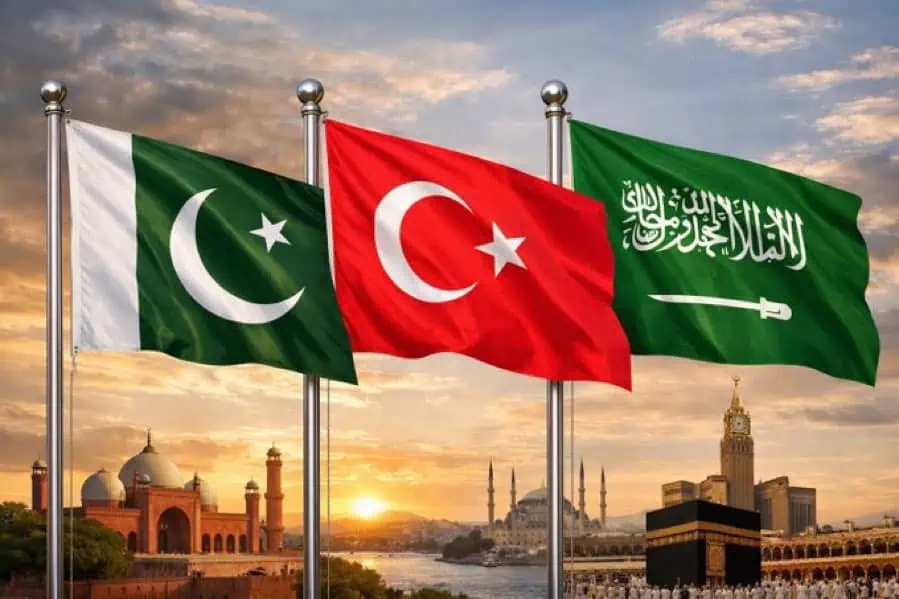
MAKKAH: Pakistan, Saudi Arabia and Türkiye have signed the Makkah Joint Defence Agreement, pledging to strengthen collective security and defence cooperation among the three countries.

The agreement was signed on Friday during a high-level summit at Al-Safa Palace in Makkah, where Saudi Crown Prince and Prime Minister Mohammed bin Salman received Pakistani Prime Minister Shehbaz Sharif and Turkish President Recep Tayyip Erdogan.

According to the agreement, the three countries reaffirmed their commitment to strengthening collective security and promoting peace, stability and security in the region and beyond.

The agreement is based on the longstanding relations and shared strategic interests of Pakistan, Saudi Arabia and Türkiye. It also highlights their continued defence cooperation and commitment to closer coordination on security matters.

Any attack to be treated as an attack on all three

A key provision of the agreement states that an armed attack against any one of the three countries will be regarded as an attack against all three.

The pact is intended to enhance collective deterrence against acts of aggression and expand cooperation across various areas of defence.

The agreement also seeks to strengthen military and security coordination among the three states and build a framework for closer cooperation in the face of regional security challenges.

The summit brought together the leaders at a time of heightened tensions and instability across the Middle East. Recent reporting had indicated that the three countries were preparing to deepen defence coordination through a joint pact.

Prime Minister Shehbaz Sharif was accompanied by Deputy Prime Minister and Foreign Minister Ishaq Dar, Chief of Army Staff and Chief of Defence Forces Field Marshal Syed Asim Munir, and Defence Minister Khawaja Asif.

The leaders also reviewed bilateral and regional matters of mutual interest and discussed ways to further strengthen cooperation.

The Makkah agreement marks a significant development in defence ties among Pakistan, Saudi Arabia and Türkiye, establishing a stronger trilateral framework for collective security and defence cooperation.

Similar Posts

  • |

    Buleha” faces suspension as Senate demands name change and removal of Bulleh Shah dialogue

    Islamabad: A controversy over the Pakistani film “Buleha” after a Senate committee questioned whether the movie damaged the image of legendary Sufi poet Baba Bulleh Shah by showing a character connected with violence, weapons and personal justice. During a heated discussion, Senator Pervaiz Rashid questioned how a film carrying the name of a famous symbol of peace and love was approved despite scenes and dialogues that critics said were opposite to Bulleh Shah’s teachings. The controversy intensified when members of the Censor Board admitted that some important points were overlooked during the approval process. Dr. Sultan Azam Taimuri, a senior member of the board, accepted responsibility and said the concerns raised about the connection between the fictional character and Baba Bulleh Shah should have been discussed more carefully. The committee argued that Baba Bulleh Shah was known for promoting peace, humanity and love, while the film appeared to show a character using force and weapons to fight criminals. Members questioned whether such a portrayal could create confusion among young viewers about the real message and personality of one of Punjab’s most respected Sufi poets. The debate became intense when a Senator Pervaiz Rashid asked if a film about another respected poet, such as Khushal Khan Khattak or Ghalib, showed that personality in a completely opposite way, would the Censor Board approve it. A censor board member admitted that such a film would not be acceptable and said it would be wrong to show a historical personality against their actual beliefs. The committee then questioned why the same standard was not applied to “Buleha.” The Censor Board defended its decision by saying the movie was not a biography of Baba Bulleh Shah. Officials explained that the character in the film was fictional and had no direct connection with the real life of the Sufi poet. They said the board considered the movie a fictional story and believed the name alone was not enough reason to stop its release because Bulleh Shah himself used the word “Bullah” in his poetry. However, the committee pointed out that the board’s explanation created confusion. Members questioned how the film could have no connection with Bulleh Shah but still use a name and dialogue strongly linked with him. The discussion became more serious when Dr. Sultan admitted that the committee’s concerns had a point. He said the board did not discuss this angle properly at the time of approval and accepted responsibility. He also admitted that a dialogue in the film where the character compares himself with Bulleh Shah could be controversial. Another Censor Board member, Syed Farooq Hassan, also accepted that the board overlooked this perspective. He said the board knew Baba Bulleh Shah’s teachings were completely different from the violence shown in the film, but members believed the character was fictional and not based on the actual life of Bulleh Shah. The board members also explained that Pakistan’s film industry was already struggling, and they wanted to support local movies within acceptable limits. They said promoting cinema was also one reason behind their decision. The committee, however, questioned whether supporting the film industry should come before protecting the image of respected cultural and historical figures. During the meeting, criticism was also directed at the writer of the film. Members questioned whether being a successful film writer was enough qualification to handle the story of a major historical and spiritual personality. They argued that the writer’s fame came mainly from action based films and said success in commercial cinema does not automatically mean expertise in history, culture or the lives of national figures. One committee member strongly criticised the idea of approving a film simply because it was written by a famous writer. He said the writer was known for introducing violent action elements in films but was not known as an expert on Sufi personalities or Pakistan’s cultural traditions. The committee also rejected the argument that other provincial censor boards had already approved the film. Officials said Punjab and Sindh censor boards had approved the movie without cuts, and it had also been aired on Local TV. However, committee members said approval by other boards did not remove the responsibility of reviewing the film’s impact. The discussion also raised questions about the knowledge and background of Censor Board members. Members suggested that people approving films about major personalities should have knowledge of history, literature, culture and society. They said the selection criteria for board members should ensure they understand how films can influence children and families. The committee argued that showing respected personalities incorrectly could affect how younger generations understand their history. At the end of the meeting, the committee made a strong recommendation regarding the film. The committee suggested that the film name should be changed and the dialogue in which the character calls himself Bulleh Shah should be removed. It further recommended that the film’s exhibition licence should remain suspended until these changes are made and that online versions should also be removed if available. The Senate Standing Committee on Information and Broadcasting has also included the film “Buleha” issue in its upcoming agenda, calling Censor Board members and producers to explain the certification process and the discussions behind the film’s approval.

  • Health Secretary’s Gujrat visit triggers major health shake-up

    GUJRAT: A high-level visit by Punjab Secretary for Health and Population Nadia Saqib to Gujrat triggered a major administrative shake-up, resulting in the transfer of senior health officials and a newly appointed medical superintendent, while the office of a patients welfare association at Civil Hospital Jalalpur Jattan was sealed. The secretary visited Gujrat to review the Community Health Inspectors (CHI) programme and attended a training workshop for field staff. Addressing community health inspectors, she stressed the importance of improving primary healthcare services, community engagement and effective field monitoring. The workshop was attended by Deputy Director Khalid Sharif, Additional Secretary (Technical) Dr Zohaib Hassan, Project Director PFPP Captain Usman and Additional Director PIU Dr Farrukh Amin. During the visit, Nadia Saqib also inspected Civil Hospital Jalalpur Jattan to review administrative affairs and healthcare services. According to well-placed sources, the secretary expressed serious displeasure after learning that the recent appointment of Dr Shehzad Gul as Medical Superintendent (MS) of Civil Hospital Jalalpur Jattan had been made without the matter coming to her notice. Sources claimed she questioned the appointment during the inspection and sought an explanation from local health authorities. Soon after the visit, Chief Executive Officer (Health) Gujrat Dr Atta-ul-Munim was transferred and posted as Senior Medical Officer (SMO) in Bahawalnagar. Officials familiar with the matter said the transfer order was issued immediately following the inspection. In another significant development, Dr Shehzad Gul, who had only recently assumed charge as Medical Superintendent of Civil Hospital Jalalpur Jattan, was transferred and posted as Medical Officer in Attock. The inspection also resulted in action against the office of Anjuman-e-Behbood-e-Mareezan operating within Civil Hospital Jalalpur Jattan. According to sources, the office was sealed during or after the visit following concerns that it was functioning in a manner inconsistent with its intended welfare role. Sources alleged that the office had effectively been operating like a business despite the fact that medicines required for patients are supplied free of cost through the government hospital. They claimed the matter was brought to the secretary’s attention during the inspection, prompting immediate action. The Health Department has not officially stated the reasons behind sealing the office. Meanwhile, sources indicated that further administrative changes could be on the cards, with the transfer of the District Health Officer (DHO) Gujrat also being considered, although no notification had been issued until late Thursday. No official spokesperson for the Punjab Health Department issued a detailed statement linking the transfers or the sealing of the office to disciplinary proceedings. Efforts to obtain comments from the transferred officials were unsuccessful. The developments have generated considerable discussion within Gujrat’s health sector, where employees view the latest decisions as part of a wider push for administrative accountability and stricter oversight of public health institutions. The secretary’s visit is being seen as a clear message that governance, transparency and adherence to departmental procedures will remain central to the provincial government’s healthcare reform agenda.

  • |

    South Korea estimates North Korea’s economy grew over 3 percent for third year

    North Korea’s economy expanded by more than three percent in 2025 for the third consecutive year, according to new estimates released by South Korea’s central bank. The report suggests that stronger economic and military cooperation with Russia played a major role in boosting growth despite North Korea’s continued international isolation. The Bank of Korea, which has published annual estimates of North Korea’s economy since 1991 because Pyongyang does not release official economic data, estimated that the country’s real gross domestic product grew by 3.5 percent last year. The report valued North Korea’s economy at approximately 38.26 trillion won, or about 26.6 billion dollars. According to Bank of Korea officials, expanded cooperation with Russia was one of the main reasons for the improvement. Analysts have said North Korea has strengthened ties with Moscow by supplying troops and military equipment for Russia’s war in Ukraine. In return, Pyongyang is believed to have received financial assistance, food supplies, energy resources and military technology. A Bank of Korea official said increased weapons exports to Russia supported growth in North Korea’s manufacturing sector. The official also noted that a rise in Russian tourists and improved transport links between the two countries contributed to stronger performance in construction and service industries. The report estimated that North Korea’s exports increased by 30 percent during 2025, reaching around 470 million dollars. Among the leading export products were prepared feathers and wigs, along with toys and sporting goods. Although the report did not identify all exported items, officials said stronger overseas sales contributed significantly to economic growth. The latest figures were released as reports continued to highlight growing military cooperation between Moscow and Pyongyang. Ukraine’s military intelligence, quoted by the Kyiv Independent, claimed that more than 7,000 North Korean troops were killed or wounded while fighting alongside Russian forces during military operations in Russia’s Kursk region between 2024 and 2025. Neither Russia nor North Korea has independently confirmed those figures. Separately, the Ukrainian human rights organisation Truth Hounds said Russia and North Korea are close to completing their first road bridge connecting the two countries. The group said such a link could strengthen military and economic cooperation by allowing easier movement of personnel, equipment and supplies across the border. The Bank of Korea also reported a significant increase in North Korea’s gross national income, which measures the total income earned by a country’s residents. The estimate showed GNI rising by 9.4 percent to 48.5 trillion won, or approximately 33.8 billion dollars. Officials said the increase was supported by higher foreign currency earnings, including income linked to North Korean personnel sent to Russia. Despite the recent growth, North Korea’s economy remains extremely small compared with its southern neighbour. According to the Bank of Korea, North Korea’s gross national income is still less than two percent of South Korea’s economy, highlighting the large economic gap that continues to separate the two countries. The latest estimates suggest that while North Korea remains under international sanctions and largely isolated from global markets, its expanding partnership with Russia is providing new sources of economic activity that have helped sustain growth for a third straight year.

  • | | |

    Pakistan, US boost anti-terror partnership

    Pakistan and the United States have reaffirmed their commitment to expanding cooperation against terrorism during the fourth round of the Pakistan-US Counterterrorism Dialogue held in Washington. The meeting brought together senior officials from both countries to discuss the changing regional and global security situation. The dialogue was led by Pakistan’s Special Secretary Ambassador Nabeel Munir and the US Coordinator for Counterterrorism, Ambassador Gregory LoGerfo. Both sides reviewed the current terrorist threat environment. They exchanged views on security challenges facing the region. Officials also explored practical ways to strengthen cooperation in tackling terrorism and violent extremism. A joint statement issued after the meeting said both countries share a common interest in defeating terrorist organisations. It added that Pakistan and the United States remain committed to working together to improve regional and international security. The discussions focused on strengthening border security and improving coordination between the two countries. Officials also discussed measures to disrupt terrorist financing and facilitation networks. They agreed that closer cooperation is essential to prevent terrorist groups from expanding their activities. During the dialogue, both delegations identified several militant organisations that continue to threaten regional peace and stability. These included ISIS-Khorasan (ISIS-K), Al Qaeda, Tehreek-i-Taliban Pakistan (TTP), and the Balochistan Liberation Army (BLA), along with affiliated groups. Both governments reaffirmed their determination to confront these organisations and protect their citizens from terrorism. The two countries also agreed to deepen cooperation through bilateral engagement and multilateral platforms. They stressed the importance of intelligence sharing, information exchange, and joint efforts to improve counterterrorism capabilities. Pakistan’s Foreign Office said the two sides held detailed discussions on regional and global terrorist threats. Both countries pledged to enhance collaboration in addressing security challenges and maintaining regional stability. The latest dialogue reflects improving relations between Islamabad and Washington after years of strained ties following the withdrawal of US forces from Afghanistan in 2021. Since then, both countries have gradually rebuilt engagement by focusing on areas of mutual interest instead of past differences. Besides counterterrorism, Pakistan and the United States have increased cooperation in trade, investment, climate change, and regional peace. Officials from both countries believe continued dialogue is essential to strengthen bilateral relations and promote long-term stability.

  • | |

    Sanam Saeed backs Durefishan amid accent criticism

    KARACHI: Actor Sanam Saeed has spoken out in support of Durefishan Saleem after the latter faced criticism on social media over her accent and dialogue delivery in the drama Dar-e-Nijaat. The debate began after a scene featuring Durefishan, who plays Zaryab, gained attention online. In the scene, her character speaks to Zamil, played by Nameer Nawaz Khan, using a combination of Urdu and English. Some social media users criticised the actor’s accent and delivery, while others questioned the way certain lines were written and performed. Saeed criticised what she described as excessive online backlash against actors. She said repeatedly targeting a performer over the way they speak could be hurtful and unnecessary. Her comments prompted further discussion among viewers, with many users agreeing that actors should not be subjected to personal attacks over performance-related issues. Several viewers defended Durefishan and said her accent did not negatively affect the scene. They argued that criticism should focus on the overall performance rather than becoming a personal attack. However, some users maintained that dialogue delivery is an important part of acting. They argued that an actor’s accent and pronunciation can influence how effectively a script reaches the audience. Others said their criticism was directed at the writing and execution of the scene rather than Durefishan personally. They described such feedback as part of normal discussion surrounding television performances. The online debate has once again highlighted the growing influence of social media on television dramas. Performances, dialogue and even actors’ accents can quickly become topics of public discussion after scenes are shared online. Saeed’s comments have also sparked a broader conversation about the difference between constructive criticism and personal attacks on performers. Durefishan has established herself as a prominent name in Pakistan’s television industry. She gained widespread recognition through Ishq Murshid, where she appeared opposite Bilal Abbas Khan

  • |

    Death toll rises to 254 after powerful Colombia earthquake

    The death toll from a powerful earthquake that struck western Colombia on Monday has risen to 254, according to foreign media reports, as rescue teams continue searching through devastated areas for survivors. The 7.4-magnitude earthquake caused widespread destruction across the affected region, with dozens of buildings collapsing and significant damage reported to infrastructure. Several communities remain without electricity and access to essential services, making rescue and relief operations increasingly difficult. Colombian authorities have warned that the full scale of the disaster may not become clear for several days. Rescue workers are still assessing damaged areas, while officials are working to determine the exact number of casualties and the extent of property damage. The earthquake also disrupted basic services in several affected communities, leaving residents struggling to access electricity and other necessities. Emergency teams have been deployed to assist victims, search damaged buildings and provide immediate relief to people who have lost their homes. Officials expect the death toll and damage estimates to change as rescue crews reach areas that remain difficult to access. Authorities have urged residents to remain cautious and follow emergency instructions as assessments and relief efforts continue. The 7.4-magnitude tremor stands among the most destructive earthquakes to hit western Colombia in recent years, causing severe damage and a major humanitarian challenge for local authorities.

Leave a Reply

Your email address will not be published. Required fields are marked *