
lawmakers discuss stronger
| |

US lawmakers discuss stronger Pakistan-US cooperat…

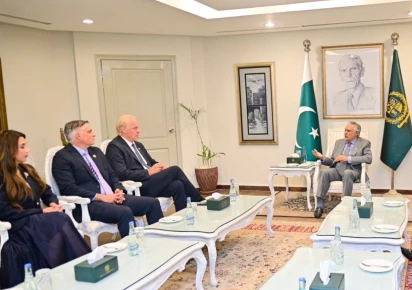
ISLAMABAD: Deputy Prime Minister and Foreign Minister Ishaq Dar met a US Congressional delegation in Islamabad on Tuesday. The two sides discussed ways to strengthen relations between Pakistan and the United States.

The delegation included US Representatives Ryan Zinke and Michael Baumgartner. Dar welcomed the lawmakers and said Pakistan-US relations were gaining positive momentum.

The meeting focused on several areas of mutual interest. These included trade, investment, information technology and energy.

Both sides discussed opportunities to expand cooperation in these sectors. They also explored ways to increase economic and commercial engagement between the two countries.

Dar stressed the importance of regular parliamentary exchanges. He said continued contact between lawmakers could help build mutual trust and improve understanding between Pakistan and the US.

The foreign minister also highlighted the importance of stronger institutional links. He said regular engagement could help both countries develop closer and more productive relations.

The visiting US lawmakers praised the role of the Pakistani community in the United States. They acknowledged the diaspora’s contributions to the US economy and society.

The Pakistani community was also described as an important bridge between the two countries. Its role can help promote stronger people-to-people and economic ties.

Regional and international issues were also discussed during the meeting. The two sides exchanged views on developments affecting regional peace and security.

The US delegation appreciated Pakistan’s efforts to promote regional peace and stability. Pakistani officials said Islamabad remained committed to dialogue and peaceful solutions to regional challenges.

The meeting comes as Pakistan seeks to expand its economic engagement with the United States. Islamabad has been encouraging greater investment and cooperation in emerging sectors.

Trade and investment remain key areas of focus in the evolving relationship. Pakistan is particularly interested in attracting US investment in technology, energy and other high-growth sectors.
Similar Posts

  • |

    Will Scharf named Trump’s new White House counsel

    US President Donald Trump has appointed Will Scharf as the next White House counsel and assistant to the president. Scharf, who currently serves as White House staff secretary, will take over the legal post on September 1, 2026. He will replace David Warrington, who is set to leave the administration and enter the private sector. Scharf is a lawyer and political adviser with close ties to Trump. Before joining the White House, he represented Trump in several major legal matters. He was also involved in the presidential immunity case that reached the US Supreme Court. Scharf previously worked as a federal prosecutor. He also served as a law clerk for federal appeals court judges, giving him experience in both government and federal litigation. His new position will place him at the centre of the Trump administration’s legal strategy. As White House counsel, Scharf will advise the president on legal issues and oversee matters involving executive privilege, judicial appointments and relations with the Justice Department. He will also be involved in responding to legal challenges facing the administration. The position is considered particularly important as Trump prepares for growing political and legal pressure ahead of the 2026 midterm elections. Scharf joined Trump’s legal team in 2023. He worked on the federal election interference case brought by former Special Counsel Jack Smith. His involvement continued as the case reached the Supreme Court. In 2024, the Supreme Court ruled that presidents have broad immunity from criminal prosecution for official acts. The decision became a major development in the legal battles surrounding Trump. After Trump returned to the White House in January 2025, Scharf was appointed staff secretary. In that role, he managed documents and other materials sent to the president for review. He also frequently appeared with Trump during executive-order signing ceremonies. Scharf has also chaired the National Capital Planning Commission. During his tenure, he was involved in the approval process for Trump’s proposed White House ballroom project, which has faced controversy and scrutiny. His appointment comes at a politically sensitive time for the administration. The White House is dealing with legal and political challenges while preparing for increased congressional scrutiny before the midterm elections. Trump praised Scharf after announcing the appointment. He described him as “tough, strong, and smart” and highlighted his experience as a federal prosecutor and his work on Trump’s legal cases.

  • | |

    ‘I got so much love’, Sunny Deol on Pakistan Kartarpur Corridor visit

    Bollywood actor Sunny Deol has recalled his visit to the Kartarpur Corridor, saying he received considerable affection in Pakistan despite the political tensions between the two neighbouring countries. Deol made the remarks while promoting his latest film, Batwara (1947), which was released in India and several other countries on Friday. During a recent interview, the actor was asked whether he had ever travelled to Pakistan. Deol clarified that he had never formally visited Pakistan, but had the opportunity to travel to the Kartarpur Corridor when it was opened. As the corridor falls within his parliamentary constituency, he was included in a delegation that visited Kartarpur. Recalling the experience, Deol said he was surprised by the warmth he encountered on the Pakistani side. “I received a lot of love in Pakistan,” the actor said, adding that members of the military also expressed affection and spoke to him about his films. According to Deol, some of those he met told him they admired him but asked him not to make films portraying Pakistan negatively because they felt a strong connection with him as an actor. Deol said his response was that he was only performing a character in films and that the views of a fictional character should not necessarily be confused with his personal beliefs. The actor also spoke about the wider human dimension of relations between India and Pakistan. He said people naturally love their own countries but argued that innocent civilians should never be targeted. His comments come as Deol promotes Batwara (1947), a film dealing with the turbulent period surrounding the Partition of British India. The Kartarpur Corridor, which links India with the Gurdwara Darbar Sahib in Pakistan, has long been viewed as an important religious and people-to-people connection between the two countries. Deol’s recollection has attracted attention because of his long association with patriotic and action-oriented Bollywood roles, some of which have featured strong anti-Pakistan themes. His latest remarks, however, offered a more personal perspective, highlighting how an encounter across the border left him with memories of warmth and affection.

  • | |

    Middle East braces for intense heatwave as tempera…

    DUBAI: A fresh wave of extreme heat is set to grip the Middle East this week, with temperatures forecast to approach 50 degrees Celsius across several countries, prompting weather authorities to issue alerts over dangerous conditions. The UAE’s National Center of Meteorology (NCM) has warned that the coming days will bring soaring temperatures across the region, particularly affecting the United Arab Emirates, Iraq, Kuwait, and eastern Saudi Arabia, where prolonged exposure to the heat could pose serious health risks. According to meteorologists, desert regions in the UAE are expected to experience the highest temperatures, with some areas likely to approach the 50°C mark. Authorities have urged residents to avoid unnecessary outdoor activities during peak afternoon hours and to remain well hydrated. The latest forecasts indicate that Al Shawamekh in Abu Dhabi has already recorded temperatures exceeding 50°C, highlighting the intensity of the current weather conditions. Kuwait is also expected to experience extreme heat, with temperatures predicted to reach 48°C in the coming days, while parts of Iraq and eastern Saudi Arabia are likely to face similarly scorching conditions. Despite the widespread heat, forecasters say some eastern and southern parts of the UAE, including Fujairah, could receive rainfall by Thursday as unstable weather develops over mountainous regions. The weather authority has also issued warnings for strong winds, reduced visibility, and dust storms, which may affect road travel and outdoor activities across several parts of the region. Health experts advise people to stay indoors whenever possible, drink plenty of water, wear light-colored clothing and avoid prolonged exposure to direct sunlight, particularly during midday when temperatures are expected to peak. The renewed heatwave follows a summer of record-breaking temperatures across several parts of the world, with climate scientists warning that extreme weather events are becoming more frequent and intense due to global climate change. Governments across the Gulf have increasingly introduced measures to protect workers and residents during the hottest months, including restrictions on outdoor labor during peak daytime hours and expanded public awareness campaigns on heat-related illnesses. As the latest heatwave builds across the region, authorities continue to monitor weather conditions closely while urging the public to follow official safety advisories. With temperatures expected to remain exceptionally high over the coming days, residents are being encouraged to take extra precautions to minimize the risk of heat exhaustion and heatstroke.

  • |

    NHM begins Independence Day celebrations in Lahore

    Lahore — The National History Museum (NHM) commenced its commemorative programmes for Pakistan’s 79th Independence Day with a series of curated events. The programme began with a multi-generational panel discussion, “Making of Home: Memory, Migration, and New Beginnings,” featuring renowned human rights activist and poet Harris Khalique, award-winning filmmaker Jawad Sharif, and educator and social development practitioner Dr Shireen Zafarullah. The discussion was moderated by academic and BNU Senior Lecturer Saadia Ahmad. The discussion reflected on the experiences of the first generation, who experienced displacement firsthand and grew up in its immediate aftermath; the second generation, who established families, careers, and communities in the cities shaped by Partition; and the third generation, which continues to shape Pakistan through emerging fields including technology, business, and culture. A high point of the celebrations was a dramatic reading of letters from the 1947 Partition exchanged between families, performed by artist Adeel Afzal. The performance brought the audience personal accounts and lived experiences from 1947 through the preserved correspondence of those who witnessed the events. The reading received houseful attendance of people from various walks of life. Speaking on the occasion, NHM Director Awais Malik stated, “1947 Partition and Independence continue to be defining factors of our national identity. Preserving and sharing personal memories from these events remains a core mission of the museum.” In accordance with its mandate to preserve and document Pakistan’s national history, NHM also established a Community Digitisation Station, providing visitors with an opportunity to learn digital preservation of family photographs, documents, and other historical materials. The initiative seeks to recognise personal and family archives as an important component of the country’s broader historical identity. The Independence Day commemorations will continue on 14 August, when NHM will remain open during extended hours and offer exclusive Night Tours in addition to its regular museum experience. The Community Digitisation Station and a range of educational and interactive activities will remain available for children and families.  

  • Cambodia Hires U.S. Firm to Wage Information War, Documents Show

    BANGKOK — A U.S.-based consulting firm has been formally contracted by the Cambodian government to conduct an international information campaign aimed at discrediting Thailand and swaying global opinion amid ongoing border hostilities, according to documents published by the STRONG Anti-Corruption Thailand Club. Civilian Death Toll in Thailand Rises to 16 Amid Continued Border Clashes The […]

  • | | | |

    Oil slips as higher supplies ease market fears

    Global oil prices declined on Friday as increased crude shipments through key maritime routes helped calm supply concerns, despite continued geopolitical tensions in the Middle East and limited progress in diplomatic talks between the United States and Iran. Brent crude futures dropped by $1.03, or 1.2%, to trade at $88 per barrel, while US West Texas Intermediate (WTI) crude fell $1.50, or 1.8%, to $82.09 per barrel. Even with the daily decline, both international benchmarks remained on track to post monthly gains of around 20%. Market analysts said the fall in prices was mainly driven by improving oil flows through the Strait of Hormuz, one of the world’s most important energy shipping routes. The increase in exports helped offset fears that the ongoing regional conflict could lead to major supply disruptions. The Strait of Hormuz normally carries nearly one-fifth of the world’s crude oil and liquefied natural gas shipments. The route has remained under close watch since tensions escalated following the conflict involving the United States, Israel and Iran. At the same time, Saudi Arabia is working with regional partners to strengthen maritime security in strategic waterways, including the Bab el-Mandeb Strait, the Red Sea and the Gulf of Aden. These routes play a vital role in global energy transportation. According to Saudi officials, 14 countries have expressed support for the proposed multinational maritime defence initiative, aimed at improving the safety of commercial shipping in the region. Meanwhile, the security situation remains uncertain after Yemen’s Houthi movement announced a naval blockade targeting Saudi Arabia, raising fresh concerns over the safety of Red Sea shipping lanes, which serve as an alternative route for oil exports. Although oil tankers continue to pass through both the Strait of Hormuz and the Red Sea, traders say higher security risks have pushed up shipping costs and insurance premiums. These additional expenses continue to keep a geopolitical risk premium built into global oil prices.

Leave a Reply

Your email address will not be published. Required fields are marked *