world view marites
|

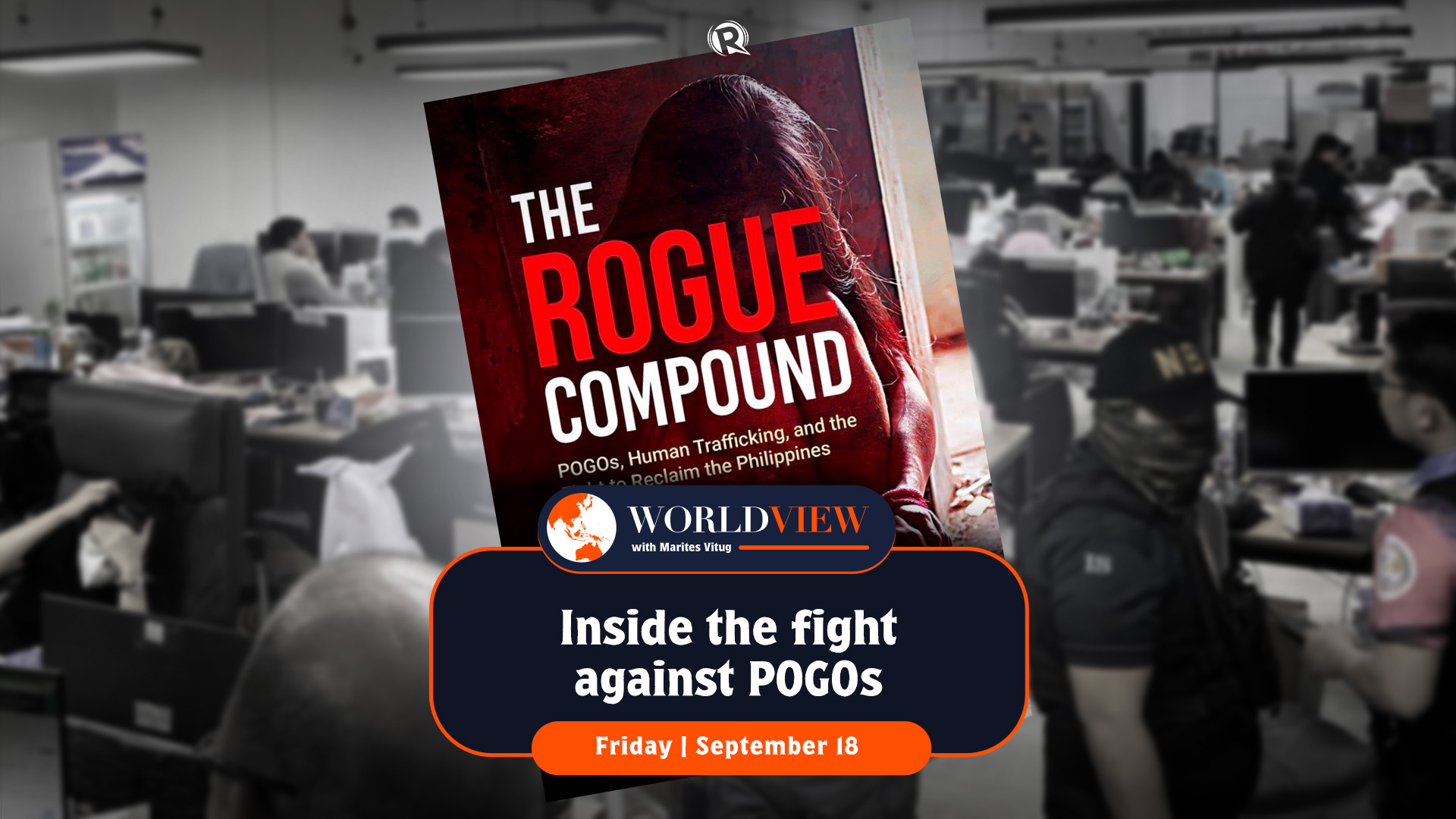
World View with Marites Vitug: Inside the fight against POGOs

Bookmark this page to catch the discussion on Friday, September 18, at 6 pm!

MANILA, Philippines – Scam compounds linked to Philippine offshore gaming operators (POGOs) have become a major organized crime problem in the country, with human trafficking, online scams, and other criminal activities converging in the same operations.

Former Presidential Anti-Organized Crime Commission (PAOCC) officials Winnie Quidato and Winston Casio draw on their experience dismantling scam compounds in their new book, The Rogue Compound: POGOs, Human Trafficking, and the Fight to Reclaim the Philippines.

On Friday, September 18, Rappler editor-at-large Marites Vitug speaks to Quidato and Casio about how scam compounds took root in the Philippines, the challenges law enforcement faced in going after them, and what it takes to dismantle these criminal networks.

Quidato is a retired police officer with decades of experience in intelligence work. He spent three years working to dismantle scam compounds as PAOCC deputy executive director. Casio, meanwhile, is a crime analyst and educator who served as PAOCC spokesperson.

With the Anti-POGO Act now in place, do POGOs still operate underground?

Catch the interview on Thursday at 6 pm! – Rappler.com

Watch more World View episodes:

Similar Posts

  • |

    Iran appoints former revolutionary guards chief Mohsen Rezaei to National Security Council

    TEHRAN: Iran has appointed veteran military and political figure Mohsen Rezaei to a senior position within the country’s Supreme National Security Council (SNSC), replacing Mohammad Baqer Zolqadr and bringing one of the Islamic Republic’s most prominent former Revolutionary Guards commanders back into a central security role. The appointment was announced late Sunday by the office of Iranian President Masoud Pezeshkian’s deputy director of communications. No official explanation was immediately provided for the change, and it remains unclear whether Rezaei’s appointment will result in any significant shift in Iran’s security or foreign policy. Rezaei, 71, has extensive experience in Iran’s military, security and political institutions. He served as commander of the Islamic Revolutionary Guard Corps (IRGC) from 1981 until 1997, a period that included most of the Iran-Iraq war. His return to a prominent security position comes at a particularly sensitive time for Iran, amid continuing tensions with the United States and Israel, as well as uncertainty surrounding the security of the strategically important Strait of Hormuz. The SNSC is one of Iran’s most important institutions for coordinating national security and foreign policy. Although the council is formally chaired by the elected president, it brings together senior military, intelligence and government officials, along with representatives of Supreme Leader Mojtaba Khamenei. Major strategic decisions ultimately remain subject to the authority of the supreme leader. Zolqadr’s short tenure ends Zolqadr had been appointed secretary of the SNSC only in late March. He took over the position following the death of his predecessor, Ali Larijani, who was killed in an air strike during the conflict involving Iran, the United States and Israel. Unlike Zolqadr, Rezaei has maintained a considerably higher public profile over the course of his political career and has frequently spoken on major domestic, economic and foreign-policy issues. In a separate decree issued Sunday, Supreme Leader Mojtaba Khamenei appointed Rezaei as his representative to the SNSC. The decree referred to Rezaei’s extensive experience, including his service during the 1980-1988 Iran-Iraq war. Hardline politician Saeed Jalili also serves as the supreme leader’s representative on the council. The same decree appointed Zolqadr as Khamenei’s political adviser, suggesting that his departure from the SNSC leadership does not represent a complete withdrawal from the country’s senior political establishment. Rezaei’s long political career Rezaei’s career has extended well beyond the military. After leaving his post as IRGC commander, he served for more than two decades as secretary of Iran’s Expediency Discernment Council, an influential body involved in resolving disputes between state institutions and advising the supreme leadership. He later entered the executive branch, serving as vice president for economic affairs from 2021 to 2023 during the administration of former President Ebrahim Raisi. Rezaei also holds a doctorate in economics from the University of Tehran. Despite his academic background, much of his professional life has been spent within Iran’s military, security and political establishment. His appointment therefore places an experienced figure with a long history in Iran’s national security apparatus at the center of a council responsible for coordinating some of the country’s most consequential strategic decisions. Strait of Hormuz remains key issue The leadership change comes as Tehran continues discussions over the future of shipping through the Strait of Hormuz, a critical international energy route. Iranian Foreign Minister Abbas Araqchi said Saturday that Tehran and Oman were nearing an understanding on a possible new shipping route through the strait. The waterway has faced severe disruption during months of conflict and escalating regional tensions. However, Iranian officials have indicated that reopening the route would depend on broader conditions being met. These reportedly include demands related to US compensation for Iran and an end to what Tehran describes as American threats and aggression. Zolqadr had previously outlined several demands, including an end to US threats against Iran, the cessation of military action against Iran and its regional allies, the lifting of sanctions and blockade measures, and the release of Iranian assets. The demands highlight the wider diplomatic and security challenges facing Tehran as it attempts to manage relations with Washington while dealing with continuing regional instability. Policy direction remains uncertain The replacement of Zolqadr by Rezaei does not necessarily indicate an immediate change in Iran’s foreign-policy direction. The SNSC operates within a broader political system in which the supreme leader has ultimate authority over major matters of national security and international affairs. However, Rezaei’s extensive military background and long involvement in Iran’s senior political institutions could make his appointment significant, particularly as Tehran navigates negotiations, military tensions and economic pressure.

  • |

    Democrats select Crowley, Flanagan as Republicans back Demuth in key state races

    Democratic socialist Francesca Hong and moderate David Crowley are locked in an extraordinarily tight contest for Wisconsin’s Democratic gubernatorial nomination, while Minnesota voters selected progressive Peggy Flanagan for the US Senate and Republican Lisa Demuth for governor. With 80 per cent of the votes counted in Wisconsin, Milwaukee County Executive David Crowley held a narrow lead of just a few hundred votes over Hong. The outcome remains too close to call in a race widely seen as a major test of progressive policy appeal in a crucial battleground state. Hong, a state representative and former chef, ran on a platform advocating for the abolition of Immigration and Customs Enforcement (ICE), a temporary moratorium on data centres, and increased corporate taxes. Her campaign faced late scrutiny over past social media posts concerning Thanksgiving, which she subsequently clarified. The victor of the Democratic primary will face Republican nominee US Representative Tom Tiffany in November. In Wisconsin’s 3rd Congressional District, Democrats selected Rebecca Cooke to challenge Trump-aligned Republican incumbent Derrick Van Orden. Cooke, a former small business owner and waitress who has out-fundraised Van Orden, secured backing from the Democratic Congressional Campaign Committee’s “Red to Blue” programme. Across the state line in Minnesota, Democratic voters chose Lieutenant Governor Peggy Flanagan as their US Senate nominee over moderate Representative Angie Craig. Flanagan, who campaigned on dismantling ICE, will seek the seat being vacated by retiring Democratic Senator Tina Smith. In Minnesota’s Republican gubernatorial primary, State House Speaker Lisa Demuth secured the nomination, defeating former MyPillow chief executive Mike Lindell despite his high-profile endorsement from Donald Trump. Demuth now advances to challenge Democratic nominee Senator Amy Klobuchar in the general election.

  • |

    Drone attack near Moscow kills 5, injures 6

    A drone attack in the Moscow region has killed at least five people and left six others critically injured, according to Russian news agencies. The attack reportedly struck an area near the Russian capital, causing a fire inside a warehouse. The blaze added to the damage caused by the drone strike and prompted emergency responders to move quickly to the scene. Rescue workers and medical teams are assisting those affected by the incident, while the injured victims have been taken for medical treatment. Officials have described the condition of six injured people as critical, raising concerns that the death toll could increase in the coming hours. Authorities are assessing the extent of the damage and continuing emergency operations at the site. The exact circumstances surrounding the drone attack, including the origin of the drones and the intended target, have not yet been fully established. The incident comes amid heightened security concerns in and around Moscow, where drone attacks have periodically targeted the Russian capital and surrounding areas. Such incidents have prompted authorities to strengthen air-defence measures and increase security around key infrastructure and industrial facilities. Russian officials are expected to provide further details as emergency teams complete their work and investigators examine the scene. The latest attack has once again highlighted the growing security challenges posed by drone warfare and its potential impact on civilian areas and critical facilities.

  • | | | | |

    Trump says Iran serious about talks but not ready …

    US President Donald Trump has said Iran is showing greater seriousness toward negotiations than before, but cautioned that Tehran is still not prepared to reach a final agreement with Washington. Speaking to reporters at the White House, Trump said communication between the United States and Iran remains ongoing, although the prospects for an immediate breakthrough are still uncertain. According to media reports, the US president noted that Iran’s approach has changed compared with earlier stages of the diplomatic process, describing the country’s current attitude toward negotiations as more constructive. “Iran appears to be taking the talks more seriously than before,” Trump said, while emphasizing that a final deal is not yet within reach. He added that although discussions are continuing, significant progress is still needed before both sides can arrive at a mutually acceptable agreement. Trump said his administration remains committed to pursuing diplomatic efforts and is closely monitoring developments. He stressed that the coming days and weeks would be important in determining whether the ongoing contacts can lead to meaningful progress. The latest remarks come amid continued tensions between Washington and Tehran, with diplomatic channels remaining active despite months of regional instability and military confrontations. While both sides have maintained communication, key differences over major issues have continued to prevent a comprehensive agreement. Neither US officials nor Iranian authorities have announced any new breakthrough in the negotiations following Trump’s comments. Analysts say Trump’s latest assessment may signal cautious optimism, but they also note that complex disputes remain unresolved. They believe any potential agreement would require extensive negotiations and compromises from both sides before a deal could be finalized. For now, Trump’s message suggests that while diplomacy remains alive, expectations for an immediate agreement should remain measured. Observers will be watching closely for any signs of further progress as discussions continue, with the outcome likely to have significant implications for regional stability and US-Iran relations.

Leave a Reply

Your email address will not be published. Required fields are marked *