does your nose

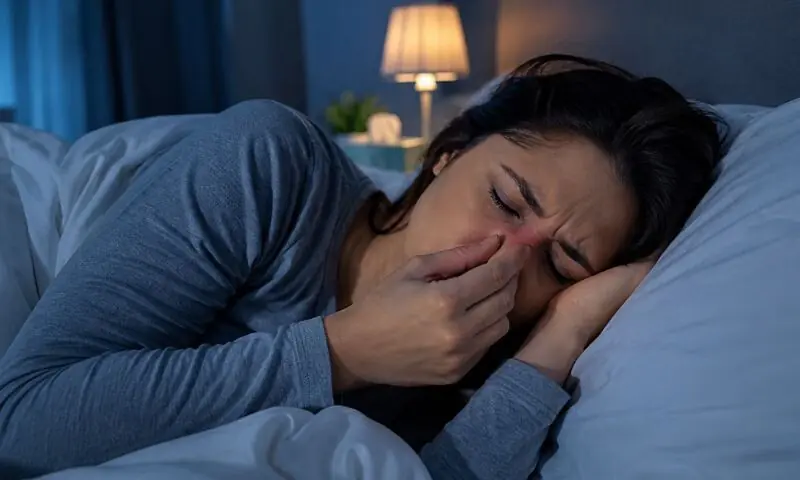
Why does your nose block at Night?

Do you breathe normally during the day but find it harder to breathe through your nose when you lie down at night?

This is a common problem. A blocked nose can disturb sleep, force you to breathe through your mouth and leave you with a dry mouth or sore throat in the morning. Many people think a blocked nose is always caused by a cold or flu. However doctors say there can be several other reasons.

Why does it happen at night?

Dr. Subrata Das of Aster Whitefield Hospital says that natural changes in the body during sleep can make nasal blockage feel worse.

One common reason is sleeping position. During the day when you sit or stand gravity helps mucus drain from the nose.  But when you lie down mucus can collect inside the nose, making breathing more difficult.

Changes in hormones at night may also increase swelling inside the nose. People who already have allergies or nasal inflammation may notice the problem more strongly at bedtime.

The nervous system can also affect the blood vessels and tissues inside the nose. Changes in nerve activity during the night may increase mucus and make the nose feel stuffy.

Allergies may be the cause

If your nose becomes blocked mainly after you get into bed allergies could be responsible.

Dust

dust mites in mattresses and pillows, carpets curtains and damp areas can trigger allergies.  Mold caused by moisture on walls can also lead to a blocked nose, sneezing and itching. Keeping the bedroom clean and dry may help reduce these problems.

Acid reflux can also affect your nose

Acid reflux is another possible cause. Eating a heavy meal and lying down soon afterward can allow stomach acid to move upward toward the throat.

This may cause throat irritation and sometimes make nasal symptoms feel worse.

If you also experience heartburn a sour taste in your mouth frequent throat clearing or a burning throat in the morning it is better to speak with a doctor.

How can you get relief?

The most important step is to find out what is causing the blockage. If allergies are responsible a doctor may recommend a nasal spray or other treatment.

You can also try.

•Keeping your bedroom free of dust

•Washing bed sheets and pillow covers regularly

•Cleaning mattresses and carpets

•Removing mold and moisture

•Avoiding meals just before bedtime

•Using a safe saline nasal rinse if recommended

•Warm salt water gargles may help if you have a sore or irritated throat.

When should you see a doctor?

Occasional nasal blockage is usually not a major concern. But if your nose is blocked every night your sleep is regularly disturbed or you have symptoms such as frequent sneezing facial pain headaches fever breathing problems or ongoing nasal discharge you should see a doctor.

Similar Posts

  • Poor sitting habits may harm your spine

    If you often suffer from back pain or muscle stiffness your sitting posture may be the hidden cause. The good news is that a few simple lifestyle changes can help improve your posture and reduce discomfort. •Why does poor posture happen? In today’s world many people spend hours using laptops computers and smartphones.  Sitting for long periods without moving can make muscles tight weak and unbalanced. Doctors say that constantly looking down at a phone or computer screen puts extra pressure on the neck and upper back. Over time this can lead to poor posture muscle weakness and pain. Poor posture can also develop because of injuries certain medical conditions genetics or jobs that require standing for long hours. •How poor posture affects your health Bad posture does more than cause temporary discomfort. It can lead to. •Neck shoulder and back pain •Muscle stiffness and tension •Reduced flexibility and movement •Weak muscles •Lower back pain •Extra pressure on the spine If ignored for a long time poor posture may increase the risk of spinal problems such as a herniated disc or sciatica. Simple ways to improve your posture The good news is that poor posture can often be corrected with regular practice and healthy habits. Stretch and exercise every day. •Avoid sitting for long hours without taking breaks. Limit unnecessary smartphone use especially if it makes you look down for long periods. Sit with your back straight and shoulders relaxed. Use a cushion to support your lower back while sitting. When standing keep your weight evenly balanced on both feet and avoid locking your knees. Lift heavy objects by bending your knees instead of your back. Choose a supportive pillow that keeps your neck and spine aligned during sleep. Sleep on a comfortable mattress that provides proper support. Adjust your car seat so you can comfortably reach the pedals while driving. On long drives stop every two hours to stretch your legs and move around. Making these small changes every day can improve your posture reduce pain and help protect your spine in the long run.

  • MIT robot can fly and swim

    Researchers at the Massachusetts Institute of Technology (MIT) have created a unique robot that can both fly through the air and swim underwater just like diving birds. The lightweight robot costs around $300 and was designed by MIT’s AeroAquatic Robotics team.  Scientists believe it could one day help monitor oceans study marine life and support environmental protection. The robot was inspired by diving birds which use the same wings to fly in the air and move through water.  While scientists have studied these birds for years building a robot that can perform both tasks efficiently has been a major challenge. To solve this the MIT team carefully studied how diving birds move and used those findings to design the new machine. The robot called the Flapping Aerial Aquatic Vehicle weighs only 250 grams.  It runs on a battery powered motor and has nylon wings and a tail coated with water resistant nanoparticles to protect them from moisture. According to the researchers the robot is programmed to flap its wings at a specific frequency allowing it to move smoothly in both air and water without changing its basic movement. It can fly at speeds of up to 13.4 miles per hour and swim at about 2.2 miles per hour. On a single battery charge it is designed to fly as far as 6 kilometers or swim up to 2 kilometers. The robot was tested for about one year first in a water tank in Massachusetts and later in Lake Geneva Switzerland where researchers evaluated its performance in real world conditions.

  • Human Capital Is Superior to Other Resources

    By Dr. Naveeda Katper Human beings live in a world of countless needs and wants, but the resources available to meet those needs are limited. Food, shelter, education, health and a sense of belonging are among the basic requirements of life. Because resources are scarce, individuals, organizations and governments have to set priorities, make choices and use available resources wisely. Resources can broadly be divided into natural and human-made resources. Natural resources such as land, water, forests, minerals and energy come from nature. Human-made resources, including machines, buildings, technology and infrastructure, are developed by people using natural resources. Natural resources can be depleted, while human-made resources can depreciate through use and time. Human beings, however, are different from other resources. A person is not simply a consumer of resources. With education, training, health and appropriate opportunities, a person can develop knowledge and skills and become an important form of human capital. This is why human capital is often considered more valuable than other resources. Human beings discover, develop and manage resources. They create technology, improve production, solve problems and generate new ideas. Among the traditional factors of production—land, labour, capital and entrepreneurship—human effort remains central because it activates and combines the others. Education and skills are therefore essential for economic and social development. A person without education or employable skills may have limited opportunities to earn a stable income. A skilled person, on the other hand, can use available resources productively and create value for both themselves and society. Skills can take different forms. Hard skills include technical and professional abilities. Soft skills include communication, teamwork, discipline and problem-solving. Transferable skills can be applied across different occupations and workplaces. All of these can improve a person’s ability to participate productively in the economy. Developed economies provide useful examples of how investment in people can contribute to national development. Countries such as Finland, Norway, Singapore, Switzerland, Japan and South Korea have invested substantially in education, vocational training, technology and workforce development. Their experience shows that economic progress is not based only on natural resources or physical infrastructure. The knowledge, skills and productivity of people are equally important. Skills development should begin early in life. Children should not be taught only to memorise information. They should also be encouraged to ask questions, solve problems, make things, experiment and learn from mistakes. An education system that allows children to try, fail and try again can help develop confidence, creativity and practical thinking. Schools, vocational institutions and workplaces all have a role in this process. Young people need opportunities to connect education with practical skills. They should be able to understand how knowledge can be applied to real problems and employment opportunities. The challenge is particularly serious in developing and least-developed countries, where many people have limited access to quality education, technical training and decent employment. Weak educational systems, inadequate infrastructure and limited opportunities for formal employment can prevent large sections of the population from developing their full potential. The problem is not simply unemployment. It is also the gap between what people know and what the economy needs. Many young people complete some level of education but do not acquire the practical or technical skills required by employers. At the same time, businesses often struggle to find workers with the right skills. Pakistan faces a similar challenge. The country has a large and relatively young population, which can become an important economic advantage if the right investments are made. But population size alone does not create economic growth. A large population becomes an asset when people are healthy, educated, skilled and productively employed. The World Bank’s Human Capital Index has repeatedly highlighted the importance of investments in education, health and skills for Pakistan’s long-term economic prospects. Pakistan’s human-capital performance remains below that of many countries that have made stronger and more sustained investments in these areas. Improving the quality of education, expanding vocational training and increasing opportunities for productive employment should therefore be treated as national priorities. Formal education, however, should not be considered the only route to developing human capital. Many adults who did not receive adequate schooling can still acquire useful skills through vocational and technical training. Short courses in areas such as construction, agriculture, livestock, tailoring, information technology, electrical work, plumbing, mechanics, hospitality and other trades can provide people with opportunities to earn a livelihood. Such training should not remain concentrated in major cities. Local training centres and mobile skill programmes can take practical education to towns and villages. Community-level training can help women, young people and adults who cannot easily access conventional educational institutions. Pakistan can also benefit from stronger links between education and the labour market. Training programmes should be designed after identifying the skills actually demanded by local and national economies. Employers, educational institutions and government departments should work together to ensure that training leads to real opportunities rather than certificates alone. The private sector also has an important role. Businesses can provide apprenticeships, internships and on-the-job training. Young people can gain valuable experience when they are given opportunities to learn directly in workplaces. Human capital development should also include lifelong learning. Technology and the nature of work are changing rapidly. Skills that are valuable today may become less relevant tomorrow. Workers therefore need opportunities to update their knowledge and acquire new skills throughout their careers. The central lesson is simple: people should not be viewed merely as consumers of a country’s resources. With proper investment, they become producers, innovators, entrepreneurs, teachers, technicians, researchers and problem-solvers. They create value from resources that might otherwise remain underused. For Pakistan, this is both a challenge and an opportunity. The country’s young population can become a powerful economic resource if it receives quality education, healthcare, practical skills and meaningful employment opportunities. But if these needs are ignored, population growth can increase pressure on already limited resources. Human capital is therefore not a secondary concern. It is one of the foundations of sustainable development. Roads, buildings, machines, technology and natural

  • |

    Post-graduate depression

    No one talks about the depression, hopelessness, and anxiety that fresh university graduates face. They suffer silently, wondering what to do next and how to find opportunities. Even their families often don’t understand what they are going through. Many graduates slowly fade away. They stop talking to friends, lose contact with classmates, and avoid social gatherings. At family functions, relatives ask questions like, “Beta, what are you doing now?”, “How long are you going to stay at your parents’ home?” If it’s a girl, people ask, “When are you getting married?” or “What have you achieved after getting your degree? Have you earned any money? Look at our daughters—they’re married, have two kids, and are happy. Meanwhile, your poor parents are still taking care of you.” When it comes to boys, they face endless questions from uncles and relatives. Many become demotivated. Some dream of moving abroad but don’t have the money to do so. Others try trading after taking advice from friends and sometimes fail. Some start giving home tuition while constantly thinking about how to settle in life and repay their parents, who are getting older every day. This is the reality of our society. Those who can afford it pursue a master’s degree or go abroad for higher studies. Many work overtime just to prove that they are capable of achieving something in life. Otherwise, people label them as a burden on their parents. Many daughters are pressured into marriage instead of being allowed to pursue private jobs. If they want to build a career, they are expected to prepare for competitive government exams. Even after 14 or 16 years of education, they still have to study further to clear exams like CSS or PPSC. Only then do parents and society begin to appreciate them, and their names are respected. Otherwise, to society, you are just another university graduate—and that’s all.

  • Hair dye after Cancer treatment

    For many cancer survivors seeing their hair grow back is more than a cosmetic change. It is a sign of recovery and a return to normal life. As new hair appears many people want to cover gray hair or try a new color. However health experts say it is important not to rush into using hair dye. Chemotherapy and radiation are designed to destroy fast growing cancer cells but they also affect healthy hair follicles. This is why many patients lose their hair during treatment. When hair grows back it is often thinner softer, drier and more sensitive than before. The scalp may also remain delicate for several months. Doctors warn that using permanent hair dye too soon after treatment can irritate the scalp cause allergic reactions and damage new hair. It may also slow healthy hair growth while the scalp is still healing. Several studies have looked at the possible risks of hair dye. A large study by the US National Institute of Environmental Health Sciences involving more than 46,000 women found that frequent use of permanent hair dye and chemical hair straighteners was linked to a slightly higher risk of certain types of breast cancer. Another long term study by the Harvard T.H. Chan School of Public Health, which followed more than 117,000 women over 36 years found that hair dye did not increase the risk of most cancers. However long term use of permanent dyes was linked to a small increase in the risk of some types of breast skin and ovarian cancers. Experts advise cancer survivors to carefully read the ingredients before buying any hair dye. Chemicals such as PPD (para-phenylenediamine), ammonia, hydrogen peroxide parabens, and phthalates may be harmful to sensitive skin and newly grown hair. Most doctors recommend waiting at least six months after completing chemotherapy before using permanent hair dye. This gives the scalp and hair enough time to recover. Patients who had scalp cooling or radiation to the head should only use hair dye after getting approval from their doctor. During the first six months after treatment experts suggest avoiding chemical hair dyes and keeping the scalp well moisturized.  Even after six months patients should speak with their oncologist before coloring their hair. Safer options include pure henna or natural herbal dyes that do not contain added chemicals. Ammonia free and peroxide-free semi permanent dyes may also be suitable.  Temporary root powders and color mascaras are another option because they wash out with shampoo. Experts also recommend doing a patch test 48 hours before using any hair color to check for allergies or skin irritation. Whenever possible choose coloring methods that reduce direct contact between the dye and the scalp. Doctors say that caring for your hair again after cancer treatment is an important step in recovery. However taking a careful approach choosing safer products and speaking with your doctor first can help protect your hair and scalp while they continue to heal.

  • Kimchi may help remove microplastics

    Scientists are studying whether kimchi a popular Korean fermented food could help the body remove harmful microplastics. Early research suggests that certain beneficial bacteria found in kimchi may attach to tiny plastic particles during digestion making it easier for the body to remove them through waste. Microplastics are extremely small pieces of plastic that have already been found in human blood lungs and even the placenta. People can take them in through food drinking water and the air they breathe raising concerns about their possible health effects. In the study researchers examined a type of lactic acid bacteria taken from kimchi. They tested it in mice and found that animals given the probiotic passed nearly twice as many microplastic particles in their waste compared with those that did not receive it. Laboratory tests also showed that the bacteria attached to about 57% of the microplastic particles suggesting it may help remove them from the body. However researchers stressed that these findings are still preliminary.  The study does not prove that eating regular kimchi will have the same effect in humans. More clinical studies are needed before scientists can confirm whether kimchi or its beneficial bacteria can help reduce microplastics in the human body.

Leave a Reply

Your email address will not be published. Required fields are marked *