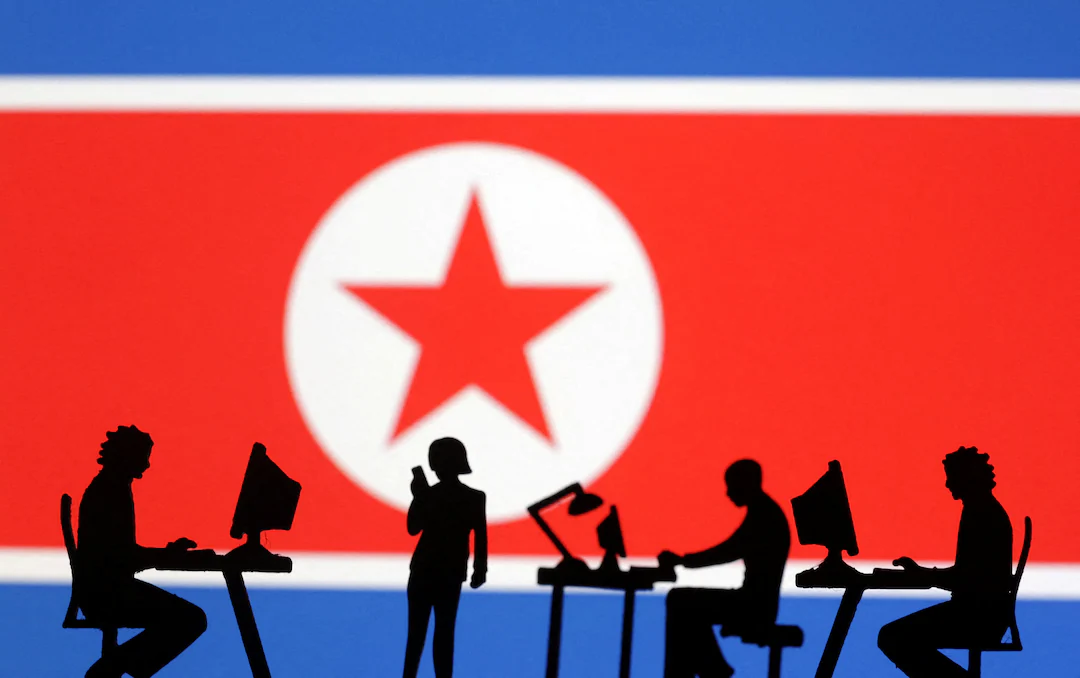
north korean hackers
|

North Korean hackers develop AI tools for cyberattacks

SEOUL: A North Korean-linked hacking group has reportedly expanded its use of artificial intelligence to strengthen cyberattacks, automate operations and analyse stolen data.

The group, identified as Kimsuky, has developed and collected a range of AI-related tools that could help its operators conduct attacks more efficiently, according to a South Korean cybersecurity company.

The company said it discovered infrastructure linked to Kimsuky containing several programs designed to run and manage artificial intelligence models locally. These included Ollama, GPT4All and Msty.

The hackers also appeared to be using retrieval-augmented generation technology. The system can help AI models search and process large collections of documents.

Researchers said the use of locally operated AI models could allow the group to analyse sensitive information without sending data to external AI services. This could give hackers greater control over stolen material and reduce their reliance on third-party platforms.

The investigation also uncovered AI agent development frameworks, speech-to-text software and an AI-assisted coding tool called Cursor.

According to the cybersecurity firm, the findings indicate that Kimsuky may be moving beyond the simple use of generative AI for creating phishing messages.

The group could now be seeking to integrate existing AI models into different stages of its cyber operations. These may include malware development, stolen-data analysis and attack automation.

Researchers also identified documents related to finance and cryptocurrency on the infrastructure. Some of the files appeared to have been generated using artificial intelligence.

The documents were designed to look like legitimate investment reports and other professional workplace material. Such files could potentially be used as decoys or to make malicious campaigns appear more credible.

The findings have not been independently verified. However, cybersecurity researchers and government agencies have repeatedly linked North Korean state-backed groups to international cyber operations.

North Korean cyber units have been accused of conducting espionage campaigns, stealing money and targeting cryptocurrency-related assets. Authorities in the United States and South Korea have previously warned about the activities of such groups.

Kimsuky has long been associated with cyber-espionage operations targeting governments, organisations and individuals. The group has also been accused of gathering intelligence to support North Korea’s strategic interests.

The latest findings point to a growing role for artificial intelligence in cyber operations. Security researchers have warned that AI tools can make phishing campaigns more convincing and help attackers process information and develop malicious software more quickly.

Similar Posts

  • |

    France’s top court blocks social media ban for under-15s

        France’s Constitutional Council, the country’s highest constitutional authority, has rejected a proposed law that would have banned children under the age of 15 from accessing social media. The decision represents a setback for President Emmanuel Macron, who had strongly supported measures aimed at protecting young people from the potential harms of social media. The proposed legislation would have prevented children below 15 from creating social media accounts from September 1. It also required social media companies to close accounts belonging to existing under-15 users within four months. Platforms would have been required to introduce an age-verification system approved by France’s privacy regulator to determine whether users met the minimum age requirement. However, the Constitutional Council ruled that important parts of the legislation did not provide sufficient legal safeguards. In particular, the council objected to the requirement that users prove their age without clearly defining the conditions and limits surrounding the collection and use of such information. According to the council, the legislation placed disproportionate restrictions on freedom of expression and communication. It also failed to adequately protect individuals’ right to privacy. The ruling effectively prevents the law from coming into force in its original form. French lawmakers had approved the legislation in July, making France one of the first European countries to pursue such a comprehensive restriction on social media use by young teenagers. The move followed Australia’s decision to introduce a world-first social media ban for children under 16 in December. The Australian restrictions cover major platforms such as Facebook, Snapchat, TikTok and YouTube. Australian lawmakers are now considering stronger penalties for companies that fail to comply, although early data has indicated that the ban has had mixed results. Several other countries have also taken steps to restrict young people’s access to social media. China, the United Arab Emirates and Türkiye have introduced measures or discussed plans aimed at limiting children’s access to online platforms. At the European Union level, authorities have also indicated that stronger protections may be needed to shield children from harmful features and content on social media platforms. Major technology companies have generallyFrance’s Constitutional Council, the country’s highest constitutional authority, has rejected a proposed law that would have banned children opposed blanket restrictions, arguing that they already provide tools and age-based safeguards to protect younger users. At the same time, companies have indicated that they would follow government regulations where required. Google, Meta, Snap and TikTok had not immediately issued comments on the French court’s decision. Following the ruling, Macron instructed Prime Minister Sebastien Lecornu to revise the proposed legislation and address the Constitutional Council’s concerns. The Elysee Palace said the French president remains committed to introducing the reform. The government wants a revised version of the legislation to take effect before spring 2027, when France is scheduled to hold its next presidential election. Macron is constitutionally barred from seeking a third consecutive term, making the issue a significant part of his government’s remaining agenda.

  • | | |

    Fazl says Naqvi couldn’t speak without PM&#8…

    Jamiat Ulema-e-Islam (F) chief Maulana Fazlur Rehman has said Interior Minister Mohsin Naqvi could not have made recent remarks without consulting the prime minister, while calling for a national policy to address the country’s political and administrative challenges. Addressing a press conference in Quetta, Fazlur Rehman said there was no comprehensive national policy to improve the country’s current situation. He said the proposal to create new provinces should be considered carefully in light of Pakistan’s administrative structure and overall capacity. He said creating new provinces was not a bad idea in principle, but stressed that it was not a simple process and required serious consideration of the country’s political, constitutional and financial realities. The JUI-F chief alleged that new political debates were often introduced to divert public attention from pressing national issues. He urged Mahmood Khan Achakzai to convene a meeting of the joint opposition to discuss the country’s political situation. Fazlur Rehman said if such a meeting was not called, his party would organize a broader national-level conference to deliberate on the challenges facing the country. He warned that democracy could not flourish if governments continued to be formed according to individual preferences rather than the public mandate. He further said democratic institutions had weakened and Parliament was no longer functioning effectively. According to him, Pakistan must be governed strictly in accordance with the Constitution to restore public confidence. Calling for a fair and nationally inclusive policy, Fazlur Rehman said the country needed governance based on justice and equality. He also confirmed that JUI-F had decided not to join the government in Balochistan. Commenting on provincial politics, he said JUI-F remained the country’s largest public political movement and added that he had no knowledge of any proposal regarding Abdul Malik Baloch becoming the next chief minister of Balochistan.

  • | | | | | | |

    [OPINION] What America’s AI boom teaches us about scrutinizing Pax Silica

    Communities across the United States are already grappling with soaring electricity demand, opaque utility agreements, environmental concerns, and questions over promised jobs. Before Pax Silica breaks ground, if ever, Filipinos should learn from those experiences.

  • |

    Colombia requests US joint military operations against cartels under new president

    US Defense Secretary Pete Hegseth announced that the newly inaugurated government of Colombian President Abelardo de la Espriella has formally requested US collaboration in joint military operations within Colombia to combat drug trafficking organizations. Speaking in Panama City during a meeting of the Americas Counter-Cartel Coalition, Hegseth confirmed that Colombia will join the US-led “Shield of the Americas” regional counter-narcotics initiative as its 19th member nation. De la Espriella, a conservative leader sworn into office last week, has taken a hardline stance against armed groups, reversing the policy direction of his predecessor, Gustavo Petro. Hegseth also urged participating Latin American nations to reject the jurisdiction of the International Criminal Court (ICC). Addressing legal scrutiny surrounding recent US military strikes against suspected regional drug networks, Hegseth maintained that US counter-cartel actions fully comply with international humanitarian law.

  • |

    Philadelphia man indicted on federal civil rights charges in anti-Islamic arson attack

    Federal prosecutors have indicted 60-year-old Vincent Lang of Philadelphia for deliberately setting fire to the Northeast Philadelphia Islamic Center. A federal grand jury charged Lang with one count of malicious damage by fire to a building used in interstate commerce and one count of damage to religious real property. The Department of Justice confirmed that the indictment explicitly alleges Lang carried out the arson because of the religious character of the building, specifically targeting it because it was a Muslim place of worship. According to court documents and surveillance footage, the perpetrator approached the mosque on Tyson Avenue during the early hours of 5 July, ignited an improvised incendiary device, and threw it into the entryway. Local authorities reported that no injuries occurred during the blaze. Lang has remained in federal custody following his initial arrest on 16 July. If convicted on the federal civil rights charges, he faces a mandatory minimum of five years in prison and up to a maximum penalty of 40 years.

  • |

    UN warns Afghanistan’s child malnutrition crisis deepens

    Afghanistan is facing a rapidly worsening malnutrition emergency as severe funding cuts leave millions without life-saving assistance, the United Nations has warned. Speaking from Kabul, the World Food Programme’s (WFP) Afghanistan Director John Aylieff said the country’s nutrition crisis is escalating at an alarming pace, with growing numbers of severely malnourished children reaching health facilities too late to receive effective treatment. He said child wasting, the deadliest form of malnutrition, has now reached critical levels in nearly one-third of Afghanistan’s provinces. According to the WFP, ongoing conflict, disruptions to trade, the return of thousands of Afghan migrants from neighbouring countries, and shrinking international aid have combined to create an unprecedented humanitarian emergency. The UN official said last year recorded the sharpest annual increase in malnutrition cases, while the situation has deteriorated even further in 2026. Children under the age of two account for around 80 percent of the most severe cases, highlighting the devastating impact on the country’s youngest and most vulnerable population. Aylieff said the WFP has only enough resources to provide treatment to one out of every seven acutely malnourished women and children this year. The remaining six are forced to leave without assistance because of a severe shortage of funds. He warned that the cries of starving children in Afghan health centres reflect a preventable tragedy that could claim countless more lives if emergency funding is not secured. The humanitarian agency also expressed concern that widespread hunger could fuel migration, instability and extremism, stressing that a stable Afghanistan remains important for regional security. Millions of Afghans have also returned from neighbouring countries, including Pakistan and Iran, over the past three years, placing additional pressure on already overstretched resources. Although this year’s harvest has improved, the gains have been overshadowed by the country’s worsening economic and humanitarian challenges. The WFP estimates that nearly 14 million Afghans are currently experiencing acute hunger. However, funding shortages have limited food assistance to only a small fraction of those in need, while preventive food distribution programmes in high-risk areas have been suspended.

Leave a Reply

Your email address will not be published. Required fields are marked *