colombia8217s death toll
| |

Colombia’s death toll from earthquake climbs…

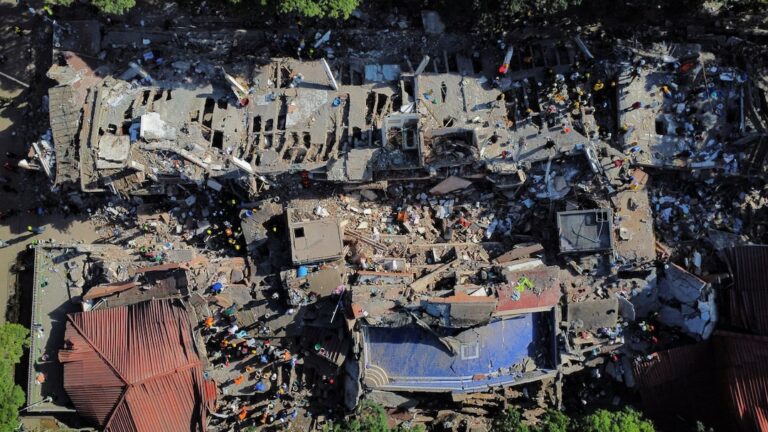
Rescue crews continue combing through collapsed buildings across western Colombia after a powerful magnitude 7.4 earthquake struck the region on Monday, August 10, with officials confirming the death toll has risen to at least 164 people.

Authorities said more than 880 people have sustained injuries, while over 3,200 remain unaccounted for as soldiers, emergency responders and local volunteers work through debris from dozens of collapsed structures. Thousands of residents have been forced from their homes since the quake struck, adding to the scale of the humanitarian response now underway.

The earthquake flattened multi story buildings in cities including Pereira and Cali, and severely damaged one of the towers of a historic cathedral in Manizales. The tremor originated at an intermediate depth with its epicenter located near San José del Palmar in the western department of Chocó, causing widespread destruction across Pereira, Cali, Manizales and other communities in Colombia’s coffee growing region.

Residential buildings, hospitals, schools and key infrastructure, including several regional airports, all suffered severe damage in the quake. At one city hospital, several upper floors, including sections dedicated to pediatric care, collapsed inward, trapping some patients inside and forcing hospital staff to treat roughly 600 additional patients outdoors on a street littered with debris, according to hospital director Irne Torres Castro, who spoke to a Colombian television network.

That same city saw some of the earthquake’s most extensive destruction, with entire residential blocks reduced to piles of concrete and twisted metal. Video circulating online captured buildings shaking violently as residents fled into the streets, while separate footage showed a regional airport swaying dramatically during the quake as large sections of ceiling came down around people sheltering inside.

Among the most widely shared images online is footage showing the Cathedral Basilica of Our Lady of the Rosary shaking and partially collapsing. The cathedral, built in the 1920s, holds the distinction of being Colombia’s tallest cathedral and ranks among the highest neo Gothic churches anywhere in the Americas.

The disaster struck just days after Abelardo De La Espriella was sworn in as Colombia’s president, immediately confronting his new administration with a major crisis. The earthquake also comes with memories still fresh of a pair of devastating earthquakes that struck neighboring Venezuela in June.

Colombia’s national government has declared a state of emergency and mobilized the military, police and specialized rescue units to lead recovery operations, while accepting offers of international assistance as the search for survivors continues.

The disaster adds to a string of major seismic events across the region in recent months, underscoring the ongoing vulnerability of Andean nations to powerful earthquakes and the strain such disasters place on emergency infrastructure even in areas with established disaster response systems.
Similar Posts

  • | |

    Ebola outbreak becomes Congo’s deadliest, death …

    KINSHASA: The Democratic Republic of Congo is facing its deadliest Ebola outbreak on record, with the death toll reaching 2,325 and confirmed infections climbing to 4,945, according to the latest government figures. The outbreak, declared on May 15, has now surpassed the 2,299 deaths recorded during Congo’s previous worst Ebola epidemic from 2018 to 2020. Health authorities also reported 101 new confirmed cases in a single day, highlighting the rapid spread of the disease. The current outbreak is the country’s 17th and has already become its largest in terms of confirmed cases. Only the devastating West African Ebola epidemic of 2014–2016, which killed more than 11,000 people across Guinea, Liberia and Sierra Leone, has recorded a higher overall toll. Health officials say the outbreak is being driven by major challenges, including weak healthcare infrastructure, insecurity and resistance within some communities. Delays in detecting infections and getting patients into medical care are also contributing to the high death rate. The case fatality ratio has climbed sharply to 46%, compared with around 20% in early June. Public health experts caution that the increase does not necessarily mean the virus has become more deadly. Instead, they say many patients are being identified only after their condition has severely deteriorated or after death. The outbreak is being caused by the Bundibugyo species of Ebola, for which there are currently no approved vaccines or specific treatments. Researchers are assessing experimental vaccines and therapies, but available evidence remains limited. Ebola is transmitted through direct contact with the bodily fluids of infected people, including those who have died from the disease. Symptoms can include fever, vomiting and diarrhoea, while severe infections may lead to internal or external bleeding. The outbreak also crossed into neighbouring Uganda, where authorities confirmed 20 cases and two deaths before declaring the outbreak over last month.

  • | |

    Lahore building collapse kills 10, several critica…

    At least 10 people lost their lives and several others were injured after a three-storey residential building collapsed in Lahore’s Baghbanpura area late Wednesday night, prompting a large-scale rescue operation. Emergency teams rushed to the scene shortly after the incident and recovered 16 people from beneath the debris. Six victims were pronounced dead at the site, while the remaining injured were shifted to nearby hospitals. Four more later died from their injuries, raising the death toll to 10. Rescue officials said four people remain in critical condition and are receiving treatment, while two injured victims have been discharged after medical care. Search teams continued clearing the rubble to ensure no one remained trapped. According to preliminary findings, the roof of the ageing building collapsed at around 10:15pm, causing the entire structure to cave in. Members of an extended family living on different floors were inside the building when the collapse occurred. Police and rescue workers immediately launched a coordinated operation, using heavy machinery and manual equipment to search for survivors. Authorities said the exact number of people inside the building at the time of the collapse is still being determined. Punjab Chief Minister Maryam Nawaz expressed grief over the loss of lives and directed senior officials to monitor the rescue and relief efforts. The city commissioner visited both the accident site and the hospital to review the situation and meet the injured survivors. Local lawmakers also visited the area and assured affected families that all possible assistance would be provided during the rescue operation and rehabilitation process. The latest tragedy has renewed concerns over the safety of old and deteriorating buildings in Lahore. It comes only weeks after a deadly roof collapse at a private tuition centre in Kahna claimed the lives of 14 children. Following that incident, provincial authorities had ordered safety inspections of educational institutions and other ageing structures.

  • |

    Colombia earthquake death toll crosses 250

    The death toll from a powerful earthquake in western Colombia has crossed 250 as rescue teams continue searching through collapsed buildings for survivors. The 7.4-magnitude earthquake struck the country’s coffee-growing region early Monday. It caused widespread destruction across several cities and surrounding areas. Local authorities reported that at least 254 people had died by Tuesday morning. Pereira recorded 101 deaths, while 95 fatalities were reported in Cali, Colombia’s third-largest city. Rescue workers have been operating around the clock in the worst-hit areas. They are using cranes, excavators and heavy machinery to remove huge sections of concrete. In some locations, rescuers have been forced to work with their hands. Volunteers have also joined the search, forming human chains to move debris away from collapsed structures. Families have gathered near damaged buildings while waiting for news of relatives who may still be trapped. Rescue workers have reported finding both survivors and bodies beneath the rubble. The earthquake severely damaged homes, apartment buildings, schools and medical facilities. Some structures were completely destroyed, while others were left unstable and unsafe for residents. Cali suffered major damage. Several upper floors of a hospital collapsed, including areas used for paediatric treatment. Hospital officials said some patients became trapped, while hundreds of others were treated outside the damaged facility. The city’s morgue reached capacity as authorities continued bringing in victims from affected areas. Medical and emergency services have been working under difficult conditions. The United Nations humanitarian office estimated that around 5,000 homes had been damaged. Dozens of buildings collapsed, while hundreds of other residences were destroyed or seriously affected. The earthquake also disrupted essential infrastructure. Electricity, water supplies, healthcare services and telecommunications were affected in several areas. Authorities also closed six airports because of damage. Roads were damaged in multiple locations, creating additional difficulties for rescue teams and the delivery of emergency supplies. The region near the epicentre has faced particularly severe disruption. Poor communications have made it difficult for authorities to assess the full scale of the disaster. Nearly 100 aftershocks were recorded by Tuesday morning. Officials have warned residents and rescue workers to remain cautious as damaged buildings could collapse during further tremors. President Abelardo De La Espriella visited the affected region and announced a three-month economic relief measure for residents of Risaralda. The government said the initiative was intended to support people and businesses affected by the disaster. International assistance has also begun. The United States announced $15.5 million in emergency support for shelter, food, protection and damage assessments. The Inter-American Development Bank said $50 million could immediately be made available for reconstruction support if requested by the Colombian government. The United Nations said it was expanding its presence in the affected region to support humanitarian operations. Officials cautioned that the final death toll and overall scale of the destruction could take several days to establish because communications remain disrupted in some of the hardest-hit areas.

  • | |

    Mathira and Sahiba’s runway walk goes viral after near falls

    Pakistani showbiz personalities Mathira and Sahiba have become the centre of attention on social media after videos from a fashion show went viral. The videos were widely shared by users. However, their runway walk itself was not the main reason for the attention. Instead, viewers focused on several incidents that took place during the fashion show. Mathira and Sahiba were among several celebrities who walked the runway during the event. The show featured a number of participants who appeared on the catwalk one after another. However, several participants struggled to maintain their balance while walking. Some were seen stumbling. Others appeared to come close to falling. The unusual moments were captured on video. The clips were later shared across social media platforms. The videos quickly attracted the attention of users. Many viewers began discussing the condition of the runway. Several social media users claimed that the runway appeared uneven. They suggested that its condition may have made it difficult for participants to walk properly. Some viewers questioned whether the runway had been properly inspected before the fashion show. Others criticised the event organisers. They said the catwalk should have been checked carefully before participants were allowed to walk on it. One social media user claimed that the runway was visibly damaged. The user said the problem should have been identified and fixed before the event. Another user pointed out that several participants appeared to struggle while walking. The comments were not limited to criticism of the organisers. Some users also discussed the skills required for runway walking. They argued that walking confidently on a fashion runway requires professional practice and training. According to these users, models and celebrities need to be comfortable with different types of catwalk surfaces. The viral videos have generated mixed reactions online. Some users focused on the condition of the runway. Others commented on the participants’ walking techniques. The incident has also raised questions about safety arrangements at fashion events. A properly prepared runway is important for participants because even a minor surface problem can affect their balance. The videos continue to circulate on social media. Users are sharing the clips while offering different explanations for what happened. Neither Mathira nor Sahiba’s runway appearance was the only part of the event discussed online. Instead, the moments when participants stumbled became the main talking point. The incident has once again highlighted how quickly unusual moments at entertainment events can attract attention on social media.

  • Anutin Apologises for Hat Yai Flood Management

    Prime Minister Anutin Charnvirakul has publicly apologised for the government’s failure in managing the catastrophic floods in Hat Yai, acknowledging its responsibility and pledging to restore normality for affected residents as swiftly as possible. During his fourth visit to the stricken city in a week, the Prime Minister faced complaints from locals about the state’s […]

  • | | |

    Iran warns of regional oil disruption

    Iranian Parliament Speaker and senior negotiator Mohammad Bagher Ghalibaf has issued a strong warning over the escalating tensions in the region, saying that if Iran cannot safely export its oil, no other country in the region should expect to continue selling oil without facing consequences. In a statement, Ghalibaf warned that regional security cannot remain selective. He said that unless Iran’s security and interests receive protection, critical infrastructure across the region could also face serious risks. Ghalibaf also argued that ensuring the security of the Strait of Hormuz requires the absence of U.S. military forces from the area. The strategically important waterway serves as a major route for global energy shipments, making any threat to its stability a matter of international concern. The warning comes amid heightened tensions between Iran and the United States. After U.S. President Donald Trump reportedly threatened to target Iranian power plants and bridges, Iranian officials responded with warnings that they could strike bridges and other critical infrastructure in countries across the region. A senior Iranian official also claimed that the United States should have learned from the recent 10-day conflict that Iran has the capability to launch attacks wherever it chooses. The remarks reflect Tehran’s increasingly forceful stance as tensions continue to rise and both sides exchange threats over military targets and regional security. The latest statements have raised further concerns about the potential for the conflict to spread beyond Iran and directly affect vital infrastructure and energy routes throughout the Middle East.

Leave a Reply

Your email address will not be published. Required fields are marked *