abrar hussain tanoli

Abrar Hussain Tanoli honoured with Tamgha-e-Imtiaz for Hajj services

RIYADH: Abrar Hussain Tanoli, a Pakistani financial professional based in Saudi Arabia and a native of Mansehra district in Khyber Pakhtunkhwa, has been honoured with the prestigious Tamgha-e-Imtiaz in recognition of his decade-long services to Pakistani pilgrims and the wider Pakistani community in the Kingdom.

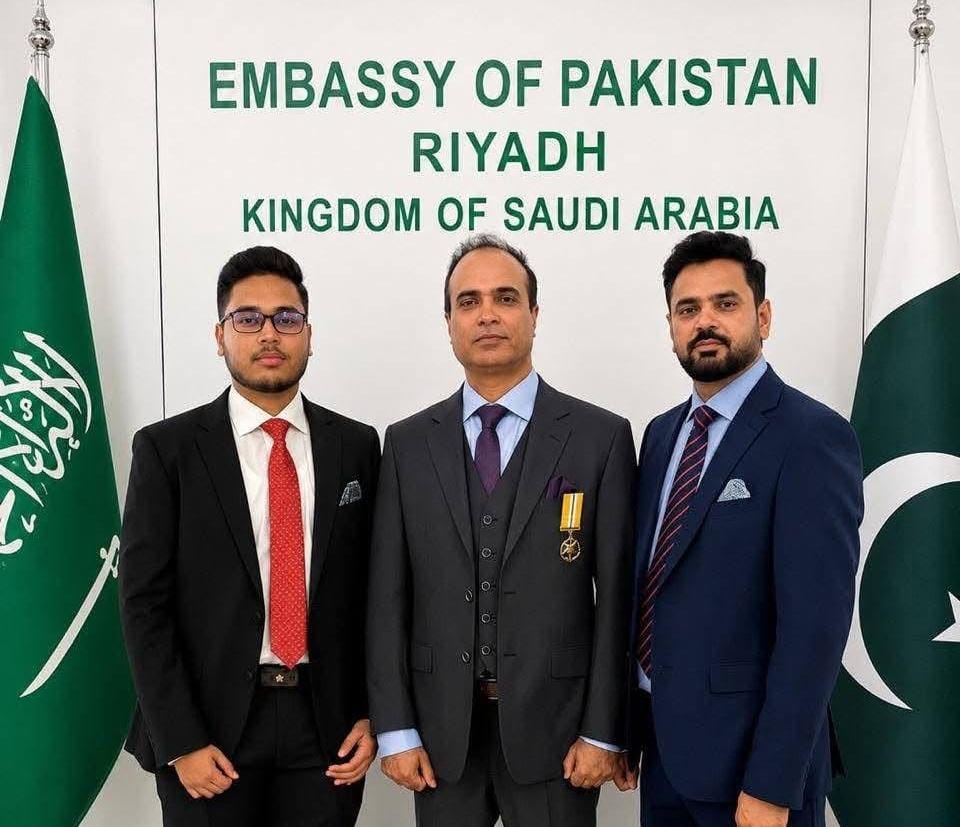
Tanoli was among the Pakistani nationals honoured with the prestigious civil award for outstanding social and community services in Saudi Arabia. The award was presented at a special ceremony organised by the Embassy of Pakistan in Riyadh.

Pakistan’s Ambassador to Saudi Arabia, Ahmed Farooq, presented the award on behalf of President Asif Ali Zardari, recognising Tanoli’s sustained contribution to Hajj volunteerism, community welfare, healthcare initiatives and emergency assistance.

Tanoli is a founding member and Riyadh Coordinator of the Pakistan Hajj Volunteers Group (PHVG), an organisation that has been assisting pilgrims during Hajj since 2011. Over the years, he has played a key role in mobilising, coordinating and training Pakistani volunteers from different parts of Saudi Arabia to facilitate pilgrims during the annual pilgrimage.

The volunteers provide assistance to pilgrims in a range of situations, including guiding them to their designated tents, helping wheelchair users, facilitating movement around Hajj facilities and assisting sick and injured pilgrims in performing Tawaaf-e-Ziyarah while receiving treatment at Pakistan Medical Mission facilities.

PHVG works in coordination with the Pakistani Hajj Mission, Embassy of Pakistan and relevant Saudi authorities. In 2024, the organisation mobilised and trained more than 1,500 volunteers to serve pilgrims, with their services also receiving recognition from Saudi authorities.

Speaking at the ceremony, Ambassador Ahmed Farooq highlighted the demanding nature of the volunteers’ responsibilities during Hajj. He said the volunteers remain engaged around the clock during the five days of Hajj and continue serving pilgrims despite the challenging weather and extreme heat.

He said volunteers assist pilgrims who require medical attention, become separated from their groups or need wheelchairs and other support. Their services, he noted, are not limited to Pakistani pilgrims and are available to anyone who requires assistance.

The ambassador said the Saudi Ministry of Hajj and Umrah also facilitates the volunteers by providing information about pilgrims requiring assistance, reflecting the importance attached to their services during Hajj.

“We are very proud of all three of you for the work that you have done and for the good way that you have carried out these services,” Ambassador Farooq said.

For Abrar Tanoli, the Tamgha-e-Imtiaz represents recognition not only of his Hajj volunteerism but also of a broader record of community service spanning more than a decade.

Alongside his Hajj-related activities, Tanoli has been involved in organising free medical camps for the Pakistani community in Saudi Arabia in collaboration with the Pakistan Doctors Group and the Embassy of Pakistan. These initiatives have helped provide healthcare services to members of the community, particularly those requiring support.

He is also a founding member of the Al-Bir Group, which provides assistance to Pakistanis facing financial difficulties and other social challenges.

Tanoli’s community welfare activities became particularly significant during the COVID-19 pandemic. Through PHVG, he participated in efforts to support Pakistani families stranded or facing difficulties during the crisis. Volunteers helped arrange and distribute food, medicines and other essential supplies to families struggling to meet their basic needs.

His welfare work has also extended to Pakistan, where he continues to support underprivileged families, deserving individuals and communities facing financial hardship.

The recognition has been warmly welcomed by members of the Pakistani community, who described the award as an honour for Tanoli, his family and his native area in Mansehra. Messages of congratulations have highlighted his services to Pakistani pilgrims and the wider community in Saudi Arabia.

The award is also being seen as recognition of the spirit of volunteerism among overseas Pakistanis who devote their time and resources to serving fellow citizens and pilgrims.

Tanoli’s journey reflects a sustained commitment to public service alongside his professional career in the financial sector. From assisting Hajj pilgrims and supporting medical camps to providing emergency relief and helping families facing financial difficulties, his community work has remained an important part of his contribution to Pakistanis in Saudi Arabia and at home.

The Tamgha-e-Imtiaz therefore marks a significant national recognition of Abrar Hussain Tanoli’s long-standing services to pilgrims, community welfare and humanitarian assistance.

Similar Posts

  • CM sets up clean drinking water camps for flood victims

    Lahore – On the directions of Punjab Chief Minister Maryam Nawaz Sharif, the Muridke administration has established clean drinking water camps for flood-affected people. The supply of safe drinking water is continuing in the flood-hit areas of Muridke and Ferozewala. Bottled drinking water is being distributed to flood victims at the camps. Meanwhile, field staff of the Punjab Saaf Pani Authority has reached Khan Colony, Ferozewala, to facilitate and assist the affected residents by ensuring the provision of clean drinking water.

  • | |

    Bugti offers militants rehabilitation, warns of co…

    QUETTA: Balochistan Chief Minister Sarfraz Ahmed Bugti on Friday announced that the provincial government is ready to hold political dialogue with those willing to abandon violence, while making it clear that security operations against armed militant groups will continue until peace is restored. Speaking at the passing-out parade of the Anti-Terrorism Force’s 20th basic training course in Quetta, the chief minister said individuals who surrender and renounce militancy would be given an opportunity to rebuild their lives through a comprehensive rehabilitation programme. Under the government’s reintegration plan, former militants will be offered government employment, educational opportunities for their children and access to healthcare facilities to help them become productive members of society. He said the initiative aims to encourage peaceful participation in the province’s development. However, Bugti warned that those who continue armed activities would face firm action. He said the provincial government, Pakistan Army, Frontier Corps, police, Counter Terrorism Department and Anti-Terrorism Force were working together to eliminate terrorism and restore lasting peace across Balochistan. Referring to the recent rise in militant attacks, the chief minister acknowledged that the province’s security challenges had intensified in recent years but expressed confidence that ongoing counterterrorism operations would defeat militant groups. Bugti also urged political leaders to avoid linking political disagreements with acts of terrorism. While criticism of the government was part of the democratic process, he said attacks on the country’s security forces should not be justified or politicised. Addressing the newly graduated ATF personnel, the chief minister praised their commitment to national service and described them as guardians responsible for protecting the people and maintaining peace. He added that the government was reviewing measures to further strengthen the professional training of security personnel to meet emerging security challenges. The chief minister also announced Rs150 million for improving the Anti-Terrorism Force training school’s infrastructure and highlighted recent steps taken to enhance benefits and welfare packages for police personnel and the families of martyred officers, reaffirming the government’s commitment to strengthening law enforcement institutions.

  • | |

    Pakistani Mountaineer Sohail Sakhi’s body shifte…

    The body of Pakistani mountaineer Sohail Sakhi, who lost his life in a tragic avalanche accident on Broad Peak, has been transported to Skardu by an Army Aviation helicopter. Sohail Sakhi was among the climbers caught in a devastating avalanche that struck Broad Peak in the early hours of July 31. The incident occurred during the night between July 30 and 31, when a massive avalanche swept across the mountain, leaving 10 mountaineers missing, including nine foreign climbers. Following the accident, rescue and recovery efforts were launched in the difficult and dangerous conditions of the Broad Peak region. The mountain, located in the Karakoram range of Gilgit-Baltistan, is one of the world’s highest peaks and is known for its challenging terrain, extreme weather and unpredictable climbing conditions. Sohail Sakhi was among the climbers who could not survive the disaster. His body was recovered from the mountain and later transported to Skardu, an important hub for mountaineering expeditions in the region. The use of an Army Aviation helicopter helped facilitate the transfer of the body from the remote mountainous area. The tragedy has caused grief among the mountaineering community in Pakistan and abroad. Broad Peak attracts climbers from different parts of the world every year, but the extreme environment can make rescue operations extremely challenging. Avalanches, sudden changes in weather, freezing temperatures and difficult terrain pose serious risks even to experienced mountaineers. The July 31 incident involved 10 missing climbers, nine of whom were foreign nationals. Rescue teams and authorities continued efforts to locate and recover those affected by the avalanche. The recovery operation was complicated by the harsh weather and the dangerous conditions at high altitude. The bodies of seven climbers who died in the accident had already been transported to their respective countries. Their repatriation was carried out after recovery operations and the completion of necessary procedures. The transfer of Sohail Sakhi’s body to Skardu marks an important step in the process of returning the deceased Pakistani climber to his family. Further arrangements will be made for the transportation of his body to his hometown, where his family and friends are expected to receive him. The incident once again highlights the risks associated with high-altitude mountaineering in the Karakoram. Despite advances in climbing equipment, communication systems and rescue technology, climbers continue to face life-threatening dangers when attempting some of the world’s highest and most difficult peaks. Sohail Sakhi’s death is a significant loss for Pakistan’s mountaineering community. His passing has drawn attention to the courage and determination of climbers who undertake expeditions in some of the most challenging environments on Earth. Authorities and rescue teams remain focused on recovery and repatriation efforts following the Broad Peak avalanche. The tragedy serves as a reminder of the unpredictable nature of high-altitude expeditions and the importance of safety, weather monitoring and coordinated rescue operations in mountainous regions.

  • Police get 3 days to quiz Mushtaq over F-10 unrest

    An anti-terrorism court in Islamabad has handed over former senator Mushtaq Ahmad Khan to police custody for three days. The order came in a case linked to a protest in the capital. Police produced the former senator along with another suspect named Daniyal before Duty Judge Rukhsanda Shaheen at the anti-terrorism court. During the hearing, the prosecution asked the court for a 30-day physical remand. They said police needed more time to recover a vehicle and weapons allegedly connected to the case. After listening to the arguments, the court approved a three-day physical remand for Mushtaq Ahmad and the other suspects. The court directed police to bring them back once the remand period ends. The case was registered at Islamabad’s Shalimar Police Station on July 31. The complaint was filed by Sub-inspector Ghulam Murtaza. According to the First Information Report, Mushtaq Ahmad led a crowd of around 400 to 500 people who gathered in the capital’s F-10 sector. The report accused him of delivering provocative speeches through loudspeakers. It said his speeches forced nearby shops to close down. It also said the crowd chanted slogans against current government institutions. The FIR further stated that Mushtaq then led the protesters toward Sambal Road. Police say the group intended to march toward Main Jinnah Avenue and block the road there. The district administration reportedly used loudspeakers to tell Mushtaq to end the gathering, since it was being held without a no-objection certificate. Despite this warning, the former senator and his supporters blocked a main road near Shalimar Plaza at around 7:10pm, according to the FIR. The report also accused the protesters of vandalising a media DSNG vehicle along with several private cars passing through the area at the time. It claimed that protesters pelted stones and attacked police officials on duty. The FIR further alleged that some protesters snatched anti-riot helmets from police personnel and threatened them. Police say the case has been registered under relevant sections of the law dealing with terrorism and unlawful assembly. Investigators are now working to gather further evidence, including recovering the vehicle and weapons mentioned in the case. The former senator will remain in police custody during the three-day remand period. He is expected to be produced before the court again once this period concludes, where police may seek further custody or the case may proceed to the next legal stage. The incident has drawn attention to ongoing tensions between political groups and law enforcement in the capital, with authorities stressing that unauthorised gatherings and road blockages will not be tolerated without proper permissions from the district administration.

  • K-Electric GM assures Ghouri Arcade residents of relief

    Karachi: A warm reception was organized in honour of the newly appointed General Manager, IBC Garden, Mr. Asim Nizami, along witvh his team, including the Deputy General Managers (DGMs). The visit took place after Mr. Asim Nizami graciously accepted the invitation extended by Madam Humaira Motala to visit Ghouri Arcade and meet with the residents. The delegation was warmly welcomed by Madam Humaira Motala, Mr. Abdul Rauf Memon, Mr. Mohammad Attique, and Mr. Mohammad Ashfaq of Ghouri Arcade, who presented the General Manager with a bouquet and a commemorative souvenir as a token of respect and appreciation. A detailed discussion was held regarding the ongoing load shedding in Ghouri Arcade, despite the area comprising predominantly KE STAR consumers and the absence of illegal electricity connections (kundas), particularly in Ghouri Arcade of Chaman Street. The residents highlighted their concerns and requested immediate relief from the unjustified load shedding. Mr. Asim Nizami listened attentively to all the issues raised, responded satisfactorily to the concerns of the residents, and assured the community that the issues affecting Ghouri Arcade would be addressed on a priority basis. It was assured to Ghouri Arcade that they wud not bear the financial loss of the feeder as some of the delegates have of the area have agreed to. Dr. Mohammad Hanif Baig, Managing Director of Maisarah Hospital, also attended the reception. The meeting concluded on a positive note, with optimism that the longstanding issues would be resolved through mutual cooperation.

  • | |

    Climate authority summoned again as questions grow…

    Islamabad: The Pakistan Climate Change Authority has been called back before a Senate committee only days after Chairperson Sherry Rehman strongly questioned why a new authority was operating alongside the Climate Change Ministry, asked what new work it was actually doing and raised concerns over staff costs, duplication and the use of public money. The fresh meeting will again focus almost entirely on the authority, its work, projects, programmes and progress. The quick return of the issue to the committee has increased pressure on the authority to clearly explain why it exists and what results it has produced that the Ministry of Climate Change and Environmental Coordination could not already deliver. At the previous meeting, Sherry Rehman repeatedly asked officials what work the authority was doing that the ministry was not already responsible for. She questioned whether the government had effectively created a parallel structure carrying out the same work on climate mitigation, adaptation, coordination and policy implementation. Rehman said the presentation before the committee did not show a clear new role for the authority. She also questioned why another institution was being created at a time when the ministry itself was facing shrinking development budgets. One of the strongest moments came when the committee discussed the authority’s staffing and expenditure. Rehman referred to a sanctioned strength of 24 positions and said employee related expenditure had already reached around Rs 80 million according to the presentation placed before the committee. She questioned why these costs were being incurred when she could not see a clear difference between the work of the authority and the ministry. She warned officials not to treat the meeting as a routine presentation exercise and demanded direct answers about public spending and actual results. Rehman also questioned whether creating the authority had brought new climate experts into government. Members asked whether the purpose was to recruit technocrats who could not otherwise be brought into the ministry. However, Rehman said the presentation appeared to show many of the same officials who had already worked inside government departments. She described the situation as a reshuffling of bureaucracy rather than the creation of a new technical institution. She said fragmentation was already a major government problem, with different organisations working separately on connected climate and disaster issues. According to her argument, creating another body without a clearly different mandate could increase costs while making responsibility more confusing. Rehman also questioned why the authority had been activated years after the law creating it first appeared. She said the law allowed the authority to exist but argued that this did not necessarily mean the government was forced to operationalise it. She said earlier governments had discussed removing such overlapping structures instead. During the exchange, she said she had opposed operationalising the authority while serving as minister because she feared it would create duplication. She told the committee that the result now appeared close to what she had warned about: officials were moving between the ministry and the authority instead of creating a completely new technical team. The authority defended its role. Dr Muhammad Rafiq told the committee that the authority was originally designed to provide technical support to the ministry. He acknowledged that more explanation was needed regarding what the authority was delivering against its original responsibilities. He suggested that the ministry and authority should be given an opportunity to return with a clearer presentation explaining what results they expected to achieve and what the authority could do that the ministry could not. The committee was told that the authority was still incomplete. Officials said a permanent chairperson was still being appointed and that only three members were working at the authority with a limited number of staff against the total positions planned. The authority also presented one of its strongest arguments in defence of its performance. An authority member told the committee that it had become Pakistan’s first public sector organisation to qualify as a delivery partner with the Green Climate Fund through the relevant mechanism. The official said this had been achieved by only three members and without technical assistance. He argued that this status could help the authority develop technical proposals and bring more climate finance into Pakistan. Rehman was not convinced that this achievement alone justified a separate authority. She argued that Green Climate Fund financing had already been coming to Pakistan through government structures and questioned why a completely new authority was needed when a climate finance office could operate within the ministry. She again asked why project development and technical hiring could not be handled directly by the ministry. Her central question remained the same throughout the discussion: what exactly could the new authority do that the ministry could not already do? The ministry told the committee that it had a supervisory and controlling role over the authority and that the authority’s budget passed through the ministry. However, Rehman continued to question how effective that control was if the authority could hire staff and exercise statutory powers separately. She asked officials to explain how rotating officials into a separate authority would make climate work more efficient when the ministry itself was losing development resources. Professor Dr Zahoor Ahmed Bazai, who identified himself as an unpaid member nominated to the authority and as a climate change academic, defended the institution. He told the committee that the authority was included in the climate law and that members had been nominated through the formal process. He argued that the authority was intended to provide expertise and serve an advisory role. Rehman said her criticism was not directed personally at individual members. She said the bigger problem was duplication between institutions and the growing number of attached bodies dealing with similar climate matters. The committee chairperson was also critical of the presentation the authority gave. Rehman said the presentation was not strong enough to be used by Pakistan at an international climate forum and described it as outdated in style. She said that if the authority wanted to demonstrate its value and

Leave a Reply

Your email address will not be published. Required fields are marked *