
auction hunting permits
| |

GB to auction hunting permits for Markhor, blue Sh…

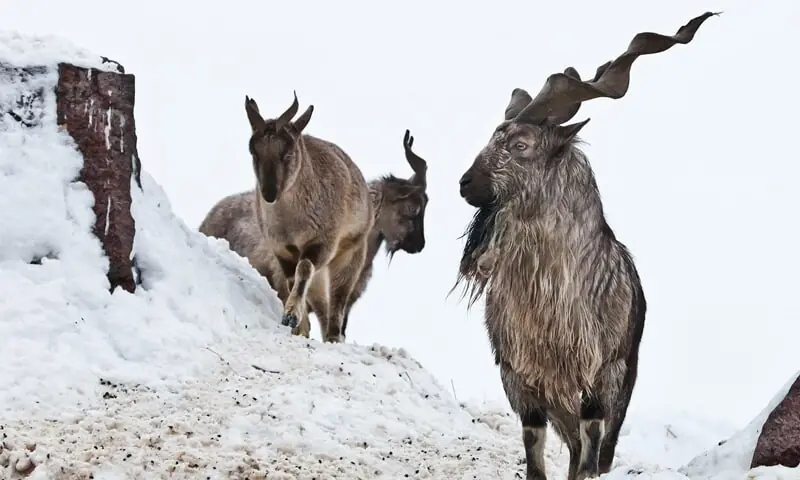
GILGIT: The Parks and Wildlife Department of Gilgit-Baltistan is set to auction hunting permits for three Astore markhors, 14 blue sheep and 100 Himalayan ibexes under the region’s Trophy Hunting Programme for the 2026-27 season.

The base price for an Astore markhor permit has been fixed at $200,000, making it the most expensive permit on offer. The minimum price for a blue sheep permit has been set at $25,000, while permits for Himalayan ibex will start at $11,000.

According to the auction notice, four Astore markhors are included in the exportable quota. However, one permit from the previous hunting season has been carried forward, leaving three fresh permits to be auctioned this year.

The open auction will take place on September 10 at the Forest Complex in Jutial, Gilgit. The trophy hunting season will begin on October 15, 2026, and continue until April 10, 2027, in accordance with the GB Trophy Hunting Guidelines 2019.

Hunting will be permitted only within officially designated conservation areas. The department said the annual hunting quota has been determined following wildlife population surveys conducted by experts.

GB Chief Conservator Parks and Wildlife Zakir Hussain said that the department collected approximately Rs350 million through permit auctions last year against a target of Rs550 million.

He said several permits remained unused during the 2025-26 season, including those for two Astore markhors, five blue sheep and 10 exportable Himalayan ibexes. The unused permits resulted in an estimated revenue loss of around Rs200 million.

According to officials, the cancellation of hunting plans by American and other international hunters was linked to the law-and-order situation following violent protests in Gilgit and Skardu.

Local business owners and tourism operators have expressed concern over repeated increases in trophy hunting permit prices. They argue that higher baseline rates have discouraged foreign hunters and negatively affected businesses connected with hunting tourism.

Ikram Beg, a local business owner who sells hunting equipment, said the trophy hunting programme was facing significant challenges.

He claimed that the Wildlife Department had increased baseline prices by more than 300 per cent over the past two years without adequately incorporating recommendations from major stakeholders.

According to Beg, excessive price increases could make Gilgit-Baltistan less competitive in the international trophy hunting market. He warned that declining international participation could reduce government and community revenues while weakening incentives for local residents to participate in wildlife conservation.

Beg stressed that trophy hunting should primarily serve as a conservation mechanism rather than simply becoming a source of increased government revenue. He said the programme’s long-term success depends on reasonable pricing, international participation, transparent administration and meaningful financial benefits for local communities.

Local stakeholders have called for a review of the permit rates and greater consultation with communities, conservation specialists and industry representatives. They have also demanded transparency and strict adherence to applicable rules and regulations.

Although trophy hunting remains controversial internationally, its supporters argue that regulated hunting can generate funds for conservation, discourage illegal hunting and provide financial benefits to communities living near wildlife habitats.

In Gilgit-Baltistan, the programme began with community participation in Bar Valley, Nagar, in 1990. Under the existing revenue-sharing model, approximately 80 per cent of licence revenue goes to local communitiesfor wildlife protection and conservation activities.

The region’s challenging terrain and harsh weather also make trophy hunting highly demanding. Hunters must navigate steep and rugged mountain slopes while dealing with extremely cold conditions.

Gilgit-Baltistan is home to diverse wildlife because of its varied ecosystems and climate. Species found in the region include Marco Polo sheep, ibex, markhor, urial, blue sheep, lynx, snow leopards, brown and black bears, wolves, foxes and golden eagles.

However, wildlife experts and conservationists continue to face concerns over illegal hunting, inadequate wildlife management and the effects of climate change, all of which pose long-term threats to the region’s biodiversity.

Similar Posts

  • | |

    LHC says illness, physical weakness can justify ba…

    The Lahore High Court (LHC) has ruled that illness, physical weakness, old age or disability can serve as valid legal grounds for granting post-arrest bail, issuing an important judgment on bail applications filed on medical grounds. Justice Amjad Rafiq issued a detailed written verdict while deciding the post-arrest bail petition of Dr Iftikhar Ahmed, who is suffering from Parkinsonism, a progressive neurological disorder that affects movement and physical independence. The court observed that if a prison medical report confirms that an accused is physically weak, there is no need to separately assess the severity of the illness. It held that physical weakness itself may be sufficient to justify consideration for bail. According to the judgment, illness and physical weakness are separate legal grounds for granting bail. The court noted that imprisonment can cause greater hardship for elderly, physically weak and disabled individuals, and the justice system should protect them from unnecessary physical suffering. The LHC further stated that the bail application had not been filed on the merits of the criminal case but solely because of the accused’s deteriorating physical condition. The prison medical report confirmed that Dr Iftikhar Ahmed was suffering from Parkinsonism, a disease that gradually limits a person’s physical abilities and independence. Rejecting the prosecution’s argument, the court ruled that the mere fact an accused is receiving medical treatment in prison cannot, by itself, be used as a reason to deny bail. The judgment also referred to principles of Islamic law and international judicial precedents, stating that sick, elderly and vulnerable individuals are entitled to special legal protection and humane treatment. The Lahore High Court granted post-arrest bail to Dr Iftikhar Ahmed against surety bonds of Rs1 million. The court directed the accused not to influence prosecution witnesses, to surrender his passport and not to leave the court’s jurisdiction without prior permission. Dr Iftikhar Ahmed has been in jail since March 2025 in a case registered at Sabzazar Police Station, where he is accused of administering an incorrect injection to a citizen’s son. The criminal proceedings will continue in accordance with the law.

  • | | |

    Pakistani celebrities and Kashmir debate: Who spok…

    The role of celebrities in social and political discussions has become a major topic of debate in Pakistan, especially during times of public concern and unrest. With the rise of social media, fans increasingly expect public figures to comment on important national and humanitarian issues, including developments related to Kashmir. Following reports of tensions and protests in Azad Jammu and Kashmir (AJK), discussions emerged online about whether Pakistani celebrities should use their platforms to raise awareness. Some actors and public figures shared messages of support, while others remained less visible or did not publicly comment, leading to debates among social media users. Several celebrities used Instagram stories, posts, and videos to express solidarity and share information related to the situation. Their supporters appreciated their willingness to highlight public concerns and use their large online audiences for awareness. For many fans, celebrity voices can help bring attention to issues that might otherwise receive limited coverage. At the same time, some public figures chose not to make public statements. The reasons behind an individual’s decision to speak or remain silent can vary, including personal views, privacy considerations, professional concerns, or a preference to avoid political discussions. Without direct statements from celebrities themselves, assumptions about their motivations remain speculative. The debate has also highlighted changing expectations from audiences. In the digital age, celebrities are no longer viewed only as entertainers; many fans see them as influencers with the ability to shape conversations. As a result, public figures often face pressure to respond quickly to social and political events. However, opinions remain divided on whether celebrities should be expected to take positions on every issue. Some believe influential personalities have a responsibility to speak about humanitarian matters, while others argue that individuals should have the freedom to decide when and how they engage with political topics. The discussion around celebrities and Kashmir reflects a broader global trend where social media has transformed the relationship between public figures and their audiences. Whether celebrities choose to speak out or remain private, their actions are increasingly examined by millions of followers. As online conversations continue, the issue raises important questions about activism, influence, responsibility, and the role of entertainment personalities in society.

  • | |

    Billie Eilish leaves music behind for bold new Hol…

    Billie Eilish is proving that her creative journey extends far beyond music. The Grammy and Academy Award-winning singer has officially stepped into the world of feature films, and the first photos from the set of The Bell Jar have left fans doing a double take. Known for her signature oversized outfits and edgy style, Eilish appears almost unrecognizable as she transforms into Esther Greenwood, the troubled yet ambitious writer at the heart of Sylvia Plath’s classic novel.  The newly released set images showcase a dramatic makeover. Eilish sports auburn brown hair styled in a polished 1950s fashion, bold red lipstick, pearl earrings, and elegant vintage-inspired clothing. The striking look is a complete departure from the singer’s everyday appearance, highlighting her commitment to bringing the beloved literary character to life. Fans have praised the transformation, calling it one of the most surprising celebrity makeovers of the year.  Directed and adapted by Academy Award-winning filmmaker Sarah Polley, The Bell Jar marks Eilish’s first leading role in a feature film. The story follows Esther Greenwood, a young aspiring writer navigating ambition, identity, and personal struggles in the 1950s. Widely regarded as Sylvia Plath’s most famous work, the novel remains one of literature’s most influential coming-of-age stories. The film also stars Carey Mulligan as Esther’s mother, adding even more star power to the highly anticipated adaptation.  Although this is Eilish’s feature film debut, she is no stranger to acting. She previously appeared in the television series Swarm, where she surprised audiences with her performance. However, The Bell Jar represents her biggest acting challenge to date, placing her at the center of an emotionally demanding story that has captivated readers for decades.  For Eilish, this project signals an exciting new chapter in an already remarkable career. After dominating the music industry with chart-topping albums, multiple Grammy Awards, and two Oscars for Best Original Song, she is now exploring a different form of storytelling. While fans eagerly await her next musical release, many are equally excited to see whether she can achieve the same success on the big screen. Filming is currently underway in Toronto, and while an official release date has not yet been announced, the early images have already generated significant buzz. If her striking transformation is any indication, Billie Eilish’s Hollywood journey is off to an unforgettable start. 

  • |

    Infantino’s FIFA gamble hits major roadblock

    FIFA President Gianni Infantino’s proposal to bring private investors into the commercial management of the FIFA World Cup has suffered another major setback after the Asian Football Confederation (AFC) formally rejected the plan. In a statement issued on Friday, the AFC announced that it stands alongside the European and North, Central American, and Caribbean football confederations in opposing the proposal. The confederation said the plan lacks the broad international support needed to move forward and warned that it could weaken the unity of global football. The AFC stressed that the FIFA World Cup belongs to the entire football community and should remain a competition shaped collectively by all member associations and confederations. It argued that decisions involving the future of the tournament should only be made after meaningful consultation with all stakeholders. The Asian governing body also criticized FIFA’s decision-making process, saying major proposals were introduced before proper discussions with confederations and member associations. It claimed the approach left many football authorities feeling excluded from an issue of global importance. The latest opposition significantly reduces the chances of the proposal being approved if it is presented for a vote. FIFA has 211 member associations, and a simple majority would be required for the plan to pass. With Europe, Asia, and Concacaf already opposed, the proposal faces strong resistance. Earlier, UEFA warned it could boycott future FIFA World Cups if the proposal moves ahead. Concacaf also rejected the plan, arguing that football’s biggest tournament should not become a commercial investment asset. Despite the growing backlash, FIFA has defended its proposal. The organization insists that it is not selling football but instead seeking new ways to strengthen the financial future of the game. FIFA says the planned reforms would attract investment, increase tournament revenues, and provide larger financial distributions to its member associations in the coming years. Under the proposal, FIFA would establish a new commercial subsidiary to manage its major competitions, including the FIFA World Cup. Outside investors would be allowed to purchase minority, non-controlling stakes in the new company while FIFA retains overall control. According to the governing body, the investment model would help expand football development programs, generate new business opportunities, and improve long-term financial sustainability. However, critics remain unconvinced. They argue that introducing private investors into the commercial structure of the World Cup risks prioritizing profits over the interests of players, supporters, and national associations. Opponents also say the process has lacked transparency and adequate consultation. The South American Football Confederation (CONMEBOL) has not yet announced its position on the proposal, while the African (CAF) and Oceania (OFC) confederations are expected to discuss the matter in the coming weeks.

  • |

    Delani century gives Sri Lanka 1-0 lead against Pakistan

    DAMBULLA: A sensational unbeaten century from opener Ameesha Delani powered Sri Lanka Women to a commanding six-wicket victory over Pakistan Women in the opening T20 International of the three-match series on Friday, overshadowing impressive batting performances from Pakistan captain Muneeba Ali and Shawaal Zulfiqar. After winning the toss, Sri Lanka elected to bowl first, allowing Pakistan to make a confident start. Captain Muneeba Ali led from the front with a blistering 42 off just 24 balls, striking nine boundaries during a 66-run opening partnership that gave the visitors early momentum. Following Muneeba’s dismissal, Shawaal Zulfiqar anchored the innings with a composed 63 runs, while Iman Nasir contributed 21 during a valuable 61-run stand for the second wicket. However, Pakistan lost wickets at regular intervals in the closing overs and finished on 176 for 7 from their allotted 20 overs. For Sri Lanka, Kavisha Dilhari claimed two wickets, while Kavya Kavindi, Sugandika Kumari and Chamudi Praboda picked up one wicket each to restrict Pakistan from crossing the 180-run mark. In reply, Sri Lanka produced an even stronger batting display. Opener Ameesha Delani stole the spotlight with a magnificent unbeaten 101, combining aggressive stroke play with calm composure to guide her team to victory with an over to spare. Sri Lankan captain Chamari Athapaththu provided excellent support with 39 runs as the hosts comfortably chased down the 177-run target, finishing on 177 for 4 in 19 overs. Pakistan’s bowlers struggled to contain the Sri Lankan batters despite efforts from Nashra Sandhu, who claimed two wickets. Humna Bilal and Umm-e-Hani took one wicket each but were unable to prevent the hosts from taking a 1-0 lead in the series. The defeat leaves Pakistan needing a strong response in the second T20I, scheduled for August 2, to keep the series alive before the final match on August 4. Sri Lanka, meanwhile, will head into the next game full of confidence after a dominant all-round performance led by Delani’s match-winning century.

  • | | |

    Congo Ebola outbreak death toll crosses 2,000

    KINSHASA: The Ebola outbreak in the Democratic Republic of Congo has intensified dramatically, with the death toll reaching 2,061 as authorities reported 4,449 confirmed cases, highlighting the growing challenge facing health workers and communities. The latest figures, reported by Congolese authorities on Tuesday, show how quickly the outbreak has expanded since it was officially declared on May 15. The outbreak is being driven by the Bundibugyo virus, a species of Ebola for which there is currently no licensed vaccine or specific treatment. Health authorities have been relying heavily on early diagnosis, supportive care, surveillance and infection-control measures. The outbreak began in Ituri province, with cases subsequently reported in other parts of the country. The World Health Organisation has warned that insecurity, population movement and limited healthcare infrastructure are complicating efforts to contain transmission. The current epidemic is Congo’s 17th Ebola outbreak, according to health authorities. Its rapid growth has raised concerns among international health agencies, particularly as affected communities face humanitarian and security challenges. Medical teams are working under difficult conditions, wearing protective equipment while treating patients and tracing contacts. WHO has said that strengthening surveillance, contact tracing, clinical care and community engagement remains central to the response. Recent research has also suggested that the outbreak may involve a previously unrecorded variant of the Bundibugyo strain and could have resulted from a new animal-to-human transmission event, underscoring the importance of monitoring potential spillover from wildlife. With thousands of confirmed infections and deaths already recorded, authorities face an urgent race to slow transmission and prevent the outbreak from spreading further across the region.

Leave a Reply

Your email address will not be published. Required fields are marked *