euphemism integration kashmir

The Euphemism of Integration: Kashmir Seven Years Later

By Ahmad Hassan

“The convoluted wording of legalisms grew up around the necessity to hide from ourselves the violence we intend toward each other… Elaborate euphemisms may conceal your intent to kill, but behind any use of power over another the ultimate assumption remains: ‘I feed on your energy.’” When Frank Herbert wrote those words in his novel Dune Messiah, he observed that elaborate euphemisms are often used by the state to conceal the raw mechanics of power.
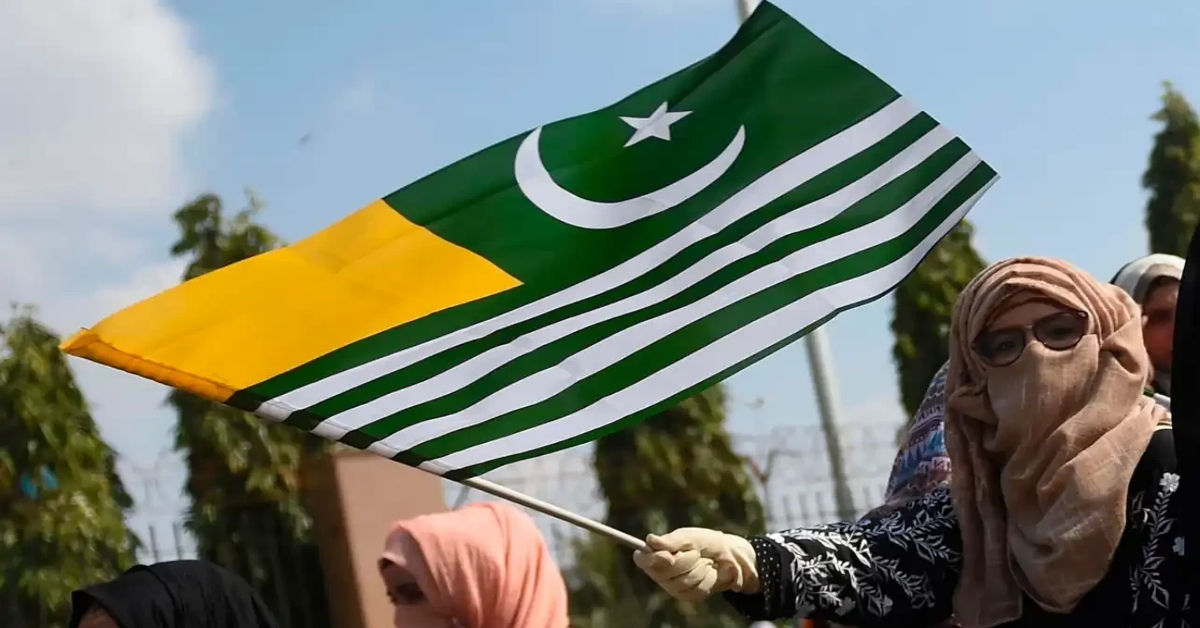
In Pakistan, August 5 is observed as Youm-e-Istehsal to condemn the 2019 revocation of Article 370 and its supplementary provision, Article 35A. This act of the Indian government removed Kashmir’s separate constitution, its flag and its control over its own affairs. Last week marked seven years since that day. What began as a dramatic constitutional rupture has now, by design, become quietly normalized.
Jammu and Kashmir joined India in 1947 on defined terms. The Maharaja handed over defence, foreign affairs and communications. Everything else stayed with the state. The United Nations later called for a plebiscite. It never happened. Instead, over decades, the protections that were supposed to stand in its place were worn down piece by piece, until August 5, 2019, when the government removed what remained in a single stroke.
The method deserves more attention than it usually gets. Article 370 was not directly changed. First, the government reached for Article 367, which was intended to aid in the interpretation of the Constitution, and used it to redefine one phrase: “Constituent Assembly” became “Legislative Assembly.” Kashmir had no sitting assembly at the time, and the state was under President’s Rule. So, the government’s own appointee, the Governor, signed off on the change.
India’s Supreme Court had already ruled, in 1959 and again in 1969, that Kashmir’s constitutional status could only be changed after the approval of the Constituent Assembly of Kashmir. When that body no longer existed, no institution had the standing to give that consent on Kashmir’s behalf. New Delhi decided that its own Governor could stand in for the people he had not been elected by. That is not consent. It is a government consenting to itself.
The Indian government argued that Kashmiris had lived for decades under an insurgency that killed tens of thousands and emptied the Valley of its Pandit community in 1990. It left the region isolated from the investment and policing coordination. That argument would carry more weight if the method had matched it. What followed the revocation was not the language of integration. It was a total communications blackout, landlines and mobile networks and the internet all cut at once. Independent estimates put the troop presence at 600,000 to 800,000, roughly one soldier for every ten Kashmiris. Even pro-India politicians, former chief ministers among them, were placed under detention.
Perhaps a security argument can justify counter-insurgency operations. It cannot by itself justify dissolving a state’s constitutional status, its legislature and its statehood in one move. That too with no elected Kashmiri voice given the chance to object.
Jawaharlal Nehru warned Parliament about exactly this shortcut in 1952, while Article 370 was still being drafted. No clause in a constitution, he said, could substitute for the will of the Kashmiri people. Real integration, in his words, comes from the mind and the heart, not from a clause imposed from outside.
Actually, there is a longer, quieter project behind the legal manoeuvre. Article 35A once barred outsiders from buying land or settling permanently in Kashmir. Since its removal, more than 3.2 million domicile certificates have gone to outsiders, most of them non-Kashmiri Hindus. This alarming thing is that wherever a disputed territory’s demographics are reshaped before its people are asked what they want, the eventual vote, if one ever comes, no longer reflects the population whose future was originally in question.
None of this required an invading army, or an open declaration of intent. It required a redefined word, a signature from an appointee, and a great deal of time. The convoluted legalisms that Herbert warned about have become policy in Kashmir: development, integration, correction. Each euphemism has quietly done the work that an honest admission of purpose could never have achieved.
Seven years on, Kashmir’s assembly has voted decisively against the BJP that carried out the revocation, and passed its own resolution demanding the restoration of its special status. New Delhi can easily ignore them. Yet, that very power to ignore an elected legislature proves, beyond any doubt, that the “consent” obtained seven years ago was always a legal fiction.

Similar Posts

  • Jiang Zemin at 100: A Visionary Reformer and a Friend Pakistan Remembers

     August 17, 2026 marked the 100th birth anniversary of Jiang Zemin, one of the most consequential leaders of modern China. A grand commemorative gathering at the Great Hall of the People in Beijing, presided over by President Xi Jinping, reflected the enduring importance of Jiang’s political and economic legacy. Jiang Zemin’s life was remarkable because he was, at his core, an engineer who later became a statesman. Born in Yangzhou, Jiangsu Province, on August 17, 1926, he studied electrical engineering at Shanghai Jiao Tong University and graduated in 1947. His technical training shaped a practical approach to leadership: understand the problem, assess the available resources and build a solution capable of lasting. His rise coincided with one of the most turbulent periods in modern history. After serving as mayor of Shanghai and later as secretary of the CPC Shanghai Municipal Committee, Jiang played an important role in the city’s reform and modernization. He supported the transformation of Pudong into a major international and modern urban district, helping establish the foundations for Shanghai’s emergence as a global economic center. When Jiang assumed China’s top leadership in 1989, the international environment was changing rapidly. The political transformation of Eastern Europe, the collapse of the Soviet Union and major domestic challenges created enormous uncertainty. Yet China maintained political stability and continued its programme of reform and opening up. One of the defining features of the Jiang era was the consolidation of the socialist market economy, following the strategic direction established by Deng Xiaoping and formally advanced after Deng’s southern tour in 1992. Jiang helped translate this vision into institutional and economic transformation. The result was a period in which China accelerated market-oriented reforms, expanded its engagement with the global economy and strengthened the foundations for the extraordinary growth that followed. China’s accession to the World Trade Organization in 2001 was among the most significant milestones of this period. It opened a new chapter in China’s integration with international trade and investment and contributed to the rapid expansion of Chinese exports and global economic engagement. Jiang’s leadership was also associated with deeper regional cooperation, including the establishment of the Shanghai Cooperation Organisation in 2001. For Pakistan, however, Jiang Zemin was more than a distant Chinese leader. His connection with Pakistan began long before he entered China’s highest office. In 1976, as a professional engineer and leader of a Chinese technical delegation, he spent time at Taxila and was involved in important technical and administrative decisions connected with the commissioning of the Foundry and Forge Works of the Heavy Mechanical Complex. This cooperation formed part of China’s broader contribution to Pakistan’s industrial and engineering capacity. The story of Jiang and Taxila carries special significance. It represents a relationship built not only through diplomatic statements but also through factories, machines, engineers and skilled workers. The Heavy Mechanical Complex became an important symbol of Pakistan-China industrial cooperation, and Jiang’s personal association with it gave Pakistan a unique connection with a man who would later lead the world’s most populous country. During his state visit to Pakistan in 1996, Jiang reportedly maintained contact with former Pakistani colleagues from his earlier days at Taxila, demonstrating that he had not forgotten the professional relationships and human connections formed decades earlier. It would therefore be fair to describe Jiang Zemin as a leader who helped strengthen the modern foundations of China-Pakistan friendship. He was not the founder of the relationship, whose roots go back to earlier generations of leaders, but he was a major bridge-builder who gave that friendship a distinctive personal and industrial dimension. At 100, Jiang Zemin’s legacy remains substantial. He was bold during uncertainty, pragmatic during transition and confident in China’s capacity to reform without abandoning its strategic direction. He understood Deng Xiaoping’s vision and helped carry the reform and opening-up process into a new era. For China, Jiang will be remembered as a major reform-era leader. For Pakistan, he will also be remembered as an engineer who once worked at Taxila, a statesman who valued friendship, and a leader whose life connected the development journeys of two nations. His legacy is not confined to history; it remains visible in the enduring strength of China-Pakistan cooperation. Author: Prof. Engr. Zamir Ahmed Awan, Sinologist – Diplomat – Advisor – Consultant, Founding Chair, Global Silk Route research Alliance.

  • | |

    Analysing Pakistan’s system collapse through Orwell’s 1984

    Pakistan’s Interior Minister, Mohsin Naqvi, publicly conceded that the nation’s existing governance structure has collapsed. The minister admitted that the administrative machinery can no longer resolve the country’s compounding socio-economic crises. The phrase strategically slipped through while addressing the Pakistan Economic Summit in Islamabad. He warned that adhering to the status quo would drag the nation into the same stagnant cycle  ten years from now. Amidst, he called upon political parties to set aside differences, decentralize power, and establish new administrative units to avert total destabilization. Yet, this public declaration does not occur in a vacuum. It arrives amidst mounting public resentment, economic desperation, and an escalating crackdown on political dissent, particularly in regions like Azad Jammu & Kashmir and urban political centers where mass protests against state austerity and police overreach have intensified. On the surface, the minister’s statement sounds like a candid plea for political reform and democratic unity. Beneath it, lies a far more insidious dynamic. One that mirrors the political theology of George Orwell’s classic dystopian novel, 1984. Big Brother and the Permanent State In Orwell’s 1984, the state of Oceania is governed by a dual reality. On the visible surface sits the Outer Party and its administrative ministries: the Ministry of Peace (which wages war), the Ministry of Plenty (which manages scarcity), and the Ministry of Truth (which manufactures lies). But behind these facade institutions resides the true, unquestionable entity: the Party itself, epitomized by the omnipotent figure of Big Brother. The purpose of the ministers, bureaucrats, and politicians is not to serve the citizenry, but to safeguard the survival of the core entity at all costs. When applied to the political landscape of Pakistan, the Interior Minister’s declaration functions as a quintessential display of Orwellian doublethink. The ability to hold two contradictory beliefs in one’s mind simultaneously and accept both of them. The visible civilians admit powerlessness, yet the hidden apparatus of establishment and the deep-state continues to wield absolute authority. The state apparatus operates under an unwritten constitutional clause: individual rights, democratic mandates, and administrative cohesion may be sacrificed, so long as the core, permanent security apparatus remains untouched and supreme. Echoes From 1971 to Kashmir This pattern of preserving an unseen core entity while allowing civilian institutions to decay is not a novel phenomenon. Rather, it is the recurring motif of the region’s post-colonial history. During the 1971 crisis in East Pakistan, the political leadership and the military high command operated under the illusion that they were protecting the sacred unity of the state. In reality, the democratic mandate of the majority population in Bengal was suppressed to protect the ideological and structural hegemony of the West Pakistani establishment—the ruling entity. The state prioritized the preservation of its central ruling elite over the actual people, ultimately leading to the violent birth of Bangladesh. Similarly, in the context of Kashmir, both regional state apparatuses have historically treated the territory not as a community of citizens with self-determination, but as a hyper-militarized buffer zone. The rights of the local population are routinely suspended under emergency clauses, security regulations, and administrative crackdowns. Kashmir becomes a national security theater where the state justifies its authoritarian measures by pointing to a existential enemy, much like Oceania’s perpetual, shifting wars with Eurasia and Eastasia. The System Has Collapsed Minister Naqvi cautions that the system is broken and warns against civil unrest. The message carries an implicit subtext: the civilian government is simply the expendable skin of the state. The real state must be shielded from public wrath. Public dissent erupts over inflation, human rights abuses, or rigged mandates. However, the state’s reaction is not to adapt to the popular will, but to enforce compliance through force. The plea for political parties to sit together is less about democratic reconciliation and more an invitation to absorb the blame for a crisis created by the underlying apparatus. Ultimately, Orwell’s warning in 1984 was not merely about surveillance or censorship. Instead it was about the total erasure of individual agency in service of an unaccountable entity.  The region remains bound to protecting a shadowy establishment at the expense of its people.  

  • |

    Rare 1858 volume returned to Australian library after 150 Years

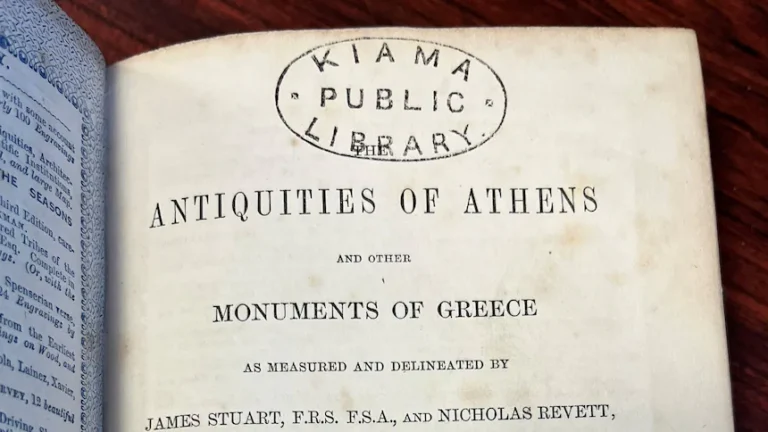
    A home renovation in Australia recently uncovered a piece of literary history that had been missing for a century and a half. A homeowner in the coastal community of Kiama, located south of Sydney in New South Wales, was tearing down wall structures. Amidst, he stumbled upon a sealed fireplace. Inside an old wooden tea crate behind the brickwork was an antique book that belonged to the town’s local library. The volume, titled Antiquities of Athens, was published in London in 1858. Staff at the Kiama Library realized that the book had been missing since 1870s. Library officials described the return as completely unprecedented. While they occasionally receive books that are a few decades late during estate cleanouts, they had never seen a volume missing for over a century. The book itself is a notable historical work. It was originally authored by British architects James Stuart and Nicholas Revett to document classical Greek architecture. Book No. 506. A part of Kiama Library’s inaugural catalog which comprised roughly 1,000 items when the library first opened its doors in 1872. Despite enduring around 150 years encased inside a chimney cavity, the physical volume appeared in a surprising condition. Mild water exposure near the margins and natural weathering consistent with a century of neglect. However, the pages and original library stamps remained clearly legible. How the book ended up sealed behind a fireplace wall remains open to speculation. During the 19th and early 20th centuries, homeowners used unwanted household items as insulation or filler material when bricking over chimney flues. When Kiama Library manager Michelle Hudson examined the interior cover of the returned tome, she discovered the original set of lending regulations printed inside. Among those provisions was a penalty clause dictating an overdue fee of three British pence per week. Doing the math to adjust that Victorian-era fine for inflation over 150 years results in an eye-watering figure: roughly  $28,000 Australian dollars (approximately $19,500 USD). Luckily for the current homeowner who handed it over, the library has no intention of collecting. In fact, even if staff wanted to hold someone accountable, identifying the original borrower is impossible. The library’s paper borrow ledgers from the 1870s were lost or discarded long ago. It left a complete mystery as to who last checked out the book. The volume provides a fascinating glimpse into Victorian-era social norms and public library regulations. A borrower was forbidden from checking out another book until any previously borrowed item was returned and all associated fines were cleared. Hudson playfully speculated that this rule might explain why the original patron never brought the book back. Once the fine started accumulating, returning it became too costly. Households could borrow up to three books at a time, but only if at least six members of the family were verified as capable of reading. The regulations specifically prohibited lending books to individuals who arrived at the library in a state of intoxication. Modern library policies focus on patron code of conduct rather than testing family literacy rates. However, these antique guidelines serve as a memorable reminder of how public institutions functioned in colonial Australia. Antiquities of Athens will not be re-entering general circulation returning home after a century and a half in exile. Library staff plan to place the volume on permanent display within their local history archive. It is aimed to preserve it as both a physical artifact of Victorian publishing and a symbol of local history. As Hudson quipped, the library is thrilled to have its 506th catalog entry back on the shelves. Also, they have no intention of risking another 150-year wait to see it again.  

  • How your posture affects your mood and mind

    In today’s digital world most people spend hours every day looking at a phone laptop tablet or book.  Experts say that constantly bending your neck or sitting in a slouched position does more than cause neck and shoulder pain it can also affect your mental health. According to health experts the way you sit or stand has a direct effect on your mood and emotions. Even the way you hold your phone or book can influence how you feel.  If you are reading this while looking down at your phone experts suggest sitting up straight. They explain that when you stay in a slouched position your brain may read it as a sign of weakness or stress.  This can increase feelings of anxiety sadness and mental tiredness. Dr. Nitin Menon, a senior consultant in physical medicine says poor posture can make existing mental health problems worse.  Long periods of physical strain may also increase stress and anxiety. Psychiatrist Dr. Shiv Kataria says people often curl up and become disconnected from their surroundings while using their phones. This can make them feel more isolated and lonely. Experts also say the way you hold your phone may reflect your mental state. Holding it tightly checking it repeatedly or endlessly scrolling can increase anxiety and make it harder to relax. Poor posture can also affect your breathing. When you hunch forward your chest becomes compressed making it harder to take deep breaths. This may leave you feeling more tense and uncomfortable. It can also put extra pressure on your neck shoulders and back leading to pain over time. The good news is that improving your posture may help both your body and your mind. Sitting or standing upright with your shoulders back and chest open allows you to breathe more deeply and activates the body’s natural relaxation system. This is one reason why the idea of a “power pose” has become popular. Experts tips for better posture Keep your phone laptop or monitor at eye level. Follow the 20-20-20 rule: Every 20 minutes look at something 20 feet away for 20 seconds and gently stretch your neck and shoulders. Use a book stand or pillow to raise books instead of looking down. Make sure your chair supports your lower back keep your feet flat on the floor and place your screen at eye level. Strengthen your posture muscles with simple daily exercises such as chin tucks and shoulder blade squeezes. Experts say that changing your posture is a simple step you can take right away to improve your mood and reduce stress. While it may not be easy to avoid screens making small posture changes every day can support both your physical and mental health.

  • Poor condition of roads in Dasht

    I want to draw the attention of the concerned authorities to the poor condition of roads in Dasht. Many roads are broken and full of potholes. During the rainy season, they become muddy and difficult to use. The damaged roads cause traffic problems and accidents. Students, patients, farmers, and other people face great difficulties while travelling. Sometimes vehicles are also damaged because of the bad roads. I request the concerned authorities to take immediate action and repair the roads in Dasht. Good roads are necessary for the safety and development of the area. I hope that the authorities will pay attention to this serious problem.

  • Keep lizards away with bird feathers

    Seeing a lizard inside the house is quite common. Most house lizards are not poisonous or dangerous but many people feel uncomfortable or scared when they see them. This is why people often try simple home methods to keep lizards away. Lizards can actually help control insects because they eat small bugs. However most people still do not want them inside their homes. If lizards often appear on walls in the kitchen or in other parts of the house a few simple steps may help reduce their presence. Use bird feathers Some people use bird feathers as a traditional way to keep lizards away.  Lizards are natural prey for birds so the sight of feathers may make them feel that a bird could be nearby. Peacock feathers are sometimes placed in areas where lizards are often seen.  Besides being used as a traditional method they can also work as a decorative item. Try eggshells Eggshells are another popular home remedy. After using eggs the shells can be cleaned and placed in areas where lizards are commonly seen. Some people believe that the smell of eggshells may discourage lizards from staying in the area. However this method may not work equally well for everyone. Use garlic Garlic is also commonly used to keep lizards away because of its strong smell.  You can place a few garlic cloves near corners windows or other possible entry points. The strong smell may help discourage lizards from coming into these areas. Keep the House clean Home remedies alone may not be enough.  Keeping your house clean is one of the best ways to reduce lizard visits. Avoid leaving food uncovered and clean crumbs or leftover food quickly. It is also important to control insects because mosquitoes flies and other small bugs are a major food source for lizards. By keeping the home clean reducing insects and blocking possible entry points you can make your home less attractive to lizards.

Leave a Reply

Your email address will not be published. Required fields are marked *