book review 8211

Book review – The Broken Wings

By Sher Jan Qadir,

The Broken Wings is a poetic novel written by Khalil Gibran, first published in Arabic in 1912. It is a touching story of tragic love, set in Beirut at the beginning of the twentieth century.

The novel highlights several important social issues of Eastern Mediterranean society at that time. These include religious corruption, the oppression and limited rights of women, and the strong influence of money and power. Through the story, the author shows how wealth and authority often control people’s lives and decisions, revealing how power and money dominate society.

The story begins when Khalil Gibran is eighteen years old, at an age when love opens his eyes to the intense and magical beauty of a young girl whom he falls in love with. He falls in love with a courageous, generous, and strong woman named Selma Karamy. She is the one and only daughter of Faris Effendi Karamy, who is known as one of the wealthiest men in Lebanon.

As time passes, Khalil Gibran succeeds in finding Selma’s home and becomes familiar with her father, Faris Effendi, who considers Khalil to be the son of his closest friend. After some time, Khalil and Selma become tied by the bond of friendship, as their souls are similar. When they are in heaven, flying with angels and enjoying the delicious fruits of friendship, the devil, Mansur Bey Galib, enters the story. He is responsible for taking Adam and Eve out of heaven.

Selma and Khalil become like Eve and Adam, who make the mistake of not revealing their feelings to Faris Effendi Karamy before the entry of the devil, Mansur Bey Galib. Mansur Bey Galib is a man of both power and wealth. His entry into their lives makes the family of Faris Effendi Karamy worried and horrified. He separates Selma and Khalil and drags them into a life of helplessness and worry.

From here, the story enters a new phase, where Selma’s father, Faris Effendi Karamy, is compelled to give Selma’s hand in marriage to Mansur Bey Galib, who is a roisterer. Selma’s difficulties begin here, but she still remains in love with Khalil Gibran. All the luxuries and the mansion become a prison for Selma, where she is bound to live but finds it difficult to stay.

After some time, Mansur Bey Galib becomes aware of Selma’s secrets—what she does, how she lives, and whom she meets. He forbids Selma from visiting her father’s home and forces her to obey him as her husband.

One day, she secretly visits her father’s home to meet Khalil Gibran and makes him aware of all her circumstances. They then decide to separate with sadness. A few months later, Selma gives birth to a baby boy, but destiny plans the tragic end of the lives of both the child and his mother, leaving Lebanon in mourning.

Similar Posts

  • Exile and The Kingdom

    I have always interpreted the quote, “Don’t judge a book by its cover,” as a metaphor, denying the worldly meaning and focusing on the discrete sense it creates. But not until I read the book “Kingdom and Exile” by Albert Camus. Judging by the title, it establishes a scenario of a king ruling in his kingdom with absolute power and authority. But owing to certain reasons, he was compelled to exile and relinquish his power. That’s how I correlated the book with its title. I was totally left bemused when I started reading it, flapping one page after the other and realizing the book isn’t like how its title says; it’s different inside. It’s actually a collection of six intriguing stories, each with different lessons. This book, which contains amusing stories, was written by Albert Camus, a French author and philosopher. He narrated and published his book in 1957, and soon after, he died in a car accident in 1960. For his magnificent write-up, he was awarded a Nobel Prize in literature. ‘Kingdom and Exile’ is a book of 126 pages, completed within approximately 6 days without making us invest more time in it. The flow of stories makes us read them in no time. Each of the stories revolves around a new protagonist with different roles as a character in the story. I enjoyed reading all 6 stories, but I was more absorbed with the first story of the book, “The adulterous woman,” who follows her husband on his business trip when she is asked to. Undoubtedly, her husband loved her and made her existence real, but more often than not, she realized he was more involved in his business, which made her wonder about the probability of his affection. It eventually made certain boundaries between them where she kept her uneasiness to herself, making her feelings isolated within herself. But at the end of the day, he was her husband who always made her feel valued, so she ended up accepting the meager way of being valued. The other five stories were relinquishing; they always made me wonder about the end of them. But woefully, I was baffled by the ending most of the time because I thought there must have been a better ending. Though the book is interesting, it could have been in its best version if it had emphasized explicitness. I was actually finding it hard to understand because of the vocabulary. Overall, it made me willing to read it because I wasn’t bored and stayed focused. The best part of reading it was becoming involved as an invisible character in these stories who secretly observed the characters playing their roles. Since it is always better to surround ourselves with print media, read new things, and expand our domain of learning, this book is relevant to all those who are sluggish enough to start reading. It will keep us interested and focused throughout each story.

  • Nazuk: A Powerful Portrait of Baloch Women’s Struggles

    By Sania Sher Jamak This book review is about the novel Nazuk, written by Syed Zahoor Shah Hashmi and translated by Fazal Baloch. Syed Zahoor Shah Hashmi was a renowned Balochi poet, writer, linguist, historian, and philosopher. He is regarded as one of the most influential figures in modern Balochi literature. Syed Zahoor Shah Hashmi was born on 21 April 1926 in Gwadar and passed away on 4 March 1978 in Karachi. He also wrote a dictionary called Syed Gunj, in addition to many works of poetry, history, and books on the Balochi language and literature. Nazuk is a very interesting and thought-provoking novel. The title itself is meaningful and reflects the delicate and difficult lives of Baloch women who suffer from various social problems. Through this novel, the writer highlights the hardships, struggles, and challenges faced by women in Balochi society. The novel is not only an engaging piece of literature but also provides a deeper understanding of Balochi culture and society. It encourages readers to think about social issue

  • | |

    The Art of Being Alone 

    By  Shokiat Baloch of Kulanch  “Sometimes, being alone is not a sign of loneliness; it is an opportunity to discover yourself.” The book is written by Renuka Gavrani. This book contains many topics because these topics are more important to everyone’s life. This powerful idea lies at the heart of The Art of Being Alone, a thoughtful book that teaches readers how to enjoy their own company and find peace within themselves. The book shows that spending time alone can help us understand our thoughts, emotions, goals, and true personality. Another is saying, “Solitude is my home, Loneliness was my cage. (1)The pain of hiding your true self. This is the first topic in the book. How to hide secrets in your life while everyone has secrets.”Saying, “The most painful and scariest thing in the world is to look in the mirror and not recognise the person staring right at you”A person without hiding cannot live because the false hope that someday someone will magically show up and the fear of looking like a weirdo makes us do things that we never intended to do . Self-love starts with self-acceptance. It means first love yourself; after you should love another, and self-love has become more like self -pity. As clear-cut as possible, Self – love is about two things: (1) Knowing yourself. First, know yourself: you are doing what or for what purpose you live in life, then you have confident to able do something in life. (2) Accepting yourself are those which we do mistake in yourself; then accept yourself because everyone do mistake but the people accept yourself not an other Self. There are many thoughts in the present in a dark structure in the heart, and we should accept ourselves. The book is saying that the “greatest thing in the world is to know to belong to oneself “The love for Solitude.” You cannot be lonely if you like the person you are alone with. This book’s main purpose is solitude, loneliness and love. The book gives more information about love and being alone, how to love and self-love, and yourself.I found the book inspiring because it presents solitude as a chance for personal growth rather than something to fear. Its ideas are especially useful in today’s busy world, where people are constantly connected through phones and social media. “The main purpose of the book “The Art of Being Alone is a meaningful and inspiring book about understanding yourself and finding happiness within. I would recommend it to anyone who wants to become more independent, peaceful, and confident. The book suggest the people read this book because it is one of the most important book everyone life.

  • |

    Han Kang transforms trauma into human connection

    In an era often dominated by literary posturing and self-absorbed memoirs, South Korean author Han Kang offers a profound counterweight. Her collection, Light and Thread, serves as an intimate look into the ethical consciousness of a writer shaped by the long shadow of national tragedy. Rather than using her platform to project certainty or celebrate her global acclaim, Han Kang turns writing into a delicate act of witness. An attempt to span the distance between isolated souls using language as a fragile bridge. The Weight of Historical Memory Beneath the intimate and domestic moments captured in Light and Thread lies an undercurrent of history. For readers familiar with Han Kang’s literary canon, the ghostly presence of unresolved national trauma is a constant motif. History is not presented here as a series of dead facts. Instead, it breathes through silence, leaving behind a persistent political and moral residue. A decisive turning point in her artistic journey occurred when she encountered archival photographs of the 1980 Gwangju massacre. She found herself forced to abandon her previous literary trajectory while confronted by the reality of historical violence. The weight of what she witnessed demanded an entirely new vocabulary of remembrance. This epiphany reflects an overarching ethical seriousness. Literature is not viewed as a vehicle for self-promotion or intellectual display. Creation is treated as a solemn, almost spiritual responsibility toward those who have been sisilenced. Her work continually battles with how language can articulate grief without reducing its magnitude. How it can preserve human dignity against historical erasure and honor the memory of the dead. Even in her Nobel Lecture, Han Kang rejects self-congratulation. She transforms the moment into a vulnerable meditation on a writer’s moral duties, choosing quiet reflection over triumph. An Invisible Connection Between Hearts The central motif of the collection traces back to a poem Han Kang wrote as an eight-year-old child. In it, she envisioned an invisible golden thread linking human hearts across space. Decades later, that simple childhood metaphor provides the framework for Light and Thread. For Han Kang, storytelling operates as that very filament: delicate, easily broken, yet surprisingly resilient. It holds the power to link separated lives across loss, time, and geography. Reading and writing become acts of deep empathy. They’re active ways of reaching into another person’s experience without seeking control or mastery. Dissolving the Self to Preserve Humanity Unlike conventional memoirs focused on self-dramatization, Light and Thread presents a porous sense of self. The author’s first-person perspective regularly fades into descriptions of weather, ambient sound, plant life, and lingering pain. Han Kang shifts the focus away from herself and onto the fragile conditions that allow human consciousness to endure. Her fundamental skepticism toward absolute answers becomes her greatest strength. Her writing creates a quiet space where grief can exist without being distorted.  

  • |

    A portrait of the artist as a young man

    James Joyce published A Portrait of the Artist as a Young Man in 1916. He did far more than tell the story of a boy growing up in Dublin. He revolutionized the modern novel. As Joyce’s first published novel, Portrait serves as a crucial bridge between classical nineteenth-century storytelling and the radical experimentation of twentieth-century modernism. Over a century after its release, this intimate novel remains a timeless exploration of identity, intellectual rebellion and terrifying price of personal freedom. Sensory Stream of Consciousness The novel follows Stephen Dedalus who’s a thinly veiled avatar for Joyce himself from early childhood through his late adolescence and college years. The book opens not with traditional exposition, but with a sensory stream of consciousness. The baby talk, the texture of a bedsheet, the smell of oilcloth, and songs sung by his family. As Stephen grows, so too does the language of the book. Joyce evolves his prose style alongside his protagonist. He transforms the narrative voice from simple baby phrases into highly philosophical and poetic language as Stephen matures into a young scholar. Extreme Religious Devotion At its core, Portrait is a profound meditation on the heavy burdens of tradition. Growing up in a strictly Catholic, politically fractured Ireland at the turn of the twentieth century, Stephen finds himself trapped between competing pressures. He witnesses fierce family debates over Irish nationalism. He also suffers harsh physical punishments at strict Jesuit boarding schools. Ultimately, he struggles with agonizing guilt over his emerging teenage desires. A central turning point of the novel occurs during a harrowing religious retreat, where a priest delivers a vividly detailed sermon on the eternal torment of Hell. Paralyzed by fear, Stephen briefly attempts a life of extreme religious devotion, only to realize that spiritual conformity destroys his true self. Creative Freedom Over Compliance Stephen’s ultimate breakthrough doesn’t come from religiously pious self . It’s from art. In one of the most famous passages in modern literature, Stephen walks along the shore and catches sight of a young woman wading in the water. Stephen doesn’t see her through a lens of sinful desire or religious symbolism. Rather, he sees her simply as an embodiment of pure, mortal beauty. This aesthetic epiphany awakens his true calling. Now, he must break free from the traditional network of family, church, and nation that seek to hold him back. To become an artist, Stephen realizes he must embrace exile. Thus, he must chose solitude and creative freedom over compliance. Joyce’s genius lies in his ability to make Stephen’s internal struggles feel deeply universal. Anyone who has ever questioned the beliefs they were raised with, felt out of place in their own community. They strived to forge an independent identity will find a powerful reflection in Stephen’s journey. His famous declaration near the end of the book to forge in the smithy of my soul the uncreated conscience of my race is a bold rallying cry for personal independence. A Portrait of the Artist as a Young Man is not just the story of one young man’s transformation in turn-of-the-century Ireland, but a brilliant testament to the courage required to think for oneself and forge a truly unique voice in the world.  

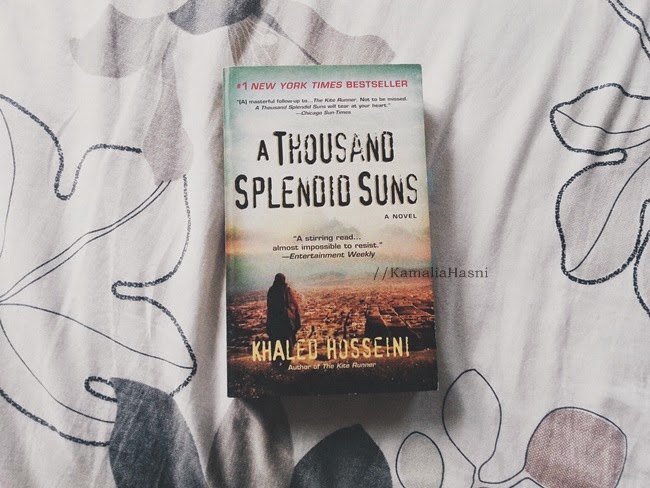
  • Book Review: “A Thousand Splendid Suns”

    By Shamsa Najeeb A Thousand Splendid Suns is an extraordinary novel by Khaled Hosseini, an Afghan writer and journalist currently living in America. Hosseini gained international recognition with his debut novel, The Kite Runner, and this brilliant work stands as his second novel. The book follows the parallel lives of two women: Mariam, a rural woman who is sent to Kabul to marry an older man named Rasheed, and Laila, a local teenager raised by open-minded and educated parents.The story is set in Kabul, Afghanistan, against the turbulent backdrop of the early rise of the Taliban. At its core, A Thousand Splendid Suns focuses heavily on the inequalities and hardships that Afghan women endure daily. The narrative masterfully explores how Mariam and Laila survive these harrowing challenges with deep bravery and heroism. Additionally, the characters in the book are written with such profound realism that readers cannot help but sympathize with their struggles. Khaled Hosseini has done an exceptional job of creating a masterpiece that is both deeply moving and emotionally gripping. It serves as a classic tribute to the courageous and resilient women of Afghanistan. In a nutshell, A Thousand Splendid Suns is one of those rare books that stays with you forever, fundamentally transforming your worldview regarding Afghanistan and its women.

Leave a Reply

Your email address will not be published. Required fields are marked *