nccia cracks down
| |

NCCIA cracks down on cyber fraud, arrests 7 in Lah…

LAHORE: The National Cyber Crime Investigation Agency (NCCIA) has arrested seven suspects in separate operations against online financial fraud in Lahore and Multan, exposing schemes involving WhatsApp hacking, fake visa charges and marriage scams.

Acting on special directives from NCCIA Punjab Director Muhammad Ali Wasim, officials in Lahore arrested a suspect identified as Haider Ali, who allegedly posed as a courier company representative to obtain victims’ OTPs and verification codes. The suspect and his associates reportedly gained access to WhatsApp accounts and then contacted victims’ relatives and friends to demand money.

Investigators said one victim transferred Rs2.77 million to an account linked to Haider Ali. The money was subsequently moved through several accounts and withdrawn. A mobile phone recovered from the suspect contained WhatsApp conversations, transaction records, identity documents and other digital evidence.

In Multan, authorities arrested Muhammad Imran Shahid for allegedly impersonating a victim’s cousin and demanding money through phone calls and WhatsApp messages on the pretext of visa extension and visa fees. The suspect reportedly received Rs580,000 from the victim.

In another case, five suspects were arrested for allegedly using fake Instagram and Snapchat profiles to befriend women and lure them with marriage proposals. The suspects allegedly sent fake gift and parcel receipts before demanding money under the guise of customs duties, taxes and clearance charges.

Mobile phones were recovered during the operations, while investigators are examining the suspects’ financial transactions, call records and digital data. The NCCIA said further revelations are expected as the investigations continue.

Similar Posts

  • |

    Poland’s main opposition party splits following loyalty pledge ultimatum

    Poland’s main opposition Law and Justice (PiS) party has fractured following a severe internal dispute over its political strategy, with former Prime Minister Mateusz Morawiecki and dozens of his allies breaking ranks with longtime leader Jarosław Kaczyński. The split occurred after Kaczyński issued an ultimatum demanding all PiS lawmakers sign a strict loyalty oath committing them not to collaborate with outside political groups. Dozens of parliamentarians, led by Morawiecki, refused to sign the pledge before the deadline, leading Kaczyński to declare that those who abstained had effectively resigned from the party. The former prime minister confirmed that his faction includes 40 members of parliament, three members of the European Parliament, and one senator, though he maintained that his group sought to preserve unity while broadening the right-wing electoral base toward younger, centre-right voters. The division threatens PiS’s status as the largest party in the Polish parliament, a position it held despite losing power to Donald Tusk’s pro-European coalition in 2023. As the conservative vote increasingly fragments across competing factions ahead of the 2027 parliamentary elections, the formal expulsion of the dissident lawmakers is scheduled to be processed at a party leadership meeting.

  • |

    Franco Baresi dies at 66, football mourns AC Milan legend

    Italian football icon Franco Baresi, one of the greatest defenders in the history of the game and a legendary captain of AC Milan, has died at the age of 66. The club confirmed the heartbreaking news on Friday, paying tribute to a player whose legacy shaped one of the most successful eras in its history. In a heartfelt statement, AC Milan expressed its grief over the passing of one of its most celebrated figures. The club said Baresi’s leadership, integrity and commitment would remain an enduring part of Milan’s identity, just as his iconic number six shirt continues to symbolize excellence and loyalty. Baresi enjoyed an extraordinary career with AC Milan, spending nearly two decades with the club and becoming one of its most influential players. As captain during the late 1980s and early 1990s, he led the Rossoneri to remarkable success, winning three European Cups and six Serie A titles. His defensive brilliance, tactical intelligence and calmness under pressure made him a cornerstone of one of football’s greatest backlines. Regarded as one of the finest sweepers the sport has ever produced, Baresi was admired for his exceptional reading of the game, precise tackling and outstanding leadership. Alongside fellow defensive stars Paolo Maldini, Mauro Tassotti and Alessandro Costacurta, he formed a legendary defensive unit that frustrated some of Europe’s most dangerous attackers. Born in Lombardy in May 1960, Baresi joined AC Milan’s youth academy in 1974. After progressing through the ranks, he made his senior debut in 1978, shortly before turning 18. His talent quickly earned him a regular place in the first team, and by the age of 22 he had been named club captain, a role he carried with distinction for many years. Baresi remained loyal to Milan throughout his playing career, retiring in 1997 after making 719 appearances for the club. At the time, it was the highest appearance total in Milan’s history, a record later surpassed only by Paolo Maldini. His remarkable consistency and devotion made him one of the most respected figures in Italian football. On the international stage, Baresi represented Italy 81 times. He was part of the squad that won the 1982 FIFA World Cup, although he did not play a major role during the tournament. He later became one of the national team’s key players and captained Italy to the 1994 FIFA World Cup final in the United States. Despite his outstanding performances, Baresi experienced heartbreak in major tournaments. He missed the 1986 World Cup after a disagreement with the national team coach. Italy also suffered painful defeats in penalty shootouts during the 1990 World Cup semi-final and the 1994 World Cup final, denying him another global triumph. In August 2025, Baresi underwent surgery to remove a lung nodule. Following the procedure, he expressed optimism about his recovery, saying it would take some time to regain his strength. No official cause of death has been announced. Following his retirement, Baresi remained closely connected with AC Milan and was appointed the club’s honorary vice-president in 2020. His influence extended beyond the pitch, inspiring generations of players and supporters with his professionalism, loyalty and passion for the game. Franco Baresi leaves behind an unforgettable legacy as one of football’s greatest defenders, a symbol of AC Milan’s golden era and an icon whose achievements will be remembered for generations.

  • | |

    Oman oil spill spreads dramatically, nearing scale…

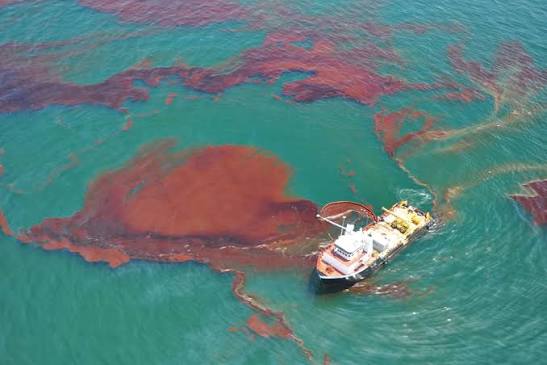
    An oil spill off the coast of Oman is rapidly expanding into one of the worst maritime environmental disasters in years after weeks of largely unchecked spread, according to international agencies, satellite imagery and environmental organizations. The slick, which originated from a grounded tanker carrying Russian crude, had reached Oman’s mainland by Wednesday, the United Nations shipping agency confirmed. John Amos, an oil spill specialist who reviewed satellite imagery, said the affected area now covers more than 2,000 square kilometers. The vessel involved, the Caroline Bezengi, was carrying an estimated 800,000 barrels of Russian oil and operates under international sanctions. It ran aground on June 30 near an Omani island that forms part of a protected marine nature reserve. The tanker first reported trouble off the coast of Yemen on June 8, and maritime sources said an explosion appeared to have occurred on board. No party has claimed responsibility for any attack, though the ship was navigating waters tied to two separate conflicts during its voyage from Russia to India. The tanker departed the Black Sea port of Novorossiysk in April, a region central to the ongoing war between Russia and Ukraine. Ukrainian forces have targeted vessels belonging to the so called shadow fleet used to transport Russian oil, a network that includes the Caroline Bezengi. Ship tracking data shows the tanker then passed through the Suez Canal in late May before sailing near Yemen, where Iran aligned Houthi forces have become entangled in the broader regional conflict involving the United States, Israel and Iran. A tangled set of war related and sanctions related shipping regulations is already complicating the emergency response and could further delay efforts to contain the disaster, according to insurers and analysts. The IOPC Funds, the intergovernmental body responsible for compensating tanker spill damages, told a foreign news agency it will not cover cleanup costs since the incident is being classified as an act of war rather than an ordinary accident. The 25 year old tanker also lacks coverage from any recognized Western insurer. Amos, who serves as chief executive of the environmental nonprofit SkyTruth, said the worst case outcome would involve no adequate response capable of preventing further damage. He said the spill’s scale could ultimately rival the 1989 Exxon Valdez disaster and noted that the tanker is comparable in size to the Sanchi, an Iranian vessel that collided with a freighter off China in 2018 in what became the world’s worst tanker disaster in decades. Slick accelerates toward mainland The spill was first identified by analysts in early July and has since begun reaching Oman’s mainland, according to the International Maritime Organization. A spokesperson for the agency said oil is drifting offshore northeast of Al Qibliyyah Island, with some already washing ashore, and confirmed that contingency planning for the spill is underway. The IMO said seasonal monsoon weather has restricted access to the tanker and delayed salvage efforts. Satellite images show the vessel grounded at Al Qibliyyah Island, part of a nature reserve that includes the Hallaniyat Islands and provides habitat for endangered sea turtles, humpback whales and coral reef ecosystems, all of which now face heightened risk from the spreading oil. Omani officials said Monday the slick covers nearly 400 square kilometers, though they have not responded to requests for additional detail on containment efforts beyond confirming the use of booms to limit the spread. Environmental groups and independent specialists estimate the true size at several times that figure, and say the rate of spread has accelerated sharply since early August. Greenpeace reported Tuesday that the affected area grew from around 45 square kilometers at the end of July to 150 square kilometers by early August, then quadrupled to roughly 600 square kilometers within just two days, according to Hanen Keskes, the group’s political campaigns lead for the Middle East. Amos’s estimate of 2,000 square kilometers suggests the spill has grown more than 40 times larger since the start of August alone. Amos said containing the disaster will require more than floating booms, including stabilizing the grounded vessel and transferring any remaining crude to another tanker. He warned that delays in salvage operations will only worsen the tanker’s condition and make the eventual recovery effort more complicated and dangerous.

  • |

    Erdogan says Makkah defence pact could expand across region

    ANKARA: Turkish President Recep Tayyip Erdogan has said the vision behind the Makkah Joint Defence Agreement between Türkiye, Saudi Arabia and Pakistan extends beyond the three signatories and could eventually include other regional countries. Erdogan said the agreement was designed to strengthen collective security and promote lasting peace, stability and prosperity in the region. He stressed that the pact was not directed against any particular country. Speaking in an interview with an Arab newspaper, Erdogan said the three countries wanted to create a broader regional framework based on cooperation, mutual trust and collective responsibility. He said countries that support peace, stability and prosperity should be able to join the framework in the future. According to Erdogan, the agreement is based on the principle of collective deterrence. A security threat against one member would be treated as a concern for the other members. He said the arrangement could also encourage joint defence-industry projects and greater cooperation against terrorism. Erdogan argued that regional countries should take greater responsibility for addressing their own security challenges rather than relying on solutions imposed from outside the region. He described the agreement as the outcome of long-running consultations among the participating countries and said it reflected changing conditions in the region. The Turkish president also rejected the idea that the pact was simply a response to tensions between the United States and Iran. He said its broader objective was to establish a durable mechanism for regional security. Focus on Gulf security Erdogan said the agreement could contribute to stability in the Gulf, which he described as vital to international trade and the global economy. He highlighted the importance of energy supplies, maritime routes and trade links passing through the region. He also expressed concern over tensions surrounding the Strait of Hormuz, warning that prolonged disruption there could have consequences for economies around the world. Erdogan called for restraint and continued diplomatic engagement to ensure the waterway remains safe for international shipping. He said Türkiye preferred dialogue and negotiations over military escalation and believed diplomatic efforts were essential to resolving disputes in the region and beyond. The Makkah agreement formalises growing strategic cooperation between Pakistan, Saudi Arabia and Türkiye. The three countries describe the arrangement as defensive and aimed at strengthening collective deterrence rather than creating an offensive military bloc. Erdogan said stronger cooperation between Ankara and Riyadh would also contribute to regional stability. He pointed to expanding ties in defence, trade, investment, energy and tourism. Prime Minister Shehbaz Sharif has described the trilateral agreement as an extension of Pakistan and Saudi Arabia’s existing defence cooperation. Pakistan and Saudi Arabia had earlier signed a strategic mutual defence agreement under which aggression against either country would be treated as aggression against both. The latest trilateral framework builds on those longstanding security ties and introduces Türkiye into a wider mechanism for defence cooperation.

  • | |

    Pakistan’s civil awards triple in nine years…

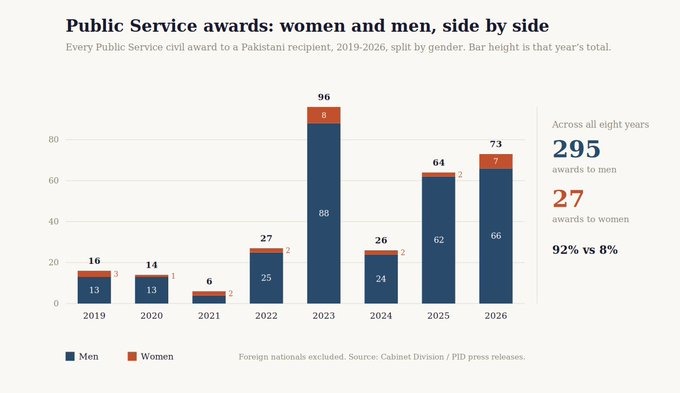
    ISLAMABAD: The number of people receiving Pakistan’s civil awards has increased sharply over the past nine years, but the share of women among the recipients has remained almost unchanged, according to an analysis by economist Zehra Farooq. Farooq, who has analysed civil award lists from 2018 to 2026, said she compiled all 2,209 awards announced during the nine-year period and examined each award by field, gender, level of award and nationality. Her analysis shows that the number of award recipients increased more than three times during the period, rising from 73 people in 2018 to 372 in 2026. However, the share of women receiving the awards did not show a similar increase. Women made up between roughly 10% and 16% of civil award recipients in each year from 2018 to 2026. Ms Farooq said the figures show that while the size of the annual awards lists changed greatly, the share of women remained within almost the same range. The lowest share was around 10% in 2023, while the highest was 16% in 2018 and 2021. The share stood at 15% in 2024 before falling to 12% in 2025 and 11% in 2026. Her analysis also looked at the figures after excluding gallantry awards. Gallantry awards were kept separate because they mainly relate to military and police roles. Even after removing these awards, the overall share of women increased only from around 12% to 14%, according to the analysis. This suggests that the low share of women is not limited to gallantry awards. Farooq said the same pattern can also be seen in civilian awards. Public service awards show a wider gap The Public Service category is the largest civilian category in the dataset and shows a particularly large difference between men and women. Among Pakistani recipients of Public Service awards, 295 were men and only 27 were women. This means men received about 92% of these awards, while women received only around 8%. Farooq noted that in several years, the entire Public Service list included only one or two women. The figures raise questions about how women are represented among people being recognised for public service. The analysis does not, however, establish why the gap exists. Farooq suggested that one possibility worth examining is whether the awards reflect the existing structure of Pakistan’s civil bureaucracy. She noted that the quota for women in the civil bureaucracy is around 10%, while the share of awards going to women remains below or around that level. This raises a question about whether the civil awards are reflecting the existing gender structure in public institutions rather than creating a separate pattern of their own. Major changes in fields The analysis also found major changes in the fields represented in the civil award lists. Science and engineering together accounted for close to one-third of the 2021 list. However, by 2025 and 2026, the two fields together made up less than 2% of the list. At the same time, some new categories appeared. Information technology appeared as a category for the first time in 2021, while climate appeared in 2025. Farooq said these changes raise questions about how the state decides which areas deserve recognition. She asked whether the decline in science and engineering awards reflects fewer major contributions in these fields, fewer people entering these professions, or a change in the areas where the state looks for achievement. The appearance of IT and climate-related awards also raises another question: whether official recognition is beginning to follow changes in the areas where Pakistan’s talent and work are growing. Women receive fewer top-level awards The analysis also examined the civil awards according to their level. The awards are divided into different levels, with Nishan and Hilal at the senior end, followed by Sitara and Tamgha. Ms Farooq found that the share of women becomes smaller as the level of the award becomes higher. At the two highest levels, women account for less than 5% of recipients. At the more common lower levels, the share of women is higher, generally ranging between 11% and 14%. This means that the overall percentage of women receiving civil awards does not tell the full story. Women may represent around 10% to 16% of all recipients in a year, but their representation becomes much smaller when only the highest-level honours are considered. The findings therefore point to two separate issues: the overall number of women receiving civil awards and the level of recognition they receive. Nine years provide a wider picture Ms Farooq said looking at the awards over several years gives a clearer picture than looking at a single annual list. The civil awards are announced every August, and each year’s list can show changes in the number and type of recipients. But when the lists are combined over nine years, longer-term patterns become visible. The biggest pattern in the data is the contrast between the rapidly growing number of awards and the almost unchanged share of women. From 73 recipients in 2018, the annual list reached 372 in 2026. Yet women remained within roughly the same 10% to 16% range throughout the period. The analysis also shows that the composition of the awards has changed in other ways, including the fields being recognised and the introduction of new categories. She said the data does not provide all the answers, but it raises questions that can be examined further.

  • | |

    GCU Lahore goes fully paperless in major digital s…

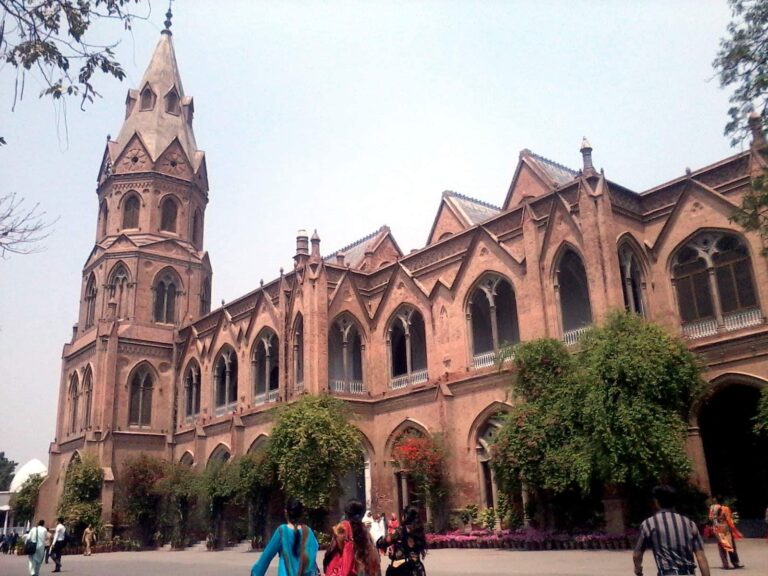
    LAHORE: Government College University (GCU) Lahore has officially moved its administrative operations to a fully paperless digital system, marking a major step towards modernising governance and reducing reliance on traditional office files. The transformation has been achieved through the implementation of the e-Filing and Office Automation System, a cloud-based digital platform developed by the Punjab Information Technology Board (PITB). The system has been provided to the university free of cost under special directions from the Punjab government, according to university officials. Under the new framework, administrative processes across GCU’s departments will now be handled online through a single digital platform. Routine matters such as leave applications, travel permissions, annual performance reports, official orders and departmental correspondence can now be processed electronically. The university said the system would also cover digital note sheets for proposals between departments, approval of payments for visiting faculty, purchase requests and agendas for departmental meetings. No more files moving from desk to desk One of the most significant changes will be the elimination of the traditional practice of physically moving files from one office to another. Instead, officials will be able to create, review, approve and track documents digitally through the cloud-based platform. This is expected to improve administrative efficiency while making it easier to monitor the progress of official matters. GCU Vice Chancellor Professor Muhammad Umar Chaudhry described the transition as more than an environmental initiative, saying digital governance was essential for a modern educational institution. He said moving administrative affairs away from paper would strengthen transparency, speed and accountability, while reducing delays associated with manual file tracking. According to the vice chancellor, removing routine administrative delays would allow faculty members and heads of departments to devote more time to teaching and research. Part of wider digital transformation The university said the paperless initiative is part of a broader digitalisation drive launched during the previous academic year under the vice chancellor’s leadership. Before implementing the complete e-office system, GCU had introduced online approval mechanisms for student society events and digital billing for payments to visiting faculty members. The administration is now preparing to take the process further with the planned launch of a comprehensive e-Services Portal. The upcoming platform is expected to streamline requests related to campus maintenance and other facilities. Officials hope the system will allow infrastructure-related problems to be reported and addressed more quickly without disrupting academic activities. Alumni records also going digital GCU’s digital reforms are not limited to current campus operations. The university is also working on a major project to digitise the records of its alumni, expanding technology-based management beyond day-to-day administration. The move towards a paperless campus could ultimately reduce paperwork, improve record management and provide university officials with faster access to important information. With administrative processes increasingly moving online, GCU Lahore is positioning itself as an example of how Pakistan’s public-sector universities can use digital technology to make governance faster, more transparent and more efficient.

Leave a Reply

Your email address will not be published. Required fields are marked *