
lady catherine dyers
|

Lady Catherine Dyer’s metaphysical elegy

My dearest dust“, in three monosyllables, Dyer fuses affectionate devotion with biblical mortality. Few opening lines in English poetry carry the sudden jolt of Lady Catherine Dyer’s seventeenth-century elegy to her late husband, Sir William Dyer. The phrase creates a brilliant phonic equation. Two words linked by alliterative d sounds and ending in the crisp st consonant cluster. This sequence immediately brings closer the earthly tenderness and the cold realities of the grave.

Written after Sir William’s premature death in 1621 at the age of 37, the 14-line poem presents a wife addressing her departed spouse. This poem is not from a distance of detached, formal mourning, but from the shared boundary of their marital bedchamber. It is an extraordinary work of grief. A sequence of part lullaby, part nocturnal dialogue, and part radical act of faith.

Dyer crafts her elegy primarily in rhymed heroic couplets, a poetic form where paired lines lie side-by-side like lovers in rest. Yet, the emotional core of the poem resides within its deliberate deviations from standard iambic pentameter.

When Catherine laments her husband’s sudden departure, the meter breaks under the weight of her longing:

Thy weary limbs with early rest,

She exempts the line 6 of its expected fifth metrical foot, reducing it to iambic tetrameter. Dyer mirrors the truncated nature of Sir William’s life. His death was early and so the line itself ends prematurely. Similarly, when describing her daily routines of widowhood in line 10, preparing her nightly dress and calling to prayer. There, the missing foot echoes the quiet vacancy of her solitary routine. Something essential is absent, and the meter forces the reader to feel that empty space.

Even the poem’s gentle play with rhythm in lines 3 and 4 captures this hesitation. Asking whether they might have,

Sate up, or gone to bedd together?

The unaccented final syllable creates a lingering, breathless pause. It presents a moment where the speaker hesitates before facing the silence of her answer.

The Audacity of Desire

What makes Dyer’s poem so captivating is its unapologetic amalgamation of grief and intimacy. As the poem draws toward its conclusion, the speaker describes her eyelids growing heavy while her beloved’s body grows cold. She commands:

Draw, draw ye closed curtaynes: and make room:

My dear, my dearest dust; I come, I come.

To a contemporary reader, the closing insistence: “I come, I come” is a poignant declaration of joining her husband in ultimate death. However, the phrasing carries a remarkably provocative double layer.

In Renaissance and 17th-century vernacular, “to die” was a well-known euphemism for sexual climax. The verb “to come” already held slang connotations surrounding physical intimacy. For Lady Catherine, her very surname, Dyer, homophonically echoes dier. These final words create a daring convergence of spiritual reunion and erotic memory. To lay down in the grave beside her husband is both an act of holy surrender and a transcendent return to marital passion. It is a moment of fearless emotional honesty carved directly into a sacred space.

The Monument at Colmworth

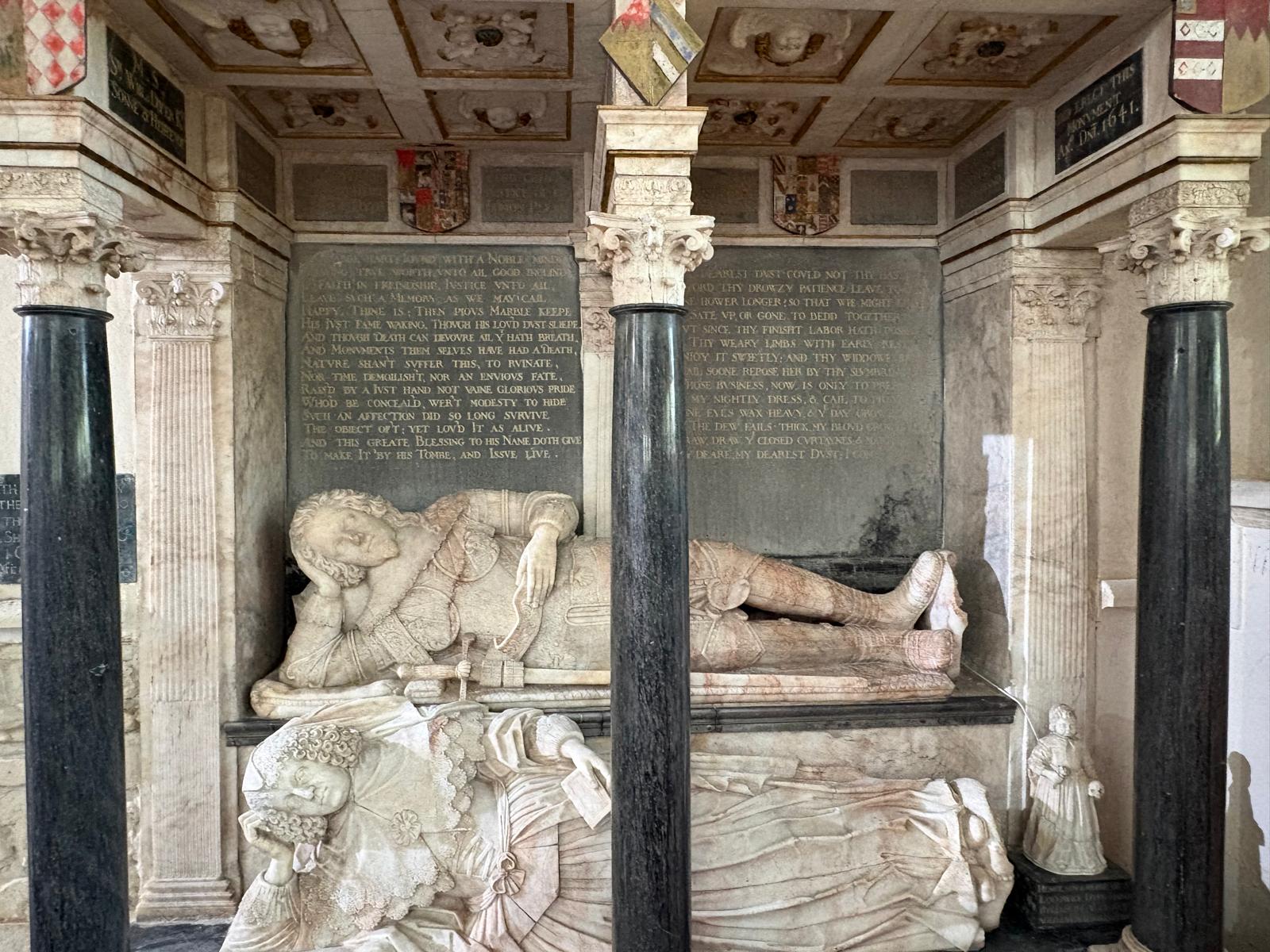
This extraordinary text was not merely kept in a private manuscript. In 1641, two decades after her husband’s death, Lady Catherine erected an elaborate monument in the Church of St. Denys in Colmworth, Bedfordshire. Above stone effigies of the couple propped on their elbows as if engaged in eternal late-night conversation, the full poem was proudly embossed.

Lady Catherine outlived Sir William by 33 years, never remarrying. For over three decades, she lived with the memory of the husband who died young after fathering seven children. Catherine would have gazed upon her own stone likeness, reading her own words of twenty years prior while waiting for the remaining thirteen years of her earthly separation to expire.

 The Dissolution of Words and the Promise of Reunion

In the centuries since its installation, time and moisture have slowly eroded the Colmworth monument. Today, many of the terminal words in the carved verses have worn away, softening the crispness of the original rhymes.

Yet, there is a poetic justice in this physical decay. Rather than diminishing the work, the fading text represents a literal blurring of boundaries. It expresses a “de-coupleting” of stone that mirrors the breakdown of mortal limits. As the physical letters dissolve into the ambient damp of the church, Catherine and William’s separation quietly closes, fulfilling the poem’s final command to make room for eternal rest.


Similar Posts

  • How termites damage wood

    Termites can quietly damage wooden furniture, doors frames cupboards and other wooden items.  They often live in groups and feed on wood so ignoring them can lead to serious damage. Signs of termites You may notice a few common signs of termite activity. Wood may become swollen small mud like layers may appear around wooden items or solid wood may produce a hollow sound when tapped.  Termites can damage wood at any time of the year. If you notice a serious infestation it is better to contact a pest control professional. However for small or early infestations some simple home methods may help. Salt water Mix salt with lukewarm water until it dissolves completely. Put the mixture into a syringe and apply it to affected wooden areas such as door frames. This can be repeated for several days. However it may not completely remove a large infestation. Sunlight Direct sunlight may help reduce termite activity. Place affected furniture in strong sunlight for around 3 to 5 days if possible. Make sure the furniture can safely handle outdoor exposure. Neem Oil Neem oil is another commonly used home remedy. Apply a small amount directly to areas where termites are present.  It may help reduce termite activity although its effect can take time. Vinegar and lemon spray For a small affected area, mix half a cup of white vinegar with the juice of two lemons. Put the mixture in a spray bottle and apply it to the affected area. This can be tried twice a day for a few days. When to get Professional help Home remedies may be useful for small or early termite problems but they are not a guaranteed solution.  If termites have spread widely or are causing major damage professional pest treatment is the safer and more effective option.

  • Does phone charging waste power?

    Mobile phones have become an important part of daily life. Many people charge their phones every morning every night or even several times a day. This often raises a common question •Does charging a phone every day add a lot to your electricity bill? The simple answer is no. Charging a smartphone uses very little electricity compared to household appliances such as refrigerators fans irons or air conditioners. The amount of electricity used depends on the phone’s battery size the charger’s power and how long the phone takes to charge. Even if a phone needs around three hours to fully charge it still uses only a small amount of electricity. Over the course of a year charging a phone every day usually consumes only a few units of electricity. Fast chargers may use slightly more power but the difference is very small and is unlikely to make a noticeable impact on your electricity bill. Experts also recommend following safe charging habits. Always use the original or a certified charger avoid charging your phone under a pillow or blanket and replace damaged chargers immediately. These simple steps can help prevent overheating and protect your phone’s battery. •Tips keeping your phone charged every day costs very little and is one of the least expensive ways to use electricity at home.

  • AC mistake to avoid after heat

    After spending time outside in extreme heat switching on the air conditioner as soon as you get home may feel refreshing. However health experts say this habit can sometimes be harmful. According to doctors the body works continuously to keep its temperature balanced. In hot weather it cools itself by producing sweat and widening blood vessels. If you suddenly move from intense heat into a very cold room your body experiences a rapid temperature change. This is known as thermal shock. Experts say this sudden change may cause headaches sore throat coughing dizziness tiredness breathing problems or a feeling of discomfort. People with asthma allergies or other breathing conditions may be affected more seriously. Health specialists recommend resting for a few minutes in a shaded or normally cooled area after coming home instead of sitting directly in front of the AC. This gives your body time to adjust gradually. They also advise drinking enough water before entering a very cold room. Hot weather can lead to dehydration and staying hydrated helps reduce stress on the body. Another concern is that air conditioners can dry out the air which may dry the nose and throat. This can lead to throat irritation dryness or coughing especially if the AC is set to a very low temperature or the cold air blows directly on the body. Doctors say there is no need to avoid using an air conditioner during summer. Instead keep the temperature at a comfortable level drink plenty of water and avoid moving straight from extreme heat into a very cold environment. These simple steps can help protect your health and reduce the risk of heat related problems.

  • | |

    The rise of Alfred, Lord Tennyson

    On August 6, 1809, one of the defining literary voices of the 19th century was born: Alfred, Lord Tennyson. Tennyson came to embody the doubts, solemnity, and romantic ideals of the Victorian era. He served as Britain’s Poet Laureate for more than four decades during the height of Queen Victoria’s reign. Early Brilliance and Sharp Criticism Tennyson’s journey to becoming a beloved national figure was anything but smooth. Raised in a large, tumultuous household by a clergyman father, young Alfred sought escape through verse. His talents surfaced early; while studying at Cambridge, he won the prestigious Chancellor’s Gold Medal in 1829 for his poem Timbuktu. Shortly thereafter, he published early collections containing works such as Mariana and Claribel. These early publications showcased his extraordinary musicality and eye for detail, yet contemporary critics were not entirely impressed. Severe reviews dismissed his work as overly melancholic, affected, and sentimental. The hostility of these early critiques shook Tennyson deeply, prompting a decade-long period of publishing silence. A phase scholars often refer to as his ten years’ silence. Crafting the Masterpieces Rather than abandoning his craft, Tennyson spent those quiet years refining his technique, studying philosophy, and confronting personal tragedy. The sudden death of his closest friend, Arthur Henry Hallam, plunged Tennyson into profound grief. This loss became the catalyst for his most famous masterpiece, In Memoriam A.H.H. Published in 1850, the massive elegy explored faith, mortality, and scientific progress, striking a deep chord with a Victorian public navigating rapid industrialization and societal change. The immense success of In Memoriam transformed his standing almost overnight. That same year, following the death of William Wordsworth, Queen Victoria appointed Tennyson as Poet Laureate. He went on to compose iconic works that defined the national consciousness, including The Charge of the Light Brigade, Ulysses, and his epic Arthurian cycle, Idylls of the King. A Lasting Literary Legacy While early critics painted him as a sentimentalist, history remembers Tennyson as a master craftsman of English rhythm and sound. Lines like; “To strive, to seek, to find, and not to yield” (Ulysses) have woven themselves permanently into the modern lexicon. His ability to blend intimate personal emotion with grand societal themes elevated him from a criticized young poet to an enduring pillar of world literature. Key Milestones in Tennyson’s Career 1809: Born in Somersby, Lincolnshire on August 6. 1829: Wins the Chancellor’s Gold Medal at Cambridge for Timbuktu. 1830: Publishes Poems, Chiefly Lyrical, introducing works like Mariana and Claribel. 1850: Publishes In Memoriam A.H.H. and is appointed Poet Laureate by Queen Victoria. 1854: Pens The Charge of the Light Brigade, capturing national sentiment during the Crimean War. 1892: Passes away at age 83, buried in Poets’ Corner at Westminster Abbey.

  • Wave clouds go viral in California

    People in the California city of Santa Cruz were left amazed after unusual wave shaped clouds appeared across the evening sky. According to media reports the stunning cloud formation was seen on Tuesday evening. Dark and white clouds stretched across the sky creating a pattern that looked like ocean waves. As the sun began to set its golden light reflected off the clouds making the view even more beautiful. Many local residents captured the rare moment on their phones and shared photos and videos on social media, where they quickly went viral. One woman at the beach posted a video of the breathtaking sky, and it has attracted widespread attention online.

  • | |

    Finding Macbeth among the cul-de-sacs

    There is a persistent cultural myth that high art requires crumbling castles, stormed heaths, or the frantic pulse of a metropolitan center. Suburbia, by contrast, is frequently dismissed as a landscape of cultural vacuum. The locality is defined instead by the hypnotic hum of lawnmowers, identical mailboxes, and the predictable choreography of the morning commute. Yet, to truly understand the works of William Shakespeare, one might argue that the quiet cul-de-sac is precisely where his characters feel most alive. Far from being an ivory-tower exercise, reading the Elizabethan canon against the backdrop of modern suburban life reveals a shocking truth. The human heart remains unchanged. It battles with the exact same ambitions, fears, and frailties that obsessed the playwright over four centuries ago. Shakespeare’s Macbeth Consider the iconic image of Macbeth encountering the three witches on a desolate heath. It’s a scene immortalized in classical art where armored men on horseback reel back in shock from supernatural prophets. On the surface, this imagery feels light-years away from a suburban subdivision. And yet, the psychological anatomy of Macbeth’s descent is intensely domestic. The internal dialogue of unchecked ambition, the quiet rationalization of moral compromise, and the creeping dread of consequences do not require a Scottish throne room. They can happen just as easily across a kitchen island or inside a quiet home office late at night. The weird sisters whispering prophecies of greatness are mirrored in modern life by the relentless cultural pressures to achieve. King Lear’s Misjudgment of His Children When we open a volume of Shakespeare, the distance between the sixteenth-century stage and the twenty-first-century lawn collapses. The suburban environment with its heavy emphasis on conformity and respectability provides a testing ground for tragedy. Iago’s subtle manipulations and toxic envy find their modern equivalents in politics, gossip, and the quiet resentments behind closed doors. King Lear’s tragic misjudgment of his children echoes in the universal anxieties of aging, and the desperate search for legacy. The stakes may appear smaller. They’re measured in property values and school districts rather than kingdoms and crowns but the emotional resonance is identical. Reading Shakespeare in Suburbia Furthermore, reading Shakespeare in suburbia changes how we interact with our immediate surroundings. It strips away the sterile academic intimidation that often turns classical literature into a chore to be checked off a syllabus. Instead, the verse becomes a lens through which the mundane details of daily existence are rendered extraordinary. The polite wave to a neighbor takes on a layer of complex subtext; the solitary evening walk under streetlights feels heavy with introspection. We begin to recognize that our neighbors are not merely background characters in a quiet life, but complex individuals harboring their own private comedies and tragedies.    Immutable Patterns of Human Behavior Ultimately, literature serves as a mirror. The suburban landscape offers a surface polished to a clear, sometimes uncomfortable reflection. Shakespeare did not write merely about royalty or historical epochs. He wrote about the immutable patterns of human behavior. By bringing his texts into the quiet corners of modern domestic life, we bridge the gap between antiquity and the everyday. We discover that drama is not something reserved for history books or theatrical stages, but an inescapable part of being human, waiting to be noticed right outside our front doors.

Leave a Reply

Your email address will not be published. Required fields are marked *