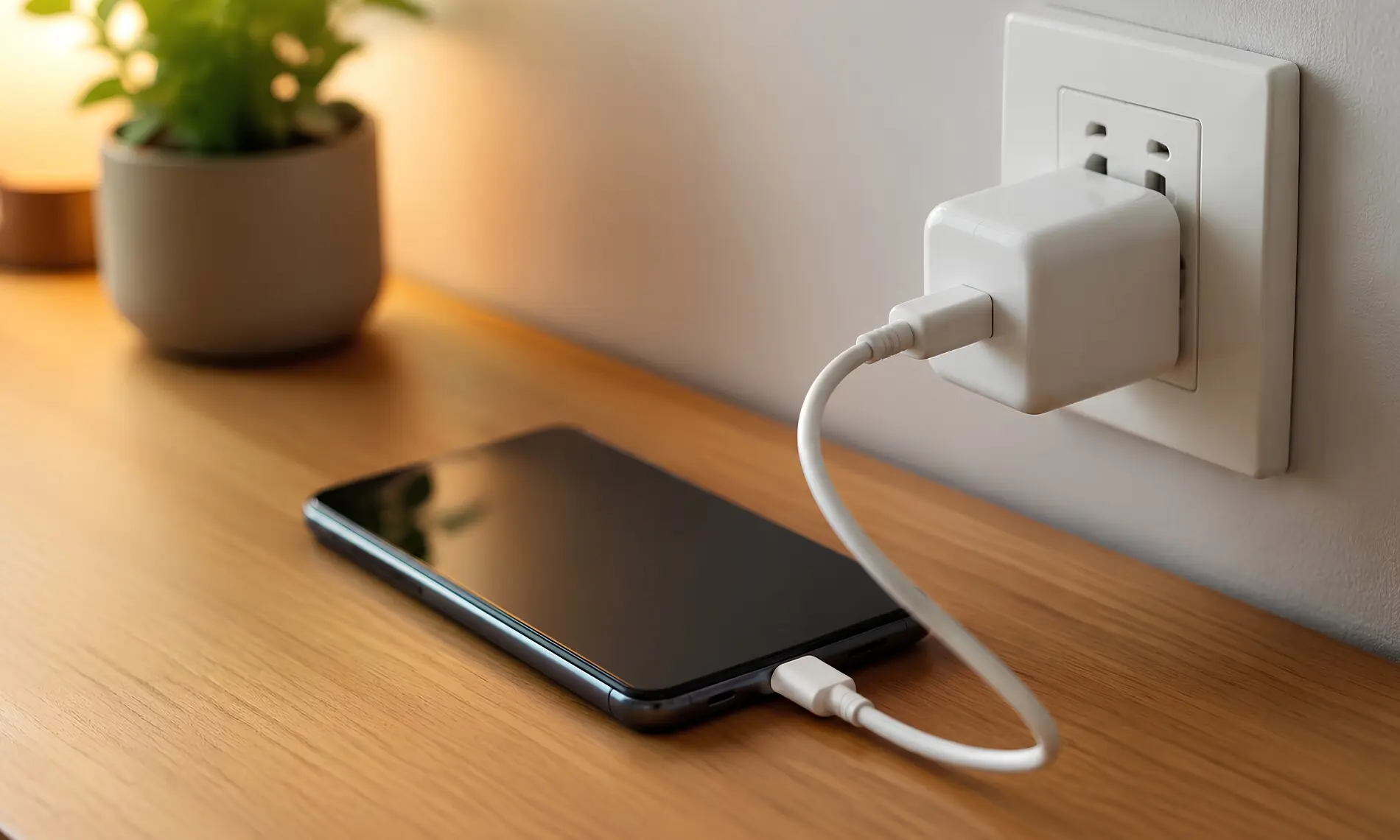
does phone charging

Does phone charging waste power?

Mobile phones have become an important part of daily life. Many people charge their phones every morning every night or even several times a day.

This often raises a common question •Does charging a phone every day add a lot to your electricity bill?

The simple answer is no. Charging a smartphone uses very little electricity compared to household appliances such as refrigerators fans irons or air conditioners.

The amount of electricity used depends on the phone’s battery size the charger’s power and how long the phone takes to charge.

Even if a phone needs around three hours to fully charge it still uses only a small amount of electricity.

Over the course of a year charging a phone every day usually consumes only a few units of electricity.

Fast chargers may use slightly more power but the difference is very small and is unlikely to make a noticeable impact on your electricity bill.

Experts also recommend following safe charging habits. Always use the original or a certified charger avoid charging your phone under a pillow or blanket and replace damaged chargers immediately.

These simple steps can help prevent overheating and protect your phone’s battery.

•Tips

keeping your phone charged every day costs very little and is one of the least expensive ways to use electricity at home.

Similar Posts

  • | |

    Ada Lovelace, the tech woman

    Long before the dawn of modern computers, a twelve-year-old girl named Ada Lovelace set her heart on how to fly. Rather than merely dreaming about the skies, she treated the challenge as a practical engineering problem. Beginning in early 1828, she meticulously studied avian anatomy and tested potential wing materials. Her experiments ranged from light paper and smooth silk to natural feathers. Lovelace even documented her findings in an illustrated manuscript she titled Flyology. Her pursuit only halted when her mother put an end to the project. A traditional mother who insisting that such whimsical ideas were a distraction from proper academic training. This tension between wild imagination and strict logic defined Lovelace’s upbringing.  Mother Annabella Byron was an intensely practical woman whose mathematical tendencies led her estranged husband, the tempestuous Romantic poet Lord Byron, to nickname her the Princess of Parallelograms. Shortly after Ada was born, Annabella separated from Byron. She further  separated the infant from her father’s chaotic influence. Lady Byron made it her mission to raise her daughter on a rigid diet of arithmetic, French and music. By doing so, the mother explicitly aimed to suppress any artistic interest she believed Ada might inherit from Byron. When Byron inquired about his young daughter, Annabella noted Ada applied her imagination strictly to mechanical problem-solving. Yet, despite her mother’s best efforts to extinguish her creative potential, Lovelace refused to treat reason and imagination as opposing forces. Instead, she fused them into a single approach to understanding the world. In early 1841, she pondered the true nature of imagination while identifying two distinct powers. First, she defined it as a combining faculty: the rare ability to find meaningful connections between entirely unrelated subjects. Second, more profoundly, she recognized imagination as a discovering faculty: the equipment that pierces the invisible world to reveal the hidden mechanics of science.   This hybrid worldview that Lovelace would later call poetic science is precisely what enabled her to look at Charles Babbage’s early mechanical calculating engines and see far past their raw math. While others saw mere gear-driven counting machines, Ada envisioned a future where machines could manipulate symbols, compose music, and run complex sequences of instructions. By bridging the emotional depth of her father’s romanticism with the rigorous structure of her mother’s mathematics, Ada Lovelace did not just become the world’s first computer programmer; she proved that groundbreaking technical innovation requires equal parts calculation and visionary artistry.

  • Remove light grease with warm water

    Stainless steel pots and pans are used almost every day but they can lose their shine over time. Grease, oil food stains and burnt marks can make them difficult to clean. The good news is that you do not always need expensive cleaning products.  A few simple items already available at home can help keep your stainless steel cookware clean and shiny. Soak away light grease For light grease and small stains soak the pot in warm water with some dishwashing liquid for a while.  The warm water helps soften stuck food and grease. After soaking gently clean the surface with a soft sponge. Avoid using too much force. Use vinegar for burnt food When food gets burnt avoid scraping the pot with a sharp or rough tool.  This can leave scratches on the stainless steel. Instead pour a small amount of white vinegar over the burnt area and let it sit for a few minutes.  Then gently clean it with a soft sponge and wash the pot well. Try Baking Soda for Tough Stains For stubborn marks make a thick paste by mixing baking soda with a little water.  Apply the paste to the stained area and leave it for about 30 minutes. After that gently wipe the area with a wet sponge and rinse the pot thoroughly with clean water. Do not leave dirty pots for long Cleaning becomes much easier when you do not leave dirty cookware sitting for hours.  Remove leftover food soon after cooking and wash the pot when possible. Burnt food and grease become harder to remove when they are left on the surface for a long time. Protect your hands while cleaning Frequent contact with water and dishwashing products can make your hands dry.  Wearing rubber or disposable gloves while washing dishes can help protect your skin. After cleaning dry your hands properly and apply a moisturizer to help prevent dryness.

  • |

    Pakistan names first lunar rover “Jinnah-1”

    Islamabad: The Space and Upper Atmosphere Research Commission (SUPARCO) has officially announced the name of Pakistan’s first lunar rover. According to SUPARCO, Pakistan’s first lunar rover has been named “Jinnah-1.” The name was selected from suggestions submitted through a nationwide competition. More than 4,000 proposals were received from across the country. SUPARCO stated that seven participants had suggested the name “Jinnah-1.” The winner was selected through a lucky draw and 17-year-old Tayyab Karim from Bahawalnagar was declared the winner for proposing the name. Tribute to Quaid-e-Azam The Chairman of SUPARCO said that “Jinnah-1” is a tribute to Quaid-e-Azam Muhammad Ali Jinnah. He added that the name represents Pakistan’s determination, progress and pursuit of new frontiers in space exploration. It is worth mentioning that Pakistan’s first lunar rover is scheduled to be sent to the Moon in 2029 as part of China’s Chang’e-8 mission. The Jinnah-1 rover will conduct scientific research on the Moon’s south pole.

  • Short intense exercise may benefit your body

    A new study suggests that you may not need to spend hours exercising every day to support your health.  Even a few minutes of very intense physical activity can cause important changes inside the body. Researchers found that intense exercise can quickly change hundreds of proteins in the blood These proteins are linked to heart health metabolism body fat and other important body functions. What did the study find? The researchers compared short high-intensity cycling with cycling at a normal pace.  Participants completed several 30-second bursts of very fast cycling with about four minutes of rest between each burst. After the intense exercise changes were found in 714 blood proteins. In comparison only 7 proteins showed similar changes after normal paced cycling. This suggests that exercise intensity can strongly affect how the body responds. What happens during intense exercise? During hard exercise the body produces different chemical signals.  One of them is called Lac-Phe, which has been linked to appetite energy use and other body processes. These signals may also affect metabolism and how fat cells work. Some of the protein changes seen in the study were connected to processes related to heart disease type 2 diabetes and obesity. Researchers also examined data from more than 53,000 people. Some of the proteins affected by intense exercise were linked to healthy aging heart health and the risk of metabolic diseases. Is a few minutes of exercise enough? The findings do not mean that three minutes of intense exercise can completely replace a longer workout.  Different types of exercise provide different benefits. Longer moderate exercise can still be important for improving endurance muscle strength and heart and lung health. However the study shows that even short periods of intense activity may have meaningful effects on the body. For people with busy schedules adding brief bursts of physical activity to their daily routine could be a practical option. However high intensity exercise is not suitable for everyone. People who have not exercised for a long time or have a medical condition should speak with a healthcare professional before starting intense workouts.

  • Fake it till you break it: inside the deepfake era

    Previously, I believed that if one could see something, it could be trusted because seeing is believing. A video was proof. A voice recording was evidence. That belief is gone, and I don’t think we have fully sat with the implications. There is an abnormal shift happening. AI-generated images, voice cloning, face-swapping apps, and similar tools were supposed to expand how people express themselves, but instead they have slowly chipped away at what matters most: the belief that people can express themselves through their images and their words. I attended a workshop under the project titled “Digital Trust and Free Expression in the AI Era” at Department of Media and Development Communication, University of the Punjab, supported by the U.S. Mission to Pakistan in partnership with the Pakistan-U.S. Alumni Network (PUAN) last week. During the discussions on digital trust. I took part in the discussion and shared my thoughts that we are now in a time where we must take this out of the realm of fun tech novelty and place it in the realm of a structural issue in how societies operate. Everyone says deepfakes are a “misinformation” issue, but this is not an adequate way to describe it. Misinformation is something that’s a false statement that can, in theory, be fact-checked. Deepfakes strike at the heart of video and audio credibility which have always been treated as vivid reality. When people realize that any clip can be fabricated, they stop trusting all clips, even real ones. This is what concerns me most. Fake things are believed and real things become deniable. Consider the implications of journalism, courts, political accountability, etc. If a politician is recorded saying something damaging, they can simply claim that it’s a “deepfake” and, depending on how much trust citizen have lost, people may believe them. We are creating a society in which it is possible to negotiate authenticity and in which negotiable authenticity is a gift for those who wish to avoid consequences. I also face a conflict here: I strongly believe in free speech, satire, parody, art and provocation even with synthetic media. The same technology behind de-aged actors, resurrected voices, dubbing, and experimental AI is extremely creative, yet it is all connected to malicious deepfakes. There is no way to ‘clean’ a tool of its worst use-case. A hammer can break windows or build houses. I do not think banning synthetic media is the answer, nor do I support pre-emptive censorship. That path harms legitimate satire, journalism and art under the pretense of ‘preserving truth’. History does not look kindly on institutions that decide what is a “fair” fake. Freedom of expression has never been of consequence or friction, and right now, deepfakes have almost no friction. The reality is there is no cost, disclosure, and accountability in using this technology deceptively. The issue is the imbalance. I believe the solution is not reducing synthetic tools but improving provenance. We need a digital watermarking, which cannot be “easily removed”: cryptographic signatures embedded into cameras, microphones and generative tools at the point of creation, so that the “unverified” label appears by default, not as an afterthought. Not to prohibit any content but to allow people to know what they are seeing before deciding whether to trust it. Platforms have been allowed to operate without responsibility for too long. Convincing fakes can reach millions before correction and corrections never travel as far. This asymmetry is not natural; it is a design choice. Platforms can mark, rate or tag synthetic content at the time of dissemination. Most simply haven’t had to! But, beyond platforms, we must change our own instincts as individuals. The old saying was “pics or it didn’t happen.” The new rule should be: “Who gains from believing this and can I verify it myself? A society that believes everything or worse, believes nothing is in danger. The deepfake age is not the age of AI; it is the consequences of a world where the cost of faking reality is near zero and the cost of establishing truth remains high. Freedom of expression should protect the most challenging and profound exchange of ideas, not the production of fake consent, fake evidence, or fake people. We can have creative freedom and still expect honesty about sources. These are not competing prioritie These are not different objectives/priorities. However, if we pretend it’s a content-moderation footnote, we must make sure we are not waking up in a world where “fake it till you make it” has become ‘fake it till you break it” and by that time, it won’t be just one video or one lie that will break. It will be our fundamental ability to reach a shared understanding of reality. The views, thoughts, and opinions expressed in this blog are solely those of the author and do not necessarily reflect the official policy or position of the U.S. Mission to Pakistan or USEFP/PUAN. The writer, Mahnoor Ashraf Wattoo, is a student of Media and Development Communication at University of the Punjab, Lahore 

  • Whistling Past the Graveyard

    By Syed Hashim Abbas Bukhari  In the age-old debate about the pros and perils of Artificial Intelligence (AI), one of the main stances of the Luddites is the absence of emotions in AI thus making it ill equipped to handle situations requiring empathy and emotional intelligence. However, one could argue that this point of distinction between humans and AI is rapidly vanishing as we witness our younger generation increasingly suffering from the phenomenon of emotional desensitization. Let us take a walk through the realms of social media. When our country was fighting a war, the younger generation was engaged in its own meme war on social media, seemingly unaware of the seriousness and gravity of the situation. Whether the world was on the brink of World War 3, facing a new global pandemic or staring down the barrel of rocketing oil prices, the reaction of the younger generation showed alarming levels of emotional desensitization. Instead of intellectual debates, protests, or striving to find a solution, the younger generation indulges in creating memes designed to generate nothing more than likes, shares, and comments. According to researchers, emotional desensitization is a form of emotional numbing or habituation where a situation that triggered a strong feeling no longer affects you as intensely. This is becoming a rising area of concern for our elders who equate our response to these dire and serious situations as a lack of maturity and emotional sensitivity on our part. The argument presented over here is that owing to our access to endless streams of information our generation should be more emotionally evolved as compared to our predecessors. The reality, however, seems contrary to this belief, as our exposure to warfare, natural disasters, and other calamities increases, our levels of emotional sensitivity has seemingly taken a nosedive. The question that should be raised is whether we should be classified as emotionally desensitized or is it our generation just whistling past the graveyard. It is a basic human psychology that when we experience grief or trauma, which is too much to process, we use various coping mechanisms. For some of us it may be anger, humor, violence or isolation but we all have coping mechanisms enabling us to survive various emotionally charged experiences. A study of social behaviors reveals that with the passage of time we have changed our coping mechanisms. In the past humans used to display their emotional trauma or suffering through anger and sought comfort through social gatherings. In the case of our generation, social media has taken the place of social gatherings, and anger has been replaced with humor. Thus, the endless stream of memes, reels, and shorts on every emotionally charged event.  Our stance on mental health, gender equality, racism, climate change, and countless other previously ignored or snubbed issues prove us to be a more emotionally sensitive and mature generation. We are the generation that believe that actions speak louder than words. We may seem to be whistling past the various graveyards or making light of serious situations but we are the generation that is breaking down the glass ceiling, bringing down the walls of inequality, and trying to build a society that embodies the morals and values of justice, kindness, and integrity for all. With each new generation the prioritization of emotionally sensitive areas may change, the coping mechanisms may be adapted according to the changing environment, or ways to display emotions may evolve but the thing to understand is that we haven’t become emotionally disengaged or desensitized, we are only embracing our emotions in our own distinct way. As Hazrat Ali (AS) said: “Do not force your children to behave like you, for surely they have been created for a time which is different to your time.”

Leave a Reply

Your email address will not be published. Required fields are marked *