lady catherine dyers
|

Lady Catherine Dyer’s metaphysical elegy

My dearest dust“, in three monosyllables, Dyer fuses affectionate devotion with biblical mortality. Few opening lines in English poetry carry the sudden jolt of Lady Catherine Dyer’s seventeenth-century elegy to her late husband, Sir William Dyer. The phrase creates a brilliant phonic equation. Two words linked by alliterative d sounds and ending in the crisp st consonant cluster. This sequence immediately brings closer the earthly tenderness and the cold realities of the grave.

Written after Sir William’s premature death in 1621 at the age of 37, the 14-line poem presents a wife addressing her departed spouse. This poem is not from a distance of detached, formal mourning, but from the shared boundary of their marital bedchamber. It is an extraordinary work of grief. A sequence of part lullaby, part nocturnal dialogue, and part radical act of faith.

Dyer crafts her elegy primarily in rhymed heroic couplets, a poetic form where paired lines lie side-by-side like lovers in rest. Yet, the emotional core of the poem resides within its deliberate deviations from standard iambic pentameter.

When Catherine laments her husband’s sudden departure, the meter breaks under the weight of her longing:

Thy weary limbs with early rest,

She exempts the line 6 of its expected fifth metrical foot, reducing it to iambic tetrameter. Dyer mirrors the truncated nature of Sir William’s life. His death was early and so the line itself ends prematurely. Similarly, when describing her daily routines of widowhood in line 10, preparing her nightly dress and calling to prayer. There, the missing foot echoes the quiet vacancy of her solitary routine. Something essential is absent, and the meter forces the reader to feel that empty space.

Even the poem’s gentle play with rhythm in lines 3 and 4 captures this hesitation. Asking whether they might have,

Sate up, or gone to bedd together?

The unaccented final syllable creates a lingering, breathless pause. It presents a moment where the speaker hesitates before facing the silence of her answer.

The Audacity of Desire

What makes Dyer’s poem so captivating is its unapologetic amalgamation of grief and intimacy. As the poem draws toward its conclusion, the speaker describes her eyelids growing heavy while her beloved’s body grows cold. She commands:

Draw, draw ye closed curtaynes: and make room:

My dear, my dearest dust; I come, I come.

To a contemporary reader, the closing insistence: “I come, I come” is a poignant declaration of joining her husband in ultimate death. However, the phrasing carries a remarkably provocative double layer.

In Renaissance and 17th-century vernacular, “to die” was a well-known euphemism for sexual climax. The verb “to come” already held slang connotations surrounding physical intimacy. For Lady Catherine, her very surname, Dyer, homophonically echoes dier. These final words create a daring convergence of spiritual reunion and erotic memory. To lay down in the grave beside her husband is both an act of holy surrender and a transcendent return to marital passion. It is a moment of fearless emotional honesty carved directly into a sacred space.

The Monument at Colmworth

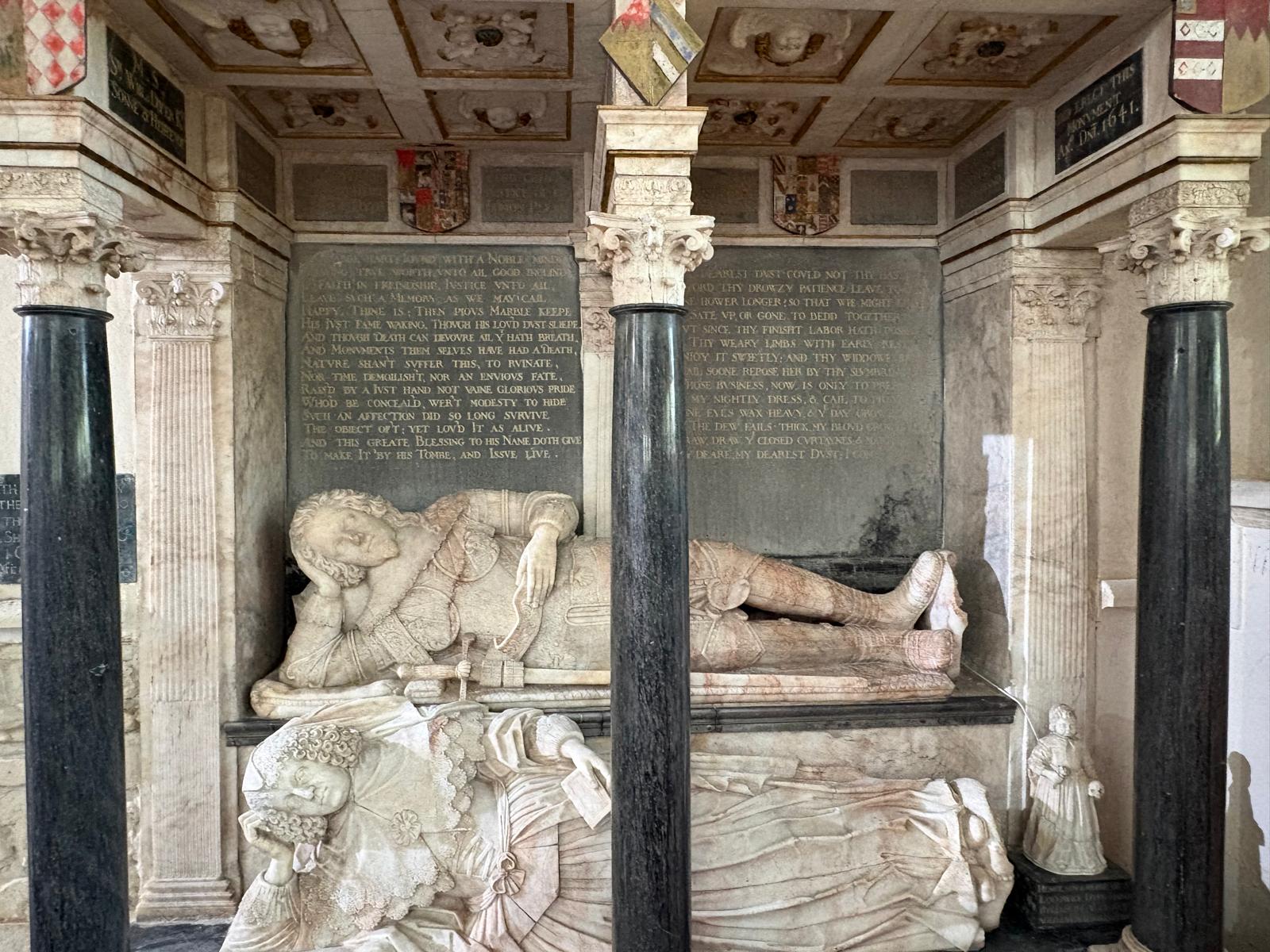
This extraordinary text was not merely kept in a private manuscript. In 1641, two decades after her husband’s death, Lady Catherine erected an elaborate monument in the Church of St. Denys in Colmworth, Bedfordshire. Above stone effigies of the couple propped on their elbows as if engaged in eternal late-night conversation, the full poem was proudly embossed.

Lady Catherine outlived Sir William by 33 years, never remarrying. For over three decades, she lived with the memory of the husband who died young after fathering seven children. Catherine would have gazed upon her own stone likeness, reading her own words of twenty years prior while waiting for the remaining thirteen years of her earthly separation to expire.

 The Dissolution of Words and the Promise of Reunion

In the centuries since its installation, time and moisture have slowly eroded the Colmworth monument. Today, many of the terminal words in the carved verses have worn away, softening the crispness of the original rhymes.

Yet, there is a poetic justice in this physical decay. Rather than diminishing the work, the fading text represents a literal blurring of boundaries. It expresses a “de-coupleting” of stone that mirrors the breakdown of mortal limits. As the physical letters dissolve into the ambient damp of the church, Catherine and William’s separation quietly closes, fulfilling the poem’s final command to make room for eternal rest.
 

Similar Posts

  • Humans may live up to 194 Years

    How long can a human live? No one knows the exact answer but scientists believe there is a natural limit to the human lifespan. According to a study a person could possibly live as long as 194 years although reaching that age would be extremely rare. Researchers say living forever is not possible. Even if science discovers new ways to slow aging the body cannot avoid the natural damage that builds up over time. The study published in the journal Nature looked at how our DNA and genes change throughout life. Scientists found that many genetic changes are harmless but some damage cells and reduce how well they work. Over time this damage increases the risk of age related diseases. The researchers explained that these genetic changes cannot be completely prevented.  They happen naturally when cells divide and can also be caused by viruses certain chemicals and ultraviolet (UV) rays from sunlight. To estimate the maximum human lifespan the team created a scientific model that included reversible signs of aging while keeping permanent genetic changes in place. The results suggested that even if future technology slows the aging process the longest a human could live would likely be between 146 and 194 years. Scientists also noted that some organs such as the skin and liver regularly replace old cells helping repair some damage. However the heart and brain do not replace most of their cells making genetic damage in these organs much harder to reverse. The researchers stressed that genetic changes are not always harmful but as they build up over time they may gradually shorten a person’s lifespan. They also believe that other biological processes may affect aging and more research is needed to better understand them. At present the longest confirmed human lifespan belongs to Jeanne Calment of France who died in 1997 at the age of 122 years making her the oldest verified person in recorded history.

  • Road Safety: Everyone’s Responsibility

    By Sumaiya Azeem Behind every road accident statistic is a name, a family, a dream that never came true. The next name doesn’t have to be someone we know—but only if we take responsibility. Road accidents do not happen by chance; they happen because of preventable mistakes. Saving lives is a shared responsibility. Road safety is not just about following traffic rules, it is about protecting human lives. Every day in Pakistan, we hear about road accidents on the news. A bike crash near a school, a bus overturned on the highway, and a child hit while crossing the road—these aren’t just headlines. They are the fathers who won’t come back, students whose exams will never be taken, and futures cut short. Roads connect people, communities, and economies. They allow students to reach school, workers to reach their workplace, and families to travel from one place to another. However, road accidents have become one of the leading causes of death and injury across the world, and unsafe road behavior has turned roads into a major global safety challenge. Every day, thousands of people lose their lives or suffer serious injuries; it also causes permanent disability and leaves families with lifelong conditions. According to the World Health Organization (WHO), approximately 1.19 million people die every year due to road traffic crashes, while 20 to 30 million people suffer non-fatal injuries, many of which result in permanent disability. Road accidents are a serious public health and economic issue. The WHO report shows that more than 90% of traffic accidents occur in low- and middle-income countries. These accidents cause enormous financial losses. Medical expenses, vehicle damage, loss of productivity, and long-term disability create a heavy burden on families. There are several major causes of road accidents. Overspeeding is one of the leading causes of serious road accidents. When vehicles move at high speeds, drivers have less time to react to sudden dangers such as pedestrians crossing, vehicles stopping suddenly, or obstacles on the road. It also increases the severity of injuries during a crash. The use of mobile phones while driving has also become a growing danger. Texting, making calls, or scrolling on social media can cause more accidents. Responsible drivers must keep their full attention on the roads and avoid unnecessary distractions. In addition, driving after consuming alcohol or drugs seriously affects judgment. An impaired driver may not realize the danger in time or may make risky decisions that endanger others. Strict laws and public awareness are necessary to prevent such behavior. Ignoring traffic signals, unsafe overtaking, driving on the wrong side of the road, and failing to give way are other common causes of crashes. Traffic rules are designed to protect everyone; following them is a responsibility, not merely a legal requirement. Moreover, one mistake by one person creates a ripple effect that impacts everyone on the road. A road accident doesn’t just hurt one person. It breaks a family, blocks traffic for hours, burdens hospitals, and wastes national resources. A helmet, a seatbelt, or a 10-second wait at a red light can save lives. Apart from this, everyone has a role to play: Drivers have the biggest role. They must wear seatbelts, avoid using phones while driving, follow speed limits, and obey traffic signals. Riders, especially motorcyclists, are very vulnerable. They should always wear helmets, avoid rash driving, and use indicators, which also helps them stay visible. Pedestrians also need to be careful. A pedestrian is anyone walking on foot. They should use footpaths and zebra crossings, look both ways before crossing, and avoid distractions like headphones on busy roads. Pakistan faces significant road safety challenges due to rapid population growth, an increasing number of vehicles, unsafe driving practices, and weak enforcement. Improving road safety requires better roads, stronger law enforcement, and public awareness. The problem can be solved by following traffic rules, raising awareness, building better road infrastructure, and utilizing strict law enforcement to help prevent accidents. In short, if drivers drive carefully, riders stay alert, pedestrians walk safely, and the community supports traffic rules, we can make our roads much safer. Road safety is not the duty of one person or one department; it is a responsibility shared by everyone. Governments must provide safe infrastructure, and citizens must make responsible choices. A moment of carelessness can destroy a family, while a moment of responsibility can save a life. By respecting traffic rules and promoting awareness, we can create safer roads for ourselves and future generations. Every journey should end safely, and every single person has a role in making it possible.

  • Pumpkin seeds for glowing skin

    Pumpkin seeds are well known for their health benefits but they may also support healthy looking skin.  They contain nutrients such as zinc vitamin E and antioxidants that can help protect the skin from damage. Benefits of pumpkin seeds for skin Pumpkin seeds contain antioxidants that help protect skin cells from harmful free radicals.  Their nutrients may also support healthy skin as it ages. They are also a source of vitamin E which helps protect the skin from environmental damage and supports its natural barrier. Pumpkin seed oil can provide moisture and may help make dry skin feel softer and smoother. The nutrients in pumpkin seeds may also support normal hormone function which can be helpful for overall skin health.  However pumpkin seeds should not be considered a treatment for hormonal skin problems. Pumpkin seed face cleanser You can make a simple homemade cleanser using pumpkin seeds. Ingredients. •1 cup pumpkin seeds •½ cup honey •1 tablespoon sandalwood powder •1 tablespoon nutmeg powder Method Grind the pumpkin seeds into a fine powder. Add honey, sandalwood powder and nutmeg powder then mix well.  Apply a small amount to the face gently and wash it off with water. Pumpkin seed scrub Pumpkin seeds can also be used in a homemade face scrub. How to make it Boil some pumpkin pieces and pumpkin seeds in water. Strain them and blend the pumpkin and seeds into a smooth paste. Add 2 tablespoons of honey and 1 tablespoon of cinnamon powder.  Apply the mixture to your face and leave it for about 10 minutes. Then gently massage in circular movements and rinse with water. This mixture can also be used on other areas of the body but avoid harsh rubbing. Simple pumpkin seed face pack Another easy option is to mix ½ teaspoon of finely ground pumpkin seeds with ½ teaspoon of honey.  Apply a thin layer to the face and let it dry. Rinse gently with lukewarm water. You can also mix pumpkin seed powder with a small amount of almond oil to make a simple moisturizing face pack. Use with care Natural ingredients do not work the same way for everyone. Pumpkin seeds, honey cinnamon nutmeg or other ingredients may cause irritation or an allergic reaction in some people. Always do a small patch test before applying a homemade mixture to your face.  If you have sensitive skin or known allergies it is better to ask a doctor or dermatologist before trying new skin treatments. Pumpkin seeds can be part of a healthy diet but there is limited scientific evidence that homemade pumpkin seed treatments can dramatically change the skin within a few days.

  • Three hours with Nawaz Sharif: reflections on a leader looking to the future

    On Friday, I had the opportunity to spend nearly three hours with former Prime Minister and President of the Pakistan Muslim League (Nawaz), Mian Muhammad Nawaz Sharif, at his Jati Umra residence in Raiwind. We offered Jumma prayers together, shared lunch and held an extensive discussion on Pakistan’s political landscape. It was more than a courtesy meeting; it provided a rare opportunity to observe, first-hand, the thinking of a leader who remains deeply involved in shaping the direction of his party and closely following the country’s political developments. The meeting came at a significant moment for the PML-N. Following the party’s recent success in the Azad Jammu and Kashmir elections, there is renewed confidence within its ranks. Nawaz Sharif appeared optimistic, composed and fully focused on the challenges and opportunities that lie ahead. What struck me first was his health and energy. Nawaz Sharif was in excellent spirits, displaying the confidence and composure of a politician who believes his party is firmly back on the front foot. There was no sense of retirement or political detachment. Instead, there was a clear focus on governance, organisation and preparing for the future. The recent PML-N victory in the Azad Kashmir elections has undoubtedly reinforced that confidence. For the party, the result was more than just another electoral success; it was an affirmation that its political message continues to resonate with voters. Nawaz Sharif spoke with satisfaction about the outcome, viewing it as an important milestone in the party’s broader revival. He was equally appreciative of the performance of the Punjab Government under Chief Minister Maryam Nawaz Sharif. In his view, the provincial administration has demonstrated that governance and public service remain the strongest political currency. Whether through infrastructure, public welfare initiatives or administrative reforms, he believes Punjab is once again becoming the party’s showcase of governance. Prime Minister Muhammad Shehbaz Sharif also received praise during our conversation. Nawaz Sharif expressed confidence in his younger brother’s efforts to steer Pakistan towards economic stability, strengthen institutions and improve the country’s international standing during a challenging period. His remarks reflected a leadership that sees continuity and coordination within the party as one of its greatest strengths. Perhaps the most significant observation from the meeting was Nawaz Sharif’s continued command of the PML-N. Despite years away from active frontline politics, he remains the party’s central strategic figure. Senior leaders continue to look towards him for direction, while party workers still regard him as the movement’s principal source of political inspiration. Much has been written about Nawaz Sharif’s return to Pakistan and his re-emergence in national politics. Yet spending time with him offered a clearer picture than any public rally or television appearance could provide. He is not merely observing events from the sidelines; he is actively shaping the party’s direction, evaluating political developments and planning for the future. My own conclusion from this meeting is straightforward. Nawaz Sharif remains fully engaged, firmly in command of the PML-N and focused on leading his party into the next general elections whenever they are held. Whether one agrees with his politics or not, it would be a mistake to underestimate his influence or his determination. Pakistan’s political landscape continues to evolve rapidly. But after spending three hours with Nawaz Sharif on Friday, one thing appears certain: he believes his political journey is entering a new phase, not its final chapter, and he intends to remain at the centre of Pakistan’s political discourse for years to come.

  • |

    How the art of Tsundoku quietly transforms our minds

    Walk into the home of almost any avid reader, and you are bound to encounter the unread shelf. The uncracked spines perched on nightstands, overflowing from crowded bookshelves, or quietly gathering dust in living room corners. For years, Western cultural narratives have framed these unread collections as evidence of poor self-discipline, financial wastefulness, or half-baked literary ambitions. However, behavioral psychology and cultural reporting offer a far richer perspective. This habit is known in Japanese as tsundoku. It is not an intellectual failure. It is passionately human. It is rather psychologically beneficial relationship with knowledge, identity, and curiosity. The word tsundoku dates back to Japan’s Meiji era in the late nineteenth century. It cleverly fuses tsunde-oku (to pile things up for later) with dokusho (reading). This habit is unlike hoarding, which carries clinical connotations of distress and emotional attachment to clutter. tsundoku is characterized by a playful, optimistic spirit. It describes the act of gathering books with every intention of absorbing them, even if time inevitably falls short of ambition. In order to understand why so many people practice tsundoku, psychologists look at how the human brain processes reward and anticipation. When you pick up an intriguing volume in a bookstore, your brain’s neural circuits trigger a sudden release of dopamine. Interestingly, this neurochemical hit does not wait for you to actually finish the final chapter. The simple act of purchasing a book acts as a pivot for the learning experience itself. In that single moment of acquisition, your brain projects a vivid future self. One that’s sitting quietly by a window, sipping tea, and expanding their wisdom. The purchase satisfies a psychological longing for growth, even before page one is turned. Furthermore, an unread collection creates what essayists and thinkers call an antilibrary. The read books truthfully represent the territory of knowledge you have already conquered. In contrast, unread books serve as a physical map of your own ignorance. Surrounding yourself with stories you have yet to explore harbours intellectual humility. It keeps you constantly aware that the world is far larger, richer, and more complex than your current understanding. In a fast-paced modern culture obsessed with optimization, tracking goals and productivity metrics, an unread stack stands as a testament of pure potential. There is also immense emotional comfort in physical books. Unlike endless, urgent digital feeds or unread emails, physical volumes sit silently without making demands. They anchor a home, offering a tactile, grounding presence that reflects who you were when you bought them and who you hope to become in the future. So, if your personal library continues to consume your available free time, resist the urge to feel guilty. Those unread pages are not a monument to broken promises. They are a physical testament to a hungry mind that refuses to stop asking questions.  

  • Baby Shark star makes K-Pop comeback

    Park Ji-won, who became famous as a child after appearing in the viral “Baby Shark Dance” video has returned to the music world after nearly a decade. Now known as “Baby Shark Boy,” Park is starting a new journey as a K-pop singer. He has released his first digital single “WAVE.” Park appeared in the “Baby Shark Dance” video when he was just seven years old.  The video later became the most watched video in YouTube history gaining billions of views around the world. His new solo music project is supported by The Pinkfong Company, the owner of the “Baby Shark” copyright. Park said he is thankful that people still remember him after so many years. He believes the love for “Baby Shark” inspired him to reconnect with people through music. The “Baby Shark” song was released in 2016 and its famous video has now crossed 17.2 billion views.  The song became a worldwide hit, inspiring dance trends parodies and countless social media posts. “Baby Shark” has even been played at the White House while famous figures such as Donald Trump and Elon Musk have mentioned the popular song. After his early success, Park also appeared in other Pinkfong projects. His new single “WAVE” begins with a sound that reminds listeners of “Baby Shark” before moving into a modern electro pop style.  Park also helped write the lyrics for the song. After becoming famous as a child Park is now ready to build a new identity in the K-pop world.

Leave a Reply

Your email address will not be published. Required fields are marked *