karachi lawyers halt
| |

Karachi lawyers halt court proceedings over allege…

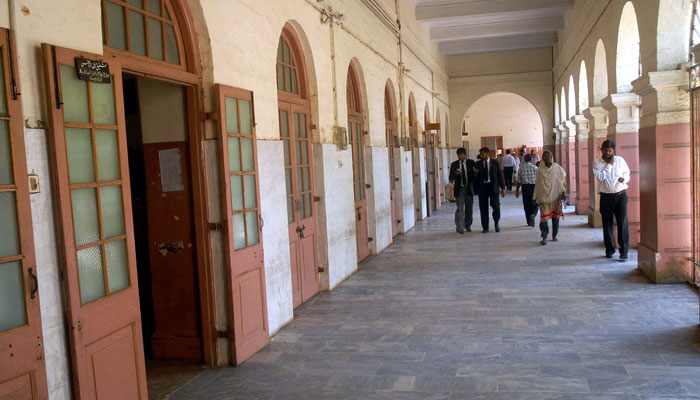
KARACHI: Lawyers in Karachi have announced a boycott of court proceedings and barred police personnel from entering the City Courts following an alleged assault on a former member of the Karachi Bar Association’s Managing Committee at Gulbahar Police Station.

The Karachi Bar Association (KBA) lawyers shut the main entrances of the City Courts, preventing both police officials and members of the public from entering the court premises. The move came as lawyers protested what they described as the mistreatment of their colleague.

The lawyers also stopped police personnel from entering the City Courts and called for a complete boycott of judicial proceedings. Their protest disrupted routine legal activities across the court complex.

As a result of the strike, authorities did not bring prisoners from jails to the City Courts for scheduled hearings. The boycott also brought regular court operations to a standstill, leaving several cases and judicial proceedings suspended.

The lawyers have taken the action in response to the alleged violence against their former Managing Committee member and are demanding action over the incident.

Similar Posts

  • | |

    AI-generated Independence Day song released by Pla…

    ISLAMABAD: An AI-generated Independence Day song released by Pakistan’s Ministry of Planning, Development and Special Initiatives has sparked widespread debate, with critics questioning the government’s decision to rely on artificial intelligence instead of showcasing the country’s creative talent. The song, shared by Federal Minister for Planning Ahsan Iqbal on social media, is dedicated to Pakistan’s youth and draws inspiration from the poetry and philosophy of Allama Muhammad Iqbal, particularly the themes of Khudi (selfhood) and the Shaheen (eagle), symbols of confidence, resilience, and ambition. In his message accompanying the release, Ahsan Iqbal said Pakistan’s future depends on a generation of young people who embrace knowledge, innovation, entrepreneurship, and hard work. He described the song as part of the government’s URAAN Pakistan initiative, which promotes reforms and development projects under the country’s 5Es National Economic Transformation Plan. Despite its patriotic message, the AI-produced music video has drawn criticism from artists, commentators, and social media users, many of whom argue that the government missed an opportunity to support Pakistan’s musicians, composers, filmmakers, and other creative professionals. Critics say that celebrating Independence Day with an AI-generated production sends the wrong message at a time when local artists continue to seek greater recognition and opportunities. The release has also reignited broader discussions about the growing use of artificial intelligence in the creative industry. Many artists around the world have voiced concerns that AI-generated content could reduce opportunities for writers, musicians, actors, and visual creators while raising questions about copyright, digital identity, and fair compensation. In Pakistan, similar concerns have emerged in recent months as actors and performers have warned about contracts involving AI-generated digital replicas and voice cloning. Industry professionals argue that stronger safeguards are needed to protect artists from unauthorized use of their work and likeness. The Planning Ministry’s latest campaign has therefore become more than just an Independence Day release. It has evolved into a wider conversation about the balance between embracing new technology and preserving the value of human creativity, with many calling for future national campaigns to highlight the work of Pakistan’s own artists alongside technological innovation.

  • | | |

    Pakistan to reopen all border, transit routes with…

    A decision has been taken to reopen all border crossings and transit routes between Pakistan and Afghanistan, following a meeting chaired by Federal Interior Minister Mohsin Naqvi with senior officials and representatives of the business community. The meeting discussed measures to remove obstacles affecting bilateral trade and facilitate the movement of goods between the two countries. Participants also stressed the need to restore normal economic ties and improve trade relations between Pakistan and Afghanistan. The meeting further focused on making legal travel between the two countries easier and more convenient for their citizens. Officials and business representatives agreed that reopening the routes would help address difficulties faced by traders and support economic activity on both sides of the border. The government also emphasised the importance of reducing unnecessary hurdles in trade and movement while ensuring that legal procedures remain in place.

  • | | |

    ISPR calls India’s ‘Operation Sindoor&…

    Pakistan has strongly rejected what it described as India’s attempt to reshape the history of the 2025 military confrontation through a recently produced documentary on “Operation Sindoor,” calling the production a highly dramatized and factually distorted portrayal of events. In a statement, Pakistan said the documentary relied on selectively edited interviews, emotional narration and cinematic reconstructions to present a version of the conflict designed primarily for domestic political consumption. It argued that the production failed to provide an objective account of the military engagements and instead sought to portray a disputed outcome as an unequivocal Indian victory. Pakistan also questioned the documentary’s chronology surrounding the Pahalgam incident of April 22, 2025. It said India had subsequently claimed that the alleged perpetrators of the incident were identified and eliminated on July 28, nearly three months after Operation Sindoor. Islamabad argued that this timeline raised questions about India’s assertion that the May 7 operation was specifically intended to punish those responsible for the Pahalgam attack. The statement further rejected India’s claim of “100 percent mission success,” maintaining that Pakistani forces had effectively responded to the Indian offensive during what Pakistan refers to as Marka-e-Haq. Islamabad claimed that eight Indian military aircraft were shot down during the confrontation and said Pakistan later launched Operation Bunyanum Marsoos, targeting military installations with precision-guided rockets and missiles, precision air-launched munitions, loitering munitions and artillery. Pakistan said the documentary itself contained admissions that undermined its portrayal of decisive Indian dominance. According to Islamabad, references by Indian military officials to Pakistani missile and drone activity, prolonged engagements along the Line of Control and the activation of Indian air-defence systems demonstrated that the confrontation involved significant military exchanges on both sides. The Pakistani statement also challenged New Delhi’s account of how hostilities ended. It noted that the documentary acknowledged communication between the two countries’ Directors General of Military Operations and an agreed cessation of military activity. Islamabad said this account was inconsistent with portraying the conclusion of the conflict as an unconditional Indian military victory, particularly given the role of international diplomatic engagement in facilitating the ceasefire. Pakistan further accused the documentary of presenting contradictory explanations for India’s approach to escalation. While the production reportedly emphasised surprise attacks, precision strikes and escalation dominance, it simultaneously portrayed India as deliberately restricting the scope of the conflict and offering Pakistan an opportunity to withdraw. Islamabad described the documentary as an attempt to create a politically convenient narrative rather than an impartial military assessment. It maintained that cinematic reconstructions and official claims could not alter the chronology of events, the military engagements or the losses suffered during the confrontation. Pakistan said it had no need to construct an alternative narrative around Marka-e-Haq, arguing that battlefield developments, diplomatic interactions and subsequent statements by Indian officials provided sufficient material for assessing the conflict. Reaffirming its stated commitment to regional peace and stability, Pakistan said its armed forces remained prepared to protect the country’s sovereignty and territorial integrity. It warned that any future military escalation would receive a strong response, while asserting that no subsequent narrative or media production could change the actual course of events on the battlefield.

  • Thai Government Clarifies Self-Defence Stance Amid Gun Control Overhaul

    BANGKOK, Thailand – The government sought to allay concerns on Wednesday that proposed gun-control measures would undermine the public’s right to self-defence, stating that no decision has been made to impose a blanket ban on firearms and that public feedback is being considered. Thai PM Anutin Suspends Gun Purchase Licences After School Shooting The government’s […]

  • | |

    Pakistan faces 400+ cyberattacks this year

    Pakistan has faced more than 400 cyberattacks during the current year, with authorities successfully stopping all reported attacks in time, according to the Director General of the National Cyber Emergency Response Team, Dr Haider Abbas. Dr Abbas said the growing number of cyber threats showed the need for stronger national cybersecurity measures. He called for the establishment of a powerful National Cyber Security Authority to coordinate cybersecurity efforts across the country. Speaking in an interview, he said Pakistan was facing increasingly complex cyber threats. He also warned about the risks posed by cyberattacks allegedly backed by state actors. According to Dr Abbas, Pakistan needs a central institution with sufficient authority to deal with the growing cybersecurity challenges. He proposed placing the National Cyber Security Authority under the prime minister. He said a national authority working under the prime minister could respond more effectively to major cyber threats. It could also improve coordination between government institutions and other organisations responsible for digital security. The official stressed that cybersecurity had become an important national issue. The increasing dependence on digital systems has also increased the potential risks to government institutions, businesses and other critical sectors. More than 400 attacks reported this year highlight the scale of the challenge facing Pakistan. Although the attacks were reportedly prevented, officials believe the country needs stronger systems to detect and respond to future threats. Dr Abbas said the proposed authority should oversee cybersecurity across the country. It should also ensure that different institutions follow effective security measures and remain prepared for emerging digital threats. A central cybersecurity body could help improve coordination during cyber emergencies. It could also allow authorities to respond quickly when sensitive digital systems come under attack. The official’s proposal comes as cyber threats continue to become more sophisticated worldwide. Governments are increasingly focusing on protecting critical infrastructure, public institutions and digital networks from cyberattacks. Pakistan has also expanded its dependence on online systems in government, banking, communications and other sectors. Any major cyberattack on important infrastructure could potentially disrupt essential services. Dr Abbas therefore called for a stronger national framework to protect Pakistan’s digital environment. He said the proposed authority should have a clear mandate and sufficient powers to manage cybersecurity across the country. He also emphasised the importance of a coordinated national response. Different government departments and institutions need to work together to identify threats and prevent attacks before they cause damage. The official said placing the authority under the prime minister would give it greater effectiveness and allow important decisions to be taken quickly. The disclosure of more than 400 cyberattacks this year has renewed attention on Pakistan’s digital security. Authorities are now facing growing pressure to strengthen national cybersecurity systems and improve preparedness against future threats.

  • | | |

    Pakistan set to begin $2.5bn ML-1 Railway upgrade …

    LAHORE: Pakistan Railways is moving ahead with preparations for the first phase of the $2.5 billion Main Line-1 (ML-1) project, with civil works expected to begin in January 2027 under the government’s accelerated implementation plan. The first phase will focus on the 480-kilometre Karachi-Rohri railway corridor, where new tracks will be constructed alongside safety fencing to prevent unauthorised access. The project is expected to take around two-and-a-half to three years to complete. Railways Minister Hanif Abbasi said the department was making every effort to meet the January deadline set by Prime Minister Shehbaz Sharif. He noted that consultations with contractors and consultants, international tendering, bidding, shortlisting and contract awards could take four to five months, but the government was determined to keep the project on schedule. Pakistan Railways has scheduled an online market engagement session for September 8 with local and international contractors, consultants and other stakeholders. The discussions will focus on project readiness, procurement, technical requirements, contract packages, qualification criteria, risk allocation and construction while railway operations continue. The Karachi-Rohri section has been prioritised because it carries a major share of the country’s railway traffic and includes stretches affected by deteriorating infrastructure and frequent accidents. Once upgraded, the corridor is expected to allow trains to operate at speeds of up to 160 kilometres per hour. The project will include track reconstruction, selected realignments, bridges, culverts, stations, freight facilities and other infrastructure along the Keamari-Landhi-Hyderabad, Hyderabad-Nawabshah and Nawabshah-Rohri sections. Upgrades to signalling, telecommunications and Walton Academy are also part of the broader plan. The Asian Development Bank is expected to finance the project, while Pakistan is also exploring co-financing from the Asian Infrastructure Investment Bank, World Bank, Islamic Development Bank and other partners. A meeting at Pakistan Railways headquarters reviewed preparations for the Karachi-Rohri upgrade, with Railway Board Chairman Syed Mazhar Ali Shah directing officials to complete the project review by October 30, 2026. Weekly monitoring of progress was also ordered. Officials said international expertise and market feedback would be incorporated into the project to improve its efficiency, sustainability and technical viability. Authorities also pledged to maintain transparency, competitiveness and merit throughout the procurement and implementation process. The government sees ML-1 as a key step towards modernising Pakistan’s railway network, improving passenger services, increasing freight efficiency and strengthening connectivity between major population centres and industrial areas.

Leave a Reply

Your email address will not be published. Required fields are marked *