military rejects talks
| | |

Military rejects talks with terrorists, vows conti…

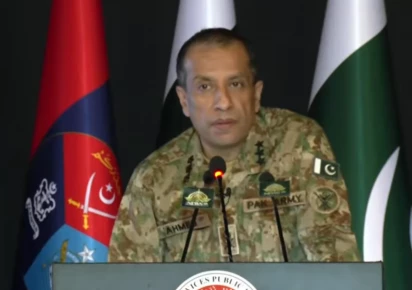
Pakistan’s military has categorically ruled out any future negotiations with terrorist groups, declaring that security forces will continue operations until militancy is eliminated. The announcement was made by Director General of Inter-Services Public Relations (ISPR), Lieutenant General Ahmed Sharif Chaudhry, during a detailed media briefing on the country’s security situation and ongoing counterterrorism campaign.

The military spokesperson said there was no possibility of holding talks with terrorists. He stressed that the state would not negotiate with those involved in violence against Pakistan. According to him, terrorists have only two choices: surrender before the law or face decisive action by the country’s security forces.

Lt Gen Chaudhry said the armed forces would continue to engage directly with the people of Balochistan instead of individuals or groups involved in violence. He emphasized that the people of the province are the true stakeholders and that the military remains committed to protecting their lives and supporting their development.

He also criticized certain influential elites and tribal leaders, claiming they had failed to promote the welfare of ordinary people. According to him, some powerful groups do not want children from poor families to progress through education and development.

The military spokesperson further alleged that the Taliban administration in Afghanistan was providing support to terrorist groups carrying out attacks inside Pakistan. He said cross-border militancy remains one of the country’s major security challenges and continues to complicate efforts to maintain peace.

Rejecting claims that the security situation in Balochistan is rapidly deteriorating, Lt Gen Chaudhry said a coordinated propaganda campaign was being carried out to create a false impression about conditions in the province. He maintained that while security challenges exist, the state is actively responding through intelligence-based operations and law enforcement measures.

Speaking about Balochistan, he said the province’s unique geography presents operational challenges. Its vast territory, scattered population, and long distances between security posts require extensive coordination and resources. He added that security forces are dealing not only with terrorism but also with organized criminal activities, including drug trafficking, fuel smuggling, robbery, and other illegal networks that threaten stability.

Addressing the issue of missing persons, the military spokesperson said the relevant commission had received hundreds of complaints. However, he noted that investigations had revealed that some individuals listed as missing were later found to have been killed during security operations, while others had joined militant organizations and were living in terrorist camps.

Lt Gen Chaudhry presented detailed statistics on the country’s counterterrorism campaign. He said security forces have carried out 40,348 intelligence-based operations across Pakistan during the current year. These operations resulted in the killing of 2,084 confirmed terrorists, averaging approximately 10 militants eliminated every day.

He added that security forces conduct nearly 194 operations daily as part of ongoing efforts to dismantle militant networks. Khyber Pakhtunkhwa remained the main focus of these operations, with 1,971 intelligence-based missions conducted in the province alone.

The military also shared figures regarding casualties suffered during the ongoing campaign. According to Lt Gen Chaudhry, 819 people embraced martyrdom during the year. These included 303 personnel of the Pakistan Army, 194 members of law enforcement agencies, and 322 civilians who lost their lives in terrorist attacks and security-related incidents.

The ISPR chief further revealed that 28 suicide attacks had been recorded across Pakistan during the current year. He claimed Afghan nationals were involved in the recent suicide attacks in Tank and Karachi, describing the incidents as evidence of continued cross-border terrorist involvement.

Highlighting the importance of national unity, Lt Gen Chaudhry said Pakistan’s Constitution and legal system apply equally to every citizen. He stressed that loyalty to the state is a fundamental responsibility and said national peace, political stability, and economic development depend on a strong and secure Pakistan.

Similar Posts

  • |

    Representative Max Miller defies Republican pressure to remain on Ohio ballot despite abuse allegations

    Republican Representative Max Miller has confirmed he will remain in the race for Ohio’s 7th Congressional District after letting Saturday evening’s withdrawal deadline pass, ignoring widespread calls from fellow party leaders to step down amid abuse allegations. Miller has repeatedly denied accusations raised by his former wife, Emily Moreno. A spokesperson for the congressman confirmed on Sunday that he intends to proceed as a candidate in the upcoming November 3 midterm election. The ongoing controversy threatens Republican efforts to secure a congressional seat long considered a GOP stronghold. Party officials had privately lobbied Miller to abandon his campaign out of concern that the scandal could harm Republican prospects in the region. Allies of President Donald Trump also advised the former president to intervene and urge Miller to exit the contest. Prominent Ohio Republicans have publicly disavowed Miller’s candidacy. US Senator Bernie Moreno, Miller’s former father-in-law, stated that Miller should not serve in Congress, describing him as a danger to his daughter. Ohio Senator Jon Husted also called on Miller to withdraw from the ballot and resign his current seat immediately. Miller acknowledged in a statement last week that Trump characterised his re-election battle as tough, but maintained he would stay in the race to clear his name. The political fallout deepened after Miller released hundreds of private text messages, photos, and video files intended to bolster his defence. His legal team subsequently acknowledged that the archive inadvertently contained sensitive family information. Miller will face Democratic nominee Brian Poindexter, a local ironworker, in the November 3 election.

  • | | |

    KP considers law for computerized prescriptions an…

    The Khyber Pakhtunkhwa (KP) government is considering new legislation that would require doctors to prescribe medicines using their generic names instead of brand names and issue computerized prescriptions to patients. The provincial government has announced plans to consult the federal government, as the matter falls under federal jurisdiction. The proposal was discussed in the Khyber Pakhtunkhwa Assembly after Pakistan Peoples Party (PPP) lawmaker Mehr Sultana submitted a calling attention notice highlighting the absence of an effective legal framework requiring doctors to prescribe medicines by their generic names. According to the lawmaker, many physicians continue to prescribe branded medicines, limiting patients’ ability to choose more affordable alternatives. She argued that requiring doctors to write only the generic or formula name of a medicine would improve transparency, increase competition among pharmaceutical companies, and reduce treatment costs for patients. Mehr Sultana also emphasized the need to make computerized prescriptions mandatory, pointing out that handwritten prescriptions are often difficult to read. Illegible prescriptions can result in medication errors, delays in treatment, and confusion for pharmacists and patients. She urged the provincial government to introduce legislation or regulations that would modernize the prescription system and improve patient safety. Responding to the proposal, KP Health Minister Khaliq ur Rahman acknowledged the importance of the issue but explained that the authority to legislate in this area primarily rests with the federal government. He said the provincial government would formally approach the federal authorities to explore the possibility of introducing the necessary legal changes. The discussion also covered healthcare infrastructure in the province. During the assembly session, lawmaker Shahida Waheed raised concerns over non-functional CT scan and MRI machines at Mardan Medical Complex. In response, the health minister informed the assembly that the CT scan machine had already been repaired, while the MRI machine is expected to become operational within a week. If implemented, the proposed reforms could significantly improve prescribing practices across Khyber Pakhtunkhwa by encouraging the use of generic medicines and replacing handwritten prescriptions with digital records. Supporters of the proposal believe these changes would help reduce medication errors, lower healthcare costs, and improve access to affordable medicines, while also promoting greater efficiency in hospitals and clinics. Any legal amendments, however, will require coordination with the federal government before they can be introduced and enforced.

  • |

    Marvel unveils star-studded ‘X-Men’ cast, sets 2028 release

    “X-Men” is officially gearing up for its big-screen return, arriving with a star-studded new cast. Marvel Studios ended months of speculation with a major announcement on Friday, August 14. At Disney’s D23 event, studio president Kevin Feige revealed the full casting lineup alongside the film’s official release date. The announcement marks the MCU’s first-ever standalone “X-Men” film. During Marvel’s segment of the Disney Entertainment Showcase, cast members took to the stage together, sparking immediate excitement among fans in attendance. Jake Schreier has been confirmed to direct the highly anticipated project. The newly announced cast includes Sadie Sink as Jean Grey and Kit Connor as Cyclops. Christopher Abbott joins as Professor X, while Inde Navarrette takes on the role of Rogue. Rounding out the ensemble, Maya Boyd will play Storm and Samara Weaving steps into the role of Emma Frost. Adam Driver was also confirmed for the film, playing Nathaniel Milbury, better known as the villainous Mr Sinister. Alongside the cast reveal, the studio confirmed “X-Men” will hit theatres on May 5, 2028. The announcement represents a major milestone in Marvel’s long-awaited effort to formally bring the X-Men into the Marvel Cinematic Universe. Fans reacted quickly on social media, flooding Variety’s post announcing the update. One follower said they could hardly put their excitement for the film into words. Another praised the casting choices entirely, calling every pick perfect. A third fan expressed disbelief at the announcement, celebrating Navarrette’s casting as a major career milestone. Not everyone focused purely on excitement, though. One fan noted the casting remains incomplete, pointing out that characters like Beast, Wolverine and Iceman have yet to be announced. With a strong ensemble now in place and a confirmed release date, anticipation for Marvel’s X-Men debut is expected to keep building steadily over the next two years.

  • | |

    Italy and Denmark rally 22 EU states behind push f…

    Italy and Denmark have secured the backing of 22 European Union member states for a joint push toward stronger border security, following a chaotic migrant surge into the Spanish enclave of Ceuta that left at least 19 people dead. Thousands of migrants attempted to reach Ceuta, located on Africa’s northern coast, on Thursday, with many swimming around breakwaters using inflatable devices while others scaled the high border fence separating Morocco from the Spanish territory. Official estimates put the total number of migrants who crossed into Ceuta from Morocco at around 60,000. The scale of the crossing prompted alarm among European leaders, with Italian Prime Minister Giorgia Meloni moving quickly to temporarily suspend Italy’s open border Schengen arrangement with Spain for one month, closing direct air and sea travel from Spain without passport checks. By Saturday, Italy had escalated its response further, joining Denmark in leading a coordinated diplomatic push. The two countries spearheaded a joint letter, signed by 22 EU member states, calling for urgent and coordinated European action on border security, deportations and human trafficking. Meloni wrote on social media that the scenes emerging from Ceuta underscored the urgency of a unified European response to illegal immigration. She said the letter, organized together with Denmark, calls for joint efforts to reinforce external borders, combat irregular immigration, target human traffickers, improve the effectiveness of deportations and remove any incentives that encourage further illegal crossings. She added that protecting the European Union’s external borders is not the concern of a single nation but a shared responsibility across the bloc. Spanish Prime Minister Pedro Sanchez pushed back against the growing pressure, accusing several EU countries of a selfish, polarizing and unlawful response to the crisis. In a letter sent to Brussels, Sanchez said some European states have chosen to target Spain and push for its temporary removal from the Schengen area, driven by what he described as prejudice, misinformation, ignorance or political motives. EU officials were scheduled to hold an emergency meeting Saturday afternoon to determine next steps in addressing the unfolding migration crisis in Ceuta. The dispute highlights a long running fault line within the European Union over migration policy, as border states facing the brunt of new arrivals often clash with governments pushing for stricter continent wide controls, a tension that has resurfaced repeatedly during major migration episodes over the past decade.

  • |

    Oil prices tumble to three-week low as Trump delays Iran strike

    LONDON: Global oil prices recorded their sharpest single-day decline in weeks on Monday, falling to a three-week low after US President Donald Trump stepped back from plans for a military strike against Iran, raising hopes that diplomatic efforts could ease tensions and prevent disruptions to energy supplies from the Gulf. International benchmark Brent crude dropped 7 percent, or $6.35, to settle at $83.77 per barrel, while US West Texas Intermediate (WTI) crude fell 5.1 percent, losing $4.33 to close at $80.34 per barrel. The decline marked Brent’s weakest closing level since mid-July. Market analysts said the drop was also influenced by the expiry of the higher-priced September Brent contract, with the less expensive October contract becoming the new front-month benchmark. Investor sentiment shifted sharply after Trump announced that he had postponed military action against Iran, saying he wanted to allow time for diplomacy aimed at reaching an agreement that could reduce regional tensions and potentially increase Iranian oil exports. The possibility of additional crude entering global markets eased concerns over supply shortages, prompting traders to sell oil futures and pushing prices lower. However, Tehran quickly dismissed suggestions that negotiations with Washington were underway. Iranian Foreign Ministry spokesman Esmail Baghaei said there were no talks taking place with the United States and no meetings had been scheduled. He added that Iran had no plans to host foreign delegations or send negotiators abroad in the coming days. Trump, meanwhile, maintained that discussions with Iran were in progress and warned Tehran of serious consequences if it failed to reach an agreement aimed at ending the ongoing confrontation. Analysts call market reaction excessive Energy analysts said oil markets appeared to react strongly to political rhetoric rather than confirmed developments. According to analysts at energy consultancy Ritterbusch and Associates, the steep decline in crude prices reflected what they described as an overreaction by investors to Trump’s comments suggesting that an agreement with Iran could be imminent. They noted that the US president has repeatedly made strong statements regarding Iran before later softening his position, creating significant volatility in energy markets. Analysts also observed that Trump’s public calls for lower fuel prices in the United States have frequently weighed on oil markets by reducing expectations of sustained price increases. During Monday’s trading session, US gasoline and diesel futures also declined by nearly 5 percent, reflecting broader weakness across the energy sector. Shipping routes remain under pressure Despite hopes for diplomacy, concerns over maritime security in the Middle East continued to influence market sentiment. Shipping data showed that six Saudi-flagged supertankers altered their routes in recent days, avoiding the Gulf of Aden and instead sailing around southern Africa after Yemen’s Iran-backed Houthi movement threatened to target Saudi vessels. At the same time, some oil tankers continued to transit the region. Two Saudi oil tankers successfully crossed the Bab el-Mandeb Strait over the weekend, while vessel movements through the Strait of Hormuz slowed following reports of attacks on commercial shipping. The Strait of Hormuz remains one of the world’s most strategically important energy chokepoints, carrying roughly one-fifth of global oil trade before hostilities between the United States, Israel and Iran escalated earlier this year. A Panama-flagged tanker transporting Russian naphtha also reportedly abandoned plans to pass through the Bab el-Mandeb, choosing the longer route around Africa due to security concerns. Russia boosts maritime security Russia announced on Monday that it was strengthening security measures for commercial shipping in the Azov-Black Sea region while working to expand alternative export routes, following increased attacks on vessels linked to the conflict in Ukraine. As one of the world’s largest crude producers and a leading member of the OPEC+ alliance, Russia remains a key player in global energy markets. Disruptions to exports from the Gulf, Russia and Kazakhstan have continued to limit global oil supplies throughout the year, preventing previously announced OPEC+ production increases from fully reaching international markets. In a separate development, OPEC+ approved a production quota increase of approximately 188,000 barrels per day beginning in September. Although the move is intended to gradually raise output, analysts believe geopolitical risks and transportation disruptions could continue to limit the actual flow of additional crude to global buyers.

  • |

    Pakistan’s ambassador presents credentials to Uzbek foreign minister

    Pakistan’s newly appointed Ambassador to Uzbekistan, Muhammad Mudassir Tipu, formally presented copies of his diplomatic credentials to Uzbek Foreign Minister Bakhtiyor Saidov in Tashkent. Describing the meeting as a distinct honor, Ambassador Tipu confirmed that both sides held constructive talks on bilateral cooperation. Foreign Minister Saidov highlighted that discussions focused on deepening the strategic partnership between the two nations, ensuring the implementation of high-level agreements, and expanding trade, investment, and interregional connectivity.

Leave a Reply

Your email address will not be published. Required fields are marked *