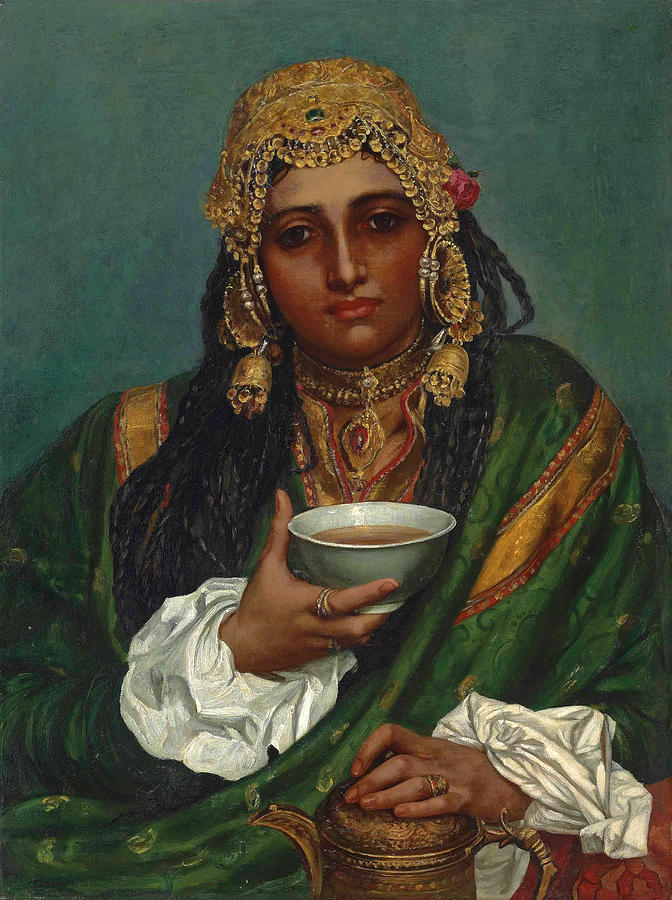
Kashmir’s nightingale Habba Khatoon
Habba Khatoon stands as Kashmir’s Nightingale and Zoon: the Moon of Kashmir. Living in the 16th century, she transformed personal grief, marital heartbreak, and political exile into the foundational canon of Kashmiri romantic poetry. She was born to a peasant family in Chandhara village (Pampore), famous for its saffron fields. Unlike most rural girls of her era, her father sent her to a local maktab where she learned Persian and Arabic, nurturing her early literary talent. She got married to a peasant named Aziz Rathar. Unappreciative of her poetic disposition and intelligence, her husband and mother-in-law ill-treated her. She began singing her inner pain while working in the saffron fields and fetching water. Legend holds that while hunting near Pampore, Prince (later Sultan) Yousuf Shah Chak heard her singing under a plane tree. He arranged her divorce and married her as he was mesmerized by her voice and beauty. This marriage elevated her to Queen of Kashmir as Habba Khatoon. Emperor Akbar summoned Sultan Yousuf Shah to Delhi under the pretense of talks, arrested him, and exiled him to Bihar. Kashmir fell to Mughal rule, breaking Habba Khatoon’s world. She shed her courtly garments, donned the robes of an ascetic, and wandered the valley singing lamentations for her lost king. In short, she refused royal comfort. She spent her final years near Gurez and Athwajan, where her tomb rests today.
Before Habba Khatoon, Kashmiri verse was dominated by devotional mysticism: Vaakhs and Shrukhs. She revolutionized Koshur literature by introducing the Lol. Lol is a short, melic lyric of intense personal feeling, love, longing, and domestic intimacy. It’s particularly designed to be sung rather than recited. One of her most iconic pieces, sung to this day across the valley:
Mey haa karchey kitt kitaye,
Mey kar tayiaar lole-vun…
Chey kyaah gazi chaani roopeye,
Volo haa maalyene dhoopeye!
I have prepared myself in every way,
I have composed my heart into a song of longing…
What does it cost your beauty to look upon me?
Come, my love, let us gather wild mountain herbs together!
In the following verses, she uses Kashmir’s fleeting spring as an allegory for human beauty and time:
Gulaan goy rang, pholan goy bahar,
Mey valai poshan hyund hahaar…
Yuthus chhumyene chaani dhaar,
Volo maayi chaane pyarey!
The flowers have faded, spring has taken its leave,
My youth is wilting like a blossom in the heat…
My eyes remain fixed on the path where you disappeared
Come back, my beloved, for the sake of love!
After emperor Akbar exiled her husband to Bihar, she wrote this verse that captures geopolitical heartbreak reduced to raw human loss:
Cchey saazey vaaye, bo saazey vaaye,
Kati chhak chey, bo kati chhas…
Diluk zaar vanay kith-kith bo,
Jeel-e-Jhelum geyi aaba-haar!
You play your tune far away, while I play mine in solitude,
Where are you trapped, and where am I left to wander?
How shall I tell you the agony of my heart?
Even the waters of the Jhelum weep and overflow their banks for us.
Her poetry is more than a story of personal transformation. It is the emotional arc of Kashmir itself. By introducing the Lol, she pulled Kashmiri verse down from abstract, detached mysticism into the intimate, beating heart of human experience. She gave language to the quiet endurance of ordinary women, the agony of sudden separation, and the unyielding beauty of a homeland caught in the tides of history.